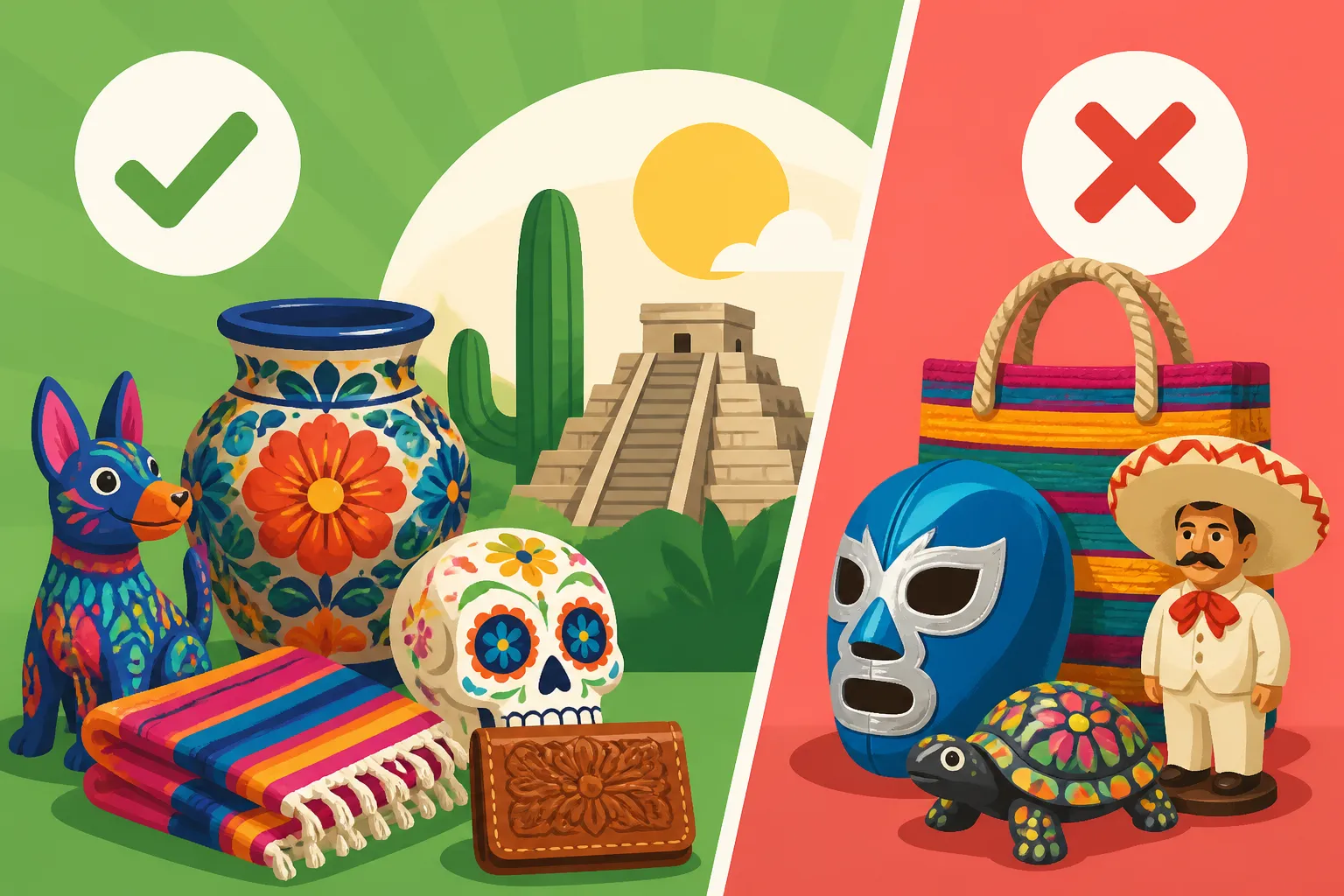
Mexican Souvenirs Worth Buying (and What to Skip)
Every visitor to Mexico ends up in the same place. You stand in a market stall with a “handwoven” rug or a “silver” bracelet in your hand, and you suspect it was machine-made in another country. You don’t want to haul junk home, and you don’t want to insult an artisan. This guide covers what is worth buying, how to check it is real, and what to skip.
Disclosure: This post may contain affiliate links. We may earn a commission at no extra cost to you if you make a purchase through these links. Read full disclosure.
How to Tell Real Mexican Craft From Mass-Produced Filler
On my first trip I bought a bright “Oaxacan” table runner from a vendor near the zócalo in Playa del Carmen. Three weeks later I saw the identical runner, same flaw included, in a souvenir shop in Puerto Vallarta, a long way across the country. That was my introduction to the mass-produced craft circuit. It is huge, it is convincing, and it sits right next to some of the finest folk art in the world.
The good news is that a few simple habits will protect you. They don’t require you to be an expert in textiles or metallurgy.
The Origin Test
Mexican crafts are very regional. Each famous item has a home town or a home valley, and the best pieces are usually bought in that place or from a cooperative that works directly with it. Black pottery comes from San Bartolo Coyotepec in Oaxaca. Carved and painted alebrijes come from San Martín Tilcajete and San Antonio Arrazola. Hammered copper comes from Santa Clara del Cobre in Michoacán. Lacquered boxes come from Olinalá in Guerrero.
When an item appears everywhere, in identical form, in every tourist zone from Cancún to Cabo, treat that as a warning. Real artisan work varies from piece to piece and from workshop to workshop. A quick way to start is to ask the seller “¿De dónde es?”, which means “where is it from?” Then ask “¿Quién lo hizo?”, which means “who made it?” Someone who sells their own family’s work will often light up and tell you the village, the technique and sometimes the name of the person who made it. Someone reselling imports tends to shrug or give a vague answer.
For a broader overview of the regional craft map, see Mexican Crafts (Artesanías): What to Buy and Where.
Price, Imperfection, and the Seller Conversation
Handmade work costs more because it takes more time. A rug woven on a foot-pedal loom in Teotitlán del Valle can take weeks. If something that claims to be handwoven is priced like a beach towel, the claim is probably false. Slight asymmetry is a good sign: uneven brushstrokes on a painted plate, minor color shifts in a naturally dyed textile, tool marks on carved wood. Perfect uniformity across a stack of “handmade” items usually means a machine made them.
Don’t let fear of being fooled make you cold or suspicious with every vendor. Most sellers in places like Mercado de Artesanías in Oaxaca or the stalls around San Miguel de Allende’s Jardín are honest. Many will happily tell you which items they made and which they buy in. Asking respectfully opens the door.
Souvenirs Genuinely Worth the Suitcase Space
These are the items I have bought repeatedly, given as gifts, and never regretted. Each one has a clear way to verify it.
| Souvenir | Where It Is Made | How to Verify It | Skip It If |
|---|---|---|---|
| Sterling silver jewelry | Taxco, Guerrero | “.925” stamp plus a maker’s registration mark | Marked “alpaca” or “níquel”, or has no stamp |
| Talavera pottery | Certified workshops in Puebla and Tlaxcala | Certification hologram and workshop signature on the base | No certification, or sold as tableware with no lead-free assurance |
| Wool rugs | Teotitlán del Valle, Oaxaca | Natural dyes, slight irregularities, weaver can name the dye sources | Synthetic sheen, perfectly uniform pattern, very low price |
| Alebrijes | San Martín Tilcajete and San Antonio Arrazola, Oaxaca | Carved from copal wood, signed by the carver | Resin or plaster body, identical copies in bulk |
| Barro negro pottery | San Bartolo Coyotepec, Oaxaca | Burnished surface, buyable at the workshop | Painted black instead of fired black |
| Hammocks | Yucatán, especially Tixkokob and Mérida | Dense hand-knotted weave, cotton or nylon labeled honestly | Loose, thin weave sold on the street at a suspiciously low price |
| Mezcal and tequila | Oaxaca and Jalisco, plus other designated states | NOM number and agave type on the label | No NOM, or labeled as “agave spirit” with additives |
| Vanilla | Papantla region, Veracruz | Whole beans or pure extract from a reputable shop | Very cheap, dark “vanilla” in plastic bottles |
Silver From Taxco
Taxco, a steep colonial town in Guerrero, has been Mexico’s silver capital for generations. Its workshops still produce excellent sterling jewelry and tableware. Genuine Mexican sterling should carry a “.925” stamp, often together with “Mexico” and a registration code that identifies the workshop. The metal sold as “alpaca”, “plata alemana” or “níquel” contains no silver at all. That is fine if you know what you are paying for, and a rip-off if you don’t.
Taxco is a manageable trip from Mexico City. You can book bus seats ahead on Busbud so you aren’t scrambling at the Terminal Sur on a busy weekend. If you want the Saturday wholesale silver market at a relaxed pace, it helps to stay overnight, and Booking.com lists plenty of small hotels in the hillside center. The town itself is a delight, as described in Taxco, Tepoztlán, and Day-Trip Pueblos Mágicos. For hallmark details and the tricks used to pass off plated pieces, read How to Buy Silver in Taxco, Mexico.
A quick scenario. A vendor on a Cancún beach offers you a heavy “Taxco silver” chain. Ask to see the stamp. If there isn’t one, or the seller says “es plata, es plata” without showing you anything, walk away politely. Real sterling sellers expect you to check, and most will point to the mark before you even ask.
Talavera From Puebla
Talavera is tin-glazed earthenware with roots in Spanish majolica. Authentic Talavera de Puebla is protected by a denomination of origin, and only certified workshops in designated parts of Puebla and Tlaxcala may sell it under that name. Certified pieces carry a hologram or certificate and the workshop’s signature on the base. Workshops such as Uriarte in Puebla city have long histories and welcome visitors.
Many shops across Mexico sell “Talavera-style” pottery. Some of it is charming and affordable, and buying it is perfectly fine as long as you understand it is decorative ware, not certified Talavera. The practical concern is food safety. Uncertified glazed pottery may contain lead. If you plan to eat or drink from a piece, buy certified work or something clearly labeled lead-free (“sin plomo”), and keep the rest for display.
For a full walkthrough of certification marks and the best workshops to tour, see How to Shop for Talavera Pottery in Puebla.
Oaxacan Textiles, Alebrijes, and Barro Negro
Oaxaca is the strongest single destination for craft shopping in Mexico. In Teotitlán del Valle, Zapotec weaving families dye wool with cochineal for reds, indigo for blues and wild marigold for yellows. Many will show you the cochineal insects being crushed on a palm, which turns the bug into a startling crimson. Buying directly from a family workshop there is very different from buying a synthetic copy in a resort town.
Alebrijes are fantastical painted creatures carved from copal wood. Visiting the carvers in San Martín Tilcajete or San Antonio Arrazola lets you see the work in progress, and pieces are often signed. In San Bartolo Coyotepec, black pottery gets its sheen from burnishing with quartz and its color from a reduced-oxygen firing. It is never painted on. A guided craft-village day trip is the easiest way to see all three towns in one go. Viator lists several circuits from Oaxaca city, so you can compare which workshops each route includes before you commit.
When you are in these villages, remember you are a guest in Indigenous communities. Ask before photographing people, and don’t treat a workshop like a museum without buying or tipping. See How to Be a Respectful Tourist in Indigenous Communities in Mexico. For dye checks and rug quality, read How to Buy Oaxacan Textiles and Rugs.
Edible and Drinkable Souvenirs
Food and drink make excellent souvenirs because you use them up and remember the trip each time. They also carry the most rules about what you may bring home, so read this section with your home country’s customs allowances in mind.
Mezcal and Tequila
A good bottle of mezcal or tequila is the classic grown-up souvenir. The most useful thing you can learn is to read the label. Look for “100% agave”. Bottles without it, often called “mixto”, can contain other sugars. Check for the NOM number, which identifies the registered producer. With mezcal, the agave variety and the production method tell you a lot. Espadín is the common workhorse. Tobalá and other wild agaves are rarer and more complex.
Skip the bottles with a worm or a scorpion inside. They are mostly a tourist gimmick, and the spirit in them is rarely the best. You will get far better bottles at a small palenque outside Oaxaca city or at a distillery in the town of Tequila, Jalisco, where you can taste before you buy. See Mezcal in Oaxaca: Tours and Tastings and Visiting the Tequila Region Near Guadalajara.
Liquor is heavy and fragile. Wrap each bottle in clothing, place it in the center of your checked bag, and check your home country’s alcohol allowance before you buy a whole case.
Vanilla, Chocolate, Coffee, and Chile
Mexican vanilla from the Papantla region of Veracruz is superb, but the cheap “vanilla” sold in large plastic bottles at markets and border towns is a classic trap. Some of these products are synthetic, and some have historically contained coumarin, a substance banned in food in the United States. Buy whole beans or pure extract from a reputable shop or a producer cooperative instead.
Oaxacan drinking chocolate, ground with cinnamon and sugar into rustic tablets, is a wonderful gift. Mayordomo is a familiar name in Oaxaca city, and smaller mills along Calle 20 de Noviembre grind to order. Coffee from Chiapas and Veracruz travels well in sealed bags. Dried chiles such as ancho, pasilla and guajillo are light and authentic, but some countries restrict seeds and plant material, so check before packing.
What to Skip
Every seasoned expat has a “regret drawer” of things bought in the first month. Here is what fills mine, and what fills my friends’.
Mass-Market Filler
The giant felt sombrero is the obvious one. It is bulky, often imported, and you will wear it exactly once. The same goes for polyester “Mexican” blankets and ponchos sold in resort zones. They feel scratchy, the colors bleed in the wash, and they are far from the wool sarapes of Saltillo or Teotitlán. Mass-produced “Mayan calendar” plaques, resin skulls and novelty shot glasses fall into the same category.
If you want a Día de Muertos keepsake, look for papel picado, sugar-skull molds or a hand-painted Catrina from a named artisan. These say far more about the culture than a factory-cast figure does. Amber is another trap. Real Chiapas amber, sold in San Cristóbal de las Casas, is warm to the touch and light. Plastic imitations are common in tourist zones, so buy from established shops with a reputation to lose.
Many of these items are sold with high-pressure tactics, especially near cruise ports. For the most common tricks, see Avoiding Common Scams in Mexico.
Items That Can Get Seized or Get You in Trouble
Some souvenirs are not just disappointing. They are illegal to take home or illegal to take out of Mexico. Genuine pre-Hispanic artifacts belong to the Mexican nation and cannot be exported. If a vendor whispers that a figurine is “original”, either it is fake or you are taking a real legal risk. Clearly labeled replicas are fine, but keep the receipt in case customs officers ask.
Avoid anything made from sea turtle shell, black coral, protected wildlife or exotic skins. Wild cacti and live plants are also off-limits for most destinations. Fresh fruit, meat products and some cheeses are commonly restricted by customs in the United States, Canada and Europe. Cuban cigars are easy to find in Cancún, but United States travelers should check current US rules before buying.
Shopping Logistics: Markets, Payment, and Getting It Home
Knowing what to buy is half the battle. The other half is buying it well and getting it home in one piece.
Where to Shop and How to Pay
The best buys usually come from three places: the artisan’s own workshop, a government or cooperative craft store, and the large regional markets. The cooperative stores in Oaxaca and San Cristóbal often pay artisans more fairly and label items by origin. That makes them a good first stop for calibrating quality and price before you head into the open markets. For a guide to market etiquette and the difference between permanent mercados and rotating street tianguis, see Markets (Mercados and Tianguis) in Mexico for Visitors. If your trip is based in the capital, Shopping in Mexico City: Markets to Malls covers places like La Ciudadela, which gathers crafts from many states under one roof.
Carry cash in small denominations. Many market artisans don’t take cards, and breaking a large note can be hard early in the morning. Bargaining is acceptable in open markets, but it should be gentle and good-humored. It is not expected in fixed-price cooperatives or galleries. Keep in mind that the margin on handmade work is often thin, so don’t grind an artisan down. See How to Bargain at a Mexican Market Politely.
Packing and Shipping Your Finds
Follow these steps for fragile and bulky items:
- Ask the seller to wrap pottery and glass. Most market vendors use newspaper and will double-wrap if you ask for “bien envuelto, por favor.”
- Put ceramics and bottles in the middle of your checked bag, surrounded on all sides by soft clothing.
- Carry small, valuable items such as silver jewelry in your hand luggage, and keep the receipts together.
- Roll rugs tightly, tie them with string and slide them into a large bag. Many Teotitlán weavers can fold a rug for travel and will show you how.
- For large purchases such as furniture, big rugs or copper sinks, ask the workshop whether it ships internationally, and get the tracking details in writing.
- Weigh your bag before you leave for the airport. Talavera and mezcal add weight faster than you expect.
Done this way, your souvenirs survive the trip, and each one carries a story about a village, a family and a skill passed down over generations. A cheap trinket can’t do that, and it’s why these pieces are worth choosing carefully.
Disclaimer
This article is for general informational purposes only and does not constitute professional advice. Laws, prices and regulations vary by location and change over time. Consult a qualified professional for guidance on your specific situation.