Using Facebook and WhatsApp to Connect with Expat Communities
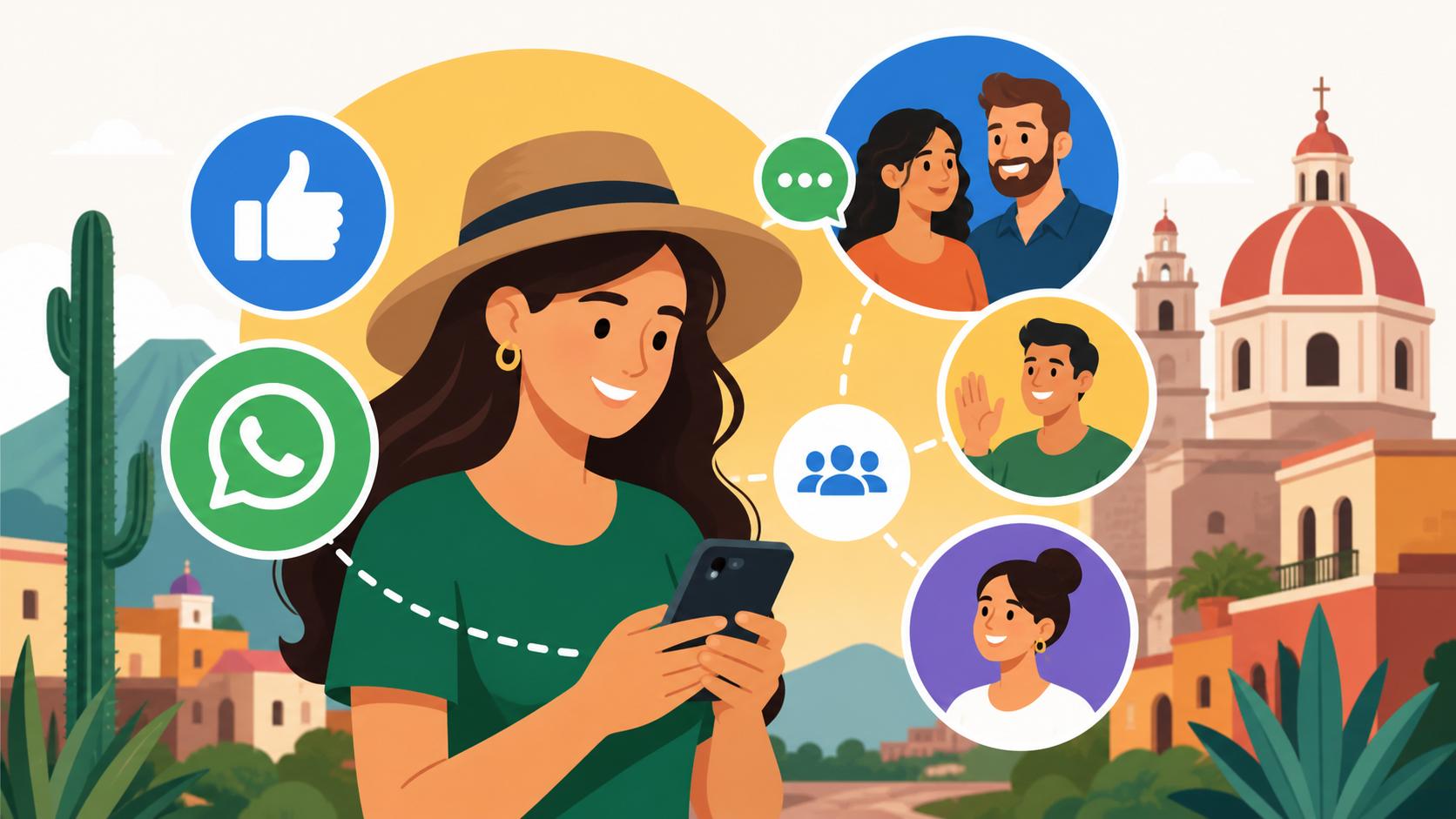
You land in Mexico, your landlord asks for your WhatsApp, the gas delivery man only takes orders by WhatsApp, and every expat you meet says “just ask in the Facebook group.” If you are not plugged into these two apps, daily life feels strangely locked. This guide covers how to find the right groups, behave well inside them, and stay safe while doing it.
Disclosure: This post may contain affiliate links. We may earn a commission at no extra cost to you if you make a purchase through these links. Read full disclosure.
Why Facebook and WhatsApp Run Expat Life in Mexico
When I first arrived, I assumed email would carry me through. It did not. My landlord never answered a single email, but he replied to a WhatsApp voice note within four minutes. That was my introduction to how Mexico actually communicates. Once you see the pattern, it explains a lot of early frustration.
WhatsApp Is the Default Phone Line
In Mexico, WhatsApp is not a nice extra. It is how the country talks. Plumbers, dentists, your building administrator, the woman who sells tamales on Saturdays, and the school your kids attend all use it. Many small businesses run WhatsApp Business accounts with catalogs, opening hours and auto-replies. Calling someone’s mobile out of the blue can even feel slightly intrusive. A short, polite message is the norm.
For expats, this means your phone number becomes your social and practical identity. WhatsApp ties your account to a number. You can keep using your home-country number, and many people do. Over time, though, a local number makes life easier. Some businesses and services will only send verification codes to Mexican numbers, and locals sometimes hesitate to message a foreign one. The reasoning is laid out in Why You Still Need a Mexican Number: Banks, Deliveries, and Verification Codes, and the practical steps are in Getting a SIM Card in Mexico (Telcel, AT&T, Movistar).
There is also a timing problem. In your first days you need data before you have a local SIM, an address or any idea which shop sells what. Many new arrivals install a travel eSIM from a provider like Airalo before they fly. That way WhatsApp works the moment the plane lands, and you can message your Airbnb host or join a newcomers’ group from the taxi. Check the provider’s own page for current plan details and pricing.
Facebook Groups Are the Expat Town Square
Facebook may feel old-fashioned back home, but in Mexico’s expat communities it is very much alive. Almost every city with a foreign population has at least one large general group, plus a cluster of smaller ones for housing, buying and selling, pets, parents, retirees and hobbies. In places like Ajijic, San Miguel de Allende, Mérida and Puerto Vallarta, these groups work like a community noticeboard, a help desk and a gossip column at the same time.
The real value is local, current knowledge you will not find in a guidebook. Which colonia lost water this week. Which immigration office is asking for an extra photocopy. Which taquería reopened after renovations. Who has a crib to give away. For retirees around the lake, these groups sit alongside long-running community institutions, which Living in Lake Chapala: Inside Mexico’s Biggest Expat Community describes in detail.
What Each Platform Does Best
Newcomers often lose time using the wrong tool for the job. Here is how I explain it to friends who have just arrived.
| Need | Facebook Groups | WhatsApp Groups |
|---|---|---|
| Asking a general question to many people | Excellent, answers stay searchable | Good, but answers get buried fast |
| Finding rentals and roommates | Very common, many dedicated groups | Common in smaller towns and buildings |
| Buying and selling second-hand items | Marketplace and bazaar groups dominate | Occasional, mostly within neighborhoods |
| Urgent local alerts like water cuts or road closures | Slower to spread | Fast, especially in neighborhood groups |
| Organising meetups and activities | Event posts and announcements | Day-to-day coordination once you are in |
| Building-level or condo communication | Rarely used | The standard tool for administrators |
| Searching past discussions | Strong group search | Weak, history is messy |
How to Find the Right Groups in Your City
Finding groups is easy. Finding the good ones takes a little strategy. Large groups can be noisy, and some are run mainly as advertising channels. The aim is a small set of well-moderated groups that match your actual life.
Searching Facebook the Smart Way
Facebook search works best with a few varied terms. This is the routine I suggest:
- Search your city name plus “expats,” for example “Expats in Mérida” or “Expats Oaxaca.”
- Search in Spanish as well, using terms like “extranjeros en” plus your city, or “renta departamentos” plus your colonia.
- Narrow by neighborhood. Mexico City groups for Roma, Condesa, Coyoacán or Del Valle are often far more useful than citywide ones.
- Filter results to Groups, then check the “About” section for rules, the admin list and how recently people have posted.
- Read a week’s worth of posts before you write anything. You will quickly see whether the group is helpful or mostly arguments.
- Answer the joining questions honestly. Many admins reject people who skip them, as a way to keep out spammers.
One habit saves a lot of grief: check whether a group has a “files” or “guides” section, or pinned posts. Long-running groups often keep lists of recommended doctors, movers and language schools. Read those first, because asking something that is pinned at the top is the quickest way to get a sarcastic reply.
Getting Into WhatsApp Groups
WhatsApp groups are more private. You usually cannot search for them, so you have to be invited. Common routes include:
- Invite links shared inside Facebook groups, often in pinned posts or welcome threads.
- Your building or condo administrator, who will usually add new tenants to the residents’ group.
- Language exchanges, gyms, yoga studios, running clubs and volunteer projects, which tend to coordinate by WhatsApp.
- Coworking spaces and nomad-friendly hostels. Places like Selina in Playa del Carmen, Tulum, Oaxaca or Mexico City often have community chats for guests and members, and those chats tend to spin off into friendship groups that last well beyond a stay.
- Your kids’ school, where each class almost always has a parents’ group.
The neighborhood and building groups surprised me most. My first building chat was all in Spanish and moved fast: water tank maintenance, a lost cat, someone reminding everyone that the garbage truck had come early. It felt overwhelming at first. Within a month it was where I learned the rhythm of the street. If your Spanish is still shaky, Living in Mexico with Limited Spanish: Survival Tips for Language Barriers has practical tactics, and WhatsApp’s built-in translation features and copy-paste into a translation app will cover a lot of ground.
Matching Groups to Your Stage of Life
Groups that suit you in month one may not suit you in month twelve. A sensible progression usually looks like this:
- On arrival, join one or two general expat groups and one housing group for your target area.
- Once you have an address, add your neighborhood group and your building’s WhatsApp chat.
- As you settle, add groups for your actual interests, such as hiking, board games, parenting, LGBTQ+ meetups, retirees or remote workers.
- After a few months, quietly leave the groups that only stress you out.
If the bigger goal is a real social circle and not just information, Making Friends in Mexico: Expat Groups, Meetups, and Social Tips covers turning online contacts into actual friendships.
Group Etiquette and Getting Real Value
Expat groups in Mexico have their own unwritten rules. Break them and you will get answers that are short, unhelpful or openly hostile. Follow them and you will be amazed at how generous strangers can be.
Posting Questions That Get Good Answers
The posts that get the best replies share a few features. They state your city and colonia, explain what you have already tried, and ask something specific. Compare “Anyone know a good doctor?” with “Looking for a general practitioner near Colonia Americana in Guadalajara who speaks some English, ideally walk-in friendly. I tried the clinic on the corner but they only do appointments.” The second one gets useful, detailed replies. The first gets a dozen people telling you to use the search bar.
A few other habits help:
- Search the group first, then mention that you did.
- Thank people who help, and update your post with what worked.
- Keep politics, home-country arguments and complaints about Mexico out of community groups unless the rules allow them.
- Remember that Mexicans are often members too. Posts that mock local customs land badly, and fairly so.
That last point matters more than many newcomers realise. Some expats use groups to vent about bureaucracy, noise or punctuality, and the tone can turn sour quickly. Frustration is normal, and I have had my share of it. Still, a group full of complaints can deepen culture shock. If you find yourself irritated by everything, Overcoming Culture Shock: Tips for Adjusting to Life in Mexico is worth reading before you hit “post.”
Buying and Selling Through Marketplace and Bazaar Groups
Facebook Marketplace and local “bazar” or “venta de garage” groups are where most expat households get furnished. People leaving Mexico sell everything at once: sofas, washing machines, bikes, kitchenware, plants, even half-used jars of peanut butter. Prices are often low because the seller has a flight to catch.
Before you buy, check what a new item costs. I keep Amazon Mexico and local department store sites open in another tab so I know whether a “bargain” fridge is really a bargain once delivery and the risk of no warranty are factored in. For the bigger picture of when used makes sense and when new is smarter, see Furnishing Your Home in Mexico: Buying New vs Second-Hand. For a closer look at ordering online, Online Shopping in Mexico: Using Amazon, MercadoLibre and Other Sites explains delivery and returns.
A few practical habits for Marketplace:
- Meet in daylight in a public place for small items, or bring a friend when collecting large furniture from a home.
- Test electronics and appliances before handing over money.
- Arrange transport in advance. Many cities have informal “flete” services with pickup trucks, and they are often advertised in the same groups.
- Agree in writing on WhatsApp whether the price includes delivery or pickup.
- Pay by bank transfer only after you have the item, unless you trust the seller.
When it is your turn to leave, these same groups become your exit route. Selling Your Car or Furniture When Leaving Mexico: Getting a Good Deal explains how to time and price a move-out sale so you are not giving everything away on your last weekend.
Asking for Service Recommendations
Some of the most valuable posts are about trades and services: electricians, carpenters, cleaners, mechanics, AC technicians, gardeners. Recommendations from neighbours who have actually used someone are gold in a country where many great workers have no website.
That said, read recommendations critically. A person recommended forty times may be truly excellent, or may simply be someone’s relative being promoted. Look for detailed comments that describe the job, how long it took and how problems were handled. Then message two or three people and compare. The guide How to Find Reliable Handymen and Services in Mexico goes through vetting, quotes and payment.
Remember to give back. When someone fixes your boiler well, post about it. Groups only work if people return the favour.
Staying Safe, Private and Balanced
Expat groups are mostly warm and helpful, but they are also where scammers go to find newcomers who do not yet know how things work. A little caution protects your money and your peace of mind.
Spotting Scams in Housing and Sales Posts
The classic scam goes like this. A beautiful, suspiciously cheap apartment in a sought-after colonia appears in a rental group. The “owner” is abroad and cannot show it, but will send the keys once you transfer a deposit. Variations include fake sellers asking for payment before collection, and impostors copying a real landlord’s photos.
Warning signs include:
- Prices far below what similar listings in the area ask.
- Pressure to pay quickly because “many people are interested.”
- Refusal to do a video call or an in-person viewing.
- New or nearly empty Facebook profiles.
- Requests to pay through unusual methods or to accounts in another person’s name.
If a listing looks wrong, ask the group. Members often recognise recycled photos within minutes. For a full checklist, see Avoiding Rental Scams: Tips to Identify Legitimate Listings in Mexico. The rule I live by is simple: never send money for a place you or a trusted person has not physically seen.
Protecting Your Privacy on WhatsApp
WhatsApp groups show your phone number to every member. In large groups, that can mean unwanted sales pitches, chain messages or worse. A few setting changes help a lot:
- In privacy settings, limit who can see your profile photo, last seen status and “about” text to your contacts.
- Change group invitation settings so that only your contacts, or specific people, can add you to groups.
- Turn on two-step verification so nobody can take over your account with a stolen SMS code.
- Be wary of calls or messages claiming to be from your bank, a government office or a delivery company asking for codes. Real ones will not ask you to read out a verification number.
- Mute busy groups instead of leaving them, so you keep the information without the constant pings.
On Facebook, think about what your profile shows publicly. Posting your exact address, the times your home is empty or your travel dates in a large public group is not a good idea anywhere, Mexico included.
Avoiding the Expat Bubble
Here is a softer warning, from someone who fell into the trap. It is very possible to live in Mexico for years and spend most of your social energy inside English-language groups. That is comfortable, and in your first months it can be a lifeline. Over time, though, it can leave you feeling like a permanent visitor.
The groups themselves can help you get out. Watch for posts about intercambios, where Mexicans and foreigners swap language practice. Look for volunteer projects, neighborhood clean-ups, posadas at Christmas, and local festivals. Join a Spanish-language group about a hobby you love, even if you lurk at first. Getting Involved Locally: Volunteering and Community Events for Expats offers ideas that put you into the community and not just next to it.
A healthy setup, in my experience, is a mix: one or two expat groups for practical questions, your building and neighborhood chats for local life, and at least one group where most members are Mexican and the conversation happens in Spanish. That last one will teach you more about your new home than any guide, this one included.
Disclaimer
This article is for general informational purposes only and does not constitute professional advice. Laws, prices and regulations vary by location and change over time. Consult a qualified professional for guidance on your specific situation.