Living in Mexico with Limited Spanish: Survival Tips for Language Barriers
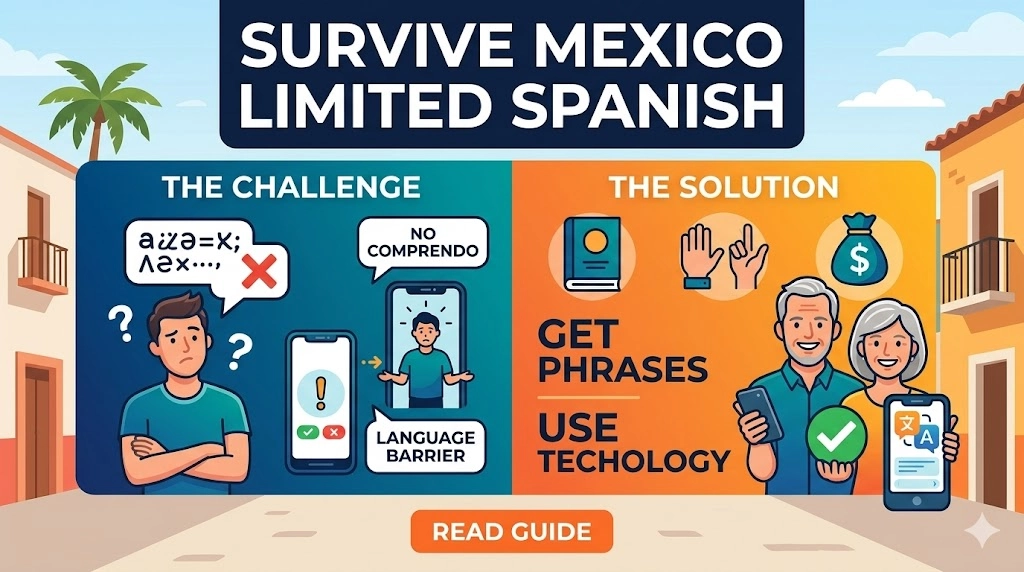
Trying to explain a burst water pipe to a panicked landlord using only hand gestures and broken high school vocabulary is a terrifying expat milestone. I remember standing in my flooded kitchen, desperately pointing at my phone while the plumber rapid-fired colloquial slang I couldn’t comprehend. This guide breaks down exactly how to survive, communicate, and thrive in Mexico before you achieve fluency.
Disclosure: This post may contain affiliate links. We may earn a commission at no extra cost to you if you make a purchase through these links. Read full disclosure.
1. The Psychological Reality of the Language Barrier
Confronting the Expat Isolation Bubble
When you first arrive in Mexico without speaking the language, your immediate instinct will be to seek safety in numbers. You will naturally gravitate toward the heavily gentrified expat hubs—neighborhoods like Roma Norte in Mexico City, the Zona Romántica in Puerto Vallarta, or the picturesque center of San Miguel de Allende. In these areas, nearly every waiter, barista, and real estate agent speaks passable, if not excellent, English. While this feels like a comforting safety net, it rapidly solidifies into an impenetrable isolation bubble.
Living exclusively within this English-speaking ecosystem creates a dangerous parallel reality. You end up living near Mexico rather than genuinely living in it. Your social circle becomes entirely comprised of other foreigners, and your understanding of the local culture remains superficial and transactional. This bubble acts as a massive barrier to integration, preventing you from understanding the neighborhood gossip, the cultural humor, and the authentic warmth of the Mexican people.
Furthermore, relying entirely on English-speaking vendors and service providers fundamentally destroys your relocation budget. In Mexico, there is a very real, unspoken “Gringo Tax” applied to foreigners who cannot negotiate in the local language. If you need a mechanic, a carpenter, or an apartment, doing business exclusively in English automatically signals that you lack local market knowledge, and the quoted price will often double. We analyze the financial impact of this dynamic deeply in our guide on Best Places to Live in Mexico for Expats (2027 Edition).
The Exhaustion of Constant Translation
Living your daily life in a language you do not fully comprehend creates a profound, invisible cognitive load. In your home country, buying a carton of milk or paying a utility bill requires zero mental effort; your brain operates on autopilot. In Mexico, every single mundane task—from figuring out which aisle holds the laundry detergent to understanding what the cashier is asking you—becomes a complex puzzle to solve.
This constant mental friction leads to a very real phenomenon known as “language fatigue.” By 3:00 PM, after spending hours trying to decipher signs, listen to rapid-fire Spanish on the street, and mentally translate your own thoughts before speaking, your brain simply shuts down. You will find yourself retreating to your apartment, closing the blinds, and watching Netflix in English just to give your mind a desperately needed break. It is exhausting, and it is completely normal.
You must be incredibly gentle with yourself during your first six months. Do not mistake this mental exhaustion for a failure to adapt. Accepting that you will feel drained and that you will make embarrassing mistakes is the absolute prerequisite for long-term success. To understand how to actively mitigate this fatigue by slowly increasing your exposure, you should review our strategies in Learning Spanish in Mexico: Top Tips and Resources for Expats.
2. Essential Technology for Daily Survival
Translating the Real World in Real Time
Before you master verb conjugations and local slang, your smartphone is your ultimate survival tool. The days of carrying a heavy, printed Spanish-English dictionary in your backpack are over. You must weaponize modern translation applications to bridge the immediate communication gap.
The absolute gold standard for physical world translation is the Google Translate camera feature. When you are standing in the aisles of a Mexican supermarket staring at ten different types of cleaning solvents, you simply open the app, point your camera at the labels, and the text magically translates into English on your screen in real time. This tool is equally indispensable when trying to decipher confusing utility bills or complex medical forms at a pharmacy.
For textual communication, specifically the relentless daily use of WhatsApp, you should install the DeepL translator app. DeepL utilizes advanced AI to provide significantly more accurate, context-aware translations than standard tools, ensuring your translated text messages to your landlord or contractor do not sound like an incoherent robot. We discuss how critical these digital tools are for remote workers in our Digital Nomads in Mexico: Remote Work Guide.
Maintaining Unbreakable Mobile Connectivity
All of the translation technology in the world is completely useless if you do not have an active internet connection. When you are standing on a street corner trying to negotiate a fare with a taxi driver, or standing in a local hardware store trying to explain that you need a specific plumbing valve, you cannot rely on finding an unsecured public Wi-Fi network.
Securing unbreakable mobile data is your single greatest tactical advantage. To avoid the overwhelming stress of navigating local cellular kiosks in broken Spanish upon arrival, savvy expats install a digital eSIM from Airalo before their flight even takes off. With an Airalo data pack, your phone instantly connects to the local Telcel or AT&T network the exact second you land.
This day-one connectivity ensures that your translation apps, Google Maps, and ride-sharing services are functional from the very first minute of your expat journey. It prevents you from being stranded, overcharged, or unable to communicate in an emergency. The peace of mind this digital safety net provides cannot be overstated. We explore the broader strategies of securing local long-term plans in Internet and Mobile Phone Plans in Mexico: Staying Connected as an Expat.
3. Navigating Housing and Bureaucracy in English
Finding Bilingual Real Estate Support
Securing a long-term apartment is arguably the most stressful milestone of moving to Mexico. When you introduce a severe language barrier into an already complex, highly bureaucratic real estate market, the potential for catastrophic financial mistakes multiplies.
Mexican lease agreements (contratos de arrendamiento) are dense, legally binding documents written in highly formalized Spanish. If you attempt to negotiate a lease or understand the complex requirements of a security deposit relying purely on automated translation, you leave yourself incredibly vulnerable to predatory clauses or outright scams. You absolutely must hire a bilingual real estate agent or a local relocation specialist whose fiduciary duty is to protect your interests.
To safely manage this transition, many expats execute a “soft landing.” By booking your first month in a secure, community-driven basecamp like Selina, you completely bypass the immediate panic of finding a long-term lease. Staying at a Selina property surrounds you with bilingual staff and veteran expats who can recommend trustworthy, English-speaking real estate professionals. This buys you the physical time to safely scout neighborhoods and legally review contracts. We detail this crucial strategy extensively in Renting a Home in Mexico: Complete Expat Guide to Leases, Deposits, and More.
Surviving Government Offices and Paperwork
At some point, every expat must interface with the Mexican government. Whether you are applying for your residency visa at the immigration office or securing your tax identification number at the federal tax authority, you will encounter the infamous Mexican trámite (bureaucratic procedure).
These government offices operate strictly in Spanish. The clerks are generally prohibited from speaking English, even if they know it, as all official business must be conducted in the national language. Attempting to navigate the intense, document-heavy requirements of these offices without speaking the language is a recipe for endless delays, missing stamps, and tear-inducing frustration.
Do not attempt these high-stakes government interactions alone. You must bring a bilingual friend, or better yet, hire a professional gestor (a local bureaucratic fixer) to accompany you. A gestor knows the exact vocabulary, the unwritten rules, and the specific clerks to speak to, turning a potentially agonizing three-day ordeal into a smooth, one-hour process. We break down the realities of dealing with these specific government entities in Taxes in Mexico for Expats: A Complete Guide to Income Tax and More.
4. Managing Healthcare and Emergencies
Locating English Speaking Doctors and Specialists
Navigating a medical diagnosis is terrifying under the best circumstances; attempting to do so in a language you barely understand is a profound nightmare. Fortunately, the private healthcare sector in Mexico is incredibly robust and heavily caters to international patients.
In major expat hubs and metropolitan centers, finding an English-speaking general practitioner or specialist is relatively straightforward. Many top-tier Mexican doctors completed their medical residencies or specialized fellowships in the United States, Canada, or the United Kingdom. When booking an appointment at a premium private hospital, you can explicitly request a bilingual physician from the hospital’s administration desk.
However, you must prepare for the reality that while your surgeon or specialist may speak impeccable English, the surrounding support staff—the triage nurses, the billing department, and the hospital orderlies—likely will not. When facing a complex medical procedure or a hospital admission, you must have your medical history pre-translated or bring a bilingual advocate. We outline the costs and logistics of navigating these private hospitals in Healthcare Costs in Mexico: Doctor Visits, Hospital Stays, and Surgery Expenses.
Pharmacy Protocols and Medical Communication
For minor ailments, you will frequently utilize the incredibly efficient Mexican system of Farmacias con Consultorio (pharmacies with attached doctor’s offices). These small clinics are perfect for a quick prescription for a sinus infection or a stomach bug, but the doctors staffing them rarely speak English.
Before you walk into a local clinic, you must prepare a “cheat sheet” on your phone. Translate your exact symptoms, the duration of the illness, and any allergies you have into Spanish. Handing the doctor your phone with a clear, translated list of symptoms is infinitely more effective than pantomiming a stomach ache.
Furthermore, to avoid the stress of trying to find specialized, non-prescription medical gear in a foreign language, smart expats proactively outfit their homes. Instead of wandering the aisles of a Mexican pharmacy trying to explain what a HEPA filter or a digital thermometer is, you can order comprehensive first-aid kits and specialized home health supplies via Amazon Mexico. Having these essential items delivered directly to your door ensures you are prepared for minor illnesses without the stress of a language barrier.
5. Daily Logistics Shopping Dining and Repairs
Conquering the Local Markets and Supermarkets
Buying groceries is a daily necessity that forcefully pushes you into the local language. If you shop exclusively at massive corporate supermarkets, you can technically survive without speaking, utilizing self-checkout lanes. However, relying on this method isolates you from the incredibly vibrant, affordable world of local Mexican agriculture.
To shop at a local tianguis (open-air market), you must master the absolute basics: numbers, weights, and polite greetings. You do not need perfect grammar; you just need to know how to point, smile, and ask ¿Cuánto cuesta? (How much does it cost?). Market vendors are incredibly accustomed to dealing with non-Spanish speakers. If you hold up two fingers and point at the avocados, they will understand.
The most crucial element of this interaction is the polite greeting. Before you point to the fruit, you must make eye contact and say Buenos días (Good morning) or Buenas tardes (Good afternoon). In Mexico, acknowledging someone’s humanity with a polite greeting before initiating a transaction is culturally mandatory. We explore this specific cultural dynamic deeply in Mexican Etiquette and Customs: Do’s and Don’ts for New Expats.
Hiring Reliable Home Maintenance Help
Eventually, a pipe will leak, the internet will drop, or the gas tank will run empty. Hiring a local plumber (plomero), electrician (electricista), or gas delivery driver when you have limited Spanish feels incredibly daunting.
The ultimate hack for managing home maintenance is to shift all communication to text-based platforms. Never try to call a local handyman on a voice call; the poor audio quality combined with colloquial slang will make comprehension impossible. Instead, ask for their WhatsApp number.
Once the communication is on WhatsApp, the language barrier practically vanishes. You can use your translation apps to carefully craft your message, describing the exact problem. You can send photos or videos of the broken pipe to visually demonstrate the issue. The contractor can reply in Spanish, which you can instantly copy and paste into your translator. This asynchronous, text-based method reduces anxiety and ensures a clear, documented understanding of the required repairs. We detail how to manage these specific domestic utilities in Home Utilities in Mexico: Setting Up Electricity, Water, Gas, and Internet.
6. Practical Steps to Build Your Vocabulary
High Impact Phrases for Everyday Survival
You do not need to master the subjunctive verb tense to survive your first year in Mexico; you simply need a toolkit of high-impact, utilitarian phrases. Focusing on functional vocabulary instantly lowers your daily anxiety and proves to locals that you are making a genuine effort.
Here is a quick-reference guide to the absolute essential survival phrases you should memorize immediately:
| English Intent | Essential Spanish Phrase | Practical Context |
| Polite Request | Me gustaría… por favor. (I would like… please.) | Ordering food, buying tickets, requesting services. |
| Cost Inquiry | ¿Cuánto cuesta esto? (How much does this cost?) | Essential for markets, taxis, and informal vendors. |
| Declining Gracefully | Ahorita no, gracias. (Not right now, thank you.) | Politely turning down street vendors or aggressive sales pitches. |
| Expressing Confusion | No entiendo, hablo poco español. (I don’t understand, I speak little Spanish.) | De-escalating misunderstandings quickly and humbly. |
| Seeking Clarification | ¿Puede hablar más despacio, por favor? (Can you speak slower, please?) | Slowing down rapid-fire local speakers so you can catch context clues. |
Creating a Low Stress Learning Environment
The goal is not to become perfectly fluent overnight; the goal is to steadily, consistently reduce the friction of your daily life. You must create a low-stress environment for language acquisition that does not feel like an overwhelming academic chore.
Start by translating your digital environment. Change the operating language of your smartphone, your GPS navigation app, and your streaming services to Spanish. This constant, passive exposure forces your brain to learn the imperative commands for mundane tasks like “save,” “delete,” and “turn left.”
Furthermore, invest in physical learning materials to reduce screen time fatigue. You can easily source high-quality, bilingual grammar workbooks and localized slang dictionaries through Amazon Mexico and keep them on your coffee table. Dedicating just twenty minutes a morning to a physical workbook while drinking your coffee provides a structured, tactile learning experience that actively accelerates your integration into the beautiful complexity of Mexican culture.
References
Primary sources (official)
- Instituto Nacional de Migración (INM): The official Mexican immigration authority, detailing the specific requirements for processing residency visas and necessary documentation. https://www.gob.mx/inm
- Procuraduría Federal del Consumidor (PROFECO): The official federal consumer protection agency, offering guidelines on real estate transactions and consumer rights in Mexico. https://www.gob.mx/profeco
Other helpful sources
- Airalo: Global eSIM provider ensuring expats maintain constant, reliable mobile connectivity to access translation apps and ride-sharing services from day one. https://www.airalo.com/
- Amazon Mexico: Essential e-commerce platform for rapidly sourcing bilingual dictionaries, home health supplies, and electronics without navigating a language barrier. https://www.amazon.com.mx/
Disclaimer
The information provided in this article is for educational and informational purposes only and does not constitute official legal, medical, or immigration advice. Mexican bureaucratic procedures, healthcare protocols, and legal requirements for housing contracts are complex and subject to frequent changes by local and federal authorities. Navigating legally binding contracts or severe medical emergencies relying solely on digital translation tools carries significant risk. Always consult with certified bilingual professionals, such as licensed real estate attorneys, authorized immigration gestores, or board-certified medical translators, when executing official documents or seeking critical care. Ensure that any services, platforms, or applications mentioned meet your specific individual requirements and legal residency status.