Internet and Mobile Phone Plans in Mexico: Staying Connected as an Expat
Arriving in a new country without a working smartphone is a fast track to sheer panic. I will never forget standing helplessly on a bustling Mexico City sidewalk, unable to load Google Maps or hail an Uber because my home carrier immediately blocked my roaming data. This guide breaks down exactly how to secure reliable mobile plans, navigate complex home internet installations, and build a bulletproof digital safety net for your new life abroad.
Disclosure: This post may contain affiliate links. We may earn a commission at no extra cost to you if you make a purchase through these links. Read full disclosure.
The Reality of Mexican Telecommunications
If you are accustomed to the seamless, hyper-competitive telecommunications markets of the United States or Northern Europe, moving to Mexico requires a fundamental reset of your expectations. The infrastructure here is a fascinating mix of world-class, gigabit fiber optics and archaic, degrading copper wires, completely dependent on your specific zip code.
The Telcel Monopoly and Market Landscape
The Mexican mobile landscape is overwhelmingly dominated by a single corporate giant: Telcel. Owned by Carlos Slim’s América Móvil, Telcel possesses the most expansive and reliable cellular coverage map in the country, hands down. Whether you are deep in the subway tunnels of the capital, relaxing on a remote Oaxacan beach, or driving along a desert highway in Baja California, Telcel is the only carrier that consistently holds a signal.
While competitors like AT&T Mexico and Movistar exist and often offer slightly cheaper data packages to entice customers, their networks are fundamentally urban. The moment you step outside the perimeter of a major metropolitan area, AT&T and Movistar signals frequently vanish or drop to virtually unusable 3G speeds. For an expat who plans to travel, explore off-the-beaten-path destinations, or simply desires peace of mind during a highway breakdown, relying on a secondary carrier is a gamble that rarely pays off.
You must accept that you will likely become a Telcel customer. This dominance means their customer service is notoriously indifferent, and their physical storefronts (Centros de Atención a Clientes) are plagued by grueling, hours-long wait times. Surviving this localized monopoly requires patience, preparation, and knowing exactly which plans to ask for before you take a numbered ticket at the door.
Fiber Optic versus Copper Wire Infrastructure
The quality of your home internet in Mexico is entirely dictated by the physical cables hanging from the concrete pole outside your apartment building. In the last five years, Mexico has undergone a massive, aggressive rollout of fibra óptica (fiber optic) infrastructure, but this rollout is highly uneven.
If you rent a modern apartment in a heavily gentrified hub like Guadalajara, Monterrey, or the Roma Norte neighborhood of CDMX, you will likely have access to symmetrical, blazing-fast fiber internet exceeding 500 Mbps. However, if you rent a stunning, centuries-old colonial home in the historic center of Mérida or San Miguel de Allende, you may be severely restricted. Many historic districts legally prohibit new overhead cables, trapping residents on degrading, legacy ADSL copper wires that struggle to maintain 10 Mbps on a good day.
When you are scouting for a long-term rental, you cannot simply trust a landlord who says the internet is “very fast.” You must physically ask to see the router and run a speed test on your phone. If the building is not wired for fiber, and your remote job depends on heavy video conferencing, you must walk away from the lease. We deeply emphasize evaluating this infrastructural reality before committing to a property in our guide to Renting a Home in Mexico: Complete Expat Guide to Leases, Deposits, and More.
The WhatsApp Rule for Expats
To understand connectivity in Mexico, you must understand that standard SMS text messaging and traditional voice calls are virtually obsolete. The entire country, from multi-national corporate executives to the vendor selling tamales on the corner, operates exclusively on WhatsApp.
If you do not have an active WhatsApp account linked to a reliable mobile data connection, you functionally do not exist in the Mexican economy. You will use WhatsApp to coordinate with your real estate agent, schedule a private water truck delivery, order food from local restaurants, and receive location pins from your Uber driver.
Because WhatsApp is considered a fundamental human right in Mexican telecommunications, almost every single mobile provider offers “unlimited social media” data packages. This means that even if you burn through your monthly allowance of gigabytes watching YouTube, your WhatsApp text messages will continue to send and receive indefinitely. Maintaining this baseline connectivity is your absolute greatest survival tool as a newly arrived expat.
Securing Your Mobile Phone Plan
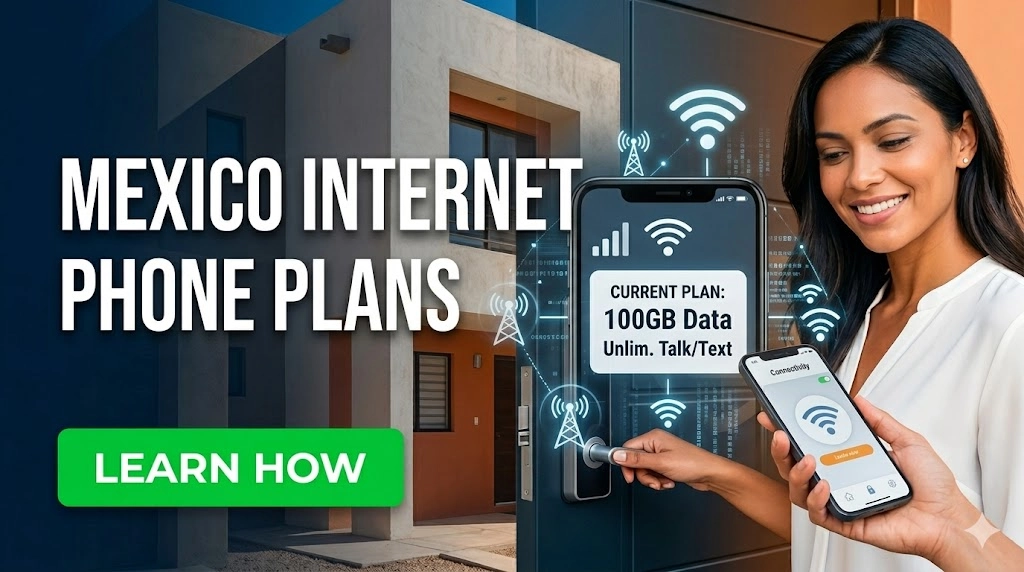
Securing a local Mexican phone number is one of the very first logistical hurdles you must clear. However, doing it efficiently requires bypassing the immediate chaos of the airport arrivals terminal and utilizing modern digital alternatives.
Day One Connectivity and eSIM Technology
The single most vulnerable moment of your relocation is the transit from the airport to your first accommodation. Historically, expats had to wander the chaotic airport terminals searching for a Telcel kiosk, point at physical SIM cards in broken Spanish, and hope their unlocked phone would accept the new chip.
Today, seasoned digital nomads entirely bypass this physical friction. Before your flight to Mexico even departs, you must secure your digital footprint by downloading a localized eSIM from Airalo. Utilizing an Airalo data pack ensures that the exact second your plane touches the tarmac, your smartphone securely locks onto the Mexican cellular network.
Having this immediate, day-one connectivity allows you to instantly WhatsApp your Airbnb host, order a secure ride-sharing service to bypass predatory airport taxi mafias, and navigate the unfamiliar streets via Google Maps. Relying on Airalo for your first few weeks completely insulates you from the stress of navigating local cellular bureaucracy until you are fully settled and ready to acquire a permanent local number. We highlight the massive tactical advantage of this digital redundancy in Digital Nomads in Mexico: Remote Work Guide.
Prepaid Amigo Plans versus Postpaid Contracts
When you are finally ready to get a local Mexican phone number, you will face a choice between a postpaid contract (Plan de Renta) and a prepaid scheme (Amigo Sin Límite). For 95% of expats, the prepaid route is vastly superior.
Securing a postpaid contract with Telcel or AT&T requires an immense amount of paperwork. You must provide a formalized lease agreement, an official utility bill in your name, your temporary or permanent residency card, and occasionally a massive cash deposit if you do not have an established Mexican credit history. Furthermore, these contracts lock you into rigid 12-month or 24-month terms, which is antithetical to the flexible expat lifestyle.
Conversely, the prepaid Amigo Sin Límite (Friend Without Limits) system requires zero paperwork. You simply walk into any OXXO convenience store, purchase a physical Telcel SIM card for roughly $4 USD, insert it into your unlocked phone, and hand the cashier cash to load a specific data package. There are no credit checks, no contracts, and you can change your data allowance month to month based on your travel schedule.
Understanding Data Allowances and Recharges
The mechanics of the Mexican prepaid system are incredibly consumer-friendly. When you recharge your phone (hacer una recarga), you are typically buying a package valid for 30 days.
A standard 200 MXN (roughly $10 USD) recharge generally grants you around 3 gigabytes of open-web browsing data, completely unlimited phone calls and SMS messages across Mexico, the US, and Canada, and unlimited data strictly for WhatsApp, Facebook, and Instagram. If you consume your 3 gigabytes in two weeks, your phone will not shut off; you will simply lose access to the open web (Safari, Google Maps, Spotify) until you go back to an OXXO and hand them another 200 pesos.
Recharging is incredibly simple. You walk into any convenience store or pharmacy, tell the cashier “Recarga Telcel por favor,” give them your 10-digit Mexican phone number, and hand them the cash. Within seconds, you will receive an SMS confirmation that your data is active. Once you successfully navigate the banking system, you can link your local debit card to the official carrier apps to recharge digitally, a process we explain in Banking in Mexico: Complete Guide for Foreigners.
Setting Up Home Internet Wi Fi
While mobile data keeps you moving, a robust home fiber-optic connection is the anchor of your remote professional life. Setting this up as a renter requires strategic provider selection and immense patience.
Choosing the Right Provider Telmex Totalplay or Izzi
The Mexican home broadband market is a fierce battleground dominated by three major players, and the “best” option depends entirely on the physical wiring on your specific street.
Telmex is the legacy national monopoly. They possess the widest coverage map, but their customer service is legendary for its agonizing slowness. If a storm knocks out your Telmex fiber line, you may wait two weeks for a technician to arrive. Totalplay is a newer, aggressive competitor operating an exclusive 100% fiber-optic network. They are widely favored by the expat community for offering the most reliable uptime, symmetrical upload speeds (crucial for video calls), and incredibly fast technician dispatch via their modern app.
Izzi is the third major player, often utilizing a hybrid coaxial-fiber network. They are deeply integrated into many luxury condominium buildings and frequently bundle internet with cable television packages. Before signing a lease, you must ask the landlord not just who services the building, but if there are actually open “ports” on the street pole for a new contract. In saturated neighborhoods, a provider may have coverage, but zero physical capacity to add a new line.
The Bureaucratic Installation Process
Initiating a new internet contract is a test of your bureaucratic endurance. You cannot simply sign up online with a foreign credit card. You must physically visit the provider’s corporate branch, pull a numbered ticket, and wait in a crowded lobby.
To open an account, you generally need your passport, your residency card, and a comprobante de domicilio (proof of address, typically a recent electricity bill). Totalplay and Izzi are notoriously strict; they will frequently refuse to open an account for an expat who only holds a tourist visa. Telmex is occasionally more lenient, but they will mandate a massive upfront cash deposit to mitigate their risk of you fleeing the country with their router.
Once the paperwork is signed, you enter the waiting phase. Installation can occur in 48 hours, or it can take three weeks if the local technicians are backlogged. You must have someone physically present in the empty apartment to allow the technicians inside to drill holes and run the fiber line through the walls. Navigating this initial friction is why we heavily advocate establishing robust contingency plans in Home Utilities in Mexico: Setting Up Electricity, Water, Gas, and Internet.
Overcoming Landlord and Contract Restrictions
If you are renting a furnished or short-term apartment, the internet will almost certainly remain in the landlord’s name. This is convenient, but it strips you of control. If the landlord opted for the cheapest, lowest-tier 20 Mbps package, you cannot legally upgrade the speed or change the provider without their explicit permission and physical presence at the telecom office.
If you are a remote worker who requires massive bandwidth, you must negotiate the internet speed before signing the lease. Tell the landlord you will happily pay the difference in the monthly premium if they upgrade the line to 300 Mbps or 500 Mbps. Get this agreement in writing.
Furthermore, if the router breaks or the line goes down, you cannot call customer service because you are not the account holder. You must relentlessly text your landlord, begging them to open a support ticket. This layer of bureaucratic abstraction is maddening during an internet outage, proving exactly why establishing your own digital redundancy is vital.
Hardware Solutions and Redundancy for Remote Workers
Mexican infrastructure is resilient, but it is routinely battered by intense tropical storms, massive earthquakes, and chronic grid underfunding. Your professional survival depends entirely on the hardware you deploy inside your home.
The Importance of a Battery Backup UPS
Blackouts (apagones) are a standard feature of daily Mexican life. During the summer rainy season, spectacular lightning storms will frequently knock out neighborhood transformers, leaving your street in the dark.
If your power drops, your fiber-optic router dies instantly, disconnecting your Zoom call and severing your workflow. To counteract this, every remote worker must purchase an Uninterruptible Power Supply (UPS). You can easily source heavy-duty, reliable UPS units directly through Amazon Mexico and have them delivered to your door before the rainy season begins.
By plugging your home router and your laptop charger directly into the UPS, you ensure that when the neighborhood grid fails, the battery seamlessly takes over. A quality UPS sourced from Amazon Mexico will keep your internet broadcasting for several hours, allowing you to comfortably finish your work, save your files, and safely shut down your systems without panic.
Upgrading Routers and Mesh Networks
Traditional Mexican homes are not built with drywall and wooden studs; they are constructed entirely of thick cinder block, rebar, and poured concrete. These dense materials act as a massive Faraday cage, completely destroying Wi-Fi signals.
If your ISP installs their cheap, default router in the front living room, you will likely have zero Wi-Fi signal in the back bedroom. Attempting to work from a home office separated from the router by two concrete walls is impossible without hardware intervention.
You must bypass the cheap ISP router by investing in a high-powered Mesh Wi-Fi network (like Google Nest or Eero). By placing multiple mesh nodes throughout the concrete house, you bounce the signal around the dense walls and blanket the entire property in strong, usable internet. Do not expect the local Telmex technician to solve your dead zones; you must proactively engineer your own internal network. We discuss outfitting your concrete home with necessary tech upgrades in Furnishing Your Home in Mexico: Buying New vs Second-Hand.
Mobile Hotspots as a Failsafe
Even with a UPS keeping your router alive, the actual fiber-optic cable hanging over the street might be severed by a falling tree branch or a careless truck driver. If the physical line is cut, your home internet is dead for days.
This is the exact scenario where your mobile phone transforms into your primary lifeline. You must be prepared to instantly convert your smartphone into a dedicated mobile hotspot for your laptop. By maintaining an active Airalo data plan, you guarantee that you can immediately tether your computer to the local 5G cellular network.
Using an Airalo eSIM allows you to bypass the catastrophic failure of the localized fiber-optic grid, ensuring you never miss a critical client meeting just because a garbage truck snagged a wire down the street. Redundant, unbreakable cellular data is the ultimate failsafe for any serious digital nomad.
Managing Dead Zones and Regional Connectivity
Your connectivity experience will fluctuate wildly depending on the specific geography and climate zone you choose to inhabit in Mexico.
Coastal Challenges and Hurricane Disruptions
If you choose to live in a breathtaking coastal destination like Tulum, Playa del Carmen, or Puerto Vallarta, you must accept that tropical environments are hostile to telecommunications infrastructure.
The heavy salt air aggressively corrodes exposed copper wiring and connection nodes. More importantly, the Caribbean and Pacific coasts are subjected to severe hurricane seasons from June through November. A Category 3 hurricane will systematically destroy overhead fiber-optic lines, cellular towers, and regional power substations. Following a major storm, you must be prepared to endure weeks without stable home internet or municipal electricity.
Coastal living requires extreme adaptability. If you rely on 100% uptime for your career, the constant threat of tropical disruption might make these zones unsuitable for year-round living, a geographical reality we heavily scrutinize in Safety in Mexico: What Expats Need to Know About Staying Safe.
Connectivity in Colonial Highlands and Pueblos Magicos
The majestic, cobblestone streets of Mexico’s colonial highlands and designated Pueblos Mágicos (Magical Towns) offer stunning aesthetics, but frequently terrible internet infrastructure.
Cities like San Cristóbal de las Casas or parts of Guanajuato are nestled deep in mountainous valleys. Laying modern fiber-optic cables through centuries-old stone infrastructure is incredibly difficult and heavily regulated by historic preservation societies. Consequently, internet speeds in these picturesque towns often hover in the agonizingly slow 10 to 20 Mbps range.
Furthermore, the dense, historic stone walls of these colonial mansions are impenetrable to cellular signals. You might have perfect 5G reception standing on the sidewalk, but the moment you step into your courtyard, your phone drops to “No Service.” If you require massive bandwidth, you must verify the infrastructure meticulously before romanticizing a move to a historic mountain village.
The Coliving Basecamp Strategy
Because assessing the true reliability of a neighborhood’s internet is impossible from abroad, the smartest tactical move a new expat can make is to execute a “soft landing.”
Do not commit to a 12-month lease in an unverified neighborhood on your first day. Instead, book your first four to six weeks in a specialized, digitally fortified coliving space like Selina. By establishing your initial footprint at a Selina property, you completely bypass the grueling wait for a Telmex technician and the stress of troubleshooting concrete dead zones.
A Selina basecamp provides guaranteed, enterprise-grade Wi-Fi, redundant backup networks, and dedicated coworking spaces engineered specifically for remote professionals. This allows you to immediately begin earning your income without missing a beat, giving you the necessary physical time to safely scout local neighborhoods, test cellular signals, and sign a lease with absolute confidence.
| Provider Type | Dominant Carrier | Best Used For | Key Weakness |
| Mobile Prepaid | Telcel | Extensive national coverage, rural travel. | Terrible customer service, long kiosk lines. |
| Digital eSIM | Airalo | Instant Day-1 connectivity, seamless hotspot redundancy. | Data caps are not suited for heavy video streaming. |
| Fiber Internet | Totalplay | Symmetrical speeds, highly reliable urban remote work. | Will not install without rigorous expat documentation. |
| Legacy Home Wi-Fi | Telmex (ADSL) | Historic centers, colonial towns where fiber is banned. | Very slow upload speeds, fragile infrastructure. |
Financial Logistics of Tech in Mexico
Maintaining your digital infrastructure requires navigating the localized payment gateways and understanding the steep import economics of consumer electronics in Latin America.
Paying Your Monthly Bills Successfully
If you manage to get a home internet contract in your name, paying the monthly invoice is a delicate dance. Mexican telecom portals—like the Totalplay or Telmex websites—utilize aggressive 3D Secure fraud prevention algorithms that routinely reject foreign US, Canadian, or European credit cards.
If your travel card is declined, the system will automatically sever your fiber-optic connection at exactly midnight on the due date. They do not offer grace periods. To circumvent this, many new expats are forced to print their paper bills and pay physically in cash at local OXXO convenience stores.
Eventually, you must digitize this process. Once you successfully open a localized bank account or verify a Mercado Pago digital wallet, you can seamlessly scan the barcode on your internet bill and pay instantly using domestic payment rails, completely bypassing the frustrating foreign card rejections. We outline these exact financial workarounds in our guide on Cost of Living in Mexico: 2026 Comprehensive Guide.
Buying Electronics and Phones Locally versus Importing
If you drop your iPhone on a cobblestone street or your laptop motherboard fries during a power surge, your first instinct will be to visit a Mexican Apple Store or an electronics retailer like Best Buy (which has actually exited the Mexican market) or MacStore.
You must brace yourself for the sticker shock. Consumer electronics, particularly premium laptops, smartphones, and camera gear, are subjected to massive import taxes (IVA and luxury tariffs) in Mexico. A MacBook Pro or an unlocked iPhone purchased at a retail store in Guadalajara can cost 25% to 40% more than the exact same model purchased in Texas or California.
Because of this brutal retail markup, seasoned expats never buy major tech hardware locally. They purchase their unlocked smartphones and premium laptops in their home countries and physically fly them down. If you absolutely must replace a broken peripheral—like a specialized ergonomic mouse, a high-end router, or a mechanical keyboard—utilizing Amazon Mexico is vastly superior to shopping at local big-box stores. Amazon Mexico frequently handles the complex import logistics on the back end, delivering reliable, high-quality gear without the localized retail extortion.
Protecting Your Gear from Power Surges
Finally, the most expensive mistake you can make in Mexico is plugging your imported, high-end electronics directly into a raw wall outlet.
Many older Mexican homes, and even some newer coastal constructions, lack proper electrical grounding. When the CFE grid fluctuates, or when the power violently re-engages after a blackout, massive voltage spikes travel through the unprotected wiring. These spikes will instantly fry the logic boards of your expensive laptops, televisions, and charging bricks.
You must treat every wall outlet as hostile. On your very first day in your new apartment, you must deploy heavy-duty surge protectors (reguladores de voltaje) on every single outlet you intend to use for electronics. Purchasing these through Amazon Mexico and installing them before you ever plug in your laptop is a mandatory insurance policy for your remote career, ensuring your expensive imported gear survives the beautiful, chaotic reality of the Mexican power grid.
References
Primary sources (official)
- Instituto Federal de Telecomunicaciones (IFT): The Mexican federal regulator for telecommunications, providing official data on fiber-optic rollouts and consumer rights regarding internet service providers. https://www.ift.org.mx/
Other helpful sources
- Airalo: Global eSIM provider ensuring immediate, unbreakable mobile data access to navigate airports, translate documents, and provide emergency hotspot redundancy when local Wi-Fi fails. https://www.airalo.com/
- Amazon Mexico: The essential e-commerce lifeline for rapidly sourcing heavy-duty UPS battery backups, mesh Wi-Fi routers, and surge protectors to defend against power grid fluctuations. https://www.amazon.com.mx/
Disclaimer
The information provided in this article is for educational and informational purposes only and does not constitute official telecommunications, legal, or professional IT advice. Telecommunications infrastructure, fiber-optic availability, and cellular coverage maps vary drastically by state, municipality, and specific neighborhood. The acceptance of foreign documents for postpaid cellular contracts and home broadband installations is highly volatile and subject to the discretion of local branch managers. Do not attempt to modify municipal fiber-optic lines or electrical outlets; always utilize authorized technicians and heavy-duty surge protection. Ensure that any digital services, eSIM applications, or e-commerce platforms mentioned meet your specific individual device requirements and legal residency status.