Banking in Mexico: Complete Guide for Foreigners
I remember standing at a bank branch in Merida for four hours, clutching my new residency card, only to be turned away because my electricity bill was in my landlord’s name. Navigating the Mexican banking system as a foreigner is an incredibly frustrating initiation rite. This comprehensive guide demystifies the exact paperwork, unwritten rules, and best institutions for securing your finances locally.
Disclosure: This post may contain affiliate links. We may earn a commission at no extra cost to you if you make a purchase through these links. Read full disclosure.
The Reality of the Mexican Banking System
Cash Dependency Versus Digital Innovation
Moving to Mexico means stepping into a dual financial reality. On one hand, you have a highly sophisticated, instantaneous digital banking network. On the other, you have a society where cash remains the ultimate king for everyday transactions. Navigating this divide is your first major hurdle as a new resident.
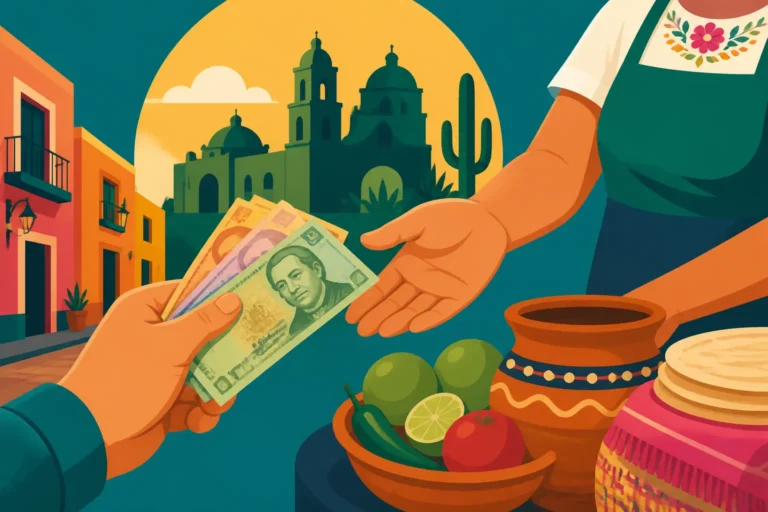
Despite rapid modernization, a vast portion of the Mexican economy operates entirely on paper money. When you go to a local street market, pay your domestic helper, or grab a quick taco from a corner stand, you must have cash on hand. Trying to use a credit card in these situations will either result in outright rejection or a polite request that you cover the vendor’s terminal commission, which is typically an extra three to five percent added to your total bill.
Conversely, the formal banking system is actually quite advanced when it comes to domestic transfers. The central bank operates SPEI, a system allowing you to send money instantly and freely between any two Mexican accounts, twenty-four hours a day. Landlords and private schools often prefer or exclusively require SPEI transfers. If you are researching the Cost of Living in Mexico: 2026 Comprehensive Guide, setting up your SPEI capability is a massive priority.
The friction happens at the intersection of these two economies. You will constantly find yourself needing exact change for a taxi while simultaneously needing to wire thousands of pesos for rent. Keeping a reserve of small-denomination bills is an ongoing administrative chore. Large bills, like the 500 or 1000 peso notes dispensed by ATMs, are famously difficult to break at small businesses, leading to the classic expat scramble of buying unnecessary items at convenience stores just to get change.
Bureaucracy and the Customer Service Experience
Mexican banks operate on a highly bureaucratic model that relies heavily on face-to-face interaction, physical signatures, and original paperwork. Unlike in North America or Europe where you can open a checking account from your smartphone in ten minutes, opening an account in Mexico requires a physical visit to a branch. For non-citizens, there are virtually no digital onboarding options available.
Customer service in the branches is notoriously slow. You do not simply walk up to a teller; you enter the bank, take a printed ticket from a machine, and wait for your number to be called by an executive at a desk. It is completely normal to wait an hour or more just to speak to someone. Once seated, the executive will scrutinize every single document you bring, looking for reasons to reject the application based on internal, unwritten compliance rules.
One of the most maddening aspects of the system is the concept of the “home branch.” Historically, the specific branch where you opened your account is where you had to return to solve any major administrative issues, like replacing a lost card or updating your signature. While this is slowly changing with the larger banks, you may still encounter tellers who refuse to help you because your account is domiciled at a branch across town.
Language is another massive barrier. Bank executives rarely speak English, and legal banking terminology in Spanish is complex. If you do not speak fluent Spanish, bringing a bilingual friend or hiring a relocation specialist to accompany you to the branch is highly recommended to ensure you fully understand the fee structures and account limits you are signing up for.
Security Concerns and Fraud Prevention
Financial security in Mexico requires a proactive, sometimes paranoid approach. ATM skimming is a highly prevalent issue, particularly in tourist-heavy zones and coastal cities. A card skimmer can drain your home bank account before you even realize your card has been compromised. The golden rule is to never, under any circumstances, use a freestanding ATM on the street, in a pharmacy, or at a gas station.
You must only use ATMs physically located inside a bank branch, preferably during business hours when security guards are present and the machines are actively monitored. Even then, you should visually inspect the card reader and wiggle it to ensure no secondary device has been glued over the top. For a deeper dive into this, reading Using ATMs in Mexico: Avoiding Fees and Staying Secure will save you significant anxiety.
Digital security is equally paramount. You must monitor your home and local accounts daily for unauthorized transactions. Because expats frequently use public Wi-Fi networks in cafes or airports, local network snooping is a real threat. Using a premium security tool like NordVPN ensures that your connection is fully encrypted when checking balances or executing transfers on an open network, keeping your financial data completely hidden from local bad actors.
Another common frustration involves bank cards simply being swallowed by the ATM. If this happens at a Mexican bank branch, retrieving it is a bureaucratic nightmare that can take days. If it happens to your home-country debit card, you might be forced to wait weeks for a replacement to be shipped internationally. Because of this risk, veteran expats always carry a backup debit card from a completely different financial institution.

Requirements for Opening a Local Account
Visas and Legal Residency Rules
The era of opening a Mexican bank account on a standard tourist visa is effectively over. Due to strict international money laundering regulations, almost every major banking institution now requires applicants to hold legal, formal residency. You must present a valid Temporary or Permanent Resident card issued by the National Institute of Migration.
If you are just starting your relocation journey, reviewing The Ultimate Guide to Mexico’s Visa and Residency Options (2027 Edition) is your first step, as you cannot secure local banking until the immigration process is fully complete. Some border town banks used to offer exceptions, but internal compliance audits have largely shut these loopholes down. Your plastic residency card is your golden ticket.
Alongside your residency card, you will be asked for your CURP and your RFC. The CURP is your population registry number, usually printed directly on your card. The RFC is your Mexican tax identification number. Recent legal changes now require almost all resident adults to obtain an RFC from the tax authority before opening a bank account, even if they do not work locally.
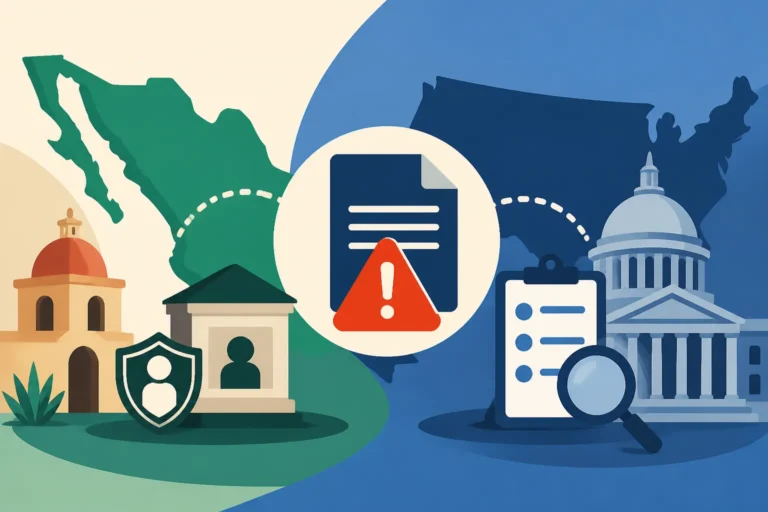
For US citizens, the Foreign Account Tax Compliance Act (FATCA) adds another layer of paperwork. You will be required to fill out a W-9 form declaring your US Social Security Number. The Mexican bank is legally obligated to report your end-of-year balances to the IRS. Refusing to provide your US tax information will result in an immediate denial of the account opening.
The Comprobante de Domicilio Challenge
The single most frustrating hurdle for every expat is the “comprobante de domicilio,” or proof of address. Mexican banks demand a recent utility bill, usually electricity (CFE) or water, issued within the last three months. The catch that causes endless headaches is that the name on the utility bill must perfectly match the name on your passport and residency card.
If you are renting an apartment, the utility bill will almost certainly be in your landlord’s name. When you present this bill to the bank executive, they will likely reject it, completely ignoring the fact that you hold a valid, legally binding lease. To understand this systemic issue, reading Understanding Mexican Rental Contracts: Key Terms and Tenant Rights will prepare you for the reality that landlords rarely transfer utilities into a tenant’s name.
There are a few workarounds, though their success depends entirely on the mood of the specific bank executive you speak to. The first is to bring your formal lease agreement alongside the landlord’s utility bill; some banks will accept this combination. Another option is to have the local internet provider install service in your name, giving you a valid, matching bill.
If you strike out repeatedly, you may have to visit multiple branches of the same bank until you find a manager willing to override the strict naming policy. It is a game of bureaucratic roulette that tests the patience of even the most seasoned expat. Mentally prepare yourself to be rejected at least once before succeeding.
Essential Documents and Biometrics
When you finally secure your appointment and your proof of address is sorted, you must bring a very specific stack of documents. You need your original passport from your home country; a driver’s license will not suffice. You also need your original Mexican residency card. Do not expect the bank to make copies; bring at least three crisp, clear photocopies of every single document yourself.
The bank will capture your biometric data during the opening process. This involves taking a digital photograph of your face and scanning all ten of your fingerprints. This biometric data is tied directly to your account and will occasionally be used to verify your identity if you need to perform high-level transactions or reset your online banking passwords in the future.
You will also need to bring cash for the initial deposit. Most standard checking accounts require a minimum opening balance, ranging from 1,000 to 4,000 pesos. It is wise to ask the executive explicitly about minimum monthly balance requirements to avoid stealthy account maintenance fees that can quietly drain your funds if your balance dips too low.
Finally, you must declare beneficiaries for the account. You need the full legal names, dates of birth, and exact residential addresses of the people you wish to inherit the funds if you pass away. Having this information written down and ready to hand to the executive dramatically speeds up the final stages of the agonizingly slow opening process.
Choosing the Right Mexican Bank
BBVA Mexico for Digital Nomads
BBVA is the undisputed giant of the Mexican banking sector, and it is arguably the best choice for expats solely because of its mobile application. The BBVA app is a masterpiece of digital banking, allowing you to pay almost every local utility bill, execute instant SPEI transfers, and manage your credit cards with incredible ease. Once the account is open, you rarely have to step foot in a branch again.
One of the best features of BBVA is the “retiro sin tarjeta” (cardless withdrawal) function. You can generate a temporary code on your app, walk up to any BBVA ATM, punch in the code, and receive your cash without ever inserting your physical debit card. This completely eliminates the risk of card skimming, providing massive peace of mind.
The major downside to BBVA is its popularity. Because everyone uses them, the lines at the physical branches are legendary. If you lose your phone or need to resolve an issue that requires a branch visit, you will easily lose half your day waiting in line. The convenience of the app comes at the cost of branch accessibility.
BBVA offers several tiers of accounts. The basic account is easy to open but comes with strict monthly deposit limits. If you plan to transfer large sums of money from abroad to buy a car or pay rent upfront, you must explicitly ask the executive to open an “unlimited” account tier, which often requires proving a higher source of income.
Intercam for Expat Specific Services
Intercam Banco has carved out a massive niche by specifically targeting the North American expat and retiree community. Unlike the massive national conglomerates, Intercam operates more like a boutique financial institution. Their branches are heavily concentrated in popular expat hubs like Puerto Vallarta, San Miguel de Allende, and Los Cabos.
The primary draw of Intercam is their bilingual staff. You are almost guaranteed to find an English-speaking executive who understands the unique frustrations foreigners face. They are famously much more lenient regarding the proof of address issue, frequently accepting foreign bank statements or leases when other major banks stubbornly refuse.
Intercam is heavily involved in the real estate market, offering specialized escrow services and handling the financial transfers required for foreigners purchasing property via a trust. If you are consulting Buying Property in Mexico: Comprehensive Guide for Foreign Buyers, Intercam will likely be the bank your real estate agent recommends for handling massive cross-border wire transfers securely.
Their digital app, however, is significantly less robust than BBVA’s, and their ATM network is tiny in comparison. Intercam is an excellent choice for holding larger sums of money and handling cross-border investments, but you may still want a secondary account at a larger bank for daily street-level convenience.
Santander and Global Connections
Santander is a massive global player, and their Mexican division is highly visible across the country. For expats coming from Europe or South America where Santander already operates, the brand familiarity is comforting. They offer a premium tier called “Santander Select,” which provides priority queuing at branches and dedicated account managers.
Their ATM network is extensive, and they frequently partner with convenience stores to allow for fee-free cash withdrawals at the register, adding a layer of safety and convenience. Their digital banking portal is functional and reliable, though slightly more prone to weekend maintenance outages than their primary competitors.
Customer service at Santander can be highly variable depending on the specific branch manager. Some expats report seamless experiences, while others highlight a rigid adherence to bureaucracy that rivals the government itself. If you qualify for the Select tier based on your initial deposit, the experience improves dramatically.
Santander is also known for offering competitive mortgage rates for foreigners holding permanent residency, though the qualification process is grueling. If your long-term plan involves financing a home rather than buying in cash, establishing a deep relationship with Santander early in your residency journey can pay dividends later.
| Bank Institution | Best Standout Feature | Biggest Drawback | Ideal Customer Profile |
| BBVA Mexico | Exceptional mobile app and secure cardless ATM withdrawals | Extremely long wait times at physical branches | Daily life, digital nomads, tech-savvy users |
| Intercam Banco | English-speaking staff and expat-focused financial services | Small ATM network and a very basic mobile app | Retirees, real estate buyers, large transfers |
| Santander | Extensive national ATM network and premium service tiers | Inconsistent branch customer service and rigid rules | General use, European and South American expats |
Managing Cross-Border Transfers and Exchange Rates
Avoiding Dynamic Currency Conversion at ATMs
The most common mistake new arrivals make happens directly at the ATM. When you insert a foreign debit card, the Mexican ATM will eventually flash a screen offering to “lock in” an exchange rate for you, typically showing the transaction amount in your home currency. This is known as Dynamic Currency Conversion (DCC), and it is a legalized scam.
The rate offered by DCC is always terribly inflated, often costing you five to ten percent more than the actual market rate. You must firmly press “Decline Conversion” or “Rechazar” every single time. By declining the ATM’s generous offer, you force the transaction to be processed by your home bank’s network, which gives you the true mid-market rate.
You will still pay the Mexican bank’s flat ATM usage fee, but you will save a fortune on the hidden markup. For a complete breakdown of how to stretch your home currency, referencing Currency Exchange in Mexico: Getting the Best Rates on Pesos is essential before making any major withdrawals.
Using currency exchange booths at the airport or in tourist centers is equally disadvantageous. These kiosks exist to profit from the massive spread between the buy and sell rates. While they are convenient for grabbing a fistful of pesos for a taxi upon arrival, they should never be used as a regular method for funding your life in Mexico.
Modern Remittance and Transfer Platforms
To move serious funds, like paying rent or funding your local bank account, you need a dedicated remittance service. Traditional Swift wires from your home bank to a Mexican bank take days, involve intermediary bank fees, and usually offer a subpar exchange rate. The modern expat entirely bypasses this outdated, expensive system.
Using a borderless platform like Wise is the standard operating procedure for transferring money. You link your home bank account to the platform, lock in the exact mid-market exchange rate, and send the funds directly to your Mexican CLABE (the 18-digit routing number). The fees are completely transparent, and the transfer often arrives in your Mexican account in seconds.
Because currency markets operate globally, the exchange rate fluctuates constantly. If you have a large transfer to make, watching the market for a few days can save you hundreds of dollars. For an in-depth look at moving large sums, Transferring Money Internationally: Best Ways to Send Money to/from Mexico offers excellent strategies for timing the market effectively.
Furthermore, avoid initiating major transfers over the weekend when markets are closed. Platforms like Wise often bake in a wider spread on Saturdays and Sundays to protect against Monday morning volatility. Execute your transfers between Tuesday and Thursday for the most stable and accurate rates.
Geoblocking and Accessing Home Accounts
One of the most terrifying experiences is trying to log into your home country’s banking portal to pay a bill, only to receive a message stating “Access Denied.” Many North American and European banks automatically block login attempts originating from Mexican IP addresses as a blanket security measure against cybercrime.
To bypass this geoblocking, you must use a Virtual Private Network. By activating a high-quality service like NordVPN before you open your banking app, you route your internet connection through a server in your home country. To your bank’s security system, it appears as though you are logging in securely from your hometown, avoiding instant account locks.
Never rely on free VPNs for financial transactions. They are often unstable, easily detected by bank security firewalls, and can compromise your data. Investing in a premium, encrypted service like NordVPN is a non-negotiable expense for an expat who needs to manage money seamlessly across borders.
Communication with your home bank is critical before you move. You must place comprehensive travel notices on all your cards. Even with these notices, aggressive fraud algorithms will frequently freeze your cards when you try to make a large purchase in Mexico. Keeping a VoIP or Skype number to immediately dial your home bank’s fraud department is mandatory.
Credit Cards and Building a Local Financial Identity
Getting Your First Mexican Credit Card
Accessing credit in Mexico is a highly localized game. Your phenomenal credit score back home means absolutely nothing to a Mexican bank manager, forcing you to start your financial reputation entirely from scratch. When you first arrive, you are essentially a financial ghost in the eyes of the credit bureaus.
Even if you deposit a large sum of money into a local checking account, the bank will likely reject your application for a basic unsecured credit card. Banks are notoriously risk-averse when lending to foreigners who could theoretically flee the country to avoid debt. Building local credit is necessary if you ever plan to finance a vehicle or sign a post-paid cellular plan.
The most common entry point is securing a guaranteed credit card. You deposit a sum of money into a locked account, and the bank issues you a credit card with an equivalent limit. To understand this timeline and strategy, consult Building Credit in Mexico: How Foreigners Can Establish Credit History.
Patience is key. After six to twelve months of paying off your secured card in full every month, the bank’s internal algorithm will eventually trigger an offer for an unsecured card. Do not constantly apply for different cards in your first year, as multiple hard inquiries on your fresh Mexican credit file will flag you as a high-risk borrower.
Understanding Local Interest Rates and MSI
Be hyper-aware of local interest rates. The Annual Percentage Rate (APR) on standard Mexican credit cards frequently exceeds fifty or sixty percent. They are absolutely not designed for carrying a balance; they are designed purely for convenience and rewards. If you carry debt on a Mexican credit card, the compounding interest will destroy your monthly budget instantly.
Mexico utilizes a highly popular promotional system called “Meses Sin Intereses” (MSI), or months without interest. When buying appliances, electronics, or furniture at major retailers, you will frequently be offered the chance to split the payment into 6, 12, or 24 equal monthly installments with zero interest applied, provided you pay exactly on time.
This MSI system is a fantastic way to furnish a home without draining your liquidity. However, it requires extreme discipline. If you miss a single payment or pay less than the required installment amount, the entire remaining balance is instantly subjected to the card’s exorbitant standard interest rate.
When your credit card statement arrives, you will see two numbers: the minimum payment, and the “pago para no generar intereses” (payment to not generate interest). You must always, without exception, pay the second number. Paying only the minimum will trigger those astronomical interest rates on the remaining balance.
Utilizing Home Country Travel Cards Effectively
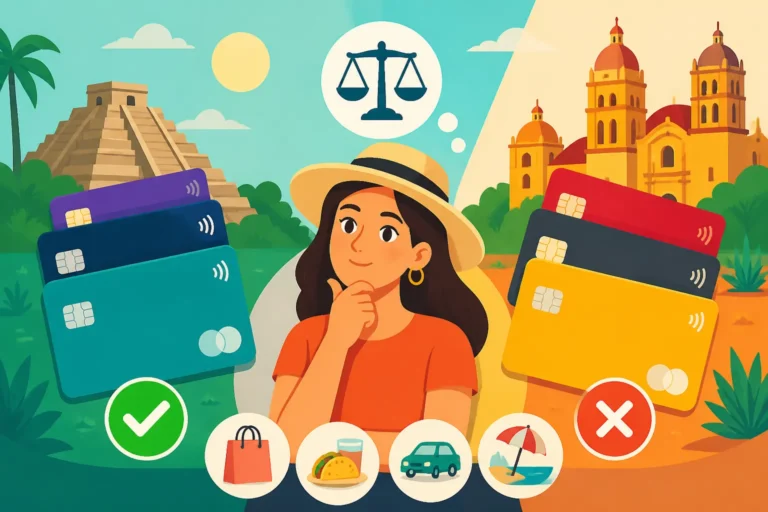
For daily expenses, travel, and online purchases, relying on your premium home country credit cards is usually the smartest financial move. You must ensure you are using a card with absolutely zero foreign transaction fees. If your card charges a standard three percent fee, you are heavily penalizing yourself every time you buy groceries.
Premium travel cards offer immense value to expats. Beyond waiving foreign transaction fees, they provide essential consumer protections, rental car insurance, and travel delay coverage that local Mexican cards rarely match. Building a strategy around these cards is the best way to maximize your purchasing power abroad.
In emergency situations, such as needing to pay a massive hospital admission deposit as outlined in Medical Emergencies in Mexico: What Expats Should Know and Prepare, a high-limit foreign credit card is a literal lifesaver. Mexican private hospitals will not admit you without securing funds upfront.
The logistical hurdle is paying the monthly bill. Because the credit card is denominated in your home currency, you cannot easily pay it using locally earned pesos. You must constantly transfer money back to your home checking account to satisfy the billing cycle, reinforcing the need for a cheap, reliable transfer system like Wise to handle the bi-directional flow of your wealth.
Preserving Wealth and Structuring Investments
Navigating High-Yield Savings and Inflation
Mexican banks and government bonds often advertise staggeringly high interest rates compared to North American or European banks. It is not uncommon to see promotional savings accounts or government CETES offering annual yields approaching ten percent. For a new expat, it is incredibly tempting to move your entire nest egg into pesos to capture this yield.
However, this strategy carries massive risks. First, the high yield is essentially a premium paid to offset the historical inflation of the peso. If you earn ten percent interest, but the peso devalues by eight percent against your home currency, your real global return is negligible. You are taking on currency risk for a minimal real reward.
Second, as a tax resident of your home country, you must report this foreign interest income, leading to complex tax filings. Understanding these cross-border tax traps is detailed heavily in Taxes in Mexico for Expats: A Complete Guide to Income Tax and More. The reporting requirements alone often outweigh the benefits of local interest.
Most veteran expats only hold enough pesos in local high-yield savings accounts to cover three to six months of living expenses. This acts as an emergency fund to insulate against sudden currency dips, but keeps the bulk of their long-term wealth protected in more stable international currencies and broad global markets.
Maintaining Offshore Brokerage Access
If you plan to continue investing in index funds, stocks, or ETFs, doing so through a Mexican brokerage is generally inefficient for foreigners due to high fees, limited access to global markets, and brutal local tax reporting requirements. You want to keep your investment portfolio offshore or in your home country.
However, many major brokerages in the US and Canada will immediately restrict or close your account if they discover you are permanently residing in Mexico, citing compliance issues with international securities laws. To prevent having your assets frozen, many expats migrate their portfolios to brokerages that explicitly cater to international residents.
Using a globally minded platform like Interactive Brokers allows you to maintain global market access without the risk of abrupt account closure due to your foreign address. They are fully accustomed to handling clients who live as expatriates or digital nomads, providing a secure harbor for your long-term wealth.
When managing these accounts, you must be meticulously aware of the tax implications. If you become a tax resident of Mexico, the tax authority will expect a cut of your capital gains. Utilizing comprehensive platforms like Interactive Brokers helps keep your trading history organized for when your accountant needs to reconcile your global income.
Real Estate Trusts and Property Taxes
Investing in Mexican real estate is a popular path for expats, either to avoid paying rent or to generate vacation rental income. However, foreigners face structural restrictions. The Mexican Constitution prohibits foreigners from directly owning residential land within fifty kilometers of the coast or one hundred kilometers of an international border.
To buy in these restricted zones, which cover almost every popular expat destination, you must establish a bank trust called a fideicomiso. The Mexican bank holds the legal title, but you are the primary beneficiary with the absolute right to use, rent, modify, or sell the property.
Establishing and maintaining a fideicomiso involves hefty setup fees and annual maintenance charges paid directly to the bank. These holding costs must be factored into your long-term investment budget. If the bank managing your trust is ever acquired or merges, the administrative paperwork to update your trust can be agonizingly slow.
If you plan to generate rental income from your Mexican property, you must pay taxes on that income in Mexico, regardless of whether the funds are deposited into a local account or a foreign one. The tax authority has strict withholding rules for rental properties, and failing to comply can lead to massive fines.
References
Primary sources (official)
- Banco de México (Banxico) – The central bank of Mexico: https://www.banxico.org.mx/
Other helpful sources
- Expat Insurance Guide to Fideicomisos – Detailed breakdown of bank trusts for property: https://www.expatinsurance.com/articles/what-is-a-fideicomiso
- Wise Guide to Opening a Bank Account in Mexico – A practical guide for foreigners navigating the banking system: https://wise.com/us/blog/opening-a-bank-account-in-mexico
Disclaimer
The information provided in this guide is for general informational purposes only and does not constitute professional financial, tax, or investment advice. Currency exchange rates, banking fees, and Mexican financial regulations are subject to constant change and vary widely between individual institutions. Always consult with a certified cross-border financial planner and a local Mexican accountant to evaluate your specific financial situation before moving capital or opening foreign accounts.