The Ultimate Guide to Mexico’s Visa and Residency Options (2027 Edition)
You have decided Mexico is the place, but the moment you open the immigration pages you are buried in terms like FMM, residente temporal, canje and solvencia económica, and every forum post seems to contradict the last one. This guide untangles Mexico’s main visa and residency options, explains how the economic solvency proof really works, and walks you through the application from consulate to residency card.
Disclosure: This post may contain affiliate links. We may earn a commission at no extra cost to you if you make a purchase through these links. Read full disclosure.
The Big Picture: Mexico’s Main Immigration Categories
When I started planning my own move, I made the classic mistake of researching “the Mexican visa” as if there were only one. There are several, and the right one depends on how long you want to stay, whether you plan to work for a Mexican employer, and how you can prove you can support yourself. Once you see the categories side by side, the whole system becomes much easier to navigate.
Visitor Status: The Starting Point for Most People
Most people first come to Mexico as visitors. Citizens of many countries, including the US, Canada and the UK, do not need a visa in advance for a tourist trip; they are admitted at the border or airport and their stay is recorded. Citizens of other countries need a visitor visa from a Mexican consulate before travelling. Our guide Visa-Exempt vs Visa-Required: Understanding Mexico’s Entry Policies explains which group you are in.
Visitor status is designed for tourism, short business trips and similar activities. It is not a residency permit, and the number of days you are granted is decided by the immigration officer on arrival, not by what you hope to get. If you are planning a long-term life in Mexico, visitor status is where you scout, not where you settle.
Temporary Residency: The Most Common Path for Expats
Temporary residency (residente temporal) is the category most expats, remote workers and early retirees end up in. It allows you to live in Mexico for longer than a visit, with a residency card that you renew until you either leave or move up to permanent residency.
There are several ways to qualify. The most common for people moving on their own resources is economic solvency, which I explain in detail below. Others include family unity, if you are the spouse, partner or close relative of a Mexican citizen or resident, and a job offer from a Mexican employer. For the full rules, see Mexico Temporary Resident Visa: Comprehensive Guide for Expats (2026 Update).
Permanent Residency: The Long-Term Goal
Permanent residency (residente permanente) is the category for people who intend to stay in Mexico indefinitely. You can reach it in a few ways: by moving up after a period as a temporary resident, through certain family ties, or, for retirees and pensioners, by meeting a higher economic solvency threshold directly at a consulate. Permanent residents do not renew their card, which is a major relief after years of renewal appointments. Mexico Permanent Residency Explained: A Complete Guide (2027) covers this category in depth.
Student and Work Categories
If you are coming to study at a Mexican institution, there is a student category tied to your enrolment. If a Mexican employer is hiring you, the process usually starts with the employer requesting authorisation from the immigration authority, the Instituto Nacional de Migración (INM), before you visit the consulate. These categories are more tightly linked to a specific institution or employer than the solvency route.
Which Path Fits You: Three Typical Scenarios
Abstract categories only go so far, so here are three people I have met over the years, with details changed.
Jenna is a remote marketing manager employed by a company in Chicago. She wants to live in Mexico City for the foreseeable future and has a steady salary. For her, temporary residency by economic solvency, using the monthly income option, is the natural fit.
Robert and Ann are recently retired Canadians with a pension and solid savings. They want to settle in Ajijic for good and never deal with renewals again. They look first at whether they can qualify for permanent residency directly as pensioners; if not, they start as temporary residents and move up later.
Luis grew up in Arizona and is married to a Mexican citizen. For him, family unity is likely to be simpler than proving solvency, because the relationship itself is the basis of the application.
None of them needed the same visa, and that is the point: start from your situation, not from the visa someone else got.
| Category | Typical reason | Main basis | Card renewal |
|---|---|---|---|
| Visitor | Tourism, short business trips | Entry at the border, or a visitor visa where required | Not a residency card |
| Temporary resident | Living in Mexico for a longer period | Economic solvency, family unity, or a job offer | Renewed while you hold it |
| Permanent resident | Staying indefinitely | Moving up from temporary, family ties, or retiree solvency | No renewal of the card |
| Student | Studying at a Mexican institution | Enrolment letter from the institution | Tied to your studies |
Economic Solvency: How Mexican Consulates Check Your Finances
This is the section most applicants worry about, and it is also where misinformation spreads fastest. For a temporary resident visa by economic solvency, the consulate wants evidence that you can support yourself without working for a Mexican employer. There are two ways to show this, and each has its own look-back period.
Option One: Monthly Income for the Last 6 Months
The first way is to prove monthly income above the consulate’s threshold during each of the last 6 months. In practice, that means bank statements showing the income arriving month after month, plus proof of where it comes from, such as an employment letter or pension documents.
This option suits remote employees, pensioners and anyone with a steady monthly deposit. The consulate is looking for consistency: income above the threshold in each of those 6 months, not an average that dips in one month and spikes in another.
Option Two: Savings or Investments Over the Last 12 Months
The second way is to show investments or bank accounts with an average monthly balance above the threshold during each of the last 12 months. Here the consulate is looking at your savings, not your income, so the evidence is usually 12 monthly statements from the relevant accounts.
People are often confused by the different periods, and some guides even mix them up. They are different on purpose: 6 months for income, 12 months for savings. If you are preparing your paperwork, make sure you collect the right number of statements for the option you choose.
| Proof option | What you show | Look-back period | Typical documents |
|---|---|---|---|
| Monthly income | Income above the threshold in each month | Last 6 months | Bank statements plus proof of employment or pension |
| Savings or investments | Average monthly balance above the threshold | Last 12 months | Bank or investment account statements |
Why I Will Not Quote You a Number
You will notice there is no figure in this guide. That is deliberate. The thresholds are set per consulate and currency and are updated every year, so a number copied from a forum or an old article is very likely to be wrong for your consulate today. Before you gather a single bank statement, go to the website of the specific Mexican consulate where you will apply and look for its current solvency figures. If the website is unclear, email or call the consulate and ask.
I have seen people prepare months of paperwork against a number they found online, only to discover at the appointment that their consulate used a different figure. Checking first takes ten minutes and saves weeks.
Preparing Your Bank Statements
The quality of your statements matters almost as much as the balance on them. Consular officers review a lot of paperwork, and anything that makes their job harder slows you down. A few habits help:
- Use official statements from your bank, not screenshots from an app. Many consulates expect the bank’s own document with your name and account details visible.
- Make sure every month in the required period is there, with no gaps: all of the last 6 months for income, or all of the last 12 months for savings.
- Highlight or tab the relevant deposits or balances so the officer can find them quickly.
- Bring the supporting evidence that explains the income, such as an employment letter or pension statement, for the income option.
- Keep a second copy of everything, because some consulates keep the originals or ask for extra copies on the day.
If your money is spread over several accounts, ask the consulate in advance how they want that presented. Some applicants bring a short cover sheet listing each account and the months covered, which makes the file easier to follow.
Choosing Between Income and Savings
- If you have a stable salary or pension that clearly clears the threshold every month, the income option is often simpler, because 6 months of statements are easier to assemble.
- If your income is irregular, for example freelance payments that arrive in bursts, the savings option can be more reliable, as long as your balance stayed above the threshold on average in each of the last 12 months.
- If neither fits cleanly, ask the consulate whether combining accounts is acceptable, rather than assuming.
Freelancers often get caught here. A month with a late client payment can make the income option fail even if the yearly total is high. In that case, the savings route may be the safer choice.
The Application Process From Consulate to Residency Card
Applying for Mexican residency is a two-stage process. The first stage happens outside Mexico, at a consulate. The second happens inside Mexico, at an INM office. Understanding that split explains most of the confusion people run into.
Step-by-Step: Applying for Temporary Residency
- Choose your consulate. You normally apply at a Mexican consulate in the country where you live, and some people pick a consulate with better appointment availability.
- Check that consulate’s current requirements and solvency figures on its own website.
- Book an appointment, which at busy consulates can take time to secure.
- Gather your documents: passport, photos, application form, and your financial evidence for the 6-month income option or the 12-month savings option.
- Attend the interview, where the officer reviews your documents and may ask about your plans.
- If approved, a visa is placed in your passport. This visa is for entering Mexico to complete the process, not the residency itself.
- Travel to Mexico and enter with that visa, making sure the officer records your entry correctly.
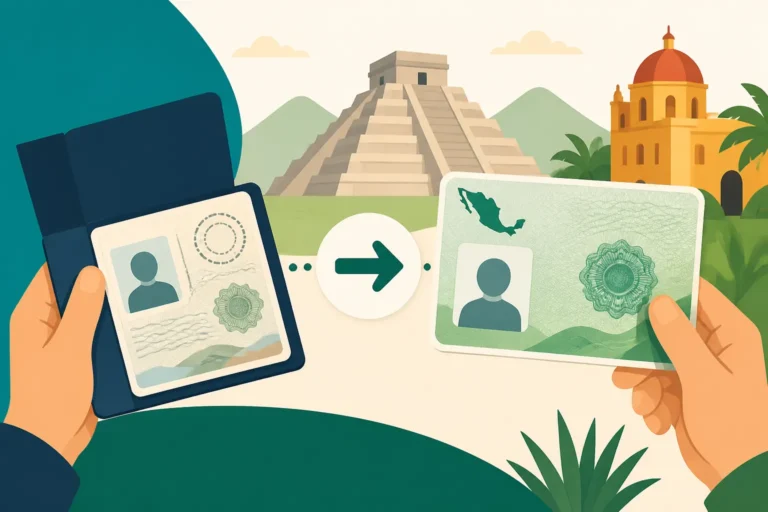
- Visit the INM office near your new home within the period stated with your visa to exchange it for your residency card. This is the canje.
For a deeper walk-through, see How to Apply for a Mexico Temporary Resident Visa: Step-by-Step Process.
Getting Your Documents Translated
At some point in the process, you are likely to need a Spanish translation of a document, especially for procedures inside Mexico, such as birth or marriage certificates for family applications. Requirements differ between consulates and INM offices, so always ask exactly what kind of translation they accept before you pay for one. Services such as RushTranslate can handle certified translations quickly, which is helpful when an appointment is approaching, but confirm first that the office will accept the format you order.
Health Coverage While You Settle In
Health insurance is not the headline requirement for most residency categories, but arriving without any cover is a risk I would never take. In the gap between landing and setting up longer-term cover, many newcomers use a travel medical policy such as SafetyWing. It is built for unexpected illness and accidents, so check its terms carefully and read the provider’s own pages for what is included.
Once you have your residency card, you can look at longer-term options, from Mexican private insurers to international health plans such as Cigna Global, which some expats prefer if they travel often or want cover in more than one country. Compare the policy terms carefully, because exclusions and waiting periods vary.
After You Get Your Card
Your residency card is the beginning of your life as a resident, not the end of the paperwork. A few things are worth knowing:
- If you have temporary residency, you will need to renew it before it expires. Our guide Renewing Your Temporary Resident Visa: Timeline and Procedures explains how.
- Changes such as a new address, a new job or a new marital status may need to be reported to INM.
- Temporary residency based on solvency does not automatically give you permission to work for a Mexican employer. See Can You Work on a Temporary Resident Visa in Mexico? Rules Explained.
- After some time as a temporary resident, you can apply to move up to permanent residency. Upgrading from Temporary to Permanent Residency in Mexico: What You Need to Know covers when and how.
Bringing Your Family
If your partner or children are moving with you, they may be able to apply as your dependants, or under family unity once you have your own residency. The requirements, including how relationships are proven, are covered in Residency in Mexico for Families: Visas for Spouses and Children. Plan their applications together with yours, because a mismatch in timing can mean extra trips to the consulate.
Mistakes That Delay Applications
| Mistake | How to avoid it |
|---|---|
| Using a solvency figure from an old article or forum | Check the current figure on your own consulate’s website |
| Bringing 12 months of statements for the income option, or 6 for savings | Income needs the last 6 months; savings need the last 12 |
| Assuming the consulate visa is the residency itself | Complete the canje at INM after arriving in Mexico |
| Entering Mexico with the wrong entry recorded | Show your visa and confirm your entry with the officer |
| Ordering translations before checking what is accepted | Ask the office what translation format it requires |
For more pitfalls, read Common Mistakes to Avoid When Applying for Mexican Residency Visas, and if the vocabulary is still overwhelming, Mexico Immigration Terminology 101: FMM, CURP, RFC, and Other Essentials is a handy glossary.
Disclaimer
This article is for general informational purposes only and does not constitute professional advice. Laws, prices and regulations vary by location and change over time. Consult a qualified professional for guidance on your specific situation.