The Canje Process: Exchanging Your Visa for a Resident Card
Standing in the immigration line at the airport with your brand-new visa sticker is an absolute nerve-wracking experience because you know the clock is officially ticking. I remember my first time landing in Mexico City; I was so terrified of the officer forgetting to check the "Canje" box on my form that I practically hovered over his shoulder. This guide solves the confusion surrounding the Canje process, ensuring you transition from a visa holder to a legal resident without the typical bureaucratic headaches.
Disclosure: This post may contain affiliate links. We may earn a commission at no extra cost to you if you make a purchase through these links. Read full disclosure.
Understanding the Canje Timeline and Why It Matters
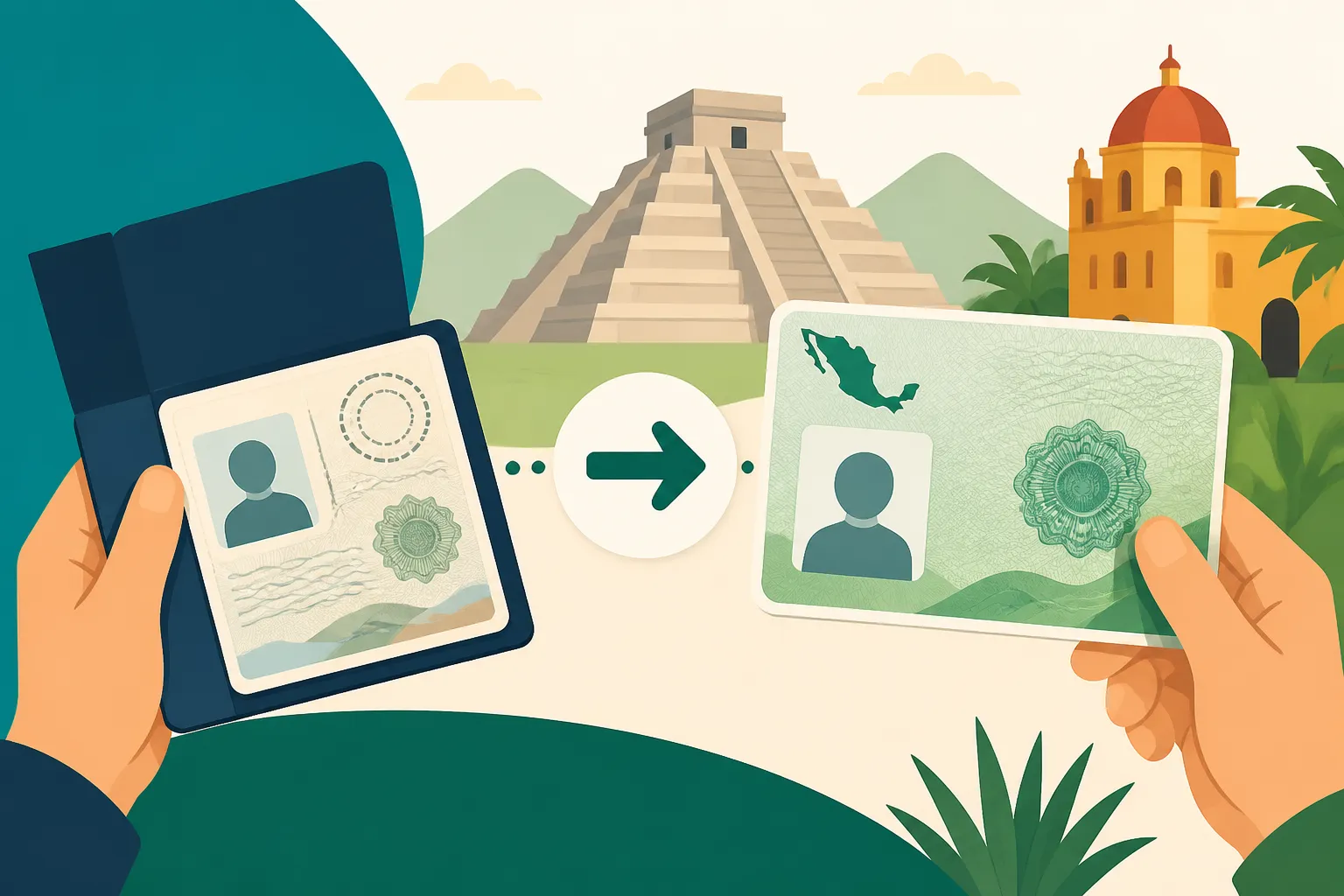
The word "Canje" literally means "exchange," and in the world of Mexican immigration, it refers to the mandatory process of swapping the visa sticker you received at a consulate for your actual plastic resident card. Many expats mistakenly believe that the sticker in their passport is their residency. It is not. It is merely an "entry permit" that allows you to enter the country one time to start your final processing. If you fail to complete this exchange within the legal timeframe, you risk your entire application being cancelled, forcing you to leave the country and start the expensive process all over again from scratch at a consulate abroad.
The 30-Day Rule: Don't Let Your Visa Expire
Once you cross the Mexican border and the immigration officer stamps your passport, you have exactly 30 calendar days to present yourself at an Instituto Nacional de Migración (INM) office to begin the Canje. This is not 30 business days; it includes weekends and holidays. I have seen countless expats lose their residency because they spent their first three weeks in Mexico "settling in" or house hunting, only to find that the local INM office had no appointments available for the next month. You must prioritize this above everything else.
The clock starts the moment you clear customs. In the past, this was tracked via a paper FMM form, but in 2026, most major airports have transitioned to a digital system. This means your entry is logged electronically, and the officer will usually write "Canje" and "30 days" on your entry stamp. It is your responsibility to ensure they do this. If they accidentally mark you as a 180-day tourist, you cannot proceed with your residency exchange until that error is corrected, which is a bureaucratic nightmare involving a "reclamation" process that can take weeks.
Entry Requirements and the Digital FMM
The process for entering Mexico has become significantly more streamlined but also more tech-reliant. When you land at an airport like Cancun or Mexico City, you will likely pass through an automated gate or a quick-scan counter. However, for those on a residency track, it is often safer to go to a manned booth. You must explicitly state to the officer: "Vengo para canje de mi visa de residencia." This ensures they enter the correct code into the system. If you are entering via a land border, the process remains more manual, and you must ensure you get the physical stamp and the correct notation.
Once you have entered, you will need to download your digital entry record from the INM portal. This digital document replaces the old green-and-white paper form and is a critical piece of the puzzle. You cannot apply for your card without it. If the portal is down—which happens more often than any of us would like—you might find yourself refreshing a browser for days. This is another reason why waiting until the last minute of your 30-day window is a recipe for a panic attack. For a deeper look at the initial steps, check out Mexico Temporary Resident Visa: Comprehensive Guide for Expats (2026 Update).
Required Documentation for the Canje Appointment
The INM is notoriously picky about paperwork. If a single staple is in the wrong place or a copy is slightly blurry, they may reject your entire folder. You aren't just bringing documents; you are curating a dossier that must meet their exact, albeit sometimes arbitrary, standards. Every office in Mexico has its own "flavor" of requirements, so while there is a national standard, your local office in Mérida might want something slightly different than the office in Puerto Vallarta.
The Format of Your Application Forms
The primary document you need is the Solicitud de Trámite, which is generated online through the INM’s official website. This form asks for your personal details, your entry date, and the specific type of residency you are exchanging. You must also provide the Formato Básico, a separate sheet where you'll list details like your height, weight, hair color, and educational background. I always recommend filling these out on a computer rather than by hand to avoid any issues with legibility.
In addition to these forms, you need your original passport and a high-quality color copy of every single page—not just the photo page. Yes, they want to see every blank page and every stamp from your trip to Thailand five years ago. You also need the original visa sticker and a copy of the entry stamp you received at the airport. If you are following a specific path, such as Temporary vs Permanent Residency in Mexico: Key Differences and Benefits, ensure your Solicitud reflects the correct category.
Translation Requirements and Certified Documents
If you are applying for residency based on family ties—for example, if you are the spouse of a resident or the parent of a Mexican citizen—you will likely need to provide marriage or birth certificates. Any document that is not in Spanish must be translated by a certified translator. This is where many people get tripped up. The INM will not accept a translation you did yourself using a popular search engine's translation tool.
For fast and reliable results that meet official standards, many expats use services like RushTranslate to handle their birth and marriage certificates. Because RushTranslate provides certified translations that are widely accepted, it saves you the hassle of hunting down a local "perito traductor" in a city you've just moved to. I’ve personally used RushTranslate for my own secondary documents when I was in a rush to meet that 30-day deadline, and the peace of mind of having a professional, certified document was worth every penny. You can find more details on document prep in our guide on How to Apostille Documents for Mexico.
| Document Category | Original Needed? | Copies Required | Special Notes |
|---|---|---|---|
| Passport | Yes | Full scan of all pages | Must be valid for at least 6 months |
| Visa Sticker | Yes | 1 Color Copy | Should be inside your passport |
| Entry Stamp/FMM | Yes (Digital/Physical) | 2 Copies | Ensure the "Canje" box is checked |
| Solicitud de Trámite | Yes | 1 Original | Generated from the INM portal |
| Formato Básico | Yes | 1 Original | Filled out in Spanish |
| Proof of Fee Payment | Yes | 2 Copies | Paid at a local bank (e5cinco) |
| Photos | Yes | 3 Infantil size | Specific rules for jewelry/hair |
Navigating the INM Office: What to Expect on Process Day
The day of your appointment (or walk-in) is usually the most stressful part of the entire move. In 2026, many INM offices have moved to an appointment-only system, but some smaller offices still operate on a "first-come, first-served" basis. This often means waking up at 4:00 AM to stand in a line outside a nondescript building, hoping you are one of the lucky 20 people they see that day. For a realistic look at the experience, see Surviving the INM Office: Tips for a Smooth Visa Processing Day.
The Morning Queue and "La Fila"
If your local office uses a queue system, "la fila" is where the real bonding with fellow expats happens. You’ll see people with folding chairs, thermoses of coffee, and stacks of folders. When the doors open at 9:00 AM, an officer will usually come out and do a "pre-check" of your documents. This is the moment of truth. If you are missing a copy or a translation from a service like RushTranslate, they will send you away right then and there.
Once you pass the pre-check, you will be given a number and told to wait in the seating area. This wait can last anywhere from one hour to six. I once spent seven hours in the Mexico City office because their computer system crashed at noon. It is essential to bring a book, a portable phone charger, and plenty of patience. Do not plan any other appointments or meetings for your Canje day. You are at the mercy of the "sistema."
Biometrics: Fingerprints and Photos
When your number is finally called, you will go to a desk where an agent will review your originals and enter your data into the national database. After the data entry, you’ll be moved to the biometrics station. Here, they will take digital scans of all ten of your fingerprints. My tip? If you have dry skin, use a little moisturizer the night before; otherwise, the scanner might have trouble reading your prints, which can cause delays and multiple retakes.
Then comes the photo. This is the photo that will be on your resident card for the next one to four years, so you might want to look your best—but there are strict rules. You cannot wear jewelry, your forehead must be completely visible (push those bangs back!), and you generally cannot wear glasses. The agent will tell you "no sonría" (don't smile), so prepare your best neutral, "I've been waiting in a lobby for five hours" face. This photo is a badge of honor for every expat.
Common Pitfalls and How to Avoid Deferrals
A "deferral" or "requerimiento" is the INM’s way of saying "try again later." It puts your application on hold and requires you to return with new or corrected information. While it’s not the end of the world, it is a significant drain on your time and energy. Understanding why these happen is the best way to prevent them. You can read more about the general system in Navigating Mexico's Immigration System: Visas, INM Procedures, and Regulations.
Name Discrepancies and Passport Errors
The most common reason for a deferral is a name mismatch. If your passport says "Robert James Smith" but you wrote "Bob Smith" on your application form, they will reject it. Every document you present must match your passport exactly. This includes any middle names or suffixes. If your birth certificate has a maiden name but your passport has a married name, this is where a certified translation from RushTranslate becomes vital, as it can help bridge the gap between documents when presented alongside a marriage license.
Another issue is the validity of your passport. If your passport is set to expire in three months, many INM offices will refuse to issue a residency card because the card's validity is often tied to the passport. Generally, you want at least six months of validity, but a year is much safer. If you need to renew your passport, do it before you start the visa process at the consulate, not during the Canje phase.
Payment Issues: Using the Right Bank Form
The Canje process is not free, and you cannot pay at the INM office. You must pay at a bank (BBVA, Santander, Banamex, etc.) before your appointment. The payment is made using a specific form called the e5cinco. You must ensure the "Clave de Referencia" and the "Cadena de la Dependencia" codes are exactly correct for the current year.
In 2026, the fees are updated annually based on the UMA (Unit of Measure and Accumulation). If you pay the 2025 rate in January 2026, your payment will be invalid, and you’ll have to pay the difference and go through a complicated refund process for the original amount. Always double-check the current fee schedule on the INM website or with a local facilitator. For more on financial requirements, check out Mexico Residency 2026: New Rules and Financial Criteria Updates.
Comparing DIY Canje vs. Hiring an Immigration Facilitator
Many expats wonder if they should handle the Canje themselves or pay a professional. There is no right answer, as it depends on your Spanish level, your patience, and your budget. However, the experience varies wildly depending on where you are in Mexico.
The Cost-Benefit Analysis of Professional Help
A facilitator (often called a "gestor") usually charges between $150 and $400 USD to handle your Canje. They don't have a "secret back door" into the INM, but they do know the agents, they know the specific preferences of that office, and they can often book appointments more efficiently than an individual. If your Spanish is minimal, a facilitator is worth their weight in gold because they will handle the communication with the agent.
On the other hand, doing it yourself is a great "welcome to Mexico" ritual. It forces you to navigate the system and gives you a sense of accomplishment. If you have all your documents in order—including your professional translations from RushTranslate—and a decent grasp of Spanish, there is no reason you can’t do it yourself. It’s an exercise in patience, but it’s entirely doable. If you are still at the consulate stage, see Mexican Consulate Appointments: Tips to Succeed in Your Visa Interview.
Regional Differences in INM Efficiency
The "Canje experience" in Mexico City is a world away from the experience in a small town like San Miguel de Allende. In the CDMX office (located in Polanco), you are dealing with a massive volume of applicants. It is fast-paced, sometimes brusque, and highly efficient. In smaller offices, the pace is slower, but the staff may be more flexible or, conversely, more confused by unusual cases.
| City/Office | Appointment Speed | Wait Time at Office | Atmosphere |
|---|---|---|---|
| Mexico City (CDMX) | High (Online system) | 4-8 Hours | Professional / Busy |
| Mérida | Medium | 3-5 Hours | Friendly / Strict |
| Playa del Carmen | Low (Hard to get) | 2-4 Hours | High-Pressure / Crowded |
| Puerto Vallarta | Medium | 2-5 Hours | Expat-focused |
| Chapala / Ajijic | High | 1-3 Hours | Very Expat-friendly |
Post-Canje: Your Life with the New Resident Card
The moment the agent hands you that plastic card is one of the most satisfying moments of expat life. You are no longer a visitor; you are a resident. However, the card is just the beginning. There are several "administrative chores" you need to complete immediately to make your life in Mexico functional.
Obtaining Your CURP and RFC
The CURP (Clave Única de Registro de Población) is your unique population registry number. It is the key to almost everything in Mexico, from getting a local SIM card to signing a lease or opening a bank account. Once your residency is approved, your CURP is generated. You should go to the official government website and print out several copies of your "Constancia de CURP." This document is often as important as the card itself. For a full breakdown, see How to Get a CURP in Mexico.
Next is the RFC (Registro Federal de Contribuyentes). This is your tax ID. Even if you don't plan on working in Mexico, you need an RFC to buy a car, sell property, or even get a high-speed internet contract in some regions. Getting an RFC involves making an appointment with the SAT (Mexico’s IRS), which can be even more difficult than getting an INM appointment. Start this process as soon as you have your resident card in hand. Learn more at How to Get an RFC in Mexico.
Travel Restrictions While Your Card Is Being Printed
In some offices, you get your card the same day. In others, you might have to wait two to four weeks for it to be printed. If you need to leave Mexico while your Canje is "in process" but before you have the card, you must obtain a Permiso de Salida y Regreso. If you leave the country without this permit while your residency is being processed, your application will be abandoned automatically, and you will not be allowed back in as a resident.
The permit costs an additional fee and is valid for 60 days. I always tell people: do not plan any international travel during your first month in Mexico. Give yourself the buffer to get the card in your hand. Once you have the physical card, you can enter and exit Mexico as many times as you like, provided the card remains valid. It’s the ultimate freedom for a global citizen.
Disclaimer
The information provided in this guide is for educational and informational purposes only and does not constitute legal or professional immigration advice. Immigration laws and procedures in Mexico are subject to frequent change, and requirements may vary significantly by regional INM offices. Always consult with the official Instituto Nacional de Migración website or a certified immigration professional before beginning your application.