Surviving the INM Office: Tips for a Smooth Visa Processing Day
You have spent weeks gathering apostilles, bank statements and passport photos. Then you arrive at your local Instituto Nacional de Migración office and find a security guard, a line out the door, and a clerk who sends you away because one photocopy is missing. This guide shows you how to prepare for INM day, get through it, and leave with your paperwork moving forward.
Disclosure: This post may contain affiliate links. We may earn a commission at no extra cost to you if you make a purchase through these links. Read full disclosure.
Why INM Days Feel So Hard and How to Reframe Them
I still remember my first canje appointment. I had a folder I was proud of, colour-coded tabs included. I sat in a plastic chair for almost three hours, listened to numbers called in rapid Spanish, and reached the window only to learn that my photos had the wrong background. I went home with nothing. If something like that has happened to you, it was not your fault, and it happens to a lot of people.
The System Runs on Local Discretion
The first thing to understand is that INM offices are not identical. The office in Mérida may handle a request one way, and the office in Puerto Vallarta may handle the same request another way. National rules exist, but each office has its own habits. One office takes appointments only. Another runs walk-in hours on certain mornings. One clerk accepts a bank statement printed from your app. The next one wants it stamped by the branch.
This is the main reason expat forums are full of contradictory advice. Everyone is reporting accurately what happened at their own office. So the most useful thing you can do before your visit is learn how your specific office works. Ask in local expat Facebook groups and look at what recent applicants say. For broader strategies on government offices in general, see Dealing with Bureaucracy in Mexico: Tips for Handling Paperwork and Appointments.
Think of It as a Multi-Visit Process
Most residency paperwork processed inside Mexico, such as the canje, renewals and changes of condition, involves more than one trip. A common sequence is a document submission, then a waiting period, then a visit for fingerprints and photos, and finally a card pickup. Expect several visits from the start. That way, a “come back later” sounds like normal progress and not like a failure.
The People Behind the Window
INM staff work under heavy caseloads, often with old computers and strict internal checklists. A clerk who rejects your documents usually isn’t being difficult on purpose. They may face consequences if they approve a file that a supervisor later flags. Patience, a greeting in Spanish, and a well-organized folder do more for you than any argument. A simple “Buenos días, vengo a entregar documentos para mi canje” starts things off well.
Preparing the Night Before
Most problems at the window come from things you could have fixed at home. The evening before your appointment is the best time to catch them.
Confirm Your Appointment and Your Trámite Type
Check your confirmation and make sure you know exactly which procedure, or trámite, you are filing. A canje, a renewal and a change from temporary to permanent residency each have different requirements. If you haven’t secured a slot yet, see How to Book an INM Appointment in Mexico. If you are exchanging a consular visa for your first card, the specific steps are in How to Complete the Canje After Entering Mexico.
Pay Your Fee Before You Arrive
At many offices you are expected to pay the government fee at a bank before your appointment and then present the receipt. This process usually starts with a payment form generated for your specific trámite. Pay with enough time to spare, keep the original receipt flat and clean, and make photocopies. Don’t rely on paying at the office itself. Some offices have no payment option on site, and some nearby banks have long lines of their own. Fees change over time, so check the current official amount for your procedure instead of trusting an old forum post.
Build a Folder That a Clerk Can Scan in Seconds
Clerks process dozens of files a day. A folder where every original is followed by its copy, in the order the checklist requests, gets through faster. Use the table below as a starting point. Then compare it against your own office’s requirements.
| Item to Bring | Why It Matters | Pro Tip |
|---|---|---|
| Passport, original and copies of all stamped pages | Identity and entry record | Copy the visa sticker and entry stamp on one page |
| Current card or visa, original and copy | Shows your existing status | Keep originals in a separate sleeve |
| Printed application form | Starts the trámite on file | Fill in by computer where possible, then sign in ink |
| Bank payment receipt, original and copies | Proves the fee was paid | Never fold or staple the original |
| Passport-style photos | Required for many procedures | Confirm size, background and whether glasses are allowed |
| Signed request letter, if your office asks for one | Formally states what you are requesting | Write in Spanish and keep it short |
| Translations of foreign documents | Required for non-Spanish documents | Ask your office which translations it accepts |
| Pens in blue and black ink | Forms must be signed at the window | Bring two, in case one dries up |
Translations and Foreign Documents
If your trámite involves a foreign birth or marriage certificate, for example when adding a spouse or child, translation rules can be a surprise. Some offices accept certified translations done abroad. Others insist on a perito traductor, a court-authorized translator in Mexico. Services such as RushTranslate are popular with expats who need certified English-to-Spanish translations quickly, and many applicants use them for consular steps. Before you order, ask your INM office whether a foreign-certified translation is enough or whether it needs a local perito. For a full breakdown of the options, see How to Get a Certified Translation for Mexican Immigration.
Health Cover While You Are Between Statuses
INM generally does not ask for proof of health insurance for most residency procedures. Even so, the processing period is a time to keep your cover active. Your old travel policy may have lapsed and you may not yet qualify for IMSS. Expats often keep an international plan such as Cigna Global during this period. If you need to leave the country unexpectedly while your card is pending, coverage that works across borders saves you a lot of worry. To check whether your particular procedure needs proof of insurance, see Do You Need Health Insurance for a Mexican Residency Visa?.
What Happens on the Day Itself
Here is the typical sequence most applicants go through, written as a step-by-step list so you know what is coming.
The Step-by-Step Flow at Most Offices
- Arrive early, ideally before the doors open. A line often forms outside, and the guard may let people in by appointment time or in the order they arrived.
- Show your appointment confirmation and passport to the guard. Some offices ask what your trámite is right at the door.
- Take a turn number from the dispenser or reception desk. Note the code on it, because numbers are often called by letter and number combinations.
- Wait in the seating area and watch the screens. Listen carefully, since some offices call names or numbers aloud.
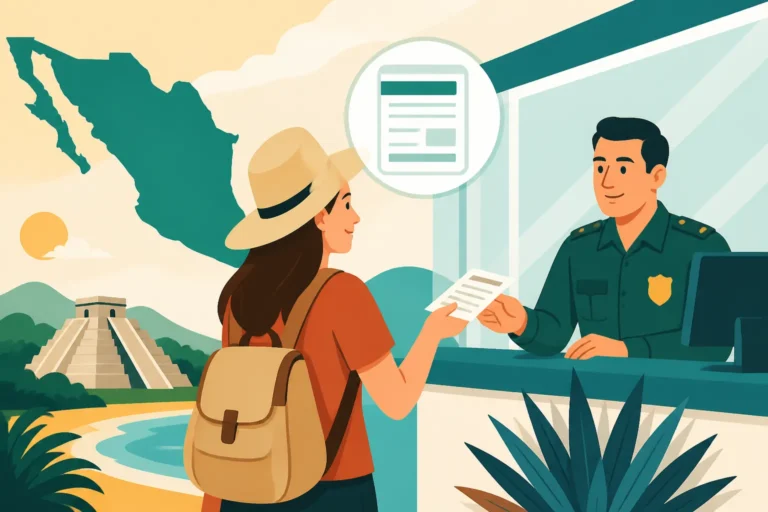
- At the window, hand over your folder with originals and copies in order. The clerk compares them and returns the originals.
- Receive your tracking details. These are typically a file number and a password printed on your receipt. Photograph that receipt right away.
- Leave with clear instructions about the next step. Usually this means checking online for a notification, a request for more documents, or a fingerprint appointment.
Waiting Room Survival
You may wait for a long time. Bring water, a small snack, a phone charger or power bank, and something to read. Many offices do not allow photos or video inside, and some ask you to keep calls short. Wear what you might wear to a bank appointment. Neat, simple clothing makes a good first impression, and a few offices have been known to turn people away for very casual beachwear.
If your Spanish is limited, write a short card with phrases like “No entiendo, ¿puede repetir más despacio, por favor?” and “¿Qué documento falta?” Keep a translation app downloaded for offline use. Bringing a Spanish-speaking friend is usually fine for support, although the clerk will speak directly to you. For broader strategies, see Living in Mexico with Limited Spanish: Survival Tips for Language Barriers. If you want to rehearse beforehand, Roleplay Lessons That Help: INM, Notario, and Bank Appointments walks through the conversation itself.
The Fingerprint and Photo Stage
Once your file is approved, you will be called back for biometrics, known locally as the toma de huellas or simply “huellas.” At this visit your fingerprints are scanned, your digital photo is taken, and you sign electronically. It is usually much quicker than the submission visit. Remove earrings if asked, keep your hair away from your face, and expect a neutral expression to be required for the photo. Some offices still want printed photos at this stage as well, so bring them just in case. For details on what happens at this appointment, see How to Get Your Fingerprints and Photo Taken for Residency (INM Process).
When Things Go Wrong and How to Recover
Even well-prepared applicants run into problems. What matters is responding calmly and quickly.
The Clerk Says a Document Is Missing
Ask politely for the exact name of the missing document and write it down. If possible, ask the clerk to write it down too. Ask whether you can bring it back the same day or whether you need a new appointment. Many experienced expats carry a few extra photocopies of everything and a spare set of photos for exactly this situation. Look out for nearby papelerías, the small stationery and copy shops that cluster around INM offices. They can be very helpful for last-minute copies and printing.
You Receive a Requerimiento
A requerimiento is an official request for more information or documents after you submit. It appears when you check your file status online. Take it seriously. These requests come with a deadline, and missing it can lead to your trámite being closed. Read the request carefully, collect exactly what it asks for, and file your response at the office within the stated period. To make sure you see these notices in time, see How to Track Your Mexican Visa Application Status Online.
Knowing When to Get Professional Help
Some situations go beyond what a well-organized DIY applicant can handle. Examples include a status that has lapsed, conflicting names across documents, a previous denial, or a family case with several applicants. A facilitator or immigration lawyer who knows your local office can be worth the cost in those cases. Compare the trade-offs in Do You Need an Immigration Lawyer for Mexico? DIY vs Professional Help.
| Situation | DIY Is Usually Fine | Consider Professional Help |
|---|---|---|
| Straightforward canje with all documents in order | Yes | Only if language is a major barrier |
| Standard renewal on time | Yes | Rarely needed |
| Requerimiento you do not understand | Possibly | Yes, if the request is unclear |
| Expired status or missed deadlines | Rarely | Yes |
| Family application with foreign civil documents | Possibly | Often helpful |
After You Get the Card
Check every detail on your new card right at the window: name spelling, date of birth, nationality and expiration date. Fixing an error immediately is much easier than coming back later. Keep in mind that your obligations to INM continue after this. If you move, you are required to update your address. See How to Change Your Address With INM in Mexico so you stay compliant.
INM day rarely goes as smoothly as you hope, but it seldom ends as badly as you fear. Bring more copies than you think you need, keep your receipts safe, stay polite, and accept that it will take more than one visit. Every expat with a resident card in their wallet has sat in those plastic chairs too.
Disclaimer
This article is for general informational purposes only and does not constitute professional advice. Laws, prices and regulations vary by location and change over time. Consult a qualified professional for guidance on your specific situation.