From Tourist to Resident: Planning Your Move to Mexico Legally
The "180-day gamble" at the airport is a stress no expat should have to endure long-term. When I first landed in Puerto Vallarta, I remember the knot in my stomach as the immigration officer hovered his stamp over my passport, wondering if I’d get the full six months or a measly seven days. This guide solves the confusion of moving beyond that uncertainty by outlining the exact roadmap to transition from a tourist to a legal resident in Mexico.
Disclosure: This post may contain affiliate links. We may earn a commission at no extra cost to you if you make a purchase through these links. Read full disclosure.
Moving Beyond the Tourist Card Limitations
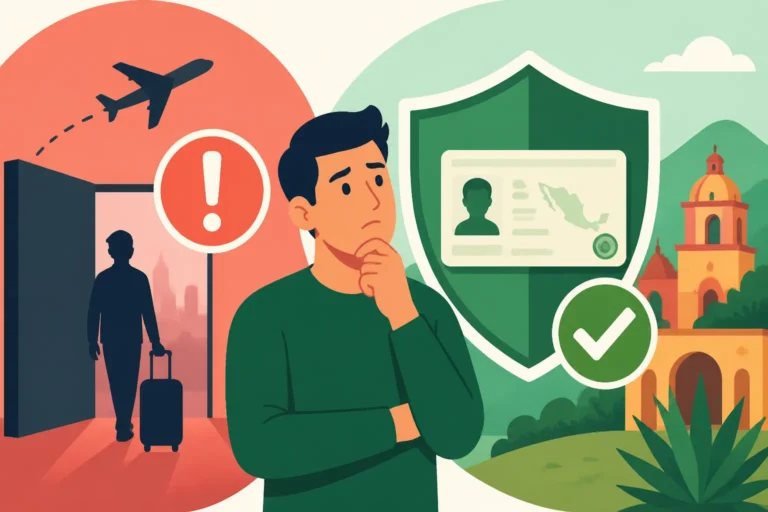
For years, many foreigners treated Mexico as a place where you could simply "border run" indefinitely. You would fly to San Diego or Guatemala for a weekend, come back, and get a fresh 180-day FMM (Forma Migratoria Múltiple). Those days are largely over. The Mexican immigration authorities (INM) have significantly tightened their stance on perpetual tourism. I’ve seen friends who have lived here for three years suddenly get pulled aside and told they have 10 days to pack their bags because the officer decided they were "living" here without the proper paperwork.
The reality of being a tourist is that you are a guest with very few rights. You cannot legally open a high-tier bank account, you cannot register a vehicle in your name in most states, and you certainly cannot get a tax ID (RFC), which is now required for everything from buying property to setting up a high-speed internet contract. Transitioning to residency isn't just about following the law; it is about building a foundation where you aren't constantly looking over your shoulder at the airport. It is the difference between being a visitor and being a neighbor.
Furthermore, relying on a tourist permit means you are at the mercy of the individual officer's discretion. We are seeing more automated gates and digital tracking. If the system flags you as someone who is spending 350 days a year in the country on a tourist visa, your next entry might be denied entirely. This guide will walk you through the Mexico Temporary Resident Visa: Comprehensive Guide for Expats (2026 Update) to ensure you never have to worry about an entry stamp again.
The Two Primary Paths Temporary vs Permanent Residency
When you decide to make the leap, you generally have two choices: Temporary Residency (Residente Temporal) or Permanent Residency (Residente Permanente). Most people start with the temporary version. This is valid for one year initially and can be renewed for another three years. It is designed for those who want to live in Mexico but aren't yet ready—or qualified—to commit to forever. It’s a great "trial run" that gives you almost all the rights of a citizen, minus the right to vote or own property in the restricted zones without a trust.
Permanent residency is often the goal for retirees. If you can prove a higher level of monthly income or significant savings, you might be able to skip the temporary stage entirely. The beauty of permanent residency is that it never expires. You get your card, and you're set for life, though you do have to notify INM if you change your address or marital status. If you are a retiree with a stable pension, you should check if you meet the criteria for Mexico Permanent Residency Explained: A Complete Guide (2027) to save yourself the hassle of future renewals.
Understanding which one fits your life stage is crucial. Temporary residency allows you to bring a foreign-plated car into Mexico for the duration of your visa, which is a massive perk for those driving down from the US or Canada. Permanent residents, however, cannot legally drive a foreign-plated car; it must be nationalized or sold. This one detail has tripped up many of my friends who moved to Lake Chapala with their beloved trucks only to find they had to export them immediately upon receiving their permanent status.
Navigating the Financial Solvency Requirements
The most significant hurdle for most applicants is proving they have the funds to support themselves. Mexico doesn't want residents who will compete for local low-wage jobs; they want people who bring outside capital into the economy. These requirements are based on the UMA (Unidad de Medida y Actualización), which changes every February. This means the amount of money you need in your bank account today might be different six months from now. It’s a moving target, and you need to aim slightly higher than the minimum to be safe.
Generally, you will need to show either a consistent monthly income (from a job, pension, or investments) for the last six months or a substantial balance in a savings or investment account for the last twelve months. The consulates are incredibly picky about this. They don't want to see a "gift" of $50,000 that landed in your account last week. They want to see the average monthly balance. If your balance dips below the requirement for even one day during that twelve-month period, many consulates will reject your application on the spot.
This is where preparation becomes vital. You need to gather your official bank statements, and they often need to be stamped by the bank or downloaded as "official" PDFs. Because these documents are in English (or your home language), you must ensure they are translated accurately. For official immigration purposes, I always recommend using a service like RushTranslate to handle your financial documents. Having a certified translation ready can prevent a nervous consulate officer from denying you simply because they couldn't clearly identify your "net income" versus "gross income" on a complicated pay stub.
| Feature | Tourist (FMM) | Temporary Resident | Permanent Resident |
|---|---|---|---|
| Duration | Up to 180 days (discretionary) | 1 year (renewable to 4) | Indefinite / Life |
| Work Rights | None (illegal) | Requires additional permit | Full work rights included |
| Foreign Car | Allowed (180 days) | Allowed (Duration of visa) | Not allowed |
| Path to Citizenship | No | Yes (after 5 years) | Yes (after 2-5 years) |
| Bank Accounts | Limited/Basic | Full Access | Full Access |
| RFC (Tax ID) | No | Yes | Yes |
The Consulate Interview Success Strategies
The process actually begins outside of Mexico. You cannot—and I repeat, cannot—change from a tourist to a resident while standing inside Mexico in most cases. You must visit a Mexican consulate abroad. This is the part that feels the most like a "test." You’ll need to book an appointment through the MiConsulado portal, which is notoriously difficult to navigate. My advice is to check for appointments at midnight Central Time or early Monday mornings, as that's when many slots are released.
During the interview, the officer is looking for two things: that you meet the financial requirements and that your intentions are genuine. I’ve seen people get rejected because they seemed "unsure" about where they were going to live. You don't need a lease agreement yet, but you should have a clear plan. "I want to move to Mérida because I love the culture and I’ve already researched the local healthcare" sounds much better than "I heard it's cheap and I want to escape my taxes." Be professional, be polite, and have your Mexican Consulate Appointments: Tips to Succeed in Your Visa Interview strategy ready.
One thing that often surprises people is the requirement for health insurance. While not every consulate asks for it, many are starting to require proof that you won't become a burden on the Mexican public healthcare system. Having a policy from Cigna Global is often a gold standard here because it provides the high-limit international coverage that consulate officers recognize. It shows you are prepared for the "what ifs" of life abroad, which goes a long way in proving your self-sufficiency.
The Canje Process What Happens Once You Land
Once the consulate approves you, they will stick a visa page in your passport. This is not your residency card! It is merely a "pre-approval" that gives you 180 days to enter Mexico and start the final process, known as the Canje (exchange). When you land in Mexico with this sticker, you must ensure the immigration officer marks your entry as "Canje" and gives you only 30 days on your FMM. If they accidentally mark you as a tourist for 180 days, you are in for a bureaucratic nightmare to get it corrected before you can proceed.
After you enter, the clock starts ticking. You have 30 days to visit the local INM office in the city where you intend to live. This is where you will provide your fingerprints, take your photos, and fill out a mountain of Spanish-language forms. This is often the most frustrating part of the journey. You might show up at 6:00 AM only to find the line is already around the block. For a detailed breakdown of this day, you should read about INM Office Visits: What to Expect When Processing Your Visa in Mexico so you know exactly which folders and photocopies to bring.
The goal of the Canje is to receive your plastic residency card. This card is your most valuable possession in Mexico. It contains your CURP (Clave Única de Registro de Población), which is essentially your social security number. Without this, you are stuck. Once you have the card, you can finally breathe. You are no longer a tourist; you are a resident. You can now learn How to Get a CURP as a Foreigner: The Mexican ID Number Explained to start integrating into the local systems like the health department and the tax office.
Avoiding Common Legal Pitfalls
The move from tourist to resident is full of "gotchas." One of the biggest mistakes is failing to notify INM when you change your address. As a resident, you are legally required to tell them within 15 days if you move to a new house. Failure to do so can result in fines or issues when you go to renew your visa. I’ve known people who moved from Playa del Carmen to Oaxaca and forgot to file the paperwork, only to have their renewal denied a year later because their "official" file was still in the Caribbean.
Another pitfall is the work authorization. A standard temporary residency visa does not automatically give you the right to work for a Mexican company or earn pesos locally. It is a "no lucrativa" status. If you find a local job or want to start a business, you must apply for an additional "permiso para trabajar." However, if you are a digital nomad working for a company in London or New York, your standard residency is perfectly fine. Just make sure you understand Mexico Immigration Terminology 101: FMM, CURP, RFC and Other Essentials so you don't accidentally tell an officer you are "working" when you mean you are "remotely employed."
Lastly, keep an eye on your expiration date. The first temporary card is only good for one year. You must start the renewal process within 30 days before it expires. If you let it expire by even one day, you usually have to start the entire process over again from a consulate outside of Mexico. It is a heartbreaking and expensive mistake to make. I suggest setting three different calendar alerts on your phone starting two months out. Trust me, Surviving the INM Office: Tips for a Smooth Visa Processing Day is a lot easier when you aren't doing it under the pressure of an expiring visa.
Preparing Your Documentation for a Smooth Transition
The success of your move depends on the "folder." Veteran expats know that you should have a physical accordion folder with every document you could possibly need. This includes your birth certificate, marriage certificate (if applying as a couple), and bank statements. In many cases, these documents must be apostilled in your home country before you arrive in Mexico. An apostille is a form of international legalization that proves your document is genuine. You cannot get a US or Canadian birth certificate apostilled once you are already in Mexico; it must be done by the Secretary of State or the relevant authority back home.
When it comes to the actual application, the INM forms are entirely in Spanish. If your Spanish isn't up to the task of technical legal jargon, don't guess. Mistyping your mother's maiden name or your place of birth can cause delays that last months. Using a professional for How to Translate Documents for Your Mexican Visa Application (Certified Translations) is a small investment that pays off in peace of mind. Services like RushTranslate are experienced in exactly what the Mexican consulates and INM offices expect to see.
If you are moving as a family, the complexity multiplies. Each member needs their own file, and you must prove the relationship between everyone. This means marriage licenses and birth certificates for the kids. The financial requirements also increase for each dependent you bring. Make sure you calculate the Financial Requirements for Families Applying Together for Mexican Residency before you book your consulate appointments to ensure your bank balance covers everyone in the household.
Final Thoughts on Your Legal Journey
Transitioning from a tourist to a resident is a rite of passage for anyone serious about living in Mexico. It’s a test of patience, organization, and respect for the local laws. Yes, the bureaucracy can be slow, and yes, the rules seem to change with the wind, but the reward is immense. Having that plastic card in your wallet means you can finally stop "visiting" Mexico and start living in it. You can buy a car, travel domestically without carrying your passport everywhere, and truly call this beautiful country home.
Don't let the fear of paperwork stop you. Start early, stay organized, and remember that every expat you see sitting in a cafe in Roma Norte or walking their dog in Ajijic has gone through exactly what you are about to do. We've all spent those long hours in the INM waiting room, and we all agree: it was worth it. If you're still wondering about the medical side of things, check out Do You Need Health Insurance for a Mexican Residency Visa? to round out your preparation. Welcome to the next chapter of your life in Mexico.
Disclaimer
The information provided in this guide is for informational purposes only and does not constitute legal, financial, or immigration advice. Immigration laws and financial requirements in Mexico are subject to frequent changes. Always consult with a qualified immigration attorney or the official Mexican consulate website for the most current regulations before making any travel or residency plans.