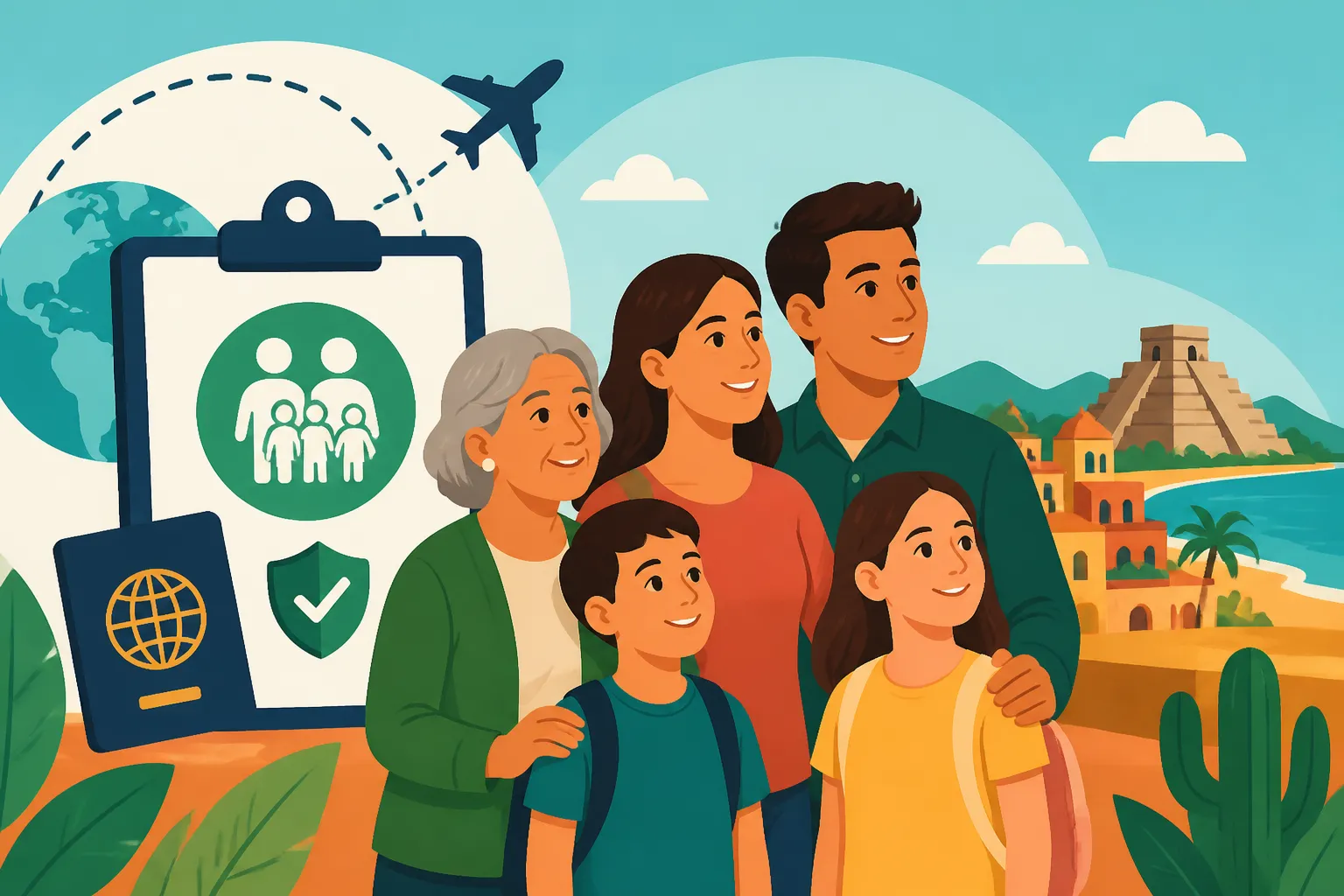
Family Unit Visas: Bringing Relatives to Mexico
The heartbreaking reality of being separated from your spouse or children while navigating the bureaucratic maze of Mexican immigration can feel like a full-time, high-stress job. I remember the sleepless nights and the stacks of paperwork when I first tried to bring my partner to join me in Querétaro. This guide provides the deep-dive clarity you need to navigate family unit visas effectively.
Disclosure: This post may contain affiliate links. We may earn a commission at no extra cost to you if you make a purchase through these links. Read full disclosure.
Understanding the Family Unity Concept in Mexican Law
Mexico places a very high value on the family unit, which is reflected in their immigration laws. Unlike some countries where "family reunification" is a secondary priority, the Mexican Ley de Migración specifically outlines paths for family members of Mexican citizens and foreign residents to live and work in the country. This isn't just a courtesy; it is a legal right, though exercising that right requires a meticulous approach to the National Institute of Migration (INM).
Who Qualifies as a Relative
When we talk about bringing relatives to Mexico, the definition of "relative" is specific. You cannot simply bring your second cousin or your best friend under this umbrella. The law recognizes spouses, common-law partners (concubinato), children, and parents. For foreign residents living in Mexico, you can sponsor your children (provided they are under 18 and unmarried) and your parents. If you are married to a Mexican citizen or have a Mexican-born child, the path to residency is even more direct.
It is important to understand that the "Family Unity" pathway is a distinct legal track. If you are already in Mexico as a temporary resident, your family members aren't automatically granted the same status. They must apply for their own residency cards, linked to your status. This link is called a vínculo, and it is the golden thread that holds the application together. Understanding the Rights and Benefits of Permanent Residents in Mexico is essential if your family path leads directly to that status, which often happens when there is a direct Mexican lineage involved.
The Difference Between Visa de Unidad Familiar and Regularization
There is often confusion between starting the process at a consulate versus doing it inside Mexico. Generally, the law requires that most people start their residency process outside of Mexico at a Mexican consulate. This is the Visa de Unidad Familiar. However, there are exceptions. If you are already in Mexico on a tourist permit and you marry a Mexican citizen or a legal resident, or if you have a child born in Mexico, you may qualify for a "Change of Status" or "Regularization" without leaving the country.
This "in-country" change is a lifesaver for families who are already physically present and want to avoid the expense of international flights just for a 15-minute interview. However, the requirements for a change of status are often stricter regarding the timeline of your current stay. If you find yourself in a situation where your initial permit has expired, you might need to look into Mexico's Regularization Programs: Giving Illegal Stays a Second Chance to see how to fix your status before applying for the family link.
Validating Relationships through Documentation
The biggest hurdle most expats face is proving the relationship to the satisfaction of the INM or the consulate. A marriage certificate from the US, Canada, or Europe is not enough on its own. It must be apostilled (or legalized, depending on the country of origin) and then translated into Spanish. This is where many people get stuck. If your documents are in English, the Mexican authorities require a certified translation.
For these critical documents, using a professional service like RushTranslate can ensure that your translations meet the strict standards required by the INM. I’ve seen applications rejected simply because a translation was done by a friend or a non-certified translator. The INM officers are looking for specific terminology that aligns with Mexican law. Having your birth certificates and marriage licenses handled by RushTranslate provides a level of professionalism that can prevent unnecessary delays in your family’s move.
Navigating the Consulate Process vs In-Country Change
Deciding where to apply is the first major strategic decision you will make. If your family member is currently outside of Mexico, the standard procedure is to book an appointment at a Mexican consulate. This is often the most stable route, as the visa issued at the consulate acts as a "pre-approval" that is very difficult for the local INM office to dispute once the person arrives in Mexico.
Applying from Abroad Consular Interview
The consular interview can be intimidating, but it’s mostly about verifying that the relationship is genuine and that the financial requirements are met. The sponsor (the person already holding residency or the Mexican citizen) usually needs to provide proof of income or savings. The amounts change every year based on the Mexican minimum wage and the UMA. For a deep dive into the numbers, you should check the Mexico Temporary Residency Financial Requirements (2026) to see if your bank balances hit the necessary marks.
During the interview, the officer will ask questions about how long you’ve been together or how you support your parents. It is conversational but evaluative. Once approved, a visa sticker is placed in the passport. This sticker is valid for a single entry into Mexico, usually within 180 days. It does not make the person a resident yet; it only gives them permission to enter for the purpose of exchanging that sticker for a residency card. This exchange is known as The Canje Process: Exchanging Your Visa for a Resident Card, and it must be started within 30 days of arrival.
The Canje Process and Local Enrollment
Once your family member lands in Mexico with their consulate-issued visa, the clock starts ticking. You must visit the local INM office to start the canje. This involves a lot of forms, specifically the Formato Básico, and paying the government fees. This is also the stage where fingerprints are taken. My experience at the INM in Mexico City was a lesson in patience—show up early, bring a book, and double-check that you have every original document and two copies of everything.
If you miss that 30-day window, you are essentially back to square one, and your relative might be considered to be in the country illegally. This is why planning the arrival date is so important. Make sure you aren't arriving right before a major holiday like Semana Santa, when the INM offices might be closed for a week, eating into your 30-day processing window. Navigating Mexico's Immigration System: Visas, INM Procedures, and Regulations can provide more context on these specific timelines.
Handling Paperwork and Apostilles
I cannot stress this enough: the apostille is the soul of your document. If you are from a country that is part of the Hague Convention (like the US or UK), your birth and marriage certificates must have that specific stamp from the Secretary of State or equivalent authority in your home region. Without it, the document has zero legal weight in Mexico.
Once you have the apostilled originals, you need those certified translations. Again, services like RushTranslate are invaluable here because they understand the need for accuracy. If an apostille is for a marriage certificate, the translation must include the text of the apostille itself. Mexican bureaucrats love stamps and official-looking seals; providing a high-quality translation from a recognized brand can actually smooth over minor interactions at the desk because it shows you’ve done your homework.
Bringing a Spouse or Common-Law Partner
The most common family unit visa is for a spouse. Mexico is quite progressive in this regard, recognizing both legal marriages and common-law unions, including same-sex partnerships. However, the proof required for each varies significantly.
Getting Married to a Mexican Citizen
If you are marrying a Mexican citizen, the path to permanent residency is incredibly fast. Usually, after being married and living in Mexico for two years, you can apply for permanent status. In some cases, if you have children together, you might even jump straight to permanent residency. For those currently planning their nuptials, understanding Getting Married to a Mexican Citizen: How It Affects Your Visa Status is vital for your long-term planning.
The INM will require the Mexican marriage certificate (Acta de Matrimonio). If you were married abroad, you must have that foreign certificate apostilled and translated. If you were married in Mexico, the process is slightly easier because the document is already in the local system. Be prepared for a potential home visit from immigration officers—though rare, they do sometimes check to ensure the marriage is not a "sham" for papers.
Proving a Common-Law Relationship Concubinato
If you aren't legally married but have lived together for a long time, you can still apply under the concubinato provision. To do this, you usually need a "Certificate of Concubinage" from a Mexican local authority (Juez de lo Familiar or a Notario Publico). This requires witnesses and proof of shared residence (like utility bills in both names).
This route is common for couples who have been together for decades but never saw the need for a marriage license. However, from an immigration standpoint, it is much more paperwork-heavy than a marriage certificate. If you are using foreign documents to prove a common-law union, make sure your translation service, such as RushTranslate, is aware that this is for a legal residency application so they can ensure the terminology is exact.
Necessary Documentation for Partners
The list of documents for a spouse or partner is extensive. You will need:
- The original and a copy of the sponsor’s residency card.
- The applicant’s valid passport.
- The marriage certificate or proof of concubinato (Apostilled and Translated).
- Proof of address in Mexico (CFE bill or Telmex bill).
- The application form (Solicitud).
| Document Type | Requirement for INM | Tip for Success |
|---|---|---|
| Foreign Marriage Certificate | Apostille + Certified Translation | Use a service like RushTranslate for speed and accuracy. |
| Proof of Income | Last 6-12 months of bank statements | Statements should be in the sponsor's name. |
| Passport Photos | Specific dimensions (usually Infantil) | Use a local "Estudio Fotográfico" near the INM office. |
| INM Fees | Paid at a bank via "Hoja de Ayuda" | Keep the original bank receipt; the office will take it. |
Visas for Children and Dependent Parents
Bringing children or elderly parents involves a different set of emotional and administrative hurdles. Mexico is very welcoming to families, but they want to ensure that the primary resident can actually afford to support the dependents.
Moving to Mexico with Children
If you are moving with minors, you need to prove the parent-child relationship via birth certificates. Again, these must be apostilled and translated. If only one parent is moving to Mexico with the child, you will likely need a notarized letter of consent from the other parent, or legal proof of sole custody. This is a common sticking point that can derail an application.
Parents often ask: Moving to Mexico with Children: Do Kids Need Separate Residency Visas? The answer is a resounding yes. Each child will have their own physical residency card and their own unique CURP. While they are linked to your "file," they are treated as individual residents. This is crucial for enrolling them in schools or accessing healthcare services.
Supporting Elderly Parents
Many expats choose Mexico as a place to bring their aging parents, often for better weather and more affordable care. To bring a parent, you must prove the relationship (your birth certificate showing their names) and your financial ability to support them. The income requirements for sponsoring a parent are higher than for a spouse or child because the government wants to ensure the parent won't become a burden on the public healthcare system.
If your parents are over a certain age, they might qualify for permanent residency almost immediately, depending on the current administrative guidelines. This provides them with more security and removes the need for annual renewals. However, you should also look into Senior Care in Mexico: Assisted Living and Home Care Options to ensure the infrastructure exists in your chosen city to support them long-term.
Financial Solvency for Families
When you apply for a family unit visa, the financial requirements are "additive." This means if the base requirement for one person is $3,000 USD a month, adding a spouse might increase that by an additional $800 to $1,000 USD. These numbers are pegged to the Unidad de Medida y Actualización (UMA), which can be a bit confusing. Understanding Mexico's UMA: How It Determines Financial Requirements is key to making sure you don't show up with "almost enough" money and get rejected.
If you are a retiree, you can use your pension or 401k statements as proof. Make sure your bank statements are clear and, if they aren't in Spanish, consider having a summary translated by RushTranslate to help the officer quickly identify the relevant figures. While some consulates accept English statements, others are becoming more rigid.
Practical Steps at the INM Office
Once you have all your documents, the real "fun" begins at the INM office. This is where the theory of immigration meets the reality of Mexican bureaucracy. Every office in the country (from Tijuana to Merida) operates slightly differently, but the core requirements remain the same.
Surviving the INM Office
My best advice for "IMN Day" is to arrive at least an hour before they open. The lines can be long, and many offices only take a certain number of people per day. Dress professionally—it sounds strange, but looking like a serious resident rather than a tourist on their way to the beach goes a long way in gaining the respect of the officers. Surviving the INM Office: Tips for a Smooth Visa Processing Day is an excellent resource for those who want to know exactly what to pack in their "immigration bag" (water, snacks, and a portable charger are a must).
Inside the office, you will be called to a window where an officer will review your folder. They are looking for reasons to say no, so make it easy for them to say yes. Organize your documents in the exact order requested on the INM website. Have your RushTranslate documents right behind the originals. If they ask a question you don't understand, be polite and ask them to repeat it slowly.
Fingerprints Photos and the Final Card
If your paperwork is accepted, you will eventually be called back for the toma de huellas (fingerprints) and your photo. Many offices now do this on the same day, while others will have you come back a week later. The photo taken at the INM is the one that will be on your card for the next year (or four), so be prepared!
Once the fingerprints are done, you usually wait in the lobby while they print the card. When they call your name and hand you that plastic card, it is one of the most relieved feelings you will ever have in Mexico. Check the card immediately for typos. If your name is spelled wrong or the "Resident" category is incorrect, tell them right then and there. It’s much easier to fix it before you walk out the door. Common Mistakes to Avoid When Applying for Mexican Residency Visas often stem from not checking the final output for small errors.
Costs Timelines and Legal Assistance
Living in Mexico as a family is a beautiful experience, but getting there has a price tag. You need to budget not just for the visas, but for the associated costs of moving and establishing a household.
Mexico Immigration Fees and Costs
The cost of a residency card changes every January. Currently, a one-year temporary residency card costs several thousand pesos, and renewals for three years are more expensive. There is also the "visa fee" paid at the consulate. For a family of four, these government fees alone can exceed $1,500 USD. You can find a detailed breakdown in Mexico Immigration Fees and Costs: Budgeting for Your Residency.
Don't forget the "hidden" costs:
- Apostille fees in your home country.
- Certified translation services like RushTranslate.
- Travel to and from the consulate and INM offices.
- Professional photos.
Do You Need an Immigration Lawyer?
Many people successfully navigate the family unit visa on their own. If you speak some Spanish and are organized, it is a "DIY-able" process. However, if your situation is complex—for example, if you are self-employed or have a non-traditional family structure—hiring a gestor or a lawyer can save you weeks of headaches. They know the local officers and understand the specific "quirks" of each office. Deciding whether to hire help is a personal choice, but reading Do You Need an Immigration Lawyer for Mexico? DIY vs Professional Help can help you weigh the pros and cons.
A lawyer will typically charge between $300 and $800 USD per person to handle the process. They don't make the process "faster" (the government moves at its own pace), but they do ensure that you only have to go to the INM office once or twice instead of five times because of missing documents.
Getting Your CURP and Tax ID
Once the residency card is in hand, your family members will need a CURP (Clave Única de Registro de Población). This is the equivalent of a Social Security Number and is required for almost everything in Mexico, from opening a bank account to getting a local SIM card. Usually, the CURP is printed on the back of your residency card, but you may need to "activate" it in the national system. How to Get a CURP as a Foreigner: The Mexican ID Number Explained is your next step once the visa process is complete.
If any of your family members plan to work or open a business, they will also need an RFC (Tax ID). This is a separate process with the SAT (the Mexican IRS), and it requires the residency card and the CURP. Bringing your family to Mexico is just the beginning; integrating into the financial and social systems is the next great adventure.
Disclaimer
This guide is for informational purposes only and does not constitute legal advice. Mexican immigration laws and financial requirements are subject to frequent changes. Always consult with the official website of the Instituto Nacional de Migración (INM) or a qualified immigration professional before beginning your application process. Your specific circumstances may require additional documentation or different procedures than those outlined here.