Border Runs in 2026: How Safe Is It to Reset Your 180-Day Tourist Allowance?
If you live in Mexico on back-to-back tourist stays, you probably know the knot in your stomach before each re-entry. Will the officer give you a full stay again, or write a much smaller number in your record? This guide covers how border runs work, the real immigration, physical and financial risks, the tax rules that apply to long stays, and when residency becomes the smarter path.
Disclosure: This post may contain affiliate links. We may earn a commission at no extra cost to you if you make a purchase through these links. Read full disclosure.
What a Border Run Really Is and Why the 180-Day Allowance Is Not Automatic
A border run is simple. You leave Mexico before your authorised tourist stay ends, spend a short time in another country, and come back in the hope of receiving a fresh authorisation. Some people walk across to San Diego for lunch. Others take a cheap flight to Houston for a weekend. Others take a bus from Chetumal into Belize for a few days. I have done versions of all three, and I have seen how each one plays out when the officer at the counter is in a generous mood and when they are not.
The main point to understand is that the tourist allowance is a maximum, not an entitlement. Mexico can authorise visitors for up to 180 days. The officer decides how many of those days you actually receive. They can give you the full amount, a few weeks, or just enough time to cover the return flight you show them. That discretion is the whole game.
How the Tourist Allowance Is Granted at the Port of Entry
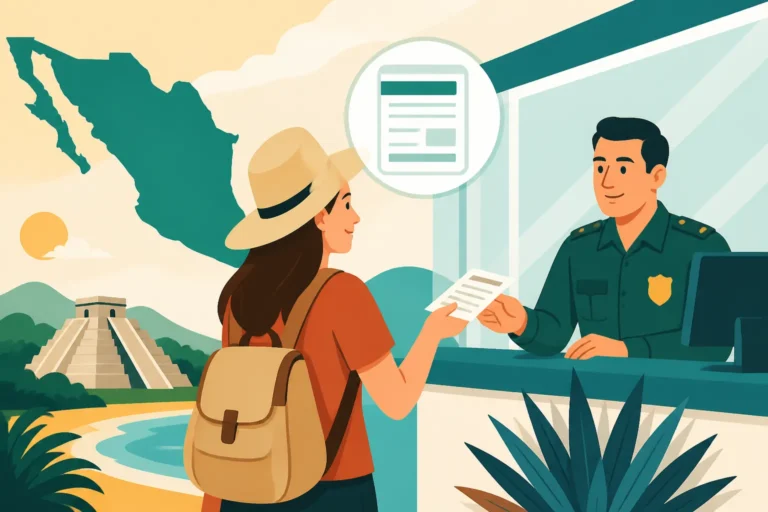
When you arrive by air at Mexico City, Cancún, Guadalajara or Puerto Vallarta, an immigration officer reviews your passport and may ask about your trip. They then record the number of days you are allowed to stay. Depending on the airport and the process in use, you might get a stamp with a handwritten number, a printed record, or an electronic registration linked to your passport. The format matters far less than the number. That number, and the date it counts from, defines your legal stay. For the full mechanics, see Mexico Tourist Card (FMM) Explained: Entry Requirements for 2026.
Picture a common first-week scene. You land at Cancún after a long day of connections. You are tired, you answer the officer’s questions in a hurry, and you take your passport back without checking it. Three weeks later a friend asks how long you got, and you discover the stamp says 30 days, not the six months you planned around. Your lease, your Spanish course and your plans are now out of step with your legal status. This happens to people all the time, and it is why the first rule of any entry, border run or not, is to check the number before you leave the counter.
Officers usually base their decision on what you tell them and what you can show. A return or onward ticket, a hotel booking or rental agreement, and some evidence that you can support yourself all help. They are not always legally required in every case, but they build the picture of a genuine visitor. If you are unsure what to carry, see Do You Need an Onward Ticket to Enter Mexico on a Tourist Visa? and Will I Get 180 Days? Understanding Mexico’s Tourist Entry Stamp Policies.
Why Officers Look Harder at Repeat Visitors
On your first entry, you are a tourist. On your third or fourth consecutive entry after spending almost the whole previous stay in Mexico, you start to look like someone who lives in Mexico without residency. That is exactly the pattern immigration officers are trained to notice.
Mexican law does not publish a minimum number of days you must spend outside the country before coming back. That gap in the rules is where both the opportunity and the anxiety come from. Nothing on paper forbids you from leaving on Friday and returning on Sunday. Nothing on paper forces the officer to give you more than a short stay when you do.
Here is how it often feels in practice. Consider an imaginary expat called Dana, a graphic designer from Portland who has spent nearly a full stay in Oaxaca City. She flies to Los Angeles, stays two nights, and flies back into Mexico City. The officer scrolls through her entry history, asks where she lives, and asks what she does for work. Dana stumbles, says she “kind of lives in Oaxaca now,” and mentions her clients. She is sent to a side office for secondary review. After a long wait and more questions, she is admitted for a few weeks instead of the months she hoped for. Nobody was rude, and nothing illegal happened. But her plan to “reset” fell apart in a few minutes.
The lesson is not to lie. Lying to an immigration officer is a much bigger risk than a short stay. The lesson is that your honest situation has to actually match tourist status. If your honest answer is “I live here,” the system is telling you something.
Land Crossings vs Flights Out for Resetting Your Days
Expats tend to sort border runs into two types: the quick land hop and the fly-out trip. Each has its own feel and its own procedural traps.
Land crossings into the United States at San Ysidro, Otay Mesa, El Paso–Ciudad Juárez or Laredo–Nuevo Laredo are cheap and fast if you already live in a border city. The catch is that leaving Mexico by land often happens with little or no Mexican exit check. If you hold a paper form or need your exit recorded, you may have to look for the INM office yourself rather than expect someone to stop you. Coming back south, you also have to make sure you are actually processed and issued a new authorisation. At many land crossings, people drift past the immigration office without realising they have entered Mexico without any record of it. That is an awful situation to discover months later at the airport.
Flying out generally gives you clean exit and entry records, because airlines and airport immigration processes are more structured. It costs more, and you face a more formal review on return, but your paperwork trail is clearer. For a deeper comparison of how procedures differ, see Crossing into Mexico by Land vs Air: How Entry Procedures Differ for Expats.
How Safe Is a Border Run? Immigration, Physical, and Financial Risk
When people ask whether border runs are “safe,” they usually mean three different things at once. Will immigration let me back in with enough time? Will I be physically safe crossing? Will something go wrong with my money, my insurance or my home while I am out? Each question deserves its own honest answer.
Immigration Risk: Short Stays, Secondary Inspection, and Refusals
The most common bad outcome is not a dramatic refusal. It is a short stay. You go through the expense and effort of leaving, and you come back with far fewer days than you need. That forces another run sooner, which makes the next entry look even more like a pattern, and the cycle tightens.
Secondary inspection is the next level. You are taken aside so a different officer can ask more questions and check your documents more closely. It is stressful, but it is not a punishment. Answer calmly and truthfully, and have your evidence ready: return ticket, accommodation details, proof of funds, and anything showing ties to your home country, such as a lease, a job or property back home.
The rarest and most serious outcome is refusal of entry. Officers can deny admission if they believe you are not a genuine visitor, if your documents are inconsistent, or if there are records problems such as a previous overstay. If you are refused at an airport, the airline is usually required to fly you back to where you came from. If you are refused at a land crossing, you are turned around. Either way, a refusal goes on record and can make future entries harder.
If you do get fewer days than you need, there are steps you can take before panic sets in. What to Do If You’re Given Less Than 180 Days on Your Mexico Tourist Permit walks through those options in detail.
Physical Safety at the Most Popular Crossing Points
Now for physical safety, which is where the word “safe” hits hardest emotionally. Most border runs pass without incident. Millions of people cross between Tijuana and San Diego every year for work, school and shopping. But border regions vary widely, and some approach roads, bus stations and crossing towns call for real caution.
These are the habits I have built over years of crossings:
- Cross in daylight. Long waits at San Ysidro or the Juárez bridges are much easier to handle in daylight. You are also not wandering around an unfamiliar area after dark looking for a taxi or a bus.
- Use structured transport. Use app-based rides or official taxi stands rather than accepting offers from people approaching you near the crossing. In Tijuana and Ciudad Juárez, I always arrange my ride before I reach the line.
- Check official travel advisories before each trip. Advice for border states changes, and a crossing that felt routine last year may deserve a second look now. Mexican state-level conditions and your home government’s advisories are both worth reading.
- Keep valuables minimal and documents secure. Carry your passport somewhere you can reach easily for officers but that is hard for pickpockets to get to. Keep a photo of your passport’s data page and your last entry record on your phone.
- Tell someone your plan. Send a friend your route, your expected crossing time and your return plan. If something goes wrong, someone knows where you were.
The southern borders deserve their own mention. Many people based in the Yucatán or Quintana Roo use the Subteniente López crossing near Chetumal into Belize. Expats in Chiapas sometimes use crossings into Guatemala such as Ciudad Hidalgo to Tecún Umán or Ciudad Cuauhtémoc to La Mesilla. These are working crossings with real traffic, and plenty of people use them without trouble. Still, they come with Belize’s and Guatemala’s own entry rules and fees, plus long road journeys through areas you may not know well. Plan those trips as proper journeys, not casual errands.
The Insurance and Money Gaps Nobody Budgets For
This is the risk that quietly ruins a border run. Many travel medical policies are built around single trips, a maximum length of time abroad, or rules about time spent in your home country. Repeatedly leaving and re-entering Mexico can raise questions about whether your policy is still active, whether a new trip has started, and whether a return visit to the US counts as being “home.” If you fall ill or have an accident during or soon after a run, those questions decide whether a claim is paid.
For people living long-term on tourist stays, it is worth reading the policy wording closely, not just the marketing page. Nomad-style subscriptions such as SafetyWing are designed around ongoing travel. Long-term international health plans such as Cigna Global are designed for people who are living abroad on a more permanent basis. Both work differently from a single-trip policy. Neither one fixes an immigration problem, but choosing a plan that matches how you actually live closes a serious gap. Check each provider’s own pages for current terms, coverage areas and costs. For a detailed look at keeping coverage active through repeated entries, see Border Runs and Policy Continuity: Keeping Cover Across Repeated Entries.
Money is the other hidden cost. Every run means transport, accommodation, food, and often paying rent on a Mexican apartment you are not sleeping in. If you are on a fixed income, those costs add up across a year faster than most people expect. Before committing to a border-run lifestyle, add up a full year’s worth of runs and compare it honestly with the one-off cost and effort of residency.
| Border Run Type | Typical Use | Immigration Paper Trail | Physical Safety Considerations | Main Downside |
|---|---|---|---|---|
| Walk-over to the US at San Ysidro or Otay Mesa | Expats in Tijuana or Baja | Exit from Mexico may not be checked automatically; you must make sure re-entry is processed | Busy crossings; arrange rides in advance and avoid lingering after dark | Easy to miss proper processing on return |
| Land crossing at El Paso–Ciudad Juárez or Laredo–Nuevo Laredo | Northern Mexico residents | Same as above; re-entry processing must be confirmed | Check advisories; daylight crossings strongly preferred | Approach routes deserve extra planning |
| Bus into Belize via Chetumal | Yucatán and Quintana Roo residents | Formal exit and entry on both sides | Long road travel; plan accommodation in advance | Belize entry rules and fees apply |
| Land crossing into Guatemala from Chiapas | Chiapas residents | Formal exit and entry on both sides | Remote road segments; travel in daylight | Long, tiring journeys |
| Flight out to a US or other foreign city | Expats in any major Mexican city | Clean airline-backed records | Generally low physical risk | Higher cost and formal questioning on return |
The Tax and Legal Side of Living on Back-to-Back Tourist Stays
This is where I see the most confusion and the most sleepless nights. People assume that staying a tourist keeps them outside the Mexican tax system and that leaving every few months means they are “not really living here.” Immigration status and tax status are separate questions with separate rules. Immigration vs Tax Residency in Mexico: Understanding the Difference goes deep on this, but the basics below are what every long-staying tourist should know.
Mexican Tax Residency Is About Your Home, Not a Day Count
Under article 9 of Mexico’s Código Fiscal de la Federación, an individual is a Mexican tax resident if they have established their home, the casa habitación, in Mexico. If you also have a home in another country, you are a Mexican resident when your centre of vital interests is in Mexico. The law says that is the case, among other situations, when more than 50% of your total income in the calendar year comes from Mexican sources, or when your main centre of professional activities is in Mexico.
Read that carefully, because it changes how you should think about border runs. Article 9 contains no day-count rule at all. Leaving the country for a weekend every few months does not, by itself, change where your home is. If you sign a long-term lease in Mérida, furnish the apartment, live there year-round apart from short trips, and run your professional life from that desk, you are building facts that point to a home in Mexico. Your immigration status does not decide the question. Your life does.
Consider a hypothetical retired couple, Ray and Sheila. They rent a house in Ajijic on a multi-year lease and keep no home in Canada, having sold it when they moved. They do a border run twice a year, flying to Phoenix. On the immigration side, their worry is whether the officer will keep giving them long stays. On the tax side, the question looks different. They have a home in Mexico and no home elsewhere, and the law ties residency to the home. Their pension is foreign-source income, which raises separate treaty and filing questions, but the starting point is clear. Border runs do not change it.
Now compare that with a digital nomad who keeps her apartment in Chicago, sublets nothing, earns all her income from US clients, and spends a few months at a time in Puerto Escondido in short-term rentals. Her facts point somewhere else entirely. Tax residency is personal and fact-specific. If your situation is anywhere near the line, speak with a qualified Mexican accountant, ideally one who also understands your home country’s rules.
Working, Overstaying, and Other Lines You Cannot Cross
Tourist status in Mexico does not allow you to work for Mexican employers or earn from Mexican sources. Remote work for foreign clients while visiting is a grey area that many people live in, but any Mexican-source activity, such as teaching classes locally, working at a hostel, or invoicing Mexican clients, crosses a clear line. Border runs do nothing to fix that. If anything, frequent re-entries invite exactly the questions about what you do that make undeclared work harder to hide. See What If You Work in Mexico on a Tourist Visa? Legal Risks Explained for a full breakdown.
Overstaying is the other line. If your authorised days run out before you leave, you are in irregular status. You will need to deal with INM before you can depart properly, which can mean paying a fine, completing paperwork and losing time at the airport or an INM office. It can also create records that make future entries harder. Mexican federal fines are generally calculated in UMA, the official reference unit. From 1 February 2026, the UMA is MXN 117.31 per day, MXN 3,566.22 per month and MXN 42,794.64 per year. If you ever receive an official notice expressed in UMA, that conversion helps you understand it. For the process of resolving an overstay, see Overstaying in Mexico: Consequences and How to Fix Your Status.
One more legal point catches people out. If you hope to switch from tourist to resident without leaving the country, the general rule is that you apply for residency through a Mexican consulate abroad and then complete the process inside Mexico. There are exceptions, especially for family ties to Mexican citizens or residents. Can You Change from a Tourist Visa to Residency Without Leaving Mexico? explains who qualifies.
Step-by-Step: Planning a Lower-Risk Border Run or Moving to Residency Instead
If after all this you still need one more run, perhaps to bridge a gap while you prepare a residency application or to finish a season before going home, plan it like a professional. If you are three or four runs into an open-ended stay, it may be time for residency.
A Practical Border Run Checklist
This is the sequence I would follow for a run in the coming months, based on what has worked for me and for friends:
- Check your current authorised days. Find the exact date your current stay ends and plan to leave well before it, not on the last day. Flight delays and bus breakdowns happen.
- Decide your honest story, then gather evidence. Can you truthfully describe yourself as a visitor? If so, assemble what supports it: a return or onward ticket, accommodation details, proof of funds, and ties to your home country. If you cannot honestly say you are a visitor, stop here and consider residency.
- Choose a route that matches your risk tolerance. Flights out give the cleanest records. Land crossings are cheaper but need more care to make sure your exit and re-entry are properly recorded.
- Check travel advisories and your destination’s entry rules. If you are not a US citizen, make sure you can legally enter the US, Belize or Guatemala before you set off. A refusal on the other side leaves you stuck between two countries.
- Review your insurance before you leave. Confirm your policy covers the trip out, your time abroad and your return to Mexico, and check any home-country rules. Save your policy number and emergency contact details where you can reach them offline.
- Spend some real time outside. There is no published minimum, but a stay that looks like an actual trip tells a more convincing story than a same-day turnaround.
- At the counter on return, answer simply and truthfully. Hand over your documents, explain your plans and keep your evidence ready.
- Check the number before you walk away. Confirm the days granted and the date they count from. If the number is lower than you expected, ask politely whether it can be reviewed. Officers sometimes adjust when shown a return ticket or other evidence.
- Photograph your entry record immediately. Store it with your passport photo so you can prove your entry date if any question comes up later.
When Temporary Residency Makes More Sense
There is a moment that comes for most long-term “tourists.” For me, it was standing in line at Mexico City’s airport after a weekend in Texas, heart pounding, rehearsing answers to questions that might not even be asked. I realised I had built a whole life on a status designed for holidays. I applied for temporary residency soon after, and I have never missed the dread of the counter.
Temporary residency is aimed at people who want to stay more than 180 days but are not yet ready for permanent residency. The economic requirements are set by each consulate, so the figures for the consulate you will actually use are the ones that matter. Here is an example from one consulate’s published requirement sheet, so you can see what the application looks like:
| Requirement From the Consulate General of Mexico in San Diego, 2026 Requirement Sheet | Amount |
|---|---|
| Economic solvency through savings or investments | Average monthly balance of USD 68,241 over the last twelve months |
| Economic solvency through employment or pension income | USD 4,049 a month over the last six months |
| Non-refundable processing fee | USD 56 |
Those are San Diego’s amounts. Other consulates set their own, so check the current requirement sheet from the consulate where you plan to apply before you start gathering bank statements. For a wider look at how solvency is shown and documented, see Mexico Temporary Residency Financial Requirements (2026).
Compared with a cycle of border runs, the trade-offs look roughly like this:
| Factor | Living on Repeated Tourist Stays | Temporary Residency |
|---|---|---|
| Length of legal stay | Whatever the officer grants at each entry, up to 180 days | Longer, set periods without re-entry reviews |
| Predictability | Low; each entry is a new decision | High once the card is issued |
| Travel costs | Recurring runs every few months | No runs needed to stay legal |
| Stress at the border | Repeated questioning about why you keep returning | Routine entries as a resident |
| Upfront paperwork | Minimal | A consular application plus in-country steps |
| Work options | No Mexican-source work allowed | Work authorisation possible through the proper process |
| Effect on tax residency | None by itself; your home and centre of vital interests decide | None by itself; your home and centre of vital interests decide |
Notice the last row. Neither status decides your tax residency on its own. The law looks at your home and your centre of vital interests. People sometimes stay tourists hoping to stay out of the tax system, and the law simply does not work that way.
For snowbirds who split the year between Mexico and home, the decision is less obvious. A part-time pattern that genuinely fits within tourist stays can work perfectly well. Residency vs Tourist Visa for Snowbirds: Which Is Better for Part-Time Expats? helps you weigh it. If your trips home are getting shorter and your Mexican life is getting bigger, that tells you which way to go.
Documents, Apostilles, and Translations Without the Panic
Paperwork is where many people freeze. They imagine a mountain of translated, stamped and certified documents, and they put off applying for another year, which usually means another round of border runs. Take it one document at a time and it becomes manageable.
Using the San Diego sheet again as an example, apostille or legalisation and an official Spanish translation are required only for documents, other than the passport, issued by a country other than the United States or Mexico. In practice, an American applying there with US bank statements and US pension letters does not need those translated for the consular stage. A third-country document is different. An applicant applying in San Diego with a Canadian marriage certificate, a British pension statement or a German birth certificate would need that document apostilled or legalised and officially translated.
When you do need a translation, options range from local translators to online certified-translation services such as RushTranslate. Before you pay anyone, confirm with your consulate what format of translation it accepts. Some offices are specific, and the rules can differ once you reach the in-country steps with INM. Apostilles and Translations for Mexican Immigration covers the different requirements in detail.
A few habits keep the process sane:
- Start with the requirement sheet, not with forums. Download the current sheet from the specific consulate where you have, or will book, your appointment, and treat it as your checklist.
- Order bank statements early. Solvency is based on a period of months, so ask your bank for complete official statements covering the whole period well before your appointment.
- Identify third-country documents first. These need the most lead time, because apostilles and translations take time to arrange.
- Keep digital and paper copies of everything. Bring originals and copies to the appointment, organised in the order the sheet lists them.
- Budget for the in-country stage. After your consular visa, you will complete the exchange for your resident card inside Mexico, which has its own forms, fees and appointments.
The day I finally held my resident card, I thought about every border run I had done: the early buses, the cheap motel rooms near the crossing, the silent prayers at the immigration counter. Border runs can bridge a short gap, and for genuine visitors they are a normal part of travel. As a way of life, they leave you at the mercy of whoever is behind the counter that day. If Mexico has become home, there is a more stable way to live here. Living in Mexico on a Tourist Permit: Risks and Limitations in 2027 is a good next read if you are still weighing the decision.
Disclaimer
This article is for general informational purposes only and does not constitute professional advice. Laws, prices and regulations vary by location and change over time. Consult a qualified professional for guidance on your specific situation.