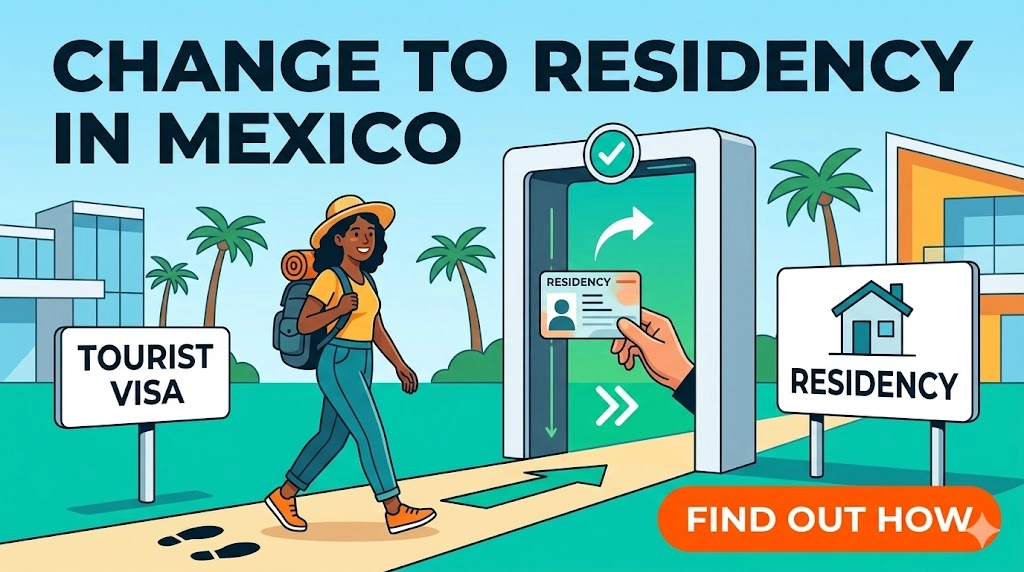
Can You Change from a Tourist Visa to Residency Without Leaving Mexico?
The Mexican National Institute of Migration (INM) operates a highly digitized, relentlessly strict border system. You cannot simply walk into an immigration office, show them your savings account, and ask to become a resident. However, if your life circumstances fit into a few highly specific, legally protected categories, you can entirely bypass the Mexican consulate and execute a formal status change from within the country. This comprehensive guide will break down the exact legal rule prohibiting in-country status changes, the “Golden Loophole” of Family Unity, the exact bureaucratic steps to get married as a tourist, and the essential translations and healthcare safety nets you need to survive the transition.
Disclosure: This post may contain affiliate links. We may earn a commission at no extra cost to you if you make a purchase through these links. Read full disclosure.
1. The General Rule: Why Most Tourists Must Leave
To understand the exceptions, you must first understand the bedrock philosophy of Mexican immigration law.
When you enter Mexico as a tourist—whether you hold a visa-exempt passport (like the US, UK, or Canada) or a visa-required passport—you are legally categorized as a Visitante sin Permiso para Realizar Actividades Remuneradas (Visitor without Permission to Perform Lucrative Activities).
The INM views your presence as strictly temporary.
The Consular Mandate for Economic Solvency
If you want to apply for standard Residente Temporal (Temporary Residency) or Residente Permanente (Permanent Residency) based on your financial strength—such as proving a high monthly remote income, a massive retirement pension, or liquid savings—you cannot do it from inside Mexico.
Mexican immigration law explicitly dictates that residency applications based on Economic Solvency must be initiated at a Mexican consulate or embassy outside of national territory.
- You cannot show the local INM office your Chase bank statements. They will not look at them.
- If you want to use the solvency route, you must fly out of Mexico, book an appointment at a consulate in your home country (or a third country), secure a pre-approved visa sticker, and fly back into Mexico to complete the process.
This is the harsh reality for 90% of digital nomads and retirees who arrive as tourists and decide they want to stay.
2. The “Golden Loophole”: Vínculo Familiar (Family Unity)
If the general rule requires you to leave, what allows you to stay? The answer lies in the Mexican Constitution, which fiercely and aggressively protects the concept of family unity.
If your life circumstances connect you to a Mexican citizen or an existing legal resident, the Mexican government entirely waives the requirement to return to a consulate. You are legally entitled to apply for a Cambio de Condición de Estancia (Change of Condition of Stay) directly at your local INM office.
This process allows you to seamlessly transition your tourist stamp into a physical residency card without ever crossing a border. There are two primary pathways under this loophole.
Pathway A: Marrying a Mexican Citizen or Resident
If you enter Mexico as a tourist and marry a Mexican national (or a foreigner who already holds a Temporary or Permanent Residency card), you are instantly eligible to change your status.
- The Financial Waiver: The absolute greatest benefit of this pathway is that the INM completely waives the grueling Economic Solvency requirements. You do not need to prove you earn $4,500 USD a month. Your right to reside is based entirely on your marriage, not your bank account.
- The Result: Upon successful processing, you will be granted a Residente Temporal (Temporary Resident) card.
- The Fast Track: While standard expats must wait four years to upgrade to Permanent Residency, spouses of Mexican citizens are fast-tracked. After holding your Temporary card for just two consecutive years, you are eligible to upgrade to Permanent Residency and apply for full Mexican citizenship.
Pathway B: Having a Mexican Child (The Ultimate Shortcut)
Mexican nationality law operates on Jus Soli (Right of the Soil). If you are in Mexico on a tourist visa and you have a child within the territorial borders of the country, that child is instantly and irrevocably a Mexican citizen by birthright.
Because the Mexican government will not deport the parents of a Mexican citizen, giving birth in Mexico grants both foreign parents an absolute, constitutionally protected immigration shortcut.
- The Result: You bypass Temporary Residency entirely. You apply for a Cambio de Condición and are immediately granted Residente Permanente (Permanent Residency).
- The Privilege: You gain the immediate, indefinite right to live and work in Mexico without ever needing to renew your visa.
For a deeper dive into the specific mechanics of this route, review our master guide: Permanent Residency through Family Ties: Marrying a Mexican or Having Mexican Children.
3. How to Get Married in Mexico on a Tourist Visa
If you plan to utilize Pathway A and marry your Mexican partner, you cannot simply walk into a church or a beach resort and declare yourselves married for immigration purposes. The INM only recognizes marriages performed by the civil government (Registro Civil).
Furthermore, a foreigner on a tourist visa cannot legally marry a Mexican citizen without first obtaining federal permission. Here is the exact bureaucratic gauntlet you must run.
Step 1: Request INM Permission to Marry
Before the Civil Registry will even look at you, you must apply to the INM for a Permiso para contraer matrimonio con un nacional (Permission to marry a national).
- You submit a formal letter requesting permission, your passport, and your digital FMM tourist receipt.
- The INM runs a background check to ensure you are not already married in Mexico or attempting immigration fraud.
- You pay a federal fee, and the INM issues a formal authorization letter.
Step 2: The Civil Registry (Registro Civil)
Armed with your INM permission letter, you and your partner go to the local Civil Registry. You must present:
- Medical certificates and pre-nuptial blood test results (a mandatory legal requirement in Mexico).
- Valid identification (your passport, their INE).
- Four witnesses with valid IDs.
- Your Foreign Birth Certificate (The Apostille Trap): You must present your original birth certificate. However, a US, Canadian, or UK birth certificate is legally meaningless to the Mexican government in its original form. It must be internationally authenticated via an Apostille from the issuing government.
Step 3: The Translation Mandate
Once your birth certificate is apostilled, you will face the language barrier. Mexican law strictly mandates that any official foreign document submitted to the Civil Registry or the INM must be accompanied by a certified Spanish translation.
You cannot run your birth certificate through a web translator. The Mexican government explicitly requires translations performed by a recognized, sworn translator embedded within the Mexican legal system (a Perito Traductor).
We strongly recommend utilizing RushTranslate for your vital records. They specialize in certified, sworn translations specifically formatted for highly sensitive, complex Mexican civil and immigration procedures. By sending your apostilled birth certificate to RushTranslate prior to visiting the Civil Registry, you ensure your identity documents are legally flawless and universally accepted. Do not risk your wedding date—and your subsequent residency application—over a translation technicality.
Step 4: The Marriage and the “Cambio”
The judge will marry you and issue your official Mexican Acta de Matrimonio. You take this newly minted marriage certificate directly back to the INM, alongside your unexpired tourist stamp, to officially file for your Cambio de Condición de Estancia.
4. The Bureaucracy of the “Cambio de Condición”
Once you have your marriage certificate (or your Mexican child’s birth certificate), the physical administrative process at the INM follows a strict, highly regulated sequence.
The Digital Formatting and the “Blue Pen” Rule
You must log onto the INM Micrositio and generate the specific application for a Cambio de Condición de Estancia. You must fill out the digital Formato Básico and draft a formal, respectful request letter (in Spanish) addressed to the INM.
Critical Bureaucratic Standard: You must sign this letter, and all accompanying INM forms, in blue ink. If you use black ink, the receiving INM agent will reject your entire dossier on the spot under the assumption that the signature might be a photocopy. This is a rigid, non-negotiable standard.
The INM Visit and the Passport Lock
You must visit your local INM office and submit your original passport, your digital FMM tourist receipt, your request letter, your tamaño infantil photographs (white background, no smiling, ears visible), and your supporting civil documents.
If the agent accepts your file, they will issue you a tracking number (NUT). From this exact moment, your application is actively processing, and your passport is effectively locked. You cannot leave Mexico. If you exit the country while a Cambio is processing, the border databases will alert the INM, your application will be instantly canceled under the presumption of abandonment, and your opportunity to change your status is destroyed.
Paying the 2026 Federal Fees
The INM agent will give you a Formato para Pago de Derechos (payment document). You must take this to a local Mexican bank (like BBVA, Santander, or Banorte). In 2026, changing your status involves two distinct fees:
- The Reception and Study Fee: Approximately $1,847 MXN just for the INM to legally review your Cambio file.
- The Card Issuance Fee: Once your file is officially approved, you return to the bank to pay the fee for the physical Temporary or Permanent Resident card. For a one-year Temporary card, this is roughly $5,570 MXN. For a Permanent card, it is roughly $6,789 MXN.
After an anxious waiting period of 3 to 8 weeks, you will return to the INM, provide digital fingerprints, and receive your official residency card. To properly budget for these federal expenses, read Mexico Immigration Fees and Costs: Budgeting for Your Residency.
5. What if Your Tourist Visa Already Expired?
This is a scenario that terrifies many travelers. You fell in love, got engaged, but the planning took too long. You look at your passport and realize your 180-day tourist stamp expired a month ago. You are now in Mexico illegally.
Can you still change your status?
Yes, but you cannot use the standard Cambio de Condición.
If your tourist visa has expired, your legal standing is broken. The INM will not process a standard status change for an undocumented migrant. You must apply for a formal Programa de Regularización Migratoria (Migratory Regularization Program).
Regularization via Family Unity
The INM prefers to bring undocumented immigrants with deep family ties into the formal, tax-paying system rather than deporting them. If you are married to a Mexican citizen or have a Mexican child, you can still fix your status without leaving the country.
- The Confession Letter: You must draft a Carta bajo protesta de decir verdad (Letter under oath to tell the truth). You must confess to your irregular status, explain why you overstayed, and formally request regularization based on Vínculo Familiar.
- The UMA Fine: You will not get away with the overstay for free. The INM will fine you based on the UMA metric (which is $117.31 MXN daily in 2026). Overstay fines typically range from 20 to 100 days of UMA, meaning you will pay an administrative penalty of **$2,346 to $11,731 MXN** before they will process your residency.
- The Outcome: Once the fine is paid and the family ties are verified, the INM will forgive the overstay and issue your Temporary or Permanent Residency card.
For a complete breakdown of the fines, risks, and strategies regarding expired visas, review our guide: Overstaying in Mexico: Consequences and How to Fix Your Status.
6. The Humanitarian Route (COMAR)
While Family Unity is the most common reason tourists transition to residents inside Mexico, there is one other major legal exception: Razones Humanitarias (Humanitarian Reasons).
If you entered Mexico as a tourist, but a sudden geopolitical crisis, a war, or severe persecution in your home country makes it impossible or physically dangerous for you to return, you can apply for refugee status.
- You must apply through COMAR (Comisión Mexicana de Ayuda a Refugiados).
- During the evaluation process, the INM will issue you a Tarjeta de Visitante por Razones Humanitarias, allowing you to stay in Mexico and work legally while your case is reviewed.
- If COMAR grants you formal refugee status or political asylum, you are legally entitled to transition that humanitarian card directly into Permanent Residency.
This is a rigorous, deeply scrutinized legal pathway designed strictly for individuals facing legitimate, documented threats to their lives or liberty.
7. Healthcare Transition: From Tourist to Resident
As a tourist, your healthcare strategy was likely quite simple: you relied on a standard travel insurance policy. However, the absolute moment you transition your status from a Tourist to a Legal Resident, that safety net vanishes.
The Travel Insurance Trap
If you read the fine print of virtually every travel insurance policy on earth, you will find a devastating clause: The policy is only valid for temporary “trips” and explicitly excludes individuals who have established legal residency in the destination country. Once the INM prints your Temporary Resident card, your travel insurance is legally void.
The Private Healthcare Imperative
Now that you are a resident of Mexico, you must protect your physical life and your financial assets permanently. Mexico boasts world-class private hospitals (such as Hospital Ángeles, Star Médica, or Hospital San Javier). These facilities offer clinical standards that rival the US and Canada.
However, they are strict for-profit businesses. In a medical emergency, hospital administrators will demand a massive, upfront credit card deposit (often ranging from $3,000 to $10,000 USD) before admitting you to the ER or beginning stabilization.
Attempting to live in Mexico as a resident without comprehensive health coverage is financial suicide. You must secure robust international health coverage to guarantee VIP access to these private facilities without facing bankruptcy.
We highly recommend securing an expat-tailored professional policy through Cigna Global. Their international plans offer direct billing networks with top-tier Mexican private hospitals. This means the hospital coordinates the massive bills directly with Cigna Global, completely bypassing the need for you to drain your savings during a medical emergency. Securing this coverage ensures your new permanent life in Mexico is physically and financially protected from day one. To understand the nuances of the public vs. private systems, read Healthcare in Mexico: Complete Guide for Expats Public vs Private.
8. Entering the Adult Ecosystem: Taxes and the RFC
Transitioning from a tourist to a resident means you can no longer hide in the shadows of the Mexican economy. You are entering the formal adult ecosystem, which means you must face the Mexican Tax Authority (SAT).
The Inescapable RFC
To legally live and function in Mexico as a resident, you are legally required to possess an RFC (Registro Federal de Contribuyentes). This is the Mexican equivalent of a Social Security Number or Tax ID.
As a tourist, you did not need one. As a resident, you are paralyzed without it.
- You need an RFC to open a standard Mexican bank account.
- You need an RFC to sign a formal, legally binding apartment lease.
- You need an RFC to buy a car, sign up for high-speed internet, or secure a cell phone contract.
- If you decide to legally work in Mexico, your employer requires your RFC to process your payroll and withhold your income tax (ISR).
Once the INM issues your residency card (which will have your newly generated CURP identification number printed on it), you must immediately book an appointment at the SAT to register your biometric data and secure your RFC and your e.firma (electronic signature).
To understand your new adult tax liabilities, including how remote income is taxed and how to avoid double taxation with your home country, thoroughly read Taxes in Mexico for Expats: A Complete Guide to Income Tax and More.
9. Summary Action Checklist for Changing Status
If you are currently sitting in Mexico on a tourist visa and your life circumstances have aligned to allow an in-country status change, use this rapid-fire checklist to ensure your transition is seamless:
- [ ] Verify Your Eligibility: Confirm you actually qualify for a Cambio de Condición (Marriage to a Mexican/Resident, birth of a Mexican child, or Humanitarian grounds). If you don’t, you must fly home and use the consulate route for Economic Solvency.
- [ ] Check Your Expiration Date: Ensure your digital FMM tourist stamp is still valid. If it has expired, prepare for a Regularización process and UMA fines instead of a standard Cambio.
- [ ] Secure INM Permission: If marrying a Mexican, obtain the mandatory INM permission letter before visiting the Civil Registry.
- [ ] Translate Foundational Documents: Send your apostilled foreign birth certificate to RushTranslate for a legally sworn, INM-compliant Spanish translation before you apply for marriage or residency.
- [ ] Prepare the Dossier: Draft your request letter and sign all INM forms exclusively in blue ink.
- [ ] Lock Down Your Travel: Submit your file and accept that your passport is locked. Do not attempt to leave Mexico while the Cambio is processing.
- [ ] Upgrade Your Healthcare: Ditch your invalid travel insurance and purchase a comprehensive Cigna Global private health insurance policy to protect your new life as a resident.
- [ ] Secure Your RFC: Once the plastic residency card is in your hand, book your SAT appointment to get your tax ID.
Changing your status from a passing tourist to a legal, documented resident without ever leaving Mexican soil is an incredible logistical privilege. By respecting the strict bureaucratic procedures, preparing flawless certified documentation, and securing your long-term healthcare, you eliminate the anxiety of the ticking tourist clock. You transform a temporary vacation into a permanent, protected, and deeply integrated life in the country you have grown to love.
References
Primary Sources (Official)
- Instituto Nacional de Migración (INM): The definitive federal portal detailing the exact legal requirements, forms, and procedures for transitioning from a tourist to a resident based on marriage or family ties. https://www.inm.gob.mx/mpublic/publico/inm-tramites.html
Other Helpful Sources
- Mexperience: A highly trusted portal providing simplified explanations of the Cambio de Condición process, the blue pen rule, and the realities of INM processing times. https://www.mexperience.com/lifestyle/mexico-immigration-guide/
- ExpatDen Mexico: A detailed, firsthand resource offering granular breakdowns of getting married in Mexico, navigating the Civil Registry, and setting up life as a new resident. https://www.expatden.com/mexico/
Disclaimer
The information provided in this comprehensive guide is for educational, logistical, and informational purposes only and does not constitute formal immigration, legal, tax, or medical advice. The approval of a Cambio de Condición or a Regularización request is granted at the absolute discretion of the INM officer handling your case. If you are currently in Mexico with an expired tourist visa, or if your marital or family situation is legally complex, we strongly, urgently recommend consulting with a certified bilingual Mexican immigration attorney to represent your case before the INM. Thoroughly verify your international travel health insurance coverage networks directly with your provider to determine your coverage validity while holding an active residency application.