Mexico Temporary Resident Visa: Comprehensive Guide for Expats (2026 Update)
If you are currently staring at a 180-day tourist stamp in your passport and wondering how to stay in Mexico without the stress of “border runs,” you aren’t alone. The Mexican government has made one thing very clear: the era of the perpetual tourist is officially over. To enjoy the world-class lifestyle of Mexico City, the colonial charm of San Miguel de Allende, or the turquoise waters of the Riviera Maya long-term, you must navigate the Temporary Resident Visa (Residente Temporal). This guide provides the exact roadmap to securing your residency, protecting your assets, and ensuring your transition to Mexico is legally ironclad.
Disclosure: This post may contain affiliate links. We may earn a commission at no extra cost to you if you make a purchase through these links. Read full disclosure.
1. What is the Temporary Resident Visa (Residente Temporal)?
The Temporary Resident Visa is the primary pathway for foreigners who wish to live in Mexico for more than six months but less than four years. Unlike a tourist visa, which is technically an entry permit (FMM), residency grants you a legal CURP (Unique Population Registry Code), allowing you to fully integrate into Mexican society.
The Shift: Why Residency is Now Mandatory
Immigration officers at major hubs like MEX, CUN, and GDL have moved almost entirely to digital systems. They can now see exactly how many days you have spent in the country over the last several years. If they detect you are “living” in Mexico on tourist status, they are authorized to grant you as little as 7 to 15 days upon entry.
Securing your Residente Temporal removes this uncertainty. It grants you the right to:
- Open a local Mexican bank account.
- Register and plate a vehicle in Mexico.
- Obtain a Mexican driver’s license.
- Enter and exit the country as many times as you like without questioning.
- Keep a foreign-plated vehicle in the country legally (unlike Permanent Residents).

2. The Financial Thresholds for 2026 (Economic Solvency)
The “Economic Solvency” requirement is the most common hurdle for expats. These numbers are tied to the Mexican Minimum Wage and the UMA (Unit of Measure and Update). Because Mexico has seen significant wage growth and peso strengthening heading into 2026, the USD/CAD/EUR requirements have increased.
Option A: Monthly Income
You must show proof of a consistent monthly income for the last six months. This can be from a salary, remote work, or a pension.
- 2026 Estimate: Approximately $4,400 – $4,800 USD per month for an individual.
- Family Members: Add approximately $1,100 USD per dependent (spouse or child).
Option B: Savings and Investments
You can prove solvency through the average monthly balance of your bank or investment accounts over the last 12 months.
- 2026 Estimate: Approximately $75,000 – $85,000 USD.
The Translation Trap: Mexican consulates require all foreign bank statements and documents to be translated into Spanish. They are notoriously strict; a simple Google Translate printout will result in an immediate rejection. We strongly recommend using RushTranslate for your certified translations. Their work is accepted by Mexican consulates globally, and their 24-hour turnaround is essential when you’re managing a tight appointment window.
3. The Two-Step Application Process: The Consulate vs. INM
Applying for residency is a “two-act play.” You cannot do the entire process from within Mexico. If you are already in Mexico as a tourist, you must leave to visit a consulate abroad for Step 1.
Step 1: The Consular Interview (Outside Mexico)
You must book an appointment at a Mexican consulate in your home country (or any consulate outside of Mexico, such as in Belize or Guatemala).
- Preparation: Gather your original bank statements, passport, and the visa application form.
- The Interview: A consular officer will review your documents and ask about your plans in Mexico. They want to ensure you have the funds to support yourself without taking a job from a Mexican citizen.
- The Sticker: If approved, a visa sticker is placed in your passport. This is not your residency card; it is a single-use entry permit that expires in 180 days.
Step 2: The “Canje” Process (Inside Mexico)
Once you have the sticker, you must enter Mexico. This is the most critical part.
- The Entry: When you pass through immigration (at the airport or land border), the officer must mark your entry as “Canje” or “Residency.” If they mistakenly mark you as a “Tourist,” your visa is void, and you must leave and re-enter.
- The 30-Day Clock: From the moment you enter, you have exactly 30 days to visit the local INM office to exchange (canje) your sticker for a physical plastic residency card.
- The Fingerprints: You will submit more forms, pay the residency fees (roughly $5,500 MXN), and provide fingerprints. Usually, within 2–4 weeks, you receive your card.
4. Healthcare and Insurance: Protecting Your Residency
While the Mexican government does not always mandate proof of health insurance during the visa interview, they do require you to be a “non-burden” on the state. More importantly, the medical landscape in Mexico is tiered, and without a safety net, an emergency can be financially devastating.
Why You Need Private International Coverage
Mexico has excellent private hospitals (like ABC in Mexico City or Joya in Puerto Vallarta). However, these facilities operate as for-profit businesses. They often require a massive upfront “guarantee deposit”—sometimes as high as $5,000 to $10,000 USD—before they will even admit you to the ER.
To avoid this, we recommend securing a policy through Cigna Global. Their international plans are designed specifically for expats, offering direct billing with Mexico’s top private hospital networks. Having Cigna Global ensures that in a crisis, you are focused on recovery, not scrambling to find a credit card with a high enough limit. For a deeper look at the system, see Healthcare in Mexico: Complete Guide for Expats Public vs Private.
5. Living and Working as a Temporary Resident
A standard Temporary Resident Visa allows you to live in Mexico and spend your foreign income, but it does not grant you the automatic right to work for a Mexican employer or earn pesos.
Remote Work and Digital Nomads
If you are a digital nomad working for a US, Canadian, or European company, you are perfectly fine under the standard residency. You are considered a “non-lucrative” resident. You don’t need a work permit because your income originates outside of Mexico. To optimize your lifestyle while navigating this, read our Digital Nomads in Mexico: Remote Work Guide.
Obtaining the “Permission to Work”
If you find a local job in Mexico, your employer must provide a job offer letter. You then apply to the INM for a “Permiso para Trabajar.” This is a separate administrative process but is relatively straightforward once you have your residency card.
6. The “Aval” and Renting Property
Once you have your residency card, your next step is usually signing a long-term lease. This is where many expats hit a bureaucratic wall known as the Aval.
Mexican landlords are terrified of squatters. To protect themselves, they usually require a co-signer (the Aval) who owns property in the same city—debt-free. Since you are new to the country, you won’t have an Aval.
The Solution: You will likely need to purchase a Póliza Jurídica (a legal insurance policy) from a law firm, which usually costs about 35% of one month’s rent. Learn more about these costs in Real Estate in Mexico: Renting vs Buying for Expats.
To outfit your new home (which usually comes without a fridge or stove), we recommend Amazon Mexico. They offer reliable delivery even in smaller towns, and their returns process is significantly easier than local big-box stores. For more on what to expect in your new home, see Furnished vs Unfurnished Rentals in Mexico: What to Expect.
7. Bureaucratic Roadblocks: Avoiding Rejection
- Bank Statement Formatting: Your bank statements must be “official.” Downloaded PDFs are usually fine, but they must show your full name, address, and the bank’s logo. If any page is missing, the consulate will reject you.
- The 30-Day Window: If you wait until day 31 to start your Canje at the INM, you can face fines, or worse, be required to leave the country and start over.
- Proof of Relationship: If you are applying for a spouse or child, your marriage or birth certificates must be apostilled (or legalized) in your home country and translated by a certified professional like RushTranslate.
8. Summary Checklist for Success
| Step | Action Item | Priority |
| 1 | Verify 2026 income/savings thresholds with your specific consulate. | High |
| 2 | Use RushTranslate for certified Spanish translations of bank letters. | Mandatory |
| 3 | Book your consulate appointment (use the SRE portal “MiConsulado”). | Urgent |
| 4 | Secure Cigna Global health insurance before entering Mexico. | Safety |
| 5 | Ensure the immigration officer at the border stamps you as “CANJE.” | Critical |
| 6 | Visit the local INM within 30 days of arrival. | Legal |
9. Transitioning to Permanent Residency
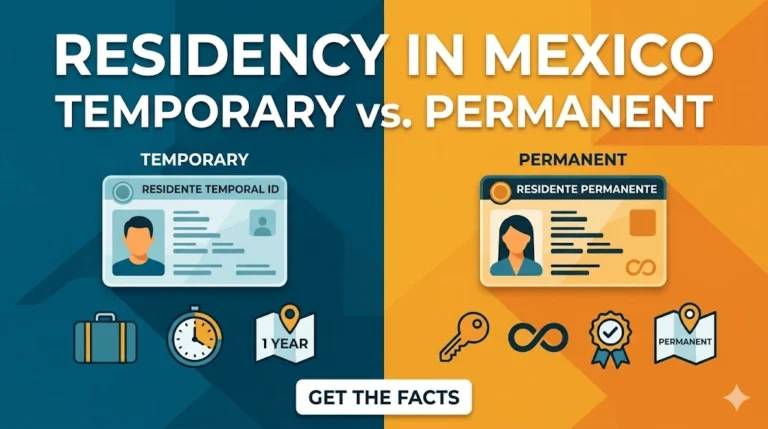
After four years of Temporary Residency, you can convert to Permanent Residency. The best part? You do not have to prove your finances again. It is an automatic right of passage as long as you have maintained your legal status. Permanent residency never expires, though you will lose the right to keep a foreign-plated car in the country.
If you are a retiree and have high enough income/savings now, you might qualify for Permanent Residency immediately. See The Ultimate Guide to Mexico’s Visa and Residency Options (2027 Edition) to compare the two.
References
Primary Sources (Official)
- Instituto Nacional de Migración (INM): The definitive federal authority for processing residency cards (canje), renewals, and monitoring immigration status within Mexico. https://www.gob.mx/inm
- Secretaría de Relaciones Exteriores (SRE): – The official portal for the Mexican Ministry of Foreign Affairs, providing specific financial requirements and appointment scheduling for consulates worldwide. https://www.gob.mx/sre/acciones-y-programas/visas-para-extranjeros
Other Helpful Sources
- ExpatDen Mexico: A highly detailed, firsthand resource offering granular breakdowns of cost of living, healthcare navigation, and localized neighborhood advice for foreigners. https://www.expatden.com/mexico/
- Mexperience: A long-standing, trusted portal providing simplified explanations of Mexican bureaucracy, legal requirements, and residency renewals. https://www.mexperience.com/lifestyle/mexico-immigration-guide/
Disclaimer
The information provided in this guide is for informational purposes only and does not constitute formal legal or immigration advice. Mexico’s immigration laws and financial thresholds are subject to change without notice in 2026. Always verify the latest requirements with your nearest Mexican consulate or a certified Mexican immigration attorney.