Renting vs Buying in Mexico: Pros and Cons for Expats
Staring at a fifty-page lease written entirely in legal Spanish while a landlord demanded a local co-signer nearly made me abandon my relocation entirely. I remember living out of a suitcase for weeks, paralyzed by the fear of making a massive financial mistake in a foreign market. This guide breaks down the harsh realities, legal hurdles, and financial logistics of renting versus buying property in Mexico.
Disclosure: This post may contain affiliate links. We may earn a commission at no extra cost to you if you make a purchase through these links. Read full disclosure.
The Realities of Renting in Mexico
Renting is undeniably the safest way to establish your new life abroad, but the Mexican rental market operates on a completely different set of rules than you might be used to in the United States, Canada, or Europe. It is highly decentralized, heavily reliant on personal networking, and riddled with unique bureaucratic hurdles that can quickly exhaust a new arrival.
Flexibility and the One Year Rule
When you first move to Mexico, the honeymoon phase is powerful. The sun is shining, the cost of living feels incredibly low, and you might immediately start looking at real estate listings with dreams of owning a beachfront villa. However, visiting a place on vacation is entirely different from dealing with its municipal water shortages, seasonal tropical storms, or the relentless noise of barking street dogs on a daily basis.
For this reason, the golden rule of Mexican relocation is to rent for at least six to twelve months before even considering purchasing a property. Renting provides the ultimate agility. It allows you to test out different neighborhoods, understand the local traffic patterns, and determine if you actually enjoy the climate during the brutal summer humidity. If you buy a house in a neighborhood that turns out to be unlivable due to a newly opened, incredibly loud nightclub next door, your capital is trapped. If you rent, you simply pack up when your lease ends.
Furthermore, your housing strategy should align perfectly with your immigration status. While you can legally purchase property on a tourist visa, you cannot legally work or stay long-term without proper residency. If you are still navigating the immigration bureaucracy, tying up hundreds of thousands of dollars in an asset you can only visit for short stints is highly risky. To understand the exact financial requirements for staying legally, review Mexico Immigration Fees and Costs: Budgeting for Your Residency.
The Aval Conundrum and Bypassing It
This is the single biggest pain point for expats trying to rent an apartment in Mexico. Because the Mexican legal system makes evicting a squatter a process that can take years, landlords fiercely protect their assets. They almost universally require an Aval (a guarantor or co-signer) to sign the lease with you.
The catch is that the Aval must usually own property outright, entirely debt-free, in the exact same city where you are renting, and they must provide a copy of their deed to the landlord as collateral. For a newly arrived expat, finding a local property owner willing to put their home on the line for your lease is virtually impossible. This requirement alone leaves many foreigners feeling entirely locked out of the traditional rental market.
Fortunately, there are a few standard workarounds. The most common is offering to pay a higher security deposit or offering to pay six months of rent in advance in cash. Alternatively, many modern landlords will accept a Póliza Jurídica (a legal policy). This is a type of eviction insurance that you pay for, usually equal to about thirty to fifty percent of one month’s rent. A third-party legal firm investigates your background, checks your foreign income, and guarantees your lease to the landlord, completely removing the need for an Aval.
Outfitting an Unfurnished Mexican Rental
When you finally bypass the landlord negotiations and sign a lease, be prepared for the stark reality of the Mexican definition of “unfurnished” (sin amueblar). In North America, an unfurnished apartment still generally includes a refrigerator, a stove, an oven, and built-in bedroom closets. In Mexico, an unfurnished home often means bare concrete walls and absolutely nothing else.
It is incredibly common to rent a home that lacks all major kitchen appliances, shelving, and sometimes even light fixtures and toilet seats, leaving only bare wires hanging from the ceiling. You must budget significantly for outfitting a raw apartment if you choose the unfurnished route to save on monthly rent. Finding these specialized home goods locally can be a massive headache, as local big-box stores often lack premium inventory or ergonomic home-office gear.
To bypass the chaotic local retail supply chain, veteran expats rely exclusively on Amazon Mexico. When I moved into my first empty apartment, Amazon Mexico was my absolute lifeline. Instead of renting a truck and driving to three different industrial parks to find a specific mattress topper or a high-quality coffee maker, I ordered everything through the localized Amazon Mexico platform. Because it operates within the country, you completely bypass the nightmarish delays and extortionate duties of international customs, allowing you to quickly transform an empty concrete box into a highly functional, comfortable home.
The Mechanics of Buying Property as a Foreigner
If you have fallen in love with a specific town, established your residency, and are ready to put down permanent roots, buying property in Mexico can be a phenomenal lifestyle investment. However, foreign ownership in Mexico is heavily regulated by the constitution and involves a uniquely bureaucratic closing process that you must understand intimately to protect your capital.
The Restricted Zone and Fideicomisos
The most intimidating aspect of buying property in Mexico is Article 27 of the Mexican Constitution. This law states that foreigners cannot directly hold the title to residential property located within the “Restricted Zone” (Zona Restringida). This zone encompasses all land within fifty kilometers of any coastline and one hundred kilometers of any international border.
If you want to buy a beachfront condo in Playa del Carmen, a retirement home in Rosarito, or a villa in Puerto Vallarta, you are buying inside the Restricted Zone. To legally purchase property here, you must use a Fideicomiso (a bank trust).
A Fideicomiso is a highly secure legal trust established with a major Mexican bank. The bank holds the actual deed to the property, but you, as the foreigner, are the primary and sole beneficiary of the trust. You retain all rights of ownership: you can sell the property, rent it out, will it to your heirs, and renovate it. The trust lasts for fifty years and is easily renewable. Establishing a Fideicomiso usually costs around two to three thousand dollars upfront, with an ongoing annual maintenance fee of roughly five hundred dollars paid directly to the bank.
The Power of the Notario Publico
In the United States or Canada, a notary is simply a person who verifies your identity and stamps a piece of paper for a nominal fee. In Mexico, the Notario Público is a highly prestigious, quasi-judicial official appointed directly by the state governor. They must be experienced attorneys, and their role is absolute paramount.
The Notario is the center of gravity in any Mexican real estate transaction. They act as a neutral third party legally responsible to the state. They verify the chain of title, ensure the property is free of hidden liens or unpaid municipal taxes, calculate the capital gains taxes for the seller, and formally record the new deed in the public registry.
You do not simply use a title company in Mexico; you use the Notario. Never, under any circumstances, hand over a large sum of money to a seller or a real estate agent without a Notario Público actively overseeing the formal transaction and drafting the official sales contract. Doing so is the fastest way to lose your entire life savings to a real estate scam.
Closing Costs and Financial Transfers
Closing costs in Mexico are significantly higher than in many Northern countries, and they are borne almost entirely by the buyer. As the buyer, you are responsible for paying the acquisition tax, the Notario fees, the trust setup fees, and the public registry fees. You should aggressively budget between five and eight percent of the total purchase price strictly for closing costs.
The actual logistics of paying for the house present another massive challenge. Most Mexican real estate transactions involving expats do not use traditional local mortgages, as Mexican interest rates are exorbitantly high. They are cash deals. You will need to transfer hundreds of thousands of dollars to a Mexican escrow account or directly to the seller. Understanding the mechanics of these massive transfers, and ensuring you have the proper immigration documentation to open local accounts to facilitate them, is vital. For a clear roadmap on formalizing your status, read How to Apply for Temporary Residency in Mexico: Step-by-Step.
Financial Implications and Holding Costs
Owning property in a foreign country introduces a complex web of tax liabilities and maintenance realities. You must navigate both the incredibly cheap holding costs that make Mexico attractive, and the potentially devastating capital gains taxes that catch many expats off guard.
Property Taxes Predial and Utilities
The greatest financial benefit of owning a home in Mexico is the Predial (annual property tax). The Predial is based on the assessed cadastral value of the property, which is historically recorded at a fraction of the actual market value.
Even for a luxury home, expats rarely pay more than a few hundred dollars per year in property taxes. Furthermore, local municipalities heavily incentivize early payments, often offering discounts of up to twenty percent if you pay your Predial in January. This low carrying cost means that if you need to return to your home country for a few months, your Mexican home will not bleed your finances dry.
However, setting up the basic infrastructure to run your home requires patience. Establishing accounts with the CFE (the national electric commission) and local water authorities often requires presenting your original deed and your resident card. To prepare for the logistical hurdles of daily domestic administration, read Setting Up Utilities in Mexico: Electricity, Water, and Internet.
Capital Gains Tax and ISR
While it is incredibly cheap to hold property in Mexico, selling it is another story entirely. The capital gains tax (Impuesto sobre la Renta or ISR) levied when you eventually sell the property can be brutal if you are not prepared.
If you are a non-resident selling a Mexican property, the government will typically take twenty-five percent of the gross sale price or thirty-five percent of your net profit, whichever is lower. However, if you are a permanent resident with a Mexican Tax ID (RFC), you can legally exempt a massive portion of these taxes if you can prove the house was your primary residence for at least three years, utilizing utility bills in your name as proof.
The golden rule of Mexican real estate is that you can only deduct the cost of home improvements from your capital gains tax if you possess a formalized, electronic tax invoice known as a CFDI (Factura) for the construction work. Handing cash to a local contractor means those improvements never happened in the eyes of the government. To deeply understand these exact liabilities, you must thoroughly read Taxes in Mexico for Expats: A Complete Guide to Income Tax and More.
Maintenance and Infrastructure Upgrades
Mexican homes require constant, vigilant maintenance. If you buy a property on the coast, the salty ocean air and intense tropical humidity will relentlessly attack your appliances, your paint, and your electronics. If you buy in the colonial highlands, you must deal with aging plumbing and potential roof leaks during the heavy summer rainy season.
Because local hardware stores (ferreterías) are often small and lack specialized tools, veteran homeowners heavily utilize Amazon Mexico to maintain their properties. When I needed a specialized dehumidifier to combat coastal mold, or heavy-duty surge protectors to protect my appliances from the notorious Mexican power grid fluctuations, Amazon Mexico delivered them directly to my door within days. Utilizing Amazon Mexico for your ongoing maintenance needs ensures you have access to high-quality, reliable tools that local markets simply do not carry, protecting the long-term value of your real estate investment.
Establishing Your Basecamp and Daily Logistics
Whether you plan to rent for a year or buy immediately, your first thirty to sixty days in Mexico require a strategic landing pad while you navigate the local real estate market.
The Co Living Bridge to Long Term Housing
The absolute worst way to hunt for real estate is to book an expensive, sterile hotel room for a week and rush into signing a long-term lease or a purchase agreement out of sheer panic. You need a comfortable, reliable basecamp that allows you to integrate into the community while you take your time touring properties.
This is exactly why so many successful expats utilize Selina as their initial bridge into the country. Booking a micro-suite or a private room at a Selina property for your first month is a brilliant logistical maneuver. Instead of dealing with sketchy Airbnb hosts or isolation, Selina provides commercial-grade internet, built-in co-working spaces, and a vibrant, immediate community.
When you stay at Selina, you can walk downstairs, grab a coffee, and instantly network with other digital nomads and seasoned expats who already know the local terrain. They can tell you which neighborhoods flood during the rainy season, which real estate agents are trustworthy, and which landlords to avoid. Selina acts as your community anchor, giving you a safe, highly connected environment to return to after a long day of viewing apartments or meeting with Notarios.
Staying Connected While House Hunting
Hunting for real estate requires you to be hyper-responsive. Good rentals disappear within hours of being posted in local Facebook groups. If you rely on your home country’s mobile plan, you will likely face severely throttled data speeds or exorbitant roaming charges while trying to navigate the city.
You must localize your cellular data the absolute second your plane lands. By downloading an eSIM profile through Airalo, you instantly connect to Mexico’s premier cellular networks without having to hunt down a physical Telcel store. Having an Airalo data package ready allows you to use Google Maps to find property addresses, use translation apps to communicate with local building managers, and immediately reply to WhatsApp messages from real estate agents.
WhatsApp is the lifeblood of Mexican real estate; no one uses email. If you do not have reliable data to respond instantly, you will lose the apartment. Airalo is the ultimate digital safety blanket, ensuring you are never disconnected during the most critical phase of your relocation. For remote workers managing their careers alongside their house hunt, maintaining this connectivity is non-negotiable; learn more in our Digital Nomads in Mexico: Remote Work Guide for 2027.
Navigating Healthcare as a Renter or Buyer
Your housing choice deeply impacts your medical infrastructure. Buying a house is a permanent declaration of your intent to stay in Mexico. As you age in place, your medical needs will inevitably increase. One of the most tragic scenarios in the expat community is witnessing a foreigner forced to fire-sale their beloved Mexican retirement home at a massive loss because they suffered a medical emergency and cannot afford the private hospital bills.
Whether you rent or buy, protecting your physical body and your financial assets is paramount. You must establish a relationship with local clinics immediately. To learn how to find trustworthy professionals, review Finding English-Speaking Doctors and Specialists in Mexico. If you need ongoing maintenance medications for a chronic condition, understanding the local pharmacy laws is vital; read Pharmacies in Mexico: How to Get Medications OTC vs Prescription.
The Mexican public healthcare system will not protect your assets if you require complex, catastrophic care. To shield your real estate investment, you must secure robust international health coverage. To compare how these catastrophic policies operate and why local plans often fall short for expats, consult Choosing Private Health Insurance: Local Mexican Plans vs International Coverage. Furthermore, understanding the divide between the overwhelmed public system and the elite private tier is essential for long-term survival; review Healthcare in Mexico: Complete Guide for Expats Public vs Private.
Making the Final Decision
Ultimately, the decision to rent or buy is intensely personal, relying heavily on your financial liquidity, your patience for foreign bureaucracy, and your long-term vision for your life in Mexico.
When Renting Makes the Most Sense
For the vast majority of new arrivals, digital nomads, and retirees testing the waters, renting is the only logical choice for the first year. It offers the freedom to learn the culture, experience the dramatic seasonal weather shifts, and explore different regions without the financial handcuffs of homeownership. Renting preserves your capital while you determine if the Mexican lifestyle truly aligns with your long-term goals.
When Buying is the Right Move
Buying is for those who are absolutely certain about their geographic location, have secured their permanent residency, and want to design their ultimate Mexican sanctuary. If you are ready to build equity in a rapidly growing international market, enjoy the incredibly low holding costs, and have the patience to navigate the Fideicomiso and Notario processes, homeownership in Mexico is a tremendously rewarding achievement.
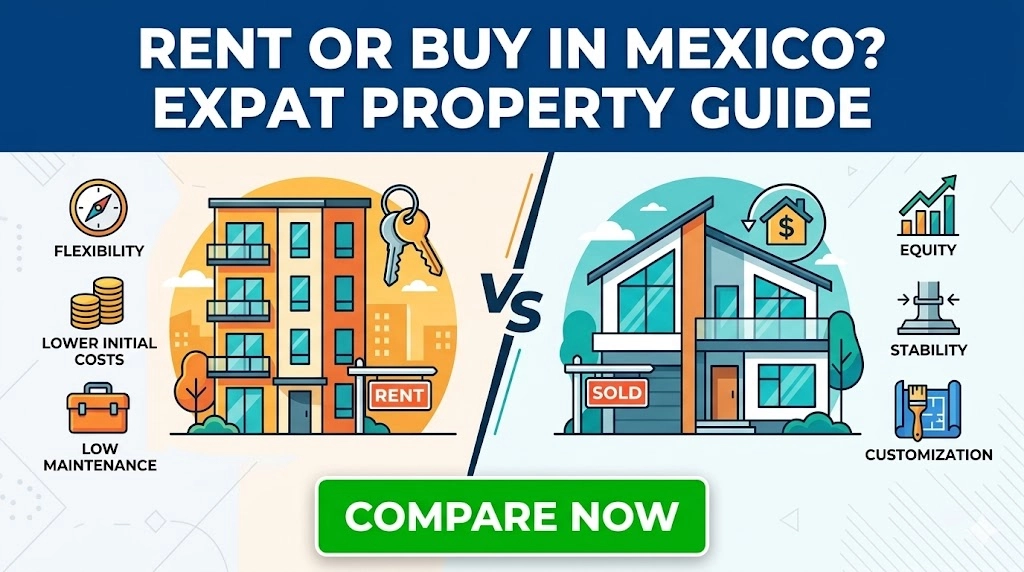
| Feature | Renting in Mexico | Buying in Mexico |
| Financial Commitment | Very low upfront costs; standard is one month deposit and first month’s rent. | High upfront closing costs (5-8%) and cash-heavy transactions. |
| Flexibility | Extremely high. You can pack up and move when your lease ends. | Low. Selling property can take months or years depending on the market. |
| Maintenance | The landlord is legally responsible for structural repairs and plumbing issues. | You are entirely responsible for all upkeep, combating humidity and salt air. |
| Major Hurdles | Overcoming the Aval (co-signer) requirement and outfitting empty apartments. | Navigating the Fideicomiso trust setup and potential capital gains taxes upon sale. |
References
Primary sources official
- Secretaría de Relaciones Exteriores (SRE): The official federal guidelines detailing the legal requirements, constitutional boundaries, and application process for establishing a bank trust in the Restricted Zone. https://sre.gob.mx/permiso-para-constituir-un-fideicomiso-en-zona-restringida
- Colegio Nacional del Notariado Mexicano: The official national body governing Notarios, explaining their legal obligations, fee structures, and indispensable role in verifying property transfers. https://www.notariadomexicano.org.mx/
Other helpful sources
- Mexperience: A highly trusted expat resource providing deep dives into market trends, the role of real estate agents, and cultural housing norms. https://www.mexperience.com/realestate/buying-selling-real-estate-in-mexico/
- Money Talks News: An incredibly detailed, firsthand breakdown of the closing process, avoiding Ejido land, and calculating closing costs for foreigners. https://www.moneytalksnews.com/slideshows/the-expats-complete-guide-to-buying-property-in-mexico/
Disclaimer
The information provided in this guide is for educational, logistical, and informational purposes only and does not constitute formal real estate, legal, tax, or financial advice. Mexican property laws, the constitutional requirements for Fideicomisos within the Restricted Zone, landlord-tenant regulations, and capital gains tax calculations are highly complex and subject to frequent legislative changes. Always retain the services of a certified Mexican Notario Público and a specialized real estate attorney to oversee any property transaction, and verify your health insurance coverage directly with your provider to ensure your assets are protected from medical liabilities.