Common Mistakes to Avoid When Applying for Mexican Residency Visas
Relocating to Mexico is a dream shared by millions. The allure of the vibrant culture, the unparalleled cuisine, the lower cost of living, and the warm, welcoming people is undeniable. But between the dream of sipping mezcal on a Oaxacan terrace and the reality of legally living there lies a formidable, heavily fortified wall: the Mexican bureaucratic system. This comprehensive guide breaks down the ten most common, devastating mistakes expats make during the Mexican residency process—and provides the exact, actionable strategies you need to avoid them.
Disclosure: This post may contain affiliate links. We may earn a commission at no extra cost to you if you make a purchase through these links. Read full disclosure.
Mistake 1: The Airport E-Gate Disaster (Entering as a Tourist)
You have spent months gathering paperwork, you aced your consular interview abroad, and you proudly have the Mexican visa sticker affixed to your passport. You land at the Mexico City or Cancún airport, exhausted but excited. You see a massive line for the human immigration officers and a completely empty line for the automated digital e-gates. You walk through the e-gate, scan your passport, and head to baggage claim.
You just voided your visa.
The Reality of the “Canje” Stamp
The visa sticker placed in your passport by the Mexican consulate is not your residency card. It is a single-use entry permit valid for 180 days. Its only purpose is to grant you the right to travel to Mexico to finish the bureaucratic process.
When you enter Mexico, you must physically exchange that sticker for a plastic card. This process is called the Canje (Exchange).
If you use an automated e-gate, the system assumes you are a standard tourist and digitally registers you as a visitor. The moment that happens, your residency visa sticker is legally nullified. You cannot fix this online. You cannot fix it at the local INM office. You will be forced to leave the country, forfeit the consular fees you already paid, and book a new appointment at a consulate abroad to start from scratch.
The Solution
When you arrive at the airport, do not use the automated e-gates. You must stand in the line for a human immigration officer. When you reach the desk, hand them your passport open directly to the visa sticker page and explicitly state: “Vengo para el canje de mi visa” (I am coming for the exchange of my visa). Watch them stamp your passport. Do not walk away from the desk until you visually confirm that they have written “Canje” or checked the residency box over the stamp, rather than marking you as a tourist.
Mistake 2: Ignoring the 30-Day Ticking Clock
Once you successfully navigate the airport and secure your Canje stamp, a lot of expats make the mistake of going into “vacation mode.” They head to the beach, spend a few weeks looking at apartments, and figure they will deal with the INM office later.
The Unforgiving Deadline
From the exact date stamped in your passport at the port of entry, you have a strict, non-negotiable 30 calendar days to initiate the Canje process at the local INM office in your new city.
This does not mean you have 30 days to think about it. It means within 30 days, you must have filled out the online Formato Básico, printed your formal request letters, paid the federal fees at a local bank, and physically submitted your dossier to an INM agent.
If you show up on day 31, the INM system will physically lock you out. Your visa sticker will expire, your legal status will evaporate, and you will be facing massive fines (calculated in daily UMA penalties) and potential deportation orders.
The Solution
Treat your first two weeks in Mexico as a bureaucratic sprint. Make visiting the INM your absolute first priority upon arrival. To understand the exact fees and forms you need to bring with you to that first INM visit, review our detailed guide on Mexico Immigration Fees and Costs: Budgeting for Your Residency.
Mistake 3: Financial Document Flaws and the Translation Trap
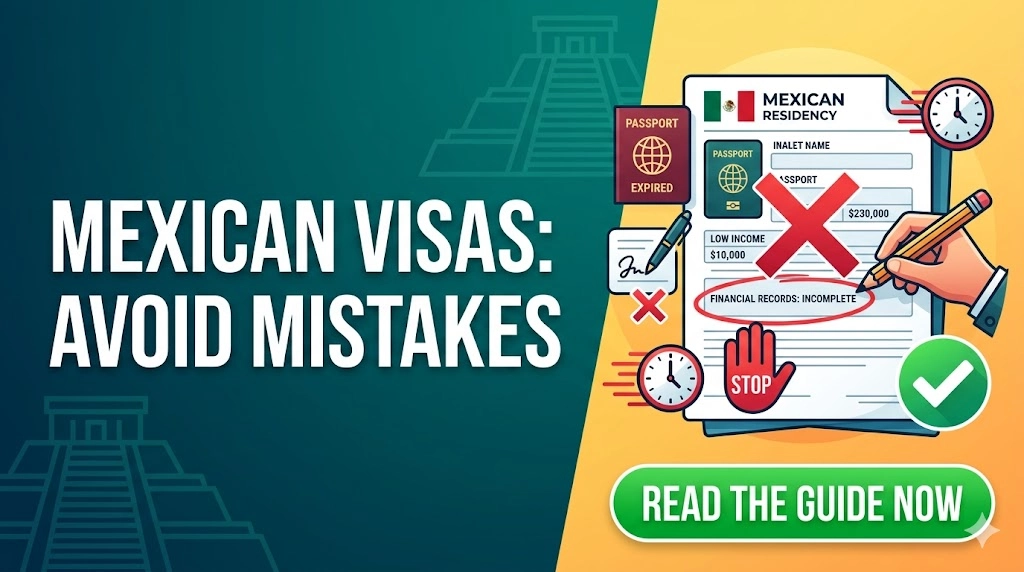
To qualify for residency, you must prove “Economic Solvency” at the consulate. In 2026, the financial thresholds are strict, requiring proof of roughly $4,400 USD in consistent monthly income or $75,000 USD in savings for a Temporary Visa.
Applicants routinely fail their consular interviews because they misunderstand how this proof must be presented.
The Screenshot Fallacy
You cannot log into your Chase or Barclays app, take a screenshot of your balance, print it out, and hand it to a consular officer. They will reject it instantly. Consulates require official, formal bank statements. Every single page of the statement must show your full legal name, your address, the bank’s official logo, and the exact daily or monthly balances. Furthermore, many North American consulates strictly require you to go into a physical bank branch and have a manager apply a “wet signature” and ink stamp to every page of your downloaded statements to prevent digital forgery.
The Certified Translation Mandate
If your bank statements, marriage certificates, or birth certificates are in English, French, or any language other than Spanish, they must be translated. You cannot run your documents through Google Translate. You cannot have your bilingual neighbor translate them. Mexican law rigidly dictates that foreign documents submitted for immigration purposes must be translated by a legally recognized, sworn translator (Perito Traductor).
We strongly recommend utilizing RushTranslate for your entire application dossier. They specialize in certified translations specifically formatted for complex immigration cases, and their work is universally accepted by Mexican consulates. By sending your financial statements, apostilled vital records, and affidavits to RushTranslate prior to your appointment, you ensure your proof of solvency is legally unassailable. Trying to save fifty bucks on a cheap translation is the fastest way to get a visa rejection.
Mistake 4: The Black Ink Catastrophe
It sounds like an urban legend, but it is one of the most rigidly enforced rules in the entire Mexican bureaucratic ecosystem.
When you prepare your formal request letters (Carta de Petición), sign your Formato Básico, or fill out any application forms for the INM, you will naturally reach for the nearest pen. If that pen is black, your application will be rejected at the window.
The Blue Pen Rule
Mexican government offices, particularly the INM, require all original signatures and handwritten form entries to be executed in blue ink.
The rationale behind this rule is anti-forgery. In an era of high-quality black-and-white and color photocopiers, an original blue ink signature is the easiest visual way for an INM agent to instantly verify that they are holding the original, legally binding document and not a duplicate. If you hand an agent a stack of papers signed in black ink, they will hand it back to you, tell you it is invalid, and send you to the back of a line that might take four hours to get through again.
The Solution
Buy a pack of blue ballpoint pens before you move to Mexico. Keep one in your passport holder. Never sign a Mexican legal document with anything else.
Mistake 5: The “Infantil” Photo Fiasco
When you apply for your physical residency card during the Canje process, you must provide physical photographs of yourself to be attached to your file. Expats frequently bring leftover passport photos from the US or Canada. The INM will reject them.
The Specifics of Mexican Immigration Photos
The INM requires a highly specific photo format known as Tamaño Infantil (Infant Size), which measures exactly 2.5 x 3.0 cm. But the size is only half the battle; the styling rules are draconian:
- Background: Must be stark white.
- Accessories: No glasses whatsoever (even if you wear them daily). No earrings, necklaces, or facial piercings.
- Visibility: Your forehead and ears must be completely exposed. If you have bangs, they must be pinned back. If you have long hair, it must be tucked behind your ears.
- Expression: You absolutely cannot smile. You must maintain a completely neutral, flat expression.
The Solution
Do not attempt to print these yourself at a pharmacy kiosk in your home country. Wait until you arrive in Mexico. Go to a local Farmacia Guadalajara, Walmart, or any small local photo studio and say: “Necesito fotos tamaño infantil para migración” (I need infant-size photos for immigration). They know the exact specifications and will produce a sheet of perfectly compliant photos for about $4 USD.
Mistake 6: The Exit Trap (Leaving Mexico During Processing)
This is a devastating mistake that ruins the relocation plans of hundreds of expats every year.
You have successfully submitted your Canje paperwork at the INM. The agent gave you a piece of paper with a tracking number (NUT), and told you to wait for an email to come back for fingerprinting. You figure that since the paperwork is processing, you have time to fly back to New York for a weekend to attend a wedding or close the sale on your old house.
If you leave Mexico, your application is permanently canceled.
The Passport Lock
During the Canje process (and during any future residency card renewals), your passport and your legal status are effectively “locked” inside the INM system. You are in a state of administrative limbo. You are no longer a tourist, but you do not yet possess the physical residency card that grants you the right to cross borders freely.
If you exit Mexican territory, the border control systems alert the INM, and your pending residency application is instantly annulled under the legal presumption that you have abandoned the process. You will not be allowed back into Mexico as a resident.
The Solution
Plan to be completely grounded inside Mexico for 4 to 8 weeks after submitting your initial paperwork to the INM. Do not book international flights. If a massive, unavoidable family emergency occurs, you can apply for a special “Exit and Return Permit” (Permiso de Salida y Regreso) from the INM, but this takes days to approve, costs extra money, and is highly stressful. The best strategy is to clear your travel calendar until the plastic card is physically in your wallet.
Mistake 7: The Permanent Resident “Car Trap”
If you are a well-funded retiree, you might qualify to skip Temporary Residency and apply directly for Permanent Residency. Or, you might be at the end of your four-year Temporary run and are getting ready to upgrade. You assume Permanent Residency is better in every way.
If you own a foreign-plated vehicle, Permanent Residency is a legal nightmare.
The TIP Ban
As a Temporary Resident, you are legally allowed to bring a US or Canadian car into Mexico under a Temporary Import Permit (TIP). That permit remains valid as long as your Temporary Residency is active.
Permanent Residents are strictly forbidden by federal customs law (Aduana) from driving or possessing a foreign-plated vehicle in Mexico.
The absolute second the INM approves your Permanent Residency, your TIP becomes legally void. Your vehicle instantly transforms into illegal contraband. If you are pulled over by the National Guard or customs agents while driving a foreign-plated car as a Permanent Resident, they have the legal authority to confiscate your vehicle on the spot. You will not get it back.
The Solution
You must resolve your vehicle situation before your Permanent Residency is approved. You must either drive the car back to the border, cancel the TIP, and leave it in your home country, or you must undertake the incredibly expensive, highly restrictive process of legally nationalizing the vehicle with Mexican plates. To fully understand this hurdle, read Bringing Your Car vs Buying in Mexico: Pros and Cons for Expats.
Mistake 8: Forgetting the RFC (Tax ID) Registration
Many expats believe that if they are retired, or if they work remotely for a company in Canada and never earn a single Mexican Peso, they are exempt from the Mexican tax system. This assumption will paralyze your life.
The Digital Mandate
The era of living off the grid in Mexico is over. The Mexican Tax Authority (SAT) now legally requires all Temporary and Permanent Residents to possess an RFC (Registro Federal de Contribuyentes), regardless of their employment status. This is the Mexican equivalent of a Social Security Number.
Without an RFC, you effectively do not exist in the Mexican financial system. You cannot:
- Open a Mexican bank account.
- Buy a car from a dealership.
- Sign a formal, post-paid cellular or fiber-optic internet contract.
- Buy or sell real estate without facing massive, punitive tax withholdings.
The Solution
Securing an appointment at the SAT is notoriously difficult and heavily backlogged. The exact day your physical residency card is issued, you must log onto the SAT portal and enter the virtual queue to get an appointment to register your RFC. If you are earning money locally, you must register under the correct tax regime. To understand your cross-border liabilities, read Taxes in Mexico for Expats: A Complete Guide to Income Tax and More.
Mistake 9: The Healthcare Gamble (Relying Solely on IMSS)
The Mexican government does not strictly mandate that you present proof of private health insurance to issue your visa, but moving to a foreign country without it is an immense financial and physical risk.
The Dual System Reality
As a legal resident, you are permitted to buy into the Mexican public healthcare system (IMSS) for a few hundred dollars a year. While IMSS is a good safety net for minor issues and pre-existing conditions, relying on it for an emergency is dangerous. The public system is chronically underfunded, heavily backlogged, and operates exclusively in Spanish. Waiting for a bed for complex surgery can take months.
Mexico boasts exceptional, world-class private hospitals (such as Hospital Ángeles or Star Médica). These elite facilities offer bilingual, premium care, but they are strict for-profit businesses. In an emergency, they will demand a massive, upfront credit card deposit—often ranging from $3,000 to $10,000 USD—before they will admit you to the ER. Medicare does not cover you in Mexico.
The Solution
Attempting to self-insure is financial suicide. You must secure robust international health coverage to guarantee VIP access to these private hospitals. We highly recommend securing an expat-tailored policy through Cigna Global. Their international plans offer direct billing networks with Mexico’s top private hospitals. This means the hospital coordinates the massive bills directly with Cigna Global, completely bypassing the need for you to drain your life savings while under duress. Ensure your physical and financial health is protected before your flight lands.
Mistake 10: Missing Your Expiration and Renewal Deadlines
The INM is not a customer service organization. They will not send you a friendly text message or an email reminding you that your Temporary Resident card is about to expire. It is entirely your responsibility to track your legal status.
The 30-Day Renewal Window
A Temporary Resident card is valid for one, two, or three years at a time. You must initiate your renewal application within the 30 calendar days immediately preceding the expiration date printed on the front of your card.
- If you apply 31 days before it expires, the system will reject you for applying too early.
- If you apply 1 day after it expires, your legal status vanishes. You are in the country illegally.
If you let your card expire, you must undergo a punitive “regularization” process. This involves writing formal letters of apology to the INM, paying massive federal fines (calculated based on how many days you overstayed), and spending months in administrative limbo. In severe cases, the INM may simply refuse to regularize you and issue a deportation order.
The Solution
The day you receive your residency card, set multiple digital calendar alerts on your phone and computer. Set an alert for six months before expiration, three months before, and exactly 30 days before. Treat the expiration date with the utmost severity. To understand the timeline of upgrading your status when you reach your four-year limit, review Upgrading from Temporary to Permanent Residency: What You Need to Know.
Conclusion: Mastering the System
Navigating the Mexican immigration system is a profound test of patience, organization, and cultural adaptation. The bureaucracy is undeniably heavy, and it is entirely unforgiving of assumptions or careless errors.
However, the reward for mastering this system is access to an extraordinary life. By avoiding the e-gates, respecting the strict legal deadlines, using blue ink, and securing your certified translations and health safety nets in advance, you strip the anxiety out of the process. You transform the INM from an insurmountable obstacle into a manageable checkpoint on the road to your new home.
References
Primary Sources (Official)
- Instituto Nacional de Migración (INM): The definitive federal portal detailing exact legal procedures, the Canje process, and strict renewal deadlines for all resident visas. https://www.inm.gob.mx/mpublic/publico/inm-tramites.html
- Secretaría de Relaciones Exteriores (SRE): The official portal outlining the consular requirements, appointment scheduling, and strict document formatting rules for initial visa applications. https://www.gob.mx/sre/acciones-y-programas/visas-para-extranjeros
Other Helpful Sources
- Mexperience: A highly trusted portal providing simplified explanations of Mexican bureaucracy, the UMA financial calculations, and common pitfalls for new expats. https://www.mexperience.com/lifestyle/mexico-immigration-guide/
- ExpatDen Mexico: A detailed, firsthand resource offering granular breakdowns of healthcare navigation, banking, and localized advice for avoiding administrative traps. https://www.expatden.com/mexico/
Disclaimer
The information provided in this comprehensive guide is for educational, logistical, and informational purposes only and does not constitute formal immigration, legal, tax, or medical advice. Requirements for document translations, UMA financial thresholds, and federal fee structures fluctuate annually. Always verify the most current requirements directly with your specific Mexican consulate, the INM, or Aduanas. We strongly recommend consulting with a certified bilingual Mexican immigration attorney or a registered immigration facilitator before submitting formal applications, paying government fees, or executing cross-border relocations.