Dual Citizenship in Mexico: Can You Keep Your Original Nationality?
One of the most profound, emotionally heavy decisions an expatriate can face is the prospect of changing their nationality. If you have spent years living in Mexico, building a business, marrying a local citizen, raising a family, or simply falling deeply in love with the culture, you have likely considered taking the ultimate step: becoming a fully naturalized Mexican citizen. However, holding two nationalities is not simply a cool party trick; it carries severe legal, tax, and border-control responsibilities. This comprehensive guide will break down exactly how the constitutional law works, the distinct pathways to naturalization, the critical “Article 32” restrictions placed on dual citizens, the inescapable tax realities of holding two passports, and the exact bureaucratic steps you must take to secure your new Mexican identity safely.
Disclosure: This post may contain affiliate links. We may earn a commission at no extra cost to you if you make a purchase through these links. Read full disclosure.
1. The Legal Foundation: The 1998 Constitutional Reform
To understand your rights today, you must understand a massive paradigm shift that occurred in Mexican constitutional law.
Before 1998, Mexico strictly forbade dual citizenship for adults. If a Mexican citizen moved to the United States and naturalized as an American, they were officially stripped of their Mexican nationality. Conversely, if a foreigner wanted to become Mexican, they were forced to stand before a judge and formally, permanently renounce their original nationality.
This archaic system changed dramatically with the amendment of Article 37 of the Mexican Constitution.
The New Reality of Dual Nationality
The Mexican government realized that forcing millions of its diaspora to choose between nationalities was economically and culturally destructive. The constitution was amended to establish a bedrock principle: Mexican nationality by birth can never be lost. Furthermore, the Nationality Law was updated to allow foreigners naturalizing in Mexico to retain their original citizenship.
What It Means for You
If you are a United States, Canadian, British, or European Union citizen applying for Mexican citizenship, the Mexican Secretariat of Foreign Affairs (SRE) will not ask you to surrender your original passport or renounce your homeland.
(Critical Note: You must also ensure your home country allows dual citizenship. The US, Canada, the UK, and Australia all currently permit their citizens to acquire a second nationality without penalty. Some nations, such as Japan or India, strictly prohibit dual citizenship and will strip you of your passport if you naturalize in Mexico. Always verify your home country’s specific nationality laws before proceeding.)

2. The Pathways to Mexican Citizenship
How do you actually acquire that second passport? The Mexican government categorizes citizenship into two distinct tracks: By Birth/Descent and By Naturalization.
Pathway A: Citizenship by Descent (Jus Sanguinis)
If you were born outside of Mexico, but at least one of your parents was a Mexican citizen at the time of your birth, you are legally considered a Mexican national by birthright.
- The Privilege: You do not have to live in Mexico, you do not have to take a Spanish language test, and you do not have to pass a history exam. You simply register your birth at a Mexican consulate abroad or at a Civil Registry (Registro Civil) inside Mexico.
Pathway B: Citizenship by Naturalization
If you have no Mexican bloodline, you must earn your citizenship through physical residency, legal compliance, and cultural integration.
- The Standard Route (5 Years): You must hold legal residency (either Temporary or Permanent, or a continuous combination of both) for five consecutive years immediately prior to your application date.
- The Fast Track (2 Years): The residency requirement is radically reduced to just two years if you meet specific, legally defined criteria:
- You are legally married to a Mexican citizen.
- You have a child who was born in Mexico (making the child a Mexican citizen by birth).
- You are a native of a Latin American country or the Iberian Peninsula (e.g., Spain, Colombia, Argentina).
- You have made outstanding cultural, social, scientific, or artistic contributions to the Mexican nation (this is highly subjective and rarely used).
To deeply understand the nuances of how to acquire and maintain the underlying residency required for these timelines, review our master guide on Qualifying for Permanent Residency in Mexico: Paths and Requirements.
The Integration Mandate: Passing the SRE Exam
If you are naturalizing, the Secretariat of Foreign Affairs (SRE) demands concrete proof that you have integrated into the culture. You must pass a rigorous, in-person examination.
- The Language Test: You must prove proficiency in the Spanish language. This includes a reading comprehension test and a conversational interview with an SRE official.
- The History & Culture Test: You must pass a multiple-choice exam covering Mexican history, geography, politics, and culture. (The SRE provides a study guide, but the test is known to be challenging).
- The Exemption: Applicants who are over the age of 60, or who are minors, are generally exempt from the rigorous history exam and instead undergo a basic, conversational Spanish interview.
3. The Golden Rule of Border Control: Article 12
Once you pass your exams, take the oath of allegiance, and the SRE hands you your official Carta de Naturalización (Naturalization Letter), your international travel logistics change permanently.
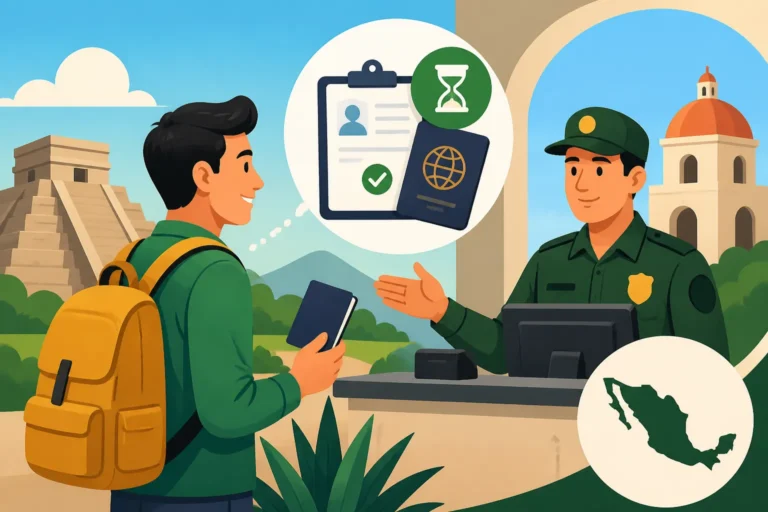
Under Article 12 of the Mexican Nationality Law, dual citizens are subject to a strict, non-negotiable rule regarding border control: If you are a Mexican citizen, you must always enter and leave Mexico presenting yourself as a Mexican.
You can no longer enter Mexico as an American tourist or a Canadian resident. You must enter as a citizen.
The Practical Application at the Airport
Managing two passports requires discipline. Here is how a bi-national trip works in practice:
- Leaving Mexico: When you go to the airport in Cancún to fly to New York, you must show the Mexican immigration (INM) officer your Mexican passport. This proves to the Mexican government that a citizen has left the country legally. You will also show your US passport to the airline agent to prove you have the right to land in America.
- Entering the United States: When you land at JFK in New York, you put your Mexican passport safely in your bag. You hand the US Customs and Border Protection (CBP) officer your US passport. (United States federal law strictly requires US citizens to enter and leave the US on their US passport).
- Returning to Mexico: When you fly back and land in Cancún, you hand the INM officer your Mexican passport. You are welcomed home as a citizen, entirely bypassing the tourist visa limitations.
For a comprehensive look at the logistical nuances of crossing the border and avoiding e-gate traps during your residency years leading up to citizenship, read Leaving Mexico and Re-entering: Travel Tips for Residents and Visa Holders.
The Danger of Ignoring the Rule
If you are a dual citizen and you attempt to enter Mexico using your US or Canadian passport (perhaps because your Mexican passport expired and you didn’t want to deal with the hassle of renewing it), you are violating federal law. You are essentially lying to the government by entering as a “tourist” when you are actually a citizen. This can result in severe fines, confiscation of your foreign passport at the border, and massive administrative headaches.
4. The “Article 32” Restrictions: What Dual Citizens Cannot Do
While dual citizenship grants you massive privileges—like the absolute right to vote in Mexican elections, work anywhere in the economy without INM permission, and bypass immigration lines forever—it does not make you exactly equal to a single-nationality Mexican in the eyes of the government.
The Mexican Constitution is fiercely protective of national sovereignty and state secrets. Article 32 explicitly restricts certain high-level societal and governmental roles to Mexicans who do not possess any other nationality.
As a dual citizen, you are legally barred from:
- Serving as the President of Mexico.
- Serving as a federal Senator or federal Deputy (Congressperson) in most circumstances.
- Serving as a Supreme Court Justice or high-level federal judge.
- Holding high-ranking command positions in the Mexican military (Army, Navy, Air Force) during peacetime.
- Serving as the captain, pilot, or chief engineer of Mexican-flagged commercial ships or commercial airlines (e.g., you cannot be a pilot for Aeroméxico or Volaris).
- Serving as a high-level federal police commander or in supreme national security roles.
If you harbor dreams of running for federal political office in Mexico or becoming an airline captain for a Mexican carrier, you would have to formally and legally renounce your US, Canadian, or UK citizenship to obtain a “Certificate of Mexican Nationality,” a specific document proving you only hold allegiance to the Mexican state. For 99% of expatriates, these high-level restrictions will never impact their daily lives.
5. The Ultimate Financial Perk: Real Estate in the Restricted Zone
One of the greatest financial and logistical motivations for expatriates to upgrade from Permanent Residency to dual citizenship involves the purchase of real estate.
The “Zona Restringida” (Restricted Zone)
Under the Mexican Constitution, foreigners are strictly, unequivocally prohibited from directly owning residential land within the Restricted Zone. This zone is defined as any land within 50 kilometers of the coastline or 100 kilometers of any international border.
To buy a beachfront condo in Playa del Carmen or a house in Rosarito, a foreigner must use a Fideicomiso (a bank trust). In a Fideicomiso, a Mexican bank holds the actual title to the property, but the foreigner is the designated primary beneficiary who retains all rights to use, rent, sell, or modify the property.
- The Drawback: While Fideicomisos are highly secure and standard practice, they are bureaucratic. They require high initial setup fees (often $2,000+ USD), mandatory annual bank administration fees (often $500 to $1,000 USD every single year), and must be renewed every 50 years.
The Citizenship Exemption
The absolute moment the SRE hands you your naturalization certificate, the Restricted Zone vanishes for you.
- You can buy beachfront property directly in your own name, obtaining a standard escritura (deed), completely bypassing the Fideicomiso system and saving thousands of dollars in bank fees over your lifetime.
- If you already own a home through a Fideicomiso as a resident, you can execute a legal procedure with a Notario Público to dissolve the trust and transfer the deed directly into your name as a Mexican citizen.
6. The Inescapable Tax Realities of Holding Two Passports
A common, incredibly dangerous myth spread in expat forums is that acquiring a second passport somehow shields you from the tax authorities of your home country, or allows you to “hide” your income in Mexico.
The Mexican Tax Reality (SAT)
Mexico taxes individuals based on physical residency, not citizenship. Whether you are a Temporary Resident, a Permanent Resident, or a fully naturalized dual citizen, if you physically live in Mexico for more than 183 days a year, the Mexican Tax Authority (SAT) considers you a tax resident. You are legally obligated to declare your global income to the SAT and pay taxes according to Mexican brackets.
The Home Country Reality (The US IRS Burden)
If you are a United States citizen, obtaining Mexican citizenship does absolutely nothing to sever your ties to the Internal Revenue Service (IRS).
- The United States is one of the only countries on earth that taxes based on citizenship, regardless of where you physically live or what other passports you hold.
- As a US-Mexican dual citizen, you must continue to file US federal tax returns every single year for the rest of your life, even if you never set foot in the US again.
- You must rigorously comply with FBAR (Foreign Bank and Financial Accounts Report) regulations, declaring your Mexican bank accounts to the US Treasury if their combined value exceeds $10,000 USD at any point in the calendar year.
- Fortunately, the US and Mexico hold robust double-taxation treaties. By utilizing the Foreign Earned Income Exclusion (FEIE) or the Foreign Tax Credit (FTC), most expats avoid paying taxes twice on the same income. But the reporting and filing burden remains absolute.
To navigate this highly complex financial landscape and avoid devastating audits, thoroughly review our master guide: Taxes in Mexico for Expats: A Complete Guide to Income Tax and More.
7. The Bureaucratic Gauntlet and the Translation Mandate
If you have successfully completed your 2 or 5 years of residency and are ready to apply for naturalization in 2026, you must prepare for a rigorous document audit by the SRE. The application is not simply a digital form; it is a massive physical dossier.
You will need to submit:
- Your current, unexpired foreign passport.
- Your Mexican Permanent or Temporary Resident card.
- A federal criminal background check from Mexico, and often local/state police checks from your home country.
- A detailed, cross-referenced list of all your entries and exits from Mexico over the last two years. (Crucial rule: You cannot have been outside of Mexico for more than 180 days in total during the two years immediately prior to applying for citizenship).
The Foreign Document Authentication Trap
If you are naturalizing based on the 2-year fast track because of your marriage to a Mexican citizen, or if you are claiming citizenship by descent using your parents’ paperwork, you will have to present foreign vital records (like your US birth certificate or your Canadian marriage license).
A foreign document is legally meaningless to the Mexican SRE in its original English, French, or German form.
- The Apostille: The document must be internationally authenticated via an Apostille from the issuing government (e.g., the US Secretary of State).
- The Certified Translation: Once apostilled, Mexican federal law strictly mandates that the document must be accompanied by a certified Spanish translation.
You cannot use an AI web translator. You cannot ask your bilingual spouse to translate it. The Mexican government explicitly requires translations performed by a recognized, sworn translator embedded within the Mexican legal system (a Perito Traductor).
We strongly recommend utilizing RushTranslate for your entire naturalization dossier. They specialize in certified, sworn translations specifically formatted for the highly sensitive, complex standards of the Mexican SRE and INM. By sending your apostilled birth certificates, marriage licenses, and foreign background checks to RushTranslate prior to your SRE interview, you ensure your identity documents are legally flawless and universally accepted. When you are applying for the ultimate prize of citizenship, do not risk a rejection—and months of agonizing delays—over a translation technicality.
8. Healthcare Across Borders: The Dual Citizen Dilemma
Becoming a Mexican citizen grants you absolute, unrestricted, and permanent access to the Mexican public healthcare system (IMSS or IMSS-Bienestar).
However, dual citizenship often creates a false sense of medical security for expatriates who split their time between their two countries.
The Coverage Void
- In Mexico: While IMSS is low-cost for citizens, the public system is chronically underfunded, heavily backlogged, and lacks the resources for immediate, complex emergency care. Most middle-class and affluent Mexican citizens do not use the public system; they rely entirely on the private healthcare sector (utilizing top-tier hospitals like Hospital Ángeles or Star Médica).
- In Your Home Country: If you fly back to the United States to visit family or attend a conference, your Mexican public healthcare does absolutely nothing for you. Conversely, your US Medicare or Canadian provincial health plan does not cross the border with you into Mexico.
The Private Healthcare Imperative
If you are a dual citizen with a bi-national lifestyle, you cannot rely on piecemeal, government-funded healthcare. A severe medical emergency—a cardiac event in Mexico City or a traffic accident in Miami—can instantly wipe out your life savings if you are on the “wrong” side of the border when it happens.
You must secure robust, globally portable health coverage. We highly recommend securing an elite international policy through Cigna Global.
Their expat-tailored plans offer direct billing networks with Mexico’s top-tier private hospitals, meaning the hospital coordinates the massive bills directly with Cigna Global rather than demanding a $10,000 USD credit card deposit while you are bleeding in the emergency room. Furthermore, their plans can be explicitly customized to cover you seamlessly when you travel back to your home country. Securing this coverage ensures your dual-citizen lifestyle is physically and financially protected, no matter which passport you use to cross the border.
To deeply understand the nuances of how these two distinct medical systems operate, review Healthcare in Mexico: Complete Guide for Expats Public vs Private.
9. Summary Action Checklist for Prospective Dual Citizens
If you are ready to take the oath and claim your Mexican identity, use this rapid-fire checklist to ensure your transition is legally unassailable:
- [ ] Verify Your Eligibility Track: Confirm you have completed the required continuous residency (5 years for the standard route, or 2 years for the marriage/Mexican children fast track).
- [ ] Audit Your Travel History: Check your passport stamps meticulously. Ensure you have not been outside of Mexico for more than 180 days in total during the two years immediately preceding your application date.
- [ ] Gather and Apostille: Collect your original home-country birth certificate and required background checks, and secure their international Apostilles from your home government.
- [ ] Translate Flawlessly: Send all apostilled foreign documents to RushTranslate for a legally sworn, SRE-compliant Spanish translation before you apply.
- [ ] Study for the Exam: Brush up on Mexican history, geography, and your Spanish conversational skills to ensure you pass the SRE integration exam on the first try.
- [ ] Understand the Border Rule: Commit to memory that once you hold the Carta de Naturalización, you must forever enter and leave Mexico using a Mexican passport.
- [ ] Secure Global Healthcare: Protect your bi-national lifestyle and your assets by securing a comprehensive Cigna Global international health policy.
- [ ] Consult a Tax Professional: Speak with a cross-border CPA to ensure your new permanent status aligns with your FBAR and IRS reporting requirements.
Choosing to become a dual citizen is a profound, beautiful commitment to the country that has welcomed you. By understanding the constitutional protections of Article 37, respecting the border mandates of Article 12, and meticulously preparing your translated, authenticated dossier, you eliminate the bureaucratic anxiety of the process. You are no longer just a passing tourist or a temporary guest; you are a fully integrated, legally protected, and immensely proud citizen of Mexico.
References
Primary Sources (Official)
- Secretaría de Relaciones Exteriores (SRE): The definitive federal portal detailing the exact legal requirements, forms, study guides for the history exam, and procedures for applying for Mexican naturalization. https://sre.gob.mx/tramites-y-servicios/nacionalidad-y-naturalizacion
Other Helpful Sources
- Mexperience: A highly trusted portal providing simplified explanations of the naturalization timeline, the exam process, and the financial benefits of bypassing the real estate Fideicomiso. https://www.mexperience.com/lifestyle/mexico-immigration-guide/
- ExpatDen Mexico: A detailed, firsthand resource offering granular breakdowns of navigating the SRE, managing dual-country tax liabilities, and securing private international healthcare as a bi-national resident. https://www.expatden.com/mexico/
Disclaimer
The information provided in this comprehensive guide is for educational, logistical, and informational purposes only and does not constitute formal immigration, legal, tax, or medical advice. The approval of a naturalization application is granted at the absolute discretion of the SRE. Always verify the most current requirements directly with the SRE or your nearest Mexican consulate before initiating the process. We strongly recommend consulting with a certified bilingual Mexican immigration attorney to manage your citizenship dossier, and a cross-border tax specialist (such as a US CPA and a Mexican Contador Público) to ensure you remain compliant with both SAT and IRS regulations.