Residency for Parents of a Mexican-Born Child: Benefits and Process
Having a child in a foreign country is one of the most exhilarating, terrifying, and logistically complex decisions an expat family can make. Between navigating a new medical system in a second language and preparing a nursery far from home, the anxiety can feel overwhelming. However, in Mexico, giving birth on local soil unlocks what is widely considered the single most powerful, legally protected immigration pathway in the country. This comprehensive guide decodes the exact processes, medical realities, and lifelong benefits of securing Mexican Permanent Residency as the parent of a Mexican-born child.
Disclosure: This post may contain affiliate links. We may earn a commission at no extra cost to you if you make a purchase through these links. Read full disclosure.
1. The Ultimate Immigration Pathway: Jus Soli
To understand why this specific residency pathway is so incredibly powerful, you must first understand the foundational philosophy of Mexican nationality law.
The Principle of Birthright Citizenship
Mexico operates under the legal doctrine of Jus Soli (right of the soil). According to Article 30 of the Mexican Constitution, any individual born within the territory of the Republic is automatically, irrevocably a Mexican citizen by birth. It does not matter if the parents are tourists, temporary residents, permanent residents, or even completely undocumented foreigners. If the child takes their first breath on Mexican soil, they are granted full Mexican citizenship.
This is a profound legal reality. Your child will instantly possess the right to a Mexican passport, the right to vote in Mexican elections when they come of age, and the unrestricted right to live, work, and own coastal or border real estate (zonas restringidas) without ever needing a bank trust (fideicomiso).
The Constitutional Protection of Family Unity
Because your child is a Mexican citizen, the Mexican government is legally and constitutionally bound to protect their family unit. The state cannot deport the parents of a Mexican citizen, nor can it force a Mexican child to live in exile because their foreign parents lack proper visas.
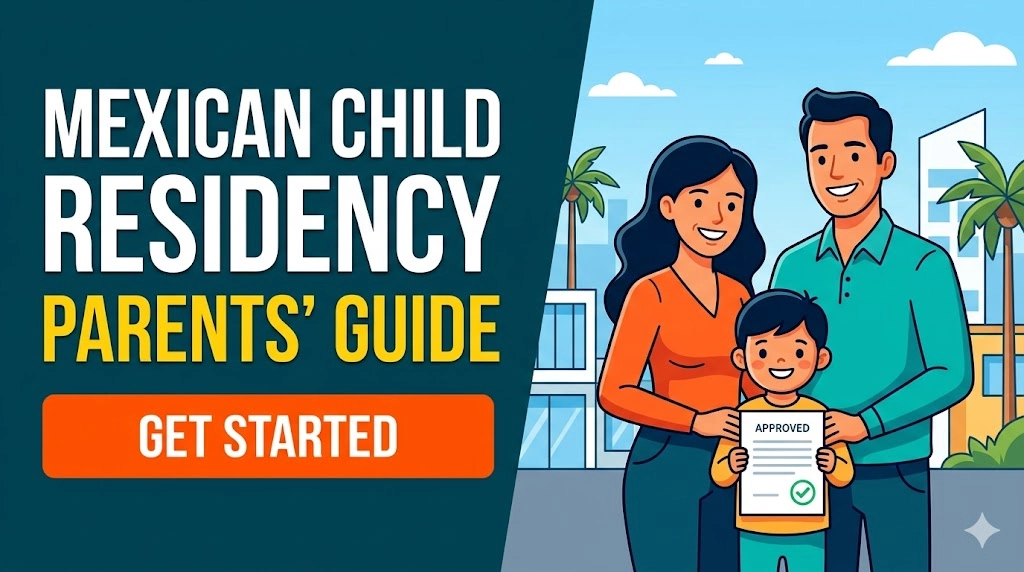
This constitutional mandate creates the Vínculo Familiar (Family Unity) immigration pathway. Because the government prioritizes keeping the family intact on Mexican soil, the foreign parents of a Mexican-born child are immediately eligible to apply for Permanent Residency (Residente Permanente). This completely bypasses the grueling, standard immigration hurdles that childless expats must endure.
2. The Massive Benefits of Birthright Residency
If you have researched standard Mexican immigration, you already know that the typical pathway to residency is a massive financial and bureaucratic burden. Qualifying via a Mexican-born child eliminates almost all of that friction.
Bypassing the UMA Financial Solvency Thresholds
The single greatest advantage of this pathway is the complete elimination of economic solvency requirements.
Under standard immigration laws in 2026, a foreign professional seeking a Temporary Resident visa must prove massive monthly income (often exceeding $4,500 to $5,200 USD per month) or liquid savings (often exceeding $75,000 to $85,000 USD). These thresholds are tied to the UMA (Unidad de Medida y Actualización) economic index and rise aggressively every year, pricing thousands of expats out of the country.
When you apply for residency as the parent of a Mexican citizen, the financial solvency requirements are entirely waived. The Instituto Nacional de Migración (INM) does not ask to see your bank statements, your investment portfolios, or your remote work paystubs. Your right to residency is based entirely on blood ties, not your bank account. This is an absolute miracle for young families, freelance creatives, and digital nomads who do not meet the towering 2026 UMA thresholds. We detail the severity of these standard financial barriers in our guide to the Mexico Temporary Resident Visa: Comprehensive Guide for Expats (2026 Update).
Immediate Permanent Status (Skipping the Temporary Phase)
Standard expats who do meet the financial requirements are only granted Temporary Residency. They receive a one-year card, followed by mandatory, expensive annual renewals for three more years. Only after four consecutive years of temporary status can they legally apply for Permanent Residency.
As the parent of a Mexican citizen, you skip this four-year waiting period entirely. You are granted Permanent Residency immediately upon the approval of your application. You receive a plastic card that never expires. You never have to return to the INM for an annual renewal, completely freeing you from the ongoing bureaucratic anxiety that haunts temporary expats.
Automatic Working Rights
Temporary residents are explicitly prohibited from working in the local Mexican economy without securing a complex, corporate-sponsored work permit.
Because you are granted Permanent Residency, you are automatically and instantly granted unrestricted working rights. You do not need corporate sponsorship. You can legally open a local business, hire Mexican employees, or accept a lucrative contract from a domestic Mexican corporation paid in MXN. This absolute freedom to participate in the local economy is a massive advantage for entrepreneurial families, a dynamic we explore deeply in Digital Nomads in Mexico: Remote Work Guide.
The Fast-Track to Citizenship (Naturalization)
Standard permanent residents must live in Mexico for five continuous years before they are eligible to apply for naturalized Mexican citizenship.
As the parent of a Mexican citizen, your timeline is drastically accelerated. You become eligible to apply for your own naturalized Mexican citizenship (and a Mexican passport) after just two years of holding your Permanent Residency card. Securing dual citizenship provides the ultimate level of security and integration, ensuring you and your child share the exact same national rights.
| Feature | Standard Economic Residency | Residency via Mexican Child |
| Financial Solvency Proof | ~$5,000/mo or ~$85k savings | Waived (None Required) |
| Initial Status Granted | Temporary (1 Year) | Permanent (Never Expires) |
| Working Rights in Mexico | Requires Separate Permit | Automatically Granted |
| Time to Citizenship | 5 Years | 2 Years |
| Application Geography | Must begin outside Mexico | Can be done inside Mexico |
3. The Medical Reality: Planning a Delivery in Mexico
Before you can claim the legal benefits of your child’s birth, you must physically navigate the Mexican healthcare system to safely deliver your baby. This requires meticulous planning, realistic budgeting, and robust insurance coverage.
Private vs. Public Hospitals
While the Mexican public healthcare system (IMSS) is available, the vast majority of expats and middle-to-upper-class Mexican nationals opt exclusively for the private healthcare sector when delivering a baby.
Private hospitals in major expat hubs like Mexico City (e.g., Hospital ABC, Hospital Ángeles), Guadalajara (e.g., Hospital San Javier), and Monterrey are absolutely world-class. They feature state-of-the-art neonatal intensive care units (NICU), luxury recovery suites, and highly credentialed, bilingual obstetricians. The level of personalized care and attention in top-tier Mexican private hospitals frequently exceeds the standard of care found in the United States or Canada.
The Financial Costs of Delivery
In the private sector, healthcare is a business. You must be prepared to pay for every aspect of the delivery.
If you are paying entirely out-of-pocket, a standard, uncomplicated vaginal delivery in a premium private hospital will typically cost between $2,000 and $4,000 USD. However, Mexico has one of the highest Cesarean section rates in the world. Many private obstetricians heavily favor scheduled C-sections for logistical predictability. A planned C-section package typically runs between $3,500 and $6,000 USD.
These “package” prices generally cover a two-night hospital stay, the operating room fees, the anesthesiologist, and the pediatrician who examines the newborn. However, these packages do not cover severe complications. If your baby requires a week in the NICU, or if the mother experiences post-partum hemorrhaging requiring intensive care, your bill will skyrocket exponentially. We break down the terrifying reality of these escalating out-of-pocket costs in Healthcare Costs in Mexico: Doctor Visits, Hospital Stays, and Surgery Expenses.
The Critical Need for International Health Insurance
You cannot gamble with the financial and physical health of your expanding family. Relying on out-of-pocket cash to fund a delivery leaves you catastrophically vulnerable to medical emergencies. Private Mexican hospitals will demand massive, immediate credit card deposits before admitting you to emergency surgery if complications arise.
Securing a premium, borderless policy from Cigna Global is the ultimate defense for an expat family planning a pregnancy abroad. Because Cigna Global is a specialized international provider, their comprehensive maternity modules are designed explicitly for expats utilizing top-tier private global facilities.
Having an active Cigna Global policy ensures that your prenatal care, delivery costs, and any unforeseen neonatal emergencies are covered. More importantly, it guarantees that you will never be denied admission to a luxury private hospital due to a lack of immediate liquidity. You can focus entirely on the safe delivery of your child, knowing the financial liabilities are fully absorbed by a world-class insurer. Note: Most international health insurance plans require a 10-to-12 month waiting period before maternity benefits kick in; you must secure this policy long before you actually conceive.
4. Bureaucracy Phase 1: The Civil Registry (Registro Civil)
The moment your baby is born, a massive bureaucratic clock begins ticking. Before you can apply for your residency, you must formally, legally prove that your child exists and that you are the parents. This happens at the local Registro Civil (Civil Registry).
The Certificado de Nacimiento
Before you leave the hospital, the delivering physician will hand you a Certificado de Nacimiento (Certificate of Birth). This is a medical document, not a legal one. It proves the physical birth occurred, but it does not grant citizenship. You must take this medical certificate to the Registro Civil to obtain the official, legal Acta de Nacimiento (Birth Certificate).
The Dual Surname Dilemma (Los Apellidos)
When you register your child’s birth in Mexico, you will encounter a profound cultural and legal naming convention that frequently causes immense stress for expats.
Under Mexican law, every individual must have two last names (apellidos). The first last name is the father’s primary last name. The second last name is the mother’s primary last name (her maiden name).
If John Smith and Mary Johnson have a baby named David, the baby’s legal Mexican name will be David Smith Johnson.
This system is rigidly enforced. You generally cannot give your child a single last name, nor can you give them a hyphenated single last name, without initiating a complex legal injunction (amparo). If you intend to secure a foreign passport for your child later (e.g., a US or UK passport), you must be prepared for the fact that their legal Mexican name might slightly differ from the name their home country issues on their consular report of birth abroad.
Translating the Parents’ Identities
To legally register the birth of your child and print their Acta de Nacimiento, the Registro Civil must verify the identities of the foreign parents. You will be required to present your foreign passports and, crucially, your own foreign birth certificates and your foreign marriage certificate (if applicable).
Because the Mexican government operates exclusively in Spanish, they will not accept a Canadian marriage license or a US birth certificate printed in English. Furthermore, these foreign documents must be formally authenticated by your home country via an Apostille stamp.
Once you secure your apostilled foreign documents, they must be officially translated into Spanish. You cannot translate these yourself, nor can you use an automated internet translator. The Registro Civil demands a legally certified translation.
This is where leveraging a premium service like RushTranslate is absolutely mandatory. Civil registry documents are dense and highly formalized. A single mistranslated legal term on your marriage certificate can trigger a bureaucratic denial, preventing you from registering your newborn child. By submitting your apostilled family documents to RushTranslate, you receive legally certified, flawlessly accurate Spanish translations back within 24 hours. Because RushTranslate guarantees acceptance by global government authorities, you eliminate the risk of rejection, ensuring your baby’s birth certificate is issued promptly.
Securing the CURP
Once the Acta de Nacimiento is printed, the Registro Civil will automatically generate your child’s CURP (Clave Única de Registro de Población). This 18-character alphanumeric code is your child’s official national identity number. Possessing the original Acta de Nacimiento and the CURP printout are the two master keys required to unlock your Permanent Residency.
5. Bureaucracy Phase 2: The INM Application Process
With your child officially registered as a Mexican citizen, you can now initiate the immigration process to secure your own legal status.
Applying from Within Mexico (Cambio de Condición)
As mentioned earlier, standard economic residency applications must begin outside of Mexico at a foreign consulate. However, the Family Unity (Vínculo Familiar) pathway offers a massive, legal geographical exception.
Because you are the parent of a Mexican citizen, you are legally permitted to change your immigration status from within Mexico. If you are currently in the country on a 180-day tourist permit (Visitante) or a Temporary Resident card, you simply apply for a Cambio de Condición (Change of Status) directly at your local INM office. You do not have to fly back to your home country to endure a grueling consular interview.
Assembling the Perfect INM Binder
Walking into a government INM office inside Mexico is a brutal test of your psychological endurance. You must present a meticulously organized physical binder of your documents. The Mexican bureaucracy operates on the “cult of the photocopy.” If the mandate asks for one copy, bring five pristine copies of every single page.
Your portfolio must include:
- Your original foreign passport and pristine photocopies of all data pages.
- Your current tourist FMM or Temporary Resident card.
- The original, freshly issued Mexican Acta de Nacimiento of your child.
- The official printout of your child’s CURP.
- Your apostilled, foreign birth certificates and marriage certificates, accompanied by the certified Spanish translations executed by RushTranslate.
- The official INM Formato Básico application form.
- A formal, signed letter (written entirely in Spanish) formally requesting Permanent Residency based on your constitutional right to family unity with your Mexican child.
- Receipts proving the payment of the government application fees at a local bank.
Surviving the Waiting Room and the Legal Limbo
You must secure an appointment at your local INM delegación. You will spend hours sitting in sterile, chaotic waiting rooms. The officials processing your file are under no obligation to speak English. If you do not understand their instructions, they will simply tell you to step aside. Patience, profound humility, and a polite demeanor are your only weapons here. We discuss how to properly navigate this specific cultural deference in Mexican Etiquette and Customs: Do’s and Don’ts for New Expats.
After you submit your paperwork, the INM can take anywhere from four weeks to four months to issue a final resolution. During this time, you exist in a highly vulnerable legal limbo.
The restrictions during this waiting period are absolute. You are absolutely forbidden from leaving the country. If you attempt to cross the border and fly home while your residency application is pending, your application is instantly abandoned, and all government fees are forfeited. You are physically trapped inside Mexico until the plastic card is in your hand. If an absolute life-or-death emergency requires travel, you must apply for a highly restricted Permiso de Salida y Regreso (Exit and Return Permit), which takes days to secure.
6. The Ripple Effect: Grandparents and Siblings
The immense power of the Jus Soli birthright does not stop at the parents. The constitutional protection of the Mexican family extends upward and outward across the generational family tree.
Sponsoring the Expat Grandparents
Because your child is a Mexican citizen, the biological grandparents of that child (your expat parents) are also immediately eligible to apply for Permanent Residency under the exact same Vínculo Familiar pathway.
This is a massive, highly strategic loophole for multi-generational families. If you have aging parents in the US, Canada, or Europe who wish to retire in Mexico, they do not have to prove massive pension income or liquid savings to the consulate. They simply use their Mexican grandchild as their legal anchor.
To execute this, the grandparents must legally prove their unbroken bloodline to the Mexican child. This means they must present the baby’s Mexican birth certificate, the expat parent’s apostilled foreign birth certificate (proving the parent-child relationship), and the grandparent’s passports. Because multiple generations of foreign documents are involved, the translation burden is heavy. Sending the entire family tree of civil documents to RushTranslate ensures the unbroken lineage is certified in flawless Spanish, allowing the INM to seamlessly approve the grandparents’ permanent residency.
Sponsoring Expat Siblings
If you have other children who were born outside of Mexico (the older expat siblings of the new Mexican baby), they are also eligible for residency based on their Mexican sibling.
However, they are generally granted Temporary Residency, not Permanent Residency. Their status is tethered to the family unit until they come of age. It ensures that the entire immediate family can legally remain together on Mexican soil without being separated by arbitrary immigration thresholds.
7. Normalizing Life as a Permanent Resident
The day you are finally called back to the INM office to pick up your physical, plastic Residente Permanente card is a day of profound liberation. The legal anxiety of living abroad is permanently extinguished.
Unlocking the Formal Economy
With your Permanent Residency card in hand, you must immediately integrate into the formal systems you were previously locked out of. Your very first task is to visit the SAT office to secure your official RFC (Tax ID). Securing this localized tax number is legally mandatory and allows you to finally legitimize your financial existence.
Next, you must walk into a local Mexican bank and open a domestic bank account. This severs your reliance on dangerous cash withdrawals and allows you to pay your hospital bills, rent, and daily expenses via the instantaneous SPEI digital network. We break down the exact steps to unlock this network and protect yourself from predatory fees in How Do Expats Typically Pay Rent in Mexico? Cash vs Bank Transfers.
Managing Tax Implications
Achieving Permanent Residency triggers an inescapable financial shift. Because you hold permanent status and your immediate family (your Mexican child) resides in the country, the federal tax authority (SAT) officially considers Mexico your primary center of vital interests.
You are legally obligated to declare your global income to the Mexican government. You must proactively consult with a cross-border CPA to ensure you are compliant with local laws while utilizing foreign tax credits to avoid devastating double taxation. We dissect this complex, highly stressful reality thoroughly in our guide on Taxes in Mexico for Expats: A Complete Guide to Income Tax and More.
Dual Citizenship for Your Child
While your child is Mexican, you will almost certainly want to secure dual citizenship for them from your home country. You must contact your local embassy (e.g., the US Embassy in Mexico City) to file a Consular Report of Birth Abroad (CRBA).
This process requires you to submit the child’s Mexican birth certificate and your foreign passports. Once approved, your child will possess both a Mexican passport and a foreign passport, granting them unparalleled global mobility and the ultimate freedom to choose where they live, work, and study for the rest of their lives.
Conclusion: A Legacy of Freedom
Choosing to deliver your child in Mexico is not merely a medical decision; it is a profound, generational legal strategy. You are gifting your child the undeniable power of dual citizenship and access to a vibrant, culturally rich nation.
Simultaneously, you are gifting yourself the ultimate immigration prize. By surviving the medical logistics, the exhaustive translations, and the bureaucratic INM waiting rooms, you secure Permanent Residency. You trade the rigid, hyper-scheduled anxiety of the Anglosphere for a permanent, legally unhindered life in Mexico, completely free from the towering financial thresholds that block thousands of other expats. It is the ultimate reward for embracing the beautiful chaos of building a family abroad.
References
Primary sources (official)
- RushTranslate: Premier certified translation service ensuring your apostilled foreign birth certificates, marriage licenses, and civil registry documents are flawlessly translated and legally accepted by the Mexican Registro Civil and INM authorities. https://rushtranslate.com/
Other helpful sources
- Cigna Global: Comprehensive international health insurance provider, offering borderless maternity policies that protect expat families from massive private hospital bills and catastrophic neonatal emergencies. https://www.cignaglobal.com/
Disclaimer
The information provided in this article is for educational and informational purposes only and does not constitute official legal, immigration, medical, or tax advice. Mexican immigration laws, the specific eligibility criteria for the Cambio de Condición por Vínculo Familiar, and INM administrative procedures are highly complex, strictly enforced, and subject to rapid, unannounced changes at the federal level. The interpretation of family unity laws regarding extended family members may vary by specific INM delegation. Always conduct extensive due diligence, verify current apostille and translation requirements directly with your local Registro Civil and INM office, and consult with a licensed, bilingual Mexican immigration attorney before making binding relocation decisions or planning a medical delivery abroad.