Household Quirks in Mexico: Water Cisterns, Gas Tanks, and More
You step into the shower, lather up your hair with expensive imported shampoo, and suddenly the water slows to a pathetic trickle before stopping entirely. I’ve been there, standing frozen and soapy in a cold stall, realizing I forgot to check the cistern level. This guide solves the mystery of the unique, and sometimes maddening, household systems that keep a Mexican home running.
Disclosure: This post may contain affiliate links. We may earn a commission at no extra cost to you if you make a purchase through these links. Read full disclosure.
Navigating the Complex Mexican Water System
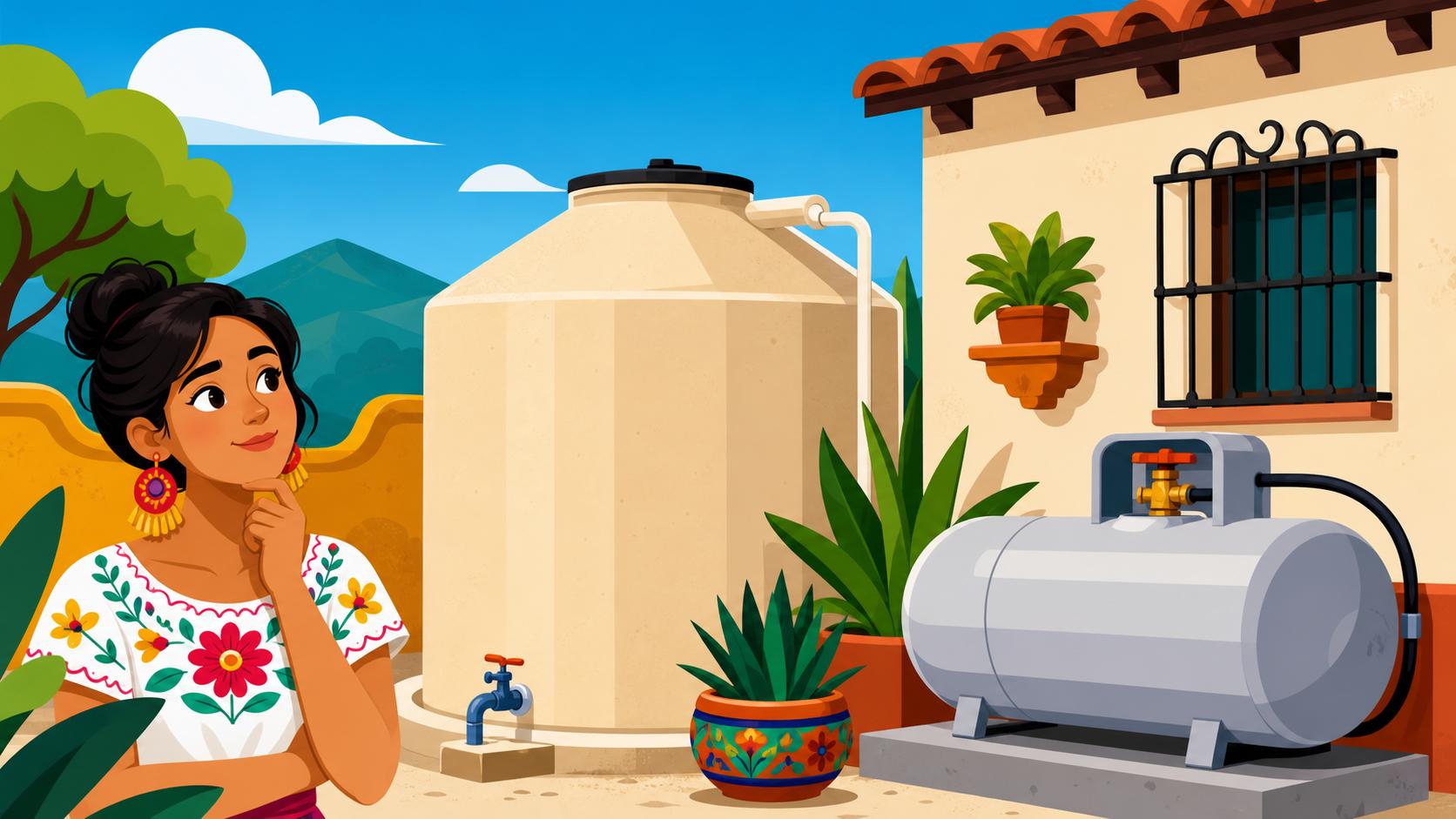
Unlike many countries where water arrives at your tap via consistent municipal pressure, the Mexican water system is a multi-stage process that requires active management. Most homes rely on a combination of a ground-level or underground cistern, known as an aljibe, and a rooftop delivery tank, known as a tinaco. Understanding the dance between these two is the first step to ensuring you never run dry.
The Tinaco and Aljibe Relationship
The aljibe is your primary reservoir. It sits beneath your garage or garden and collects water from the city line. Because city water pressure in Mexico can be intermittent—sometimes only running for a few hours a day or a few days a week—the aljibe ensures you have a backup supply. However, you cannot get water to your second-floor shower from the ground. This is where the tinaco comes in.
The tinaco is that giant black or beige plastic drum you see on almost every rooftop in Mexico. A water pump (bomba) pushes water from the aljibe up to the tinaco. Most homes use a gravity-fed system, meaning the weight of the water in the rooftop tank provides the pressure for your faucets. If your pump fails or the float switch (electronivel) gets stuck, the tinaco won't refill, and you’ll run out of water despite having a full cistern downstairs. If you find yourself in a bind while waiting for a plumber, staying at a managed property like Selina can provide a much-needed break from these DIY infrastructure headaches.
Maintaining Your Water Pump and Pressure
The water pump is the heart of your home. These pumps are often exposed to the elements and can be temperamental. It is common for the "prime" to be lost if air gets into the line, requiring you to manually add water to the pump mechanism to get it sucking again. Furthermore, the gravity-fed pressure from a tinaco is often lower than what many expats are used to.
To solve this, many foreigners install a "pressurizer" (presurizadora). This is a small device that kicks in whenever a tap is opened, mimicking the high-pressure experience of a US or European home. If you are Renting a Home in Mexico: Complete Expat Guide to Leases, Deposits, and More, always ask if the house has a pressurizer or if you are strictly relying on gravity. Low pressure can make it nearly impossible to use modern dishwashers or high-end showerheads.
Filtration and Potability
One of the most persistent questions for newcomers is: Is Tap Water Safe to Drink in Mexico? The short answer is no. While the water leaving the treatment plant might be potable, the journey through aging city pipes and sitting in your rooftop tinaco (which may not have been cleaned in years) introduces contaminants.
Most expats rely on garrafones, the 20-liter blue jugs delivered to your door. However, a more sustainable long-term solution is installing a multi-stage reverse osmosis system under your sink. You can easily find these filtration kits on Amazon Mexico, and they save you the physical strain of hauling heavy jugs up the stairs every week. For more on managing your daily health and hydration, check out Drinking Water in Mexico: Filter or Bottled? What Expats Do.
| System Component | Location | Function | Maintenance Level |
|---|---|---|---|
| Aljibe | Underground | Bulk storage of city water | Low (Clean every 2 years) |
| Tinaco | Rooftop | Provides gravity-fed pressure | Medium (Check float switch) |
| Bomba (Pump) | Near Aljibe | Moves water from bottom to top | High (Watch for leaks/priming) |
| Presurizadora | Near Tinaco | Boosts water pressure for showers | Medium (Electrical check) |
Managing Gas LP and Water Heaters
In Mexico, "city gas" via a pipeline is rare, limited mostly to specific neighborhoods in massive hubs like Mexico City or Monterrey. For the rest of us, life is powered by Liquid Petroleum (LP) gas. This gas fuels your stove, your clothes dryer, and, most importantly, your hot water.
Stationary Tanks vs. Gas Cylinders
There are two ways to store gas: a stationary tank (tanque estacionario) located on your roof, or portable cylinders (cilindros) kept in a utility area. Stationary tanks are far superior for expats. They usually have a gauge so you can see how much fuel is left, and the gas truck comes to your house, pulls a long hose to the roof, and fills it up.
Portable cylinders, on the other hand, require you to swap the entire tank. You have to listen for the distinctive jingle or shouted cry of the "Gasero" driving through the neighborhood. Managing these can be a logistical nightmare if you don't speak the language yet. I highly recommend Propane Gas 101: Using Gas Tanks and Deliveries in Mexico to understand the nuances of how to read your gauge and avoid being overcharged by unscrupulous delivery drivers.
How to Order Gas and Avoid Scams
Ordering gas is an essential skill for Living in Mexico: Cultural and Practical Guide for New Expats. You can call the gas company directly, use their app, or sometimes even WhatsApp them. When the truck arrives, make sure the meter on the truck starts at zero. A common "quirk" is for drivers to skip the zeroing process, charging you for gas you didn't receive.
If you are just moving in and haven't set up a local phone line yet, using an eSIM from Airalo can give you the data you need to find local gas companies and use translation apps to communicate with the driver. Always tip the gasero a few pesos, especially if they have to drag that heavy hose through a complicated courtyard or over a high wall.
Boiler Types and Maintenance
The boiler (water heater) in a Mexican home is often a "pilot light" style or an "on-demand" (instantaneous) heater. Instant heaters are great for saving gas, but they require a certain amount of water pressure to trigger the heating element. If your tinaco is low or your pump is off, you might find yourself with plenty of water but zero heat.
If you have a traditional tank boiler, you’ll likely need to light the pilot light manually if it blows out in a heavy wind. Learning the specific "click and turn" sequence of your boiler is a vital part of your first week in a new home. If you're struggling with the logistics of setting these up, you can find more help in our guide on Home Utilities in Mexico: Setting Up Electricity, Water, Gas, and Internet.
Electrical Systems and Utility Management
The electrical grid in Mexico, managed by the CFE (Comisión Federal de Electricidad), is generally reliable but has its own set of idiosyncrasies that can fry your electronics if you aren't careful.
Understanding CFE Bills and Voltage Issues
In Mexico, electricity is billed every two months. The pricing is tiered: the more you use, the more expensive each kilowatt-hour becomes. If you run your air conditioning 24/7, you can easily fall into the "DAC" (Doméstica de Alto Consumo) category, which removes all government subsidies and can triple your bill.
It is also important to note that voltage can fluctuate. In the US or Canada, 110v is standard and stable. In Mexico, it can dip or spike, especially during the rainy season. I learned this the hard way when my expensive laptop charger melted during a localized brownout. Investing in high-quality surge protectors and even voltage regulators for your "big ticket" items like refrigerators is non-negotiable. You can find robust voltage regulators on Amazon Mexico that are specifically designed for the Mexican power grid.
Dealing with Power Outages
Power outages are a fact of life, especially during the summer months when the grid is strained by air conditioners or during the tropical storm season. Often, an outage is just a blown transformer on your street. While the CFE is usually quick to respond, it’s wise to have a plan.
For many expats, Power Outages in Mexico: How to Prepare for Electrical Blackouts involves keeping a backup power station or a "no-break" (UPS) for your internet router. If you work remotely, you’ll want to ensure you have a way to keep your devices charged. Knowing how to pay your bill is also crucial to avoid a manual disconnection; more details can be found in Paying Utility Bills in Mexico: Methods and Tips for Expats.
Structural Realities and Daily Maintenance
Mexican homes are built differently than North American ones. They are typically made of concrete, brick, and stone, which handles the heat well but creates other issues like humidity and sound travel.
Humidity and Salt Air Challenges
If you live in a coastal area like Puerto Vallarta or Playa del Carmen, the salt air is a silent killer for appliances and electronics. Even inland, the rainy season can bring "wall sweat" and mold. Unlike drywall, concrete holds moisture. You will likely see "salitre"—a white, powdery substance—pushing through the paint on your walls. This isn't necessarily a sign of a leak; it's often just ground moisture wicking up through the foundation.
To manage this, many expats use dehumidifiers or "DampRid" buckets in their closets to protect clothing. It’s a constant battle, but part of the trade-off for living in a beautiful tropical climate. For more tips on maintaining your space, see our Living in Mexico: Cultural and Practical Guide for New Expats.
Trash Collection and Neighborhood Etiquette
Trash collection in Mexico is often a daily or near-daily service, but it’s rarely a large automated truck with a robotic arm. Usually, it's a small crew of men who jump off the truck and grab bags by hand. Because of the heat and the local street dog population, you should never leave trash bags on the ground overnight. Most homes have a small elevated metal basket (basurero) outside the front gate.
In many neighborhoods, the trash collectors are not fully paid by the municipality and rely on tips. It is customary to give them a few pesos (5-10 MXN) once a week or a larger "aguinaldo" (Christmas bonus) in December. This small gesture ensures they never "accidentally" miss your house.
Disclaimer
This guide is intended for informational purposes only. Household systems and regulations in Mexico can vary significantly by state, municipality, and even specific neighborhoods. Always consult with a licensed local plumber, electrician, or property manager before attempting to repair or modify your home's infrastructure. Prices, service availability, and specific "quirks" described are based on common expat experiences as of 2026 and are subject to change.