Can Foreigners Buy Beachfront Property in Mexico? Understanding the Restricted Zone
Navigating the legal maze of Mexican real estate can feel like trying to find a specific street in Mexico City without a map or a working cell signal. I remember sitting in a dusty office in Mazatlán, clutching a brochure of a condo with an ocean view, only to be told by a well-meaning local that as a foreigner, I could never "actually" own it. This guide demystifies the Restricted Zone and proves that your dream of a beachfront sunrise is entirely possible with the right legal structure.
Disclosure: This post may contain affiliate links. We may earn a commission at no extra cost to you if you make a purchase through these links. Read full disclosure.
Defining the Restricted Zone and Why It Exists
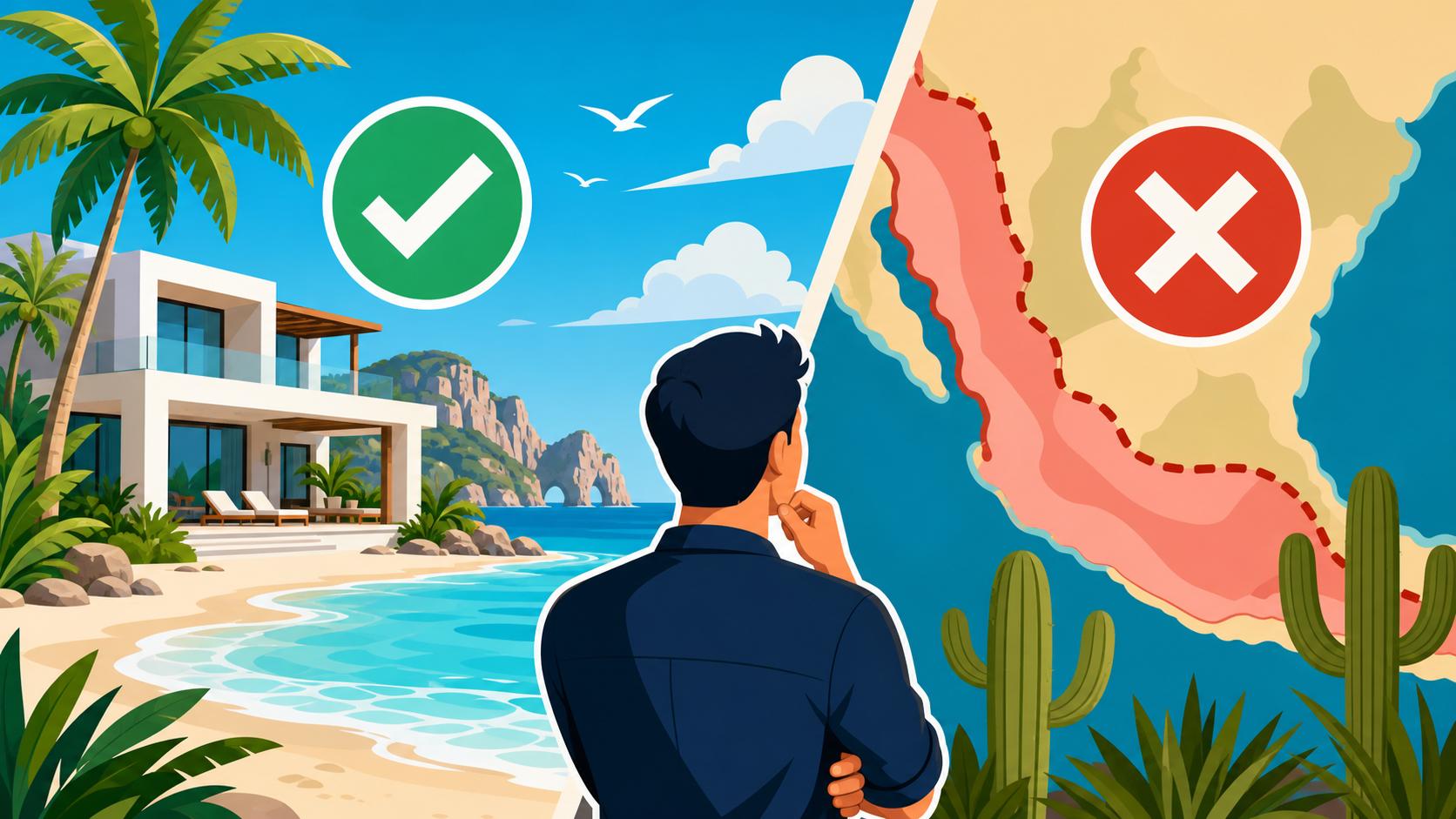
The term Restricted Zone often sounds more ominous than it actually is. When I first started scouting properties, the phrase conjured up images of military checkpoints or high-security areas where foreigners were banned from stepping foot. In reality, it is a purely legal designation that dictates how you hold the title to your land. If you are looking at a map of Mexico, the Restricted Zone includes all land located within 100 kilometers (about 62 miles) of any international border and within 50 kilometers (about 31 miles) of any coastline.
The 50/100 Rule Explained
The 50/100 rule is the foundation of Article 27 of the Mexican Constitution. This law was originally designed to protect Mexico’s national security and prevent foreign entities from gaining too much control over the country's sensitive edges. While the geopolitical landscape has changed significantly since the constitution was written, the law remains firmly in place. This means that if you want a house in a popular expat hub like Puerto Vallarta, Playa del Carmen, or Cabo San Lucas, you are technically trying to buy in the Restricted Zone.
For those of us coming from the US, Canada, or Europe, the idea that a constitution prevents you from owning land in certain areas seems like a deal-breaker. However, the Mexican government realized decades ago that foreign investment is vital for the economy. To bridge the gap between constitutional law and economic reality, they created two very specific, very legal workarounds that allow us to enjoy that beachfront lifestyle without violating the supreme law of the land.
The Historical Context of Mexican Land Laws
Understanding the "why" behind these rules helped me sleep better at night when I was signing my first set of contracts. Mexico has a long and complicated history with foreign intervention. By keeping the legal title of coastal land in a specific format, the government maintains a level of oversight. It is not about keeping you out; it is about ensuring the land is managed through a Mexican legal entity or a trusted financial institution.
I often tell newcomers that while the paperwork feels different, the protections are quite robust. You aren't "renting" the land from the government, and you aren't in a precarious position where someone can just kick you out. You are simply using a different legal "bucket" to hold your property rights. If you’re just starting your search, staying at a Selina location in a coastal town is a great way to meet other expats who have already navigated these waters and can share their personal "boots on the ground" stories.
Methods for Foreigners to Own Property in the Restricted Zone
There are two primary ways to secure your piece of paradise in the Restricted Zone: the fideicomiso and the Mexican corporation. Choosing between them depends entirely on your long-term goals for the property. Are you looking for a quiet retirement nest, or do you plan to run a boutique bed and breakfast?
The Fideicomiso Bank Trust Route
The fideicomiso is the most common path for individual expats. In this arrangement, a Mexican bank acts as the trustee, holding the legal title to the property for your benefit. You are the beneficiary, and you hold all the rights of ownership. This means you can sell the property, lease it to others, renovate it, or pass it down to your heirs. It is a 50-year trust that can be renewed indefinitely.
The biggest hurdle for me was the mental shift of realizing the bank "owns" the title. However, the bank cannot use the property, sell it without your permission, or encumber it with debt. They are essentially a silent partner that exists solely to satisfy the constitutional requirement. You still pay the Property Taxes in Mexico: What Expats Need to Know About Predial and manage the utilities just like any other homeowner. When I was setting up my first trust, I spent hours researching What Is a Fideicomiso? A Foreigner’s Trust for Owning Coastal Property to ensure I wasn't signing away my life savings, and I quickly realized it is the gold standard for residential ownership.
Owning Through a Mexican Corporation
If you are a "serial entrepreneur" expat or looking to buy multiple properties for investment purposes, forming a Mexican corporation might be the better move. Unlike the fideicomiso, a Mexican corporation can own property in the Restricted Zone directly and "fee simple." The catch is that the corporation must be Mexican, even if it is 100% foreign-owned, and the property must be used for "non-residential" purposes.
Now, don't let the "non-residential" label scare you. This can include rental properties, developments, or commercial spaces. If you plan to live in the house yourself, the trust is usually easier. But if you're building a rental empire, the corporation offers different tax advantages and allows for easier scaling. You will, however, need a Mexican accountant to file monthly tax returns, which is a significant administrative burden compared to a trust. Before jumping into this, I highly recommend checking out Starting a Business in Mexico: Financial and Legal Basics for Foreigners to see if the corporate headache is worth the financial gain.
| Feature | Fideicomiso (Bank Trust) | Mexican Corporation |
|---|---|---|
| Best For | Personal residential use | Commercial / Investment use |
| Ownership Type | Beneficial rights (Trust) | Fee Simple (Direct) |
| Duration | 50 years (Renewable) | Indefinite (Life of Corp) |
| Annual Costs | Bank trustee fee ($500 – $700 USD) | Accounting and filing fees |
| Setup Time | 30 – 60 days | 45 – 90 days |
| Usage | Private living or long-term rental | Business operations / Airbnbs |
Navigating the Buying Process and Avoiding Scams
Buying property in Mexico is not like buying a house in the suburbs of Chicago or Toronto. The process involves different players and a much heavier emphasis on the Notario Público. One of my biggest mistakes early on was assuming a "realtor" in Mexico had the same licensing and fiduciary duties as one in the US. In many parts of Mexico, real estate is still an unregulated industry.
The Role of the Notario Público
The most important person in your transaction is the Notario Público. Unlike a notary in the US who simply stamps a signature for five dollars, a Mexican Notario is a high-level attorney appointed by the state governor. They are responsible for ensuring the title is clear, calculating and collecting taxes, and formally recording the deed in the Public Registry.
The Notario does not represent you or the seller; they represent the law. Because of this, I always suggest hiring your own independent attorney to review the contracts before they ever reach the Notario. This extra layer of protection is vital when you’re navigating Buying Property in Mexico: Comprehensive Guide for Foreign Buyers. They will check for liens, hidden debts, and ensure the seller actually has the right to sell the land—something that isn't always a given in coastal areas where family land disputes are common.
Due Diligence and Closing Costs
Closing costs in Mexico are significantly higher than what you might be used to. You should budget between 5% and 8% of the purchase price for your closing costs. This includes the 2% acquisition tax, the Notario's fees, the setup of the fideicomiso, and various registration fees. I was shocked by this number at my first closing, but it is the price of doing things legally and correctly.
During your due diligence, make sure to verify the "uso de suelo" (land use permit). I've seen expats buy a beautiful lot thinking they could build a three-story house, only to find out the area is restricted to single-story ecological dwellings. While you are in the thick of these negotiations, staying connected is crucial. I found that using an eSim from Airalo allowed me to coordinate with my lawyer and the bank without hunting for local SIM cards or paying massive roaming fees every time I had to make a "quick" call to the trust department.
Practical Considerations for Beachfront Living
Once the paperwork is signed and the keys are in your hand, the reality of coastal living sets in. It’s a dream, yes, but it’s a dream that requires a lot of maintenance. The salt air that feels so good on your skin is actually a slow-moving predator for your appliances, electronics, and even the rebar inside your concrete walls.
Maintenance, Salt Air, and Upkeep
In my first year of owning a coastal property, I lost a toaster, a microwave, and an outdoor fan to corrosion. Everything rusts. You will learn to love stainless steel and high-quality outdoor paint. I eventually started ordering specialty dehumidifiers and protective covers from Amazon Mexico because local hardware stores would often run out during the humid summer months.
You also need to consider the local infrastructure. Beach towns are beautiful, but they often struggle with power surges and water consistency. Investing in a good surge protector for your whole house and a reliable cistern system is not a luxury; it’s a necessity. If you’re coming from a place where everything "just works," the learning curve for Home Utilities in Mexico: Setting Up Electricity, Water, Gas, and Internet can be steep.
Safety and Connectivity as an Expat
Safety is the number one question I get from people thinking about buying in the Restricted Zone. Most coastal expat communities are very safe, but property crime like petty theft can happen if a house looks abandoned for six months of the year. Many expats choose to live in gated communities, which offer peace of mind but also come with HOA and Maintenance Fees: Budgeting for Gated Communities and Condos.
Connectivity is the other major factor. If you’re a digital nomad or still working remotely, you need to verify the fiber optic availability before you buy. Some of the most beautiful "hidden" beaches have terrible internet. During my house hunts, I often spent a week at a Selina in the area first to test the local infrastructure and see if the "vibe" of the neighborhood matched my daily needs. Being surrounded by other remote workers gave me a realistic view of the power outages and internet reliability in that specific town.
Using Technology to Simplify the Move
Moving to Mexico involves a mountain of logistics. Between coordinating with moving companies and setting up a new home, you'll want to simplify wherever possible. I rely heavily on Amazon Mexico for everything from kitchen gadgets to garden tools, as the delivery network has improved massively over the last few years. It saves me the headache of trying to fit a blender on the back of a local taxi.
For communication, having a reliable data plan is non-negotiable. Whether you are using Google Maps to find a remote property or Google Translate to talk to a contractor, Airalo provides that immediate connectivity the moment you cross the border. And if you aren't ready to commit to a long-term lease or purchase, spending a few months at a Selina allows you to "test drive" a city without the pressure of a 50-year trust hanging over your head. It’s the perfect way to figure out if you really want to be in the Restricted Zone or if a mountain town like San Miguel de Allende is more your speed.
Final Thoughts on Coastal Ownership
Buying beachfront property in Mexico is a journey of patience and due diligence. The Restricted Zone is not a barrier; it is simply a different legal path. By using a fideicomiso or a Mexican corporation, you gain the same rights and security as any local homeowner. Yes, the taxes are a bit higher, and the salt air will eat your electronics, but waking up to the sound of the Pacific or the Caribbean makes every bit of paperwork worth it.
Take your time, hire a good lawyer, and don't rush the process. Mexico isn't going anywhere, and that perfect beach house will be much more enjoyable when you know every "i" is dotted and every "t" is crossed according to the Mexican Constitution.
Disclaimer
The information provided in this article is for informational purposes only and does not constitute legal, financial, or real estate advice. Mexican laws and regulations regarding property ownership and immigration are subject to change. Readers should consult with a qualified Mexican attorney, a certified Notario Público, and a professional tax advisor before making any real estate investments or legal decisions in Mexico. This guide is based on general practices as of 2026 and may not reflect the specific nuances of every municipality or individual case.