Paying Utility Bills in Mexico: Methods and Tips for Expats
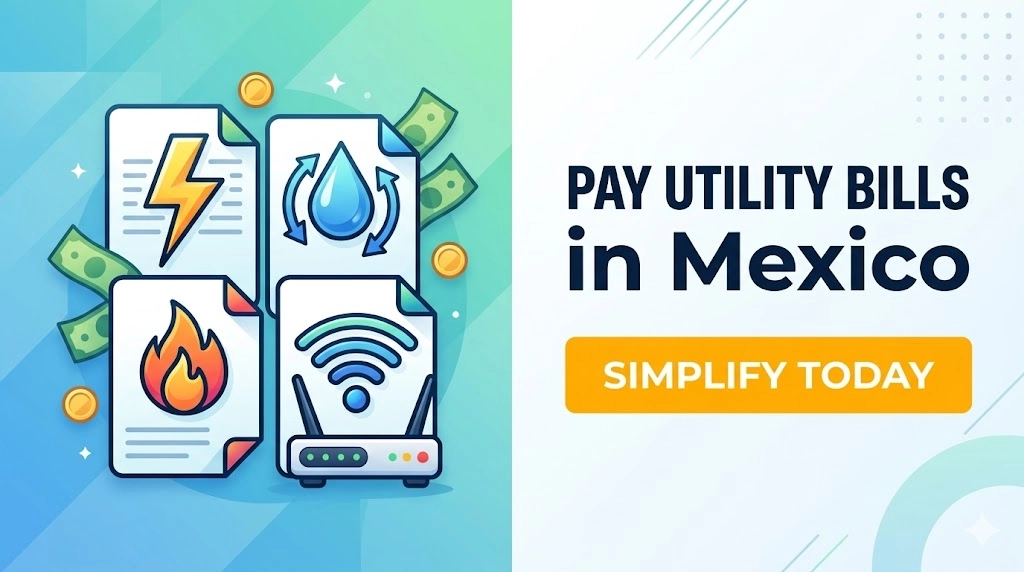
I still remember the sheer panic of coming home to a sweltering apartment in Mérida because my utility app quietly rejected my foreign credit card and cut my power. Figuring out how to pay utility bills in Mexico is a brutal, frustrating rite of passage. This guide breaks down exactly how to navigate payment gateways, avoid disconnections, and manage expenses.
Disclosure: This post may contain affiliate links. We may earn a commission at no extra cost to you if you make a purchase through these links. Read full disclosure.
The Shocking Reality of Mexican Utility Billing
If you are accustomed to setting all of your monthly household expenses on autopay using a single credit card in the United States or Europe, the Mexican utility system will feel like a jarring leap backward. You must unlearn the expectation of automated, frictionless billing and adopt a proactive, manual approach to keeping your lights on and your water flowing.
Paper Bills and the Bi-Monthly Schedule
In Mexico, the digital revolution has not completely erased the physical paper trail. For major utilities like electricity and municipal water, the primary method of invoicing is still a physical paper bill (recibo) printed on thin paper and delivered directly to your home.
You must routinely check your front gate, your mailbox, or the narrow crack under your front door. Utility workers simply wedge the paper bill into your property’s exterior. If a heavy rainstorm washes the bill away, or a stray dog tears it up, you are still entirely responsible for the payment. Ignorance of the amount due is not a valid legal defense for missing a payment deadline in Mexico.
Furthermore, you must adjust to the bi-monthly billing cycle (cobro bimestral). The national electricity provider bills standard residential homes every two months, rather than every thirty days. This can make monthly budgeting confusing for new expats, as you must mentally divide the large sum and set aside capital for the off-months to avoid a cash-flow shock when the double-month bill finally arrives. We heavily emphasize tracking this staggered schedule in our Cost of Living in Mexico: 2026 Comprehensive Guide.
The Comprobante de Domicilio Paradox
The physical paper bills you receive are not just invoices; they are the most critical administrative documents you will possess as an expat. In Mexico, a recent utility bill serves as your Comprobante de Domicilio (Proof of Address). You cannot open a bank account, buy a car, or renew your residency visa without presenting an original utility bill that is less than three months old.
This creates a paradox for renters. Because utility debts stay attached to the physical property rather than the individual, landlords fiercely guard the utility accounts. The bills will almost certainly arrive in your landlord’s name, not yours. Fortunately, Mexican institutions generally accept a landlord’s CFE bill as your proof of address, provided you can also show a formalized lease agreement tying you to that exact location.
Because these flimsy pieces of paper are so vital to your legal existence in the country, you cannot afford to lose them. Veteran expats treat their utility bills like passports. I highly recommend purchasing a fireproof document safe or a heavy-duty expanding folder from Amazon Mexico to securely store every single paper receipt you receive. Keeping a pristine physical paper trail will save you from endless bureaucratic headaches.
Why Your Foreign Credit Card Keeps Failing
The most infuriating moment for a new expat is attempting to pay a Mexican utility bill online using a premium travel credit card from their home country. You will input your Visa or Mastercard details, hit submit, and receive a vague “Transaction Failed” error message, often with no explanation.
This happens because Mexican payment gateways utilize highly aggressive, localized 3D Secure fraud prevention algorithms. When the Mexican payment processor attempts to ping your US, Canadian, or UK bank to verify the transaction, it flags the foreign billing address and the cross-border IP address as high-risk fraudulent activity. The transaction is instantly blocked before it ever reaches your home bank.
If you attempt to run the same foreign card three or four times in a row, the utility company’s website will lock your account entirely for suspected fraud. You will then be forced to physically visit their corporate office, stand in line for two hours, and pay in cash to unlock your profile. To avoid this agonizing digital lockout, you must eventually establish a localized financial footprint, a strategy we detail completely in Banking in Mexico: Complete Guide for Foreigners.
Mastering the CFE Electricity Bill
The Comisión Federal de Electricidad (CFE) is the monolithic, state-owned monopoly that provides electricity to the entire country. You have no alternative providers to choose from. Understanding how CFE calculates, bills, and collects payments is a mandatory survival skill for living south of the border.
Deciphering the Recibo and Usage Tiers
When you receive your CFE recibo, it will look like a complex algebraic equation. CFE utilizes a heavily subsidized, tiered pricing structure for standard residential users. As long as you keep your electricity consumption within the “basic” or “intermediate” tiers, the Mexican government pays a significant portion of your bill, resulting in bi-monthly totals that often hover between $15 and $30 USD.
However, if you cross the consumption threshold, you fall into the dreaded DAC tier (Tarifa Doméstica de Alto Consumo). The moment you enter DAC, you lose all government subsidies. You are charged a massive premium for every single kilowatt-hour you consume. Running an air conditioning unit continuously during a Mexican summer is the fastest way to trigger the DAC rate, turning a $30 bill into a $400 nightmare.
To prevent this, you must actively monitor your consumption. Smart expats do not wait for the paper bill to arrive to see if they crossed the threshold. By ordering smart plugs with energy monitoring capabilities via Amazon Mexico, you can actively track exactly how much power your heavy appliances are drawing in real-time, allowing you to throttle your AC usage before you trigger the punitive DAC tier. We explain the broader realities of managing these specific home infrastructures in Home Utilities in Mexico: Setting Up Electricity, Water, Gas, and Internet.
The CFEmático Kiosks and OXXO Payments
Because online payment portals aggressively reject foreign credit cards, the most reliable way for a new expat to pay their CFE bill is physically in person. The most ubiquitous method is taking your paper bill to a local OXXO convenience store. You hand the cashier the bill, they scan the barcode, you pay in physical pesos, and OXXO charges a nominal commission fee of roughly 15 pesos (under $1 USD).
If you want to avoid the OXXO commission or if your bill is past due (OXXO cannot process late bills), you must visit a CFEmático. These are automated, ATM-like kiosks located outside of official CFE offices. They operate 24/7. You simply scan the barcode on your bill, insert physical cash or a local Mexican debit card, and the machine prints a receipt.
You must keep the tiny, printed receipt from the CFEmático or the OXXO cashier. If CFE makes an administrative error and attempts to cut your power for “non-payment,” that physical receipt is your only proof that you settled your debt. Do not throw it away until the next billing cycle arrives showing a zero balance.
Navigating the CFE Contigo App
CFE does offer a mobile application called “CFE Contigo” to help users track their usage and pay digitally. To register, you will need the Número de Servicio printed at the top of your physical bill.
While the app is a fantastic concept, its execution is notoriously unstable. The app frequently crashes during the end-of-month billing surges, and just like the desktop website, it will almost universally reject foreign credit cards. If you successfully open a Mexican bank account, you can link your localized Mexican debit card to the CFE Contigo app and pay seamlessly.
However, if you are relying on the app to check your balance while standing at an OXXO, a crash can leave you stranded. This is why having redundant mobile data is critical. If your home Wi-Fi is acting up, having an active Airalo eSIM ensures you can instantly switch to a secure cellular connection, pull up the digital barcode on the CFE app, and hand it to the cashier before the deadline passes.
Managing Water and Municipal Services
While electricity is governed by a massive national monopoly, water and municipal services are managed at the hyper-local level. Every city has its own water board, its own billing schedule, and its own unique set of infrastructural challenges that you must adapt to.
SAPAL, SIAPA, and Local Water Boards
Unlike CFE, there is no national water company in Mexico. If you live in Guadalajara, you deal with SIAPA; in León, it is SAPAL; in the Riviera Maya, it is Aguakan. Because these are municipal entities, their payment portals are often archaic, rarely translated into English, and highly prone to rejecting international payment methods.
In many municipalities, the water bill (recibo de agua) arrives monthly. In some older neighborhoods, there are no individual water meters for apartments; the building receives one massive bill, and the landlord divides the cost equally among the tenants, adding it to your monthly rent. You must explicitly clarify how water is billed before signing your lease, a negotiation tactic we highlight in Renting a Home in Mexico: Complete Expat Guide to Leases, Deposits, and More.
If you are directly responsible for the bill, you can usually pay it at local convenience stores, designated supermarkets, or directly at the municipal water office. For property owners, many municipalities offer a massive discount (often 10% to 15%) if you pay the entire estimated annual water bill in a single lump sum in January, known as the Pago Anual Anticipado.
Paying for Private Water Delivery
The true cost of water in Mexico is rarely reflected on the municipal bill. Because city pipes frequently run dry during the spring drought season, you will inevitably have to purchase water from the private sector to fill your home’s underground cistern (cisterna).
You must order a pipa (a massive private water truck). This transaction exists entirely outside of formal utility billing. You will coordinate the delivery via WhatsApp with a local pipero (truck driver). When the truck arrives and fills your tank, you are expected to pay the driver immediately in physical cash.
A standard 10,000-liter truck can cost anywhere from $50 to $100 USD depending on seasonal demand. If you do not have physical pesos on hand, the driver will simply leave, and your house will remain dry. Because you must constantly text drivers and send GPS pins of your home to coordinate these private deliveries, maintaining continuous mobile data via an Airalo data pack is an absolute operational necessity. If your home internet goes down and your cistern is empty, your mobile phone is your only lifeline to resupply your water.
The Hidden Costs of Trash Collection
Waste management introduces another layer of localized, cash-based utility payments. In many traditional Mexican neighborhoods, there are no communal dumpsters or automated trucks that lift plastic bins from the curb.
Instead, a sanitation truck slowly rolls through the neighborhood while a worker violently rings a heavy brass handbell. When you hear the bell, you must run outside and hand your garbage bags directly to the workers on the back of the truck. While municipal trash collection is technically a tax-funded service, the sanitation workers are drastically underpaid.
It is a deeply ingrained cultural expectation that you tip (dar propina) the workers when you hand them your trash. Keeping a stack of 10 or 20 peso coins near your front door is an absolute necessity. Handing them a small cash tip every time they take your bags ensures they will wait an extra ten seconds for you when you are running late, and it fosters immense goodwill in your new neighborhood.
Domestic Gas and Telecommunications
To cook your food, take a hot shower, and maintain your remote job, you must master the logistics of domestic LP gas and fiber-optic internet. Missing a payment for either of these services will bring your daily life to a grinding halt.
Stationary Tanks versus Portable Cylinders
Piped natural gas is a rarity in Mexico. Your home will utilize Liquid Petroleum (LP) gas, delivered by truck. The billing for this utility is entirely prepaid; you only pay when you request a refill, meaning there is no monthly paper bill to track.
If your home has a Tanque Estacionario (a massive stationary tank on the roof), you hail a pipa de gas. The driver runs a hose up the side of your building to fill it. If you use Cilindros (portable metal tanks in your patio), you physically swap your empty tank for a full one when the truck drives by.
In both scenarios, you pay the gas company driver directly. While some modern, corporate gas fleets now carry mobile credit card terminals, the vast majority still operate exclusively in cash. You must budget hundreds of pesos in physical currency to cover these sudden, vital resupplies. You cannot put a hot shower on your foreign credit card.
Paying Telmex, Totalplay, and Izzi
Your fiber-optic internet is the only utility you will likely place in your own name as a renter. The market is dominated by Telmex, Totalplay, and Izzi. Their billing cycles are ruthlessly precise.
Unlike the leniency you might experience with internet providers back home, Mexican telecom companies do not grant grace periods. If your monthly invoice is due on the 15th, and your payment has not cleared by 11:59 PM on the 15th, an automated algorithm will instantly sever your fiber-optic connection at exactly midnight.
To prevent this, you can pay your bill via their respective mobile apps, at a physical branch, or at an OXXO. If you have successfully navigated the local banking system, you can set up domiciliación (direct debit) to automatically pull the funds from your Mexican account every month, providing the ultimate peace of mind.
The Importance of Uninterrupted Mobile Data
If you fail to pay your Telmex or Totalplay bill on time, the situation quickly cascades. You wake up with no home internet. To pay the past-due bill and restore service, you need to access the provider’s app or your mobile banking portal. But because your home Wi-Fi is dead, you cannot connect.
This is the exact scenario where relying exclusively on your home internet is a fatal flaw. You must maintain an active, independent mobile data connection. By keeping an Airalo eSIM active on your device, you immediately switch to the local 5G cellular network. You can instantly open the Telmex app, pay the overdue balance, and have your home fiber-optic connection restored within minutes, completely bypassing the crisis.
Furthermore, once your power or internet is restored after an outage, the surge of electricity re-entering the grid can easily destroy sensitive electronics. To protect your laptop and your router, utilizing a high-quality surge protector and UPS battery backup sourced via Amazon Mexico is an absolute, non-negotiable insurance policy against grid fluctuations.
Strategic Payment Methods for Expats
As you transition from a newly arrived tourist to a seasoned resident, paying your utilities in physical cash at an OXXO will eventually become tedious. You must upgrade your financial architecture to automate and digitize your life in Mexico.
The SPEI Transfer Network
The ultimate goal for any expat is to bypass the physical lines and the foreign credit card rejections entirely. To do this, you must open a local Mexican bank account (such as BBVA, Santander, or Banorte).
Once you possess a localized debit card and access to a Mexican banking portal, the entire utility landscape shifts. Mexican banks are directly integrated with the national utility providers. You can simply log into your BBVA app, select “Pay Services,” input your CFE or Telmex account number, and pay the bill instantly from your peso balance.
Furthermore, having a Mexican account grants you access to the SPEI network, the instantaneous, zero-fee domestic transfer system. You can transfer money instantly to your landlord for the municipal water bill or pay private contractors directly. We break down the exact steps to unlock this network in Digital Payments in Mexico: Using Mobile Apps and Wallets (CoDi, etc.).
Using Mercado Pago and Digital Wallets
If you are struggling to open a traditional Mexican bank account due to visa restrictions, the greatest alternative workaround is Mercado Pago.
Mercado Pago is the premier digital wallet in Latin America. You can download the app and verify your identity using your passport or temporary residency card. The app features a built-in barcode scanner. When your paper CFE bill or Telmex invoice arrives, you simply open Mercado Pago, scan the paper barcode with your phone’s camera, and the app instantly pays the utility company.
You can fund your Mercado Pago wallet by executing low-cost international transfers from your home bank using platforms like Wise, effectively bridging the gap between your foreign dollars and your localized Mexican utility debts.
The Cash-Only Backup Plan
Despite the immense convenience of SPEI and Mercado Pago, you must never completely abandon physical currency. The Mexican digital infrastructure is occasionally prone to massive, system-wide outages. Bank terminals crash, the CFE app goes offline for maintenance, and OXXO registers temporarily lose connection to the central servers.
If you are facing a disconnection deadline and the digital systems are down, physical cash is your only savior. You should always maintain an emergency reserve of at least 2,000 to 3,000 MXN in small bills hidden securely in your home precisely to cover an impending electricity bill or a sudden private water truck delivery.
The Soft Landing Alternative
Managing these fragmented, localized, and highly bureaucratic utility systems during your first month in the country is a guaranteed recipe for burnout. Attempting to decipher a DAC tier on a CFE bill while negotiating with a gas truck driver in broken Spanish will destroy the romance of moving abroad.
This is exactly why veteran expats absolutely refuse to sign a long-term lease on day one. Instead, they execute a strategic “soft landing.” By booking your first four to six weeks at a premium, turnkey coliving space like Selina, you completely bypass the utility nightmare.
Staying at a Selina property means that your electricity, high-speed internet, municipal water, and domestic gas are seamlessly managed and baked directly into your upfront nightly rate. You never see a paper bill, and you never have to hail a truck. This massive reduction in logistical friction allows you to spend your first month securing your residency, opening your local bank account, and scouting permanent neighborhoods, ensuring that when you finally do sign a lease, you are financially and culturally equipped to handle the utility grid like a local.
References
Primary sources (official)
- Procuraduría Federal del Consumidor (PROFECO): The federal consumer protection agency, offering guidelines on utility disputes and authorized pricing for LP Gas. https://www.gob.mx/profeco
Other helpful sources
- Airalo: Global eSIM provider ensuring immediate, reliable mobile data access to pay utility bills online when home fiber-optic networks fail. https://www.airalo.com/
- Amazon Mexico: Essential e-commerce platform for expats needing rapid delivery of document safes, surge protectors, and smart home energy monitors. https://www.amazon.com.mx/
Disclaimer
The information provided in this article is for educational and informational purposes only and does not constitute financial, legal, or professional infrastructural advice. Utility pricing, CFE subsidy thresholds, and municipal water delivery schedules vary drastically by state, municipality, and specific neighborhood. The acceptance of foreign credit cards on Mexican utility portals is highly volatile and subject to unannounced changes by local payment processors. Attempting to manipulate utility meters or execute DIY repairs on electrical panels or LP gas lines is illegal and highly dangerous. Always utilize authorized payment channels and hire licensed local technicians for infrastructural maintenance. Ensure that any services, platforms, or e-commerce strategies mentioned meet your specific individual requirements and legal residency status.