Adjusting to the Metric System: Using Kilometers, Liters, and Celsius in Mexico
One of the most disorienting moments for any new arrival in Mexico happens at the local carnicería when you realize your brain cannot compute how many kilograms are in a pound while a line of people waits behind you. I remember standing there, blankly staring at a pile of arrachera, feeling completely illiterate. This guide provides the practical mental shortcuts and real-world context you need to master kilometers, liters, and Celsius without losing your mind.
Disclosure: This post may contain affiliate links. We may earn a commission at no extra cost to you if you make a purchase through these links. Read full disclosure.
The Daily Shift: Mastering Meters and Kilograms in the Kitchen and Market
When you first begin Settling in Mexico: Step-by-Step Guide to Your First 30 Days as an Expat, the most immediate hurdle is the grocery store. In the U.S. or Canada, we think in pounds and ounces, but in Mexico, the kilogram is king. Everything from your body weight at the doctor's office to the amount of tomatoes you need for salsa is measured in grams (g) and kilograms (kg).
Grocery Shopping by the Kilo
Walking into a bustling Mercado can be intimidating if you aren't sure how to ask for what you need. A kilogram is roughly 2.2 pounds. While that sounds simple on paper, doing the math in your head while navigating a crowded aisle is another story. A veteran tip I always share is to think in "medios" (halves) and "cuartos" (quarters).
Instead of asking for a pound of ground beef, ask for a "medio kilo" (half kilo), which is about 1.1 pounds. If you only need a small amount of ham or cheese, ask for a "cuarto" (quarter kilo), which is roughly 9 ounces. You will find that Grocery Shopping in Mexico: Supermarkets vs Local Markets becomes much easier when you stop trying to convert back to imperial and start visualizing the physical volume of a kilo. For smaller items like spices or expensive nuts, prices are often listed per 100 grams. If you're using a recipe from home, remember that a standard stick of butter (4 ounces) is approximately 113 grams.
Kitchen Conversions and Cooking
If you brought your measuring cups and spoons from home, you might feel safe, but you'll soon realize that Mexican recipes and packaged goods use milliliters (ml) and liters (L). A standard cup is about 240ml. When you are Moving to Mexico: What to Pack and What to Buy Locally, I highly recommend buying a glass measuring jug that shows both cups and milliliters. You can easily find these on Amazon Mexico if your local supermarket doesn't have the specific style you like.
It’s also worth noting that "a pinch" or "a spoonful" remains relatively universal, but professional baking in Mexico is almost always done by weight in grams rather than volume. If you plan on baking at high altitudes, such as in Mexico City or San Miguel de Allende, the combination of metric measurements and air pressure changes will require a bit of a learning curve.
Body Weight and Health
Stepping on a scale at a Mexican gym or clinic can be a shock if you see a number like "70" and forget it's in kilograms. To get a rough estimate of your weight in pounds, double the kilos and add 10 percent. For example, 80kg doubled is 160; 10 percent of 160 is 16; total is 176 lbs. While this isn't scientifically perfect, it's a great "good enough" calculation for daily life. When Staying Healthy in Mexico: Essential Tips for Food, Water, and Preventive Care, keeping track of your metrics is vital, especially if a doctor asks for your weight for a medication dosage.
On the Road: Navigating Kilometers and Liters
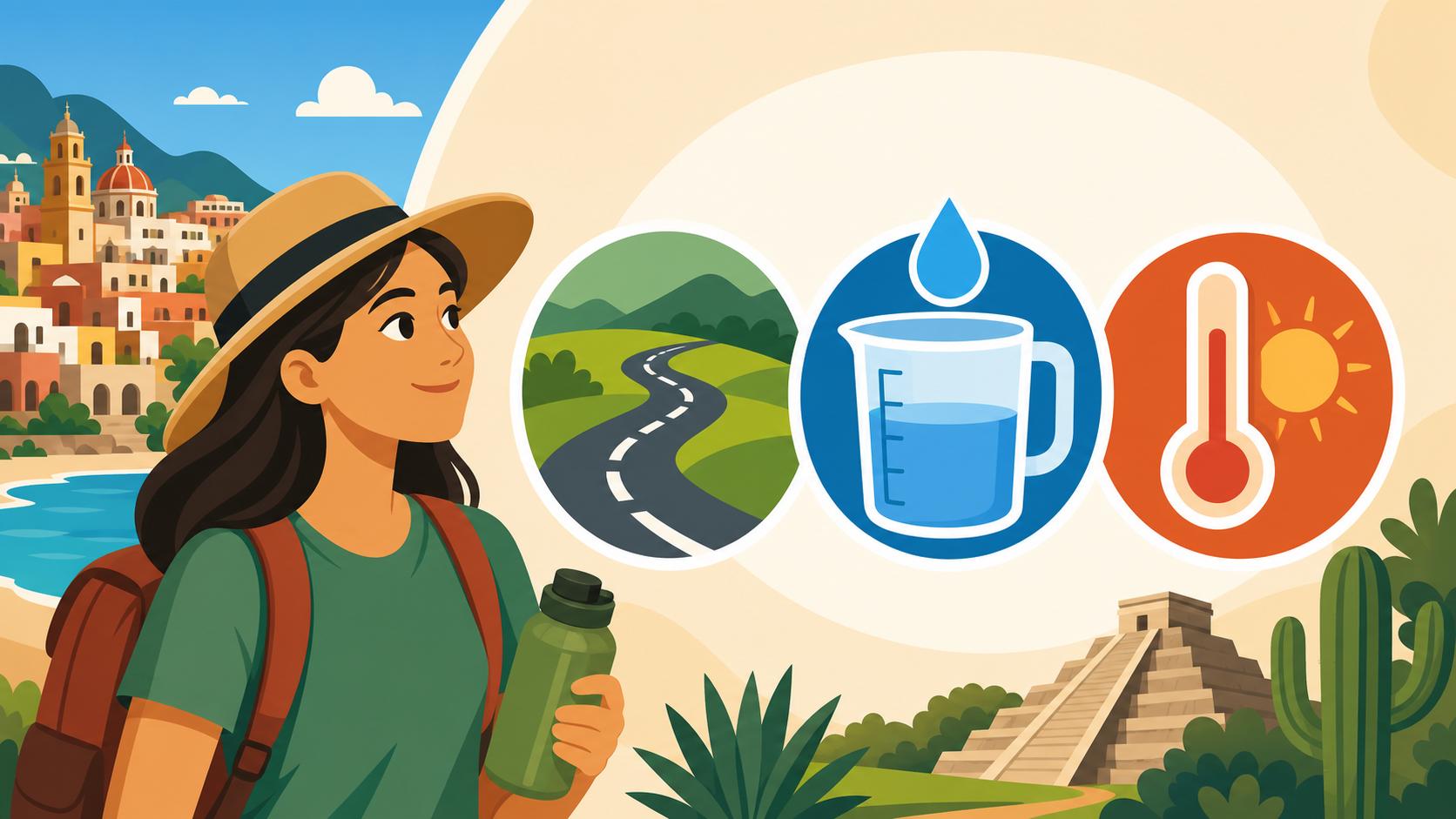
Driving in Mexico introduces a whole new set of numbers that can be genuinely dangerous if misunderstood. Speed limits are in kilometers per hour (km/h), and distances are in kilometers (km). If you see a sign that says 100, and you treat it like 100 miles per hour, you are going to have a very bad day with the Federal Police.
Understanding Distance and Speed
A kilometer is roughly 0.6 miles. The easiest way to wrap your head around this while driving is the "60% Rule." If the sign says 80 km/h, you are doing about 50 mph. If you are Taking Road Trips in Mexico: Safety and Planning Tips, you'll notice that distances between cities feel much larger because the numbers are higher. A 300km trip sounds like a cross-country trek, but it’s really only about 186 miles.
However, do not let the smaller unit of measurement fool you into thinking you will arrive faster. Mexican highways, or "cuotas," are generally excellent, but secondary roads can be winding and full of "topes" (speed bumps). Always check your GPS for time rather than just looking at the kilometer markers. If you are staying at a Selina location in a place like Oaxaca or Playa del Carmen and planning a day trip, always ask the locals how many hours it takes, not how many kilometers, as the metric distance rarely accounts for mountain curves or traffic.
Fueling Up: Liters and Tire Pressure
Gasoline is sold by the liter, not the gallon. There are approximately 3.78 liters in one U.S. gallon. When you pull into a Pemex or an Oxxo Gas, the attendant will ask how much you want. Most expats simply say "lleno" (full) or ask for a specific peso amount, like "quinientos pesos" (500 pesos).
Tire pressure is one of the few areas where you might still see PSI (pounds per square inch), but many modern Mexican air pumps use "bares" (bars) or kilopascals (kPa).
| Item | Imperial Unit | Metric Equivalent | Quick Mental Hack |
|---|---|---|---|
| Distance | 1 Mile | 1.6 Kilometers | 5 miles is 8 km |
| Weight | 1 Pound | 0.45 Kilograms | 1 kg is a bit over 2 lbs |
| Volume | 1 Gallon | 3.78 Liters | 4 liters is roughly a gallon |
| Liquid | 1 Fluid Ounce | 30 Milliliters | 10 oz is 300 ml |
| Length | 1 Inch | 2.54 Centimeters | 4 inches is 10 cm |
| Height | 5'10" | 178 Centimeters | 160 cm is a small adult |
Living with the Climate: Understanding Celsius and Weather Patterns
Temperature is perhaps the hardest adjustment because it affects how you dress and how you manage your home. We are used to the granularity of Fahrenheit, where every degree feels distinct. In Celsius, a single-degree jump is much more significant.
Decoding the Temperature
The easiest way to survive the switch to Celsius is to memorize five key "anchor" points:
- 0°C is Freezing: (32°F) You won't see this often in Mexico unless you're in the northern mountains in winter.
- 10°C is Chilly: (50°F) Time for a light jacket or a "sudadera."
- 20°C is Perfect: (68°F) This is the classic "eternal spring" weather of the highlands.
- 30°C is Hot: (86°F) You’ll want shade and a cold drink.
- 40°C is Extreme: (104°F) This is common in places like Hermosillo or Mérida in the summer. Stay indoors.
When you are Coping with Heat and Humidity: Tips for Expats in Tropical Climates, understanding these numbers helps you decide when to run the AC and when to just open the windows. If you're using an eSIM from Airalo to stay connected while traveling, your weather app will likely default to Celsius once you cross the border. Resist the urge to toggle it back to Fahrenheit in the settings; the sooner you force your brain to associate "28 degrees" with "beach weather," the faster you will feel at home.
Managing Your Home Comfort
Most ovens in Mexico use Celsius for their temperature dials. If your recipe calls for 350°F, you need to set your oven to 175°C. If you are Renting a Home in Mexico: Complete Expat Guide to Leases, Deposits, and More, check the appliances during your walkthrough. Many older ovens don't even have numbers—they just have "low, medium, high" (bajo, medio, alto) or numbers 1 through 5.
Similarly, your water heater (boiler) might have a Celsius setting. Setting it to 50°C is usually plenty for a hot shower without scalding yourself. If you are Living in Mexico: Cultural and Practical Guide for New Expats, you'll find that these small mechanical adjustments are part of the "hidden" workload of moving abroad.
Practical Tools and Resources for a Metric Lifestyle
You don't have to do this all by memory. In the beginning, lean on technology and physical tools to bridge the gap. Over time, the "feel" of a kilogram or a kilometer will become second nature, but for the first six months, it’s okay to "cheat."
Digital Apps and Conversion Hacks
I always recommend having a dedicated conversion app on your phone. While Google Search works, a standalone app is often faster when you are in a basement grocery store with spotty data. Since you’ll likely have a local SIM or an Airalo data plan, you can also use voice assistants. Asking your phone "What is 180 Celsius in Fahrenheit?" while your hands are covered in flour is a lifesaver.
Another hack is to change the units on your wearable fitness tracker. If your watch tells you that you've walked 5 kilometers instead of 3 miles, you start to build a physical sense of how long a kilometer actually is. This is a core part of Living in Mexico City: An Expat's Guide to Neighborhoods and Lifestyle, where walking is a primary mode of transportation.
Buying Measuring Tools in Mexico
Don't try to bring everything from your old life. Go to a local "ferretería" (hardware store) and buy a metric tape measure. If you are trying to describe a repair to a landlord or a handyman, using inches will only lead to confusion and mistakes. Measuring your windows for curtains or a space for a new fridge in centimeters ensures that everyone is on the same page.
You can find high-quality digital kitchen scales and body weight scales on Amazon Mexico that allow you to toggle between units. I recommend keeping it on metric. If you keep switching back to imperial to "see what it really is," you're just delaying your brain's ability to adapt. Embrace the "Mexican reality" and trust that within a year, you’ll be the one explaining to a new arrival that 30 degrees is actually quite pleasant as long as there is a breeze.
Important Disclaimer
This guide is intended for informational purposes and reflects the personal experiences of expats living in Mexico. While we strive for accuracy, measurement standards and local practices may vary by region. Always verify critical measurements, especially regarding medication dosages or legal requirements, with a qualified professional in Mexico. This information does not constitute legal, medical, or professional advice.