Street Safety: Tips for Avoiding Pickpockets and Scams in Mexico
Walking through a crowded Zócalo or a bustling market in Guadalajara can be an assault on the senses in the best way possible, but it is also where many foreigners lose their guard—and their wallets. I still remember the sinking feeling in my stomach when I realized my phone had been lifted from my pocket during a simple five-minute walk in Roma Norte. This guide solves the anxiety of navigating Mexican streets by providing battle-tested strategies to spot common scams and outsmart pickpockets before they ever target you.
Disclosure: This post may contain affiliate links. We may earn a commission at no extra cost to you if you make a purchase through these links. Read full disclosure.
Understanding the Landscape of Street Safety in Mexico
When you first move to Mexico, the narrative you hear from the media back home is often one of extreme violence and high-level crime. However, for the average expat or tourist, the reality is far more mundane but no less frustrating: petty theft. Pickpocketing and "trickster" scams are the most common hurdles you will face in urban centers like Mexico City, Guadalajara, or Monterrey. These are crimes of opportunity, usually carried out by individuals or small groups who have spent years perfecting the art of the distraction.
The first step in staying safe is recognizing that you are likely being watched, especially in high-traffic zones. Foreigners are often perceived as carrying more cash and higher-end electronics, making them a "target of high value." This doesn't mean you should live in fear, but it does mean you need to shed the relaxed "vacation brain" that many of us bring when we first arrive. Understanding the difference between a dangerous neighborhood and a high-theft neighborhood is key. You can find more context on this in our guide on Safety in Mexico: What Expats Need to Know About Staying Safe.
I often tell newcomers that the most important thing is to manage your "visual footprint." If you look like you are lost, staring at a phone screen with a giant backpack on your back, you are inviting attention. Professionals who engage in street theft look for these cues. They look for the person who is distracted by the sights, the person struggling with too many shopping bags, or the person who has their phone tucked loosely into a back pocket. Adjusting your posture and awareness is the single most effective deterrent.
Common Street Scams Every Expat Should Recognize
The "Mustard Scam" or "Bird Dropping Scam" is a classic in Mexico, particularly in busy plazas. Here is how it usually goes: You are walking along, and suddenly you feel a wet splat on your shoulder or back. A seemingly kind stranger rushes up to tell you that a bird just pooped on you, or perhaps you "accidentally" got some mustard on your shirt. They will offer to help you clean it up, pulling out tissues and hovering close. While they are busy "cleaning" your clothes, their accomplice is reaching into your other pocket or swiping the bag you set down on the ground. If anyone approaches you to "help" with your clothing, keep walking and do not stop until you are in a safe, enclosed space like a hotel lobby or a restaurant.
Another frequent ruse is the "Broken Eyeglasses" or "Dropped Item" scam. A person will walk directly into your path and drop a pair of glasses or a ceramic item that was already broken. They will then act distraught, claiming you broke their expensive property and demanding immediate cash payment for the damage. This often happens in crowded areas like the Metro or busy pedestrian streets like Madero in Mexico City. The goal is to create a scene and pressure you into paying "la mordida" or a quick bribe to make them go away. Understanding Mexican Etiquette and Customs: Do's and Don'ts for New Expats can help you stay calm and firm in these high-pressure social interactions.
Then there is the ATM "Helper." This is particularly prevalent in tourist-heavy beach towns. Someone will linger near an ATM and notice you are having trouble with the machine—or they will claim the machine is "broken" and direct you to another one that they have tampered with. In some cases, they will even try to "clean" your card's chip with a cloth that actually contains a skimmer. Never accept help at an ATM. If a machine looks suspicious or doesn't work, walk away and find a different bank inside a secure building. If you ever find yourself in a situation where you need to report such an incident, knowing the Emergency Numbers in Mexico: How to Call Police, Fire, or Ambulance is vital for your peace of mind.
Proactive Habits to Protect Your Belongings
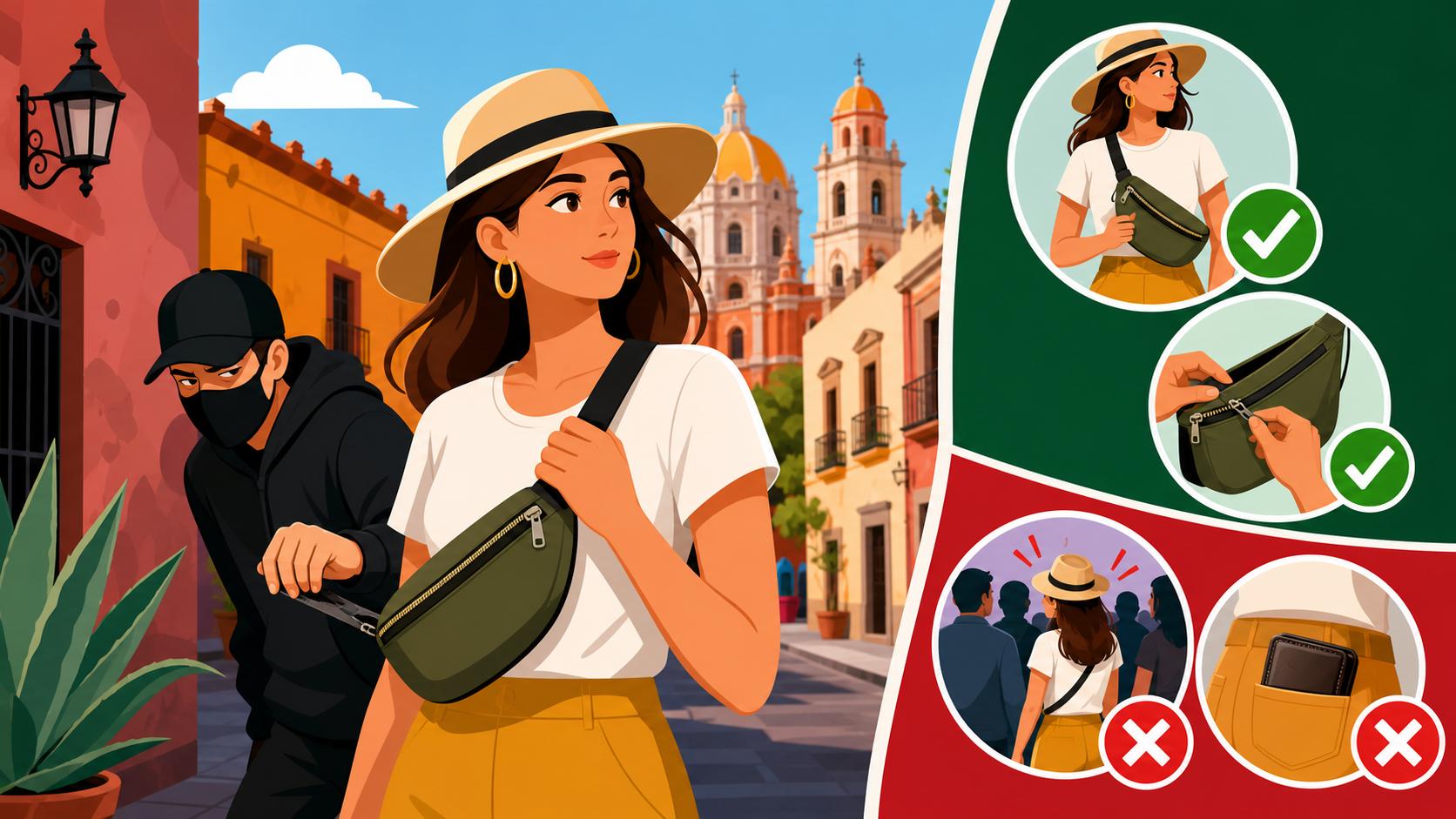
The way you carry your valuables is your second line of defense. The "back pocket" is a non-starter in Mexico; it is essentially a gift to a skilled pickpocket. I always recommend moving your wallet and phone to your front pockets, and if possible, keeping your hand resting over them in crowded areas. For those who carry a purse or a small bag, always wear it "cross-body" and keep the bag itself positioned toward your front, not your hip.
Many veterans of the expat life use "dummy wallets." This is an old but effective trick: you carry a secondary, cheap wallet with a few expired credit cards and a small amount of cash (maybe 200 or 300 pesos). In the unlikely event of a confrontation, you hand over the dummy wallet while your real credit cards and ID are hidden in a money belt or an internal pocket. For those who prefer modern gear, you can find excellent anti-theft bags on Amazon Mexico that feature locking zippers and slash-proof straps.
Staying connected safely is also a major part of the strategy. I’ve seen many expats get their phones snatched while looking at Google Maps on a street corner. To avoid this, consider using an e-SIM from Airalo so you always have a data connection without needing to find local Wi-Fi, which can sometimes be a trap for data skimming. Check your map while still inside a cafe or a building, and if you must check it on the street, step into a doorway and keep your back to the wall. This minimizes the chance of a "drive-by" snatching from a motorcycle or bicycle.
Navigating Transportation Safely
Transportation hubs are hotspots for pickpockets. The Mexico City Metro, while efficient, is a prime location for the "squeeze and lift." This happens when a group of people crowds around you as you enter or exit a train car. In the chaos of the "squeeze," someone’s hand is in your pocket. If you are using public transit, consider wearing your backpack on your chest rather than your back. It might look a bit silly, but it is the standard practice for safety-conscious locals and expats alike. You can read more about the nuances of local life in our Living in Mexico: Cultural and Practical Guide for New Expats.
When it comes to taxis, the rule is simple: never hail a "Libre" (street taxi) if you can avoid it, especially at night. These white-and-pink or gold-and-maroon cabs are not always vetted, and there is a risk of "express kidnappings" where the driver takes you to several ATMs to drain your accounts. Instead, use official "Sitio" taxis from a designated stand or stick to ride-sharing apps. For a deeper dive into this, check out Using Uber and Ride-Sharing Apps: A Guide for Expats in Mexico to understand why they are generally the safer bet.
If you are staying in a social hub like a Selina property, they often have trusted drivers or shuttles you can use. This takes the guesswork out of the equation and ensures you are being handled by someone who is accountable to a business. Even when using an app, always verify the license plate and the driver's name before getting into the vehicle. It is a small habit that can prevent a very large problem. For more details on the safety of different transit options, see Are Taxis Safe in Mexico? Using Cabs vs Ride-share Apps.
Comparison of Common Safety Tactics
| Tactic | Pros | Cons | Best Used In |
|---|---|---|---|
| Front-Pocket Wallet | Harder to lift without notice | Can be uncomfortable | Daily walks, markets |
| Cross-body Bag | Difficult to snatch-and-run | Can strain the shoulder | Tourist sites, plazas |
| Dummy Wallet | Provides a safe "out" | Requires carrying two items | High-risk night areas |
| Money Belt | Virtually impossible to steal | Hard to access quickly | Travel days, long bus rides |
| Digital Maps (In-door) | Prevents phone snatching | Can be inconvenient | Navigating new neighborhoods |
Situational Awareness in Specific Neighborhoods
Safety isn't uniform across the country or even within a single city. For instance, Living in Mexico City: An Expat's Guide to Neighborhoods and Lifestyle will show you that while Polanco feels very secure, the neighboring areas around the Centro Histórico require a much higher level of vigilance. Pickpockets in the Centro are professionals; they often work in teams of three or four, where one person creates a distraction (like dropping coins or starting a loud argument), another does the "lift," and the third person takes the stolen item and disappears into the crowd.
In coastal areas, the scams are often more "transactional." You might be approached by someone offering a "free" tour or a discounted jet ski rental, only to find that the price triples once you are away from the main crowd. Always get prices in writing and pay at the end of the service whenever possible. If you are ever unsure about a situation, trust your gut. If a person seems overly friendly or a deal seems too good to be true, it almost certainly is.
When you are out at night, especially in "Zona Rosa" types of entertainment districts, be wary of drink spiking. Never leave your drink unattended, and if a stranger offers to buy you a drink, ensure you see the bartender pour it and hand it to you directly. This isn't just a tip for women; male expats are also frequently targeted for robbery through the use of sedatives in drinks. Staying in well-lit areas and moving in groups remains the golden rule of nightlife safety.
What to Do If You Become a Victim
If the worst happens and you are pickpocketed or scammed, do not attempt to chase the thief or engage in a physical confrontation. Many of these petty criminals carry small knives or work with associates who are nearby and ready to intervene. Your safety is worth more than a smartphone or a few thousand pesos. Once you are in a safe location, the first step is to cancel your credit cards and freeze your bank accounts.
You will likely need to file a police report, known as a "denuncia," especially if you need to make an insurance claim or replace a stolen passport. Be prepared for a slow process. Mexican bureaucracy can be overwhelming, and unless you speak fluent Spanish, you may want to bring a friend to help translate. While the police may not be able to recover your items, having the official paperwork is essential for the administrative side of being an expat.
In some cases, you might encounter situations involving local authorities that feel like a scam. It is important to know your rights and when it is appropriate to stand your ground or when it is safer to comply. Our article on Dealing with Corruption: Should Expats Pay “Mordida” (Bribes? offers a realistic look at how to handle these uncomfortable interactions with grace and legal awareness. Remember that the goal is always to de-escalate and move on with your life as quickly as possible.
Disclaimer
The information provided in this guide is for educational and informational purposes only. While every effort has been made to ensure the accuracy of these tips based on real-world expat experiences in Mexico, safety conditions can change rapidly. The author and this website are not responsible for any incidents, losses, or damages that may occur while traveling or living in Mexico. Always follow the advice of local authorities and your national embassy.