Dealing with Corruption: Should Expats Pay “Mordida” (Bribes)?
You’re driving down a sun-drenched coastal road, your favorite playlist is humming, and then the flash of blue and red lights appears in your rearview mirror. My first time, my heart was in my throat, and I almost reached for my wallet before the officer even reached the window out of pure panic. This guide helps you navigate the high-stress dilemma of corruption in Mexico without compromising your ethics or legal status.
Disclosure: This post may contain affiliate links. We may earn a commission at no extra cost to you if you make a purchase through these links. Read full disclosure.
Understanding the Landscape of Corruption and the Mordida
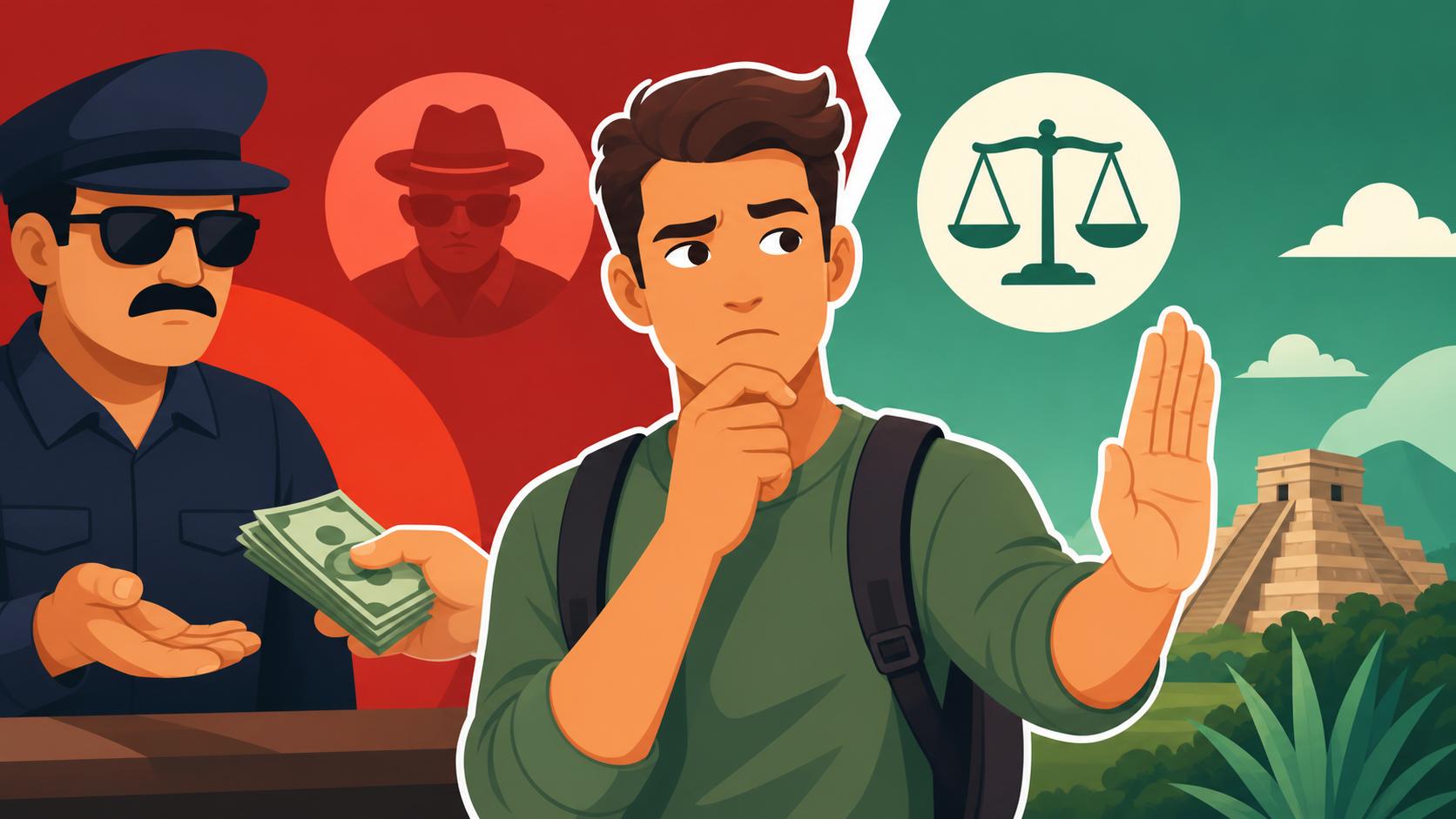
The term "mordida" literally translates to "the bite." In the context of Mexican daily life, it refers to a small bribe paid to a public official—most commonly a traffic officer—to make a problem go away or to expedite a process. For many expats, this is the most jarring aspect of Living in Mexico: Cultural and Practical Guide for New Expats. It feels like a betrayal of the rule of law, yet you will inevitably meet people who insist it is just "how things work here."
The reality is nuanced. Corruption in Mexico is a systemic issue often fueled by low wages for police officers and a lack of resources within local municipalities. When an officer pulls you over and suggests a "refresco" (a soda) or tells you that the fine is very expensive but you can pay a smaller "multa" directly to them, they are testing your resolve. I remember sitting in my car in Playa del Carmen, sweating not just from the heat but from the moral weight of the situation. It is easy to feel like a guest who shouldn't rock the boat, but paying the mordida actually makes life harder for every expat who comes after you.
Corruption isn't limited to the roads. It can creep into Dealing with Bureaucracy in Mexico: Tips for Handling Paperwork and Appointments or even while Renting a Home in Mexico: Complete Expat Guide to Leases, Deposits, and More. However, the most frequent encounter you will have is with the transit police. Understanding that this is often a psychological game of chicken rather than a legal requirement is your first step toward handling it with grace and firmness.
The Psychology of the Traffic Stop
When a transit officer stops a foreigner, there is often an assumption of wealth and a lack of knowledge regarding local laws. They might tell you that your How to Get a Mexican Driver's License as a Resident (Visa Implications) is invalid or that you committed a phantom infraction like "driving too close to the line." Their goal is often to see if you will offer cash to avoid the perceived "hassle" of going to the police station.
In my experience, the most effective tool is extreme, unwavering politeness coupled with a total lack of hurry. If you show that you have all day to resolve the issue legally, the officer often loses interest because their "profit" comes from quick turnovers. I’ve seen expats get flustered and angry, which only escalates the situation. Instead, keep your voice low, stay respectful, and never be the first one to mention money.
Distinguishing Between Federal and Municipal Police
It is vital to know who is pulling you over. The Guardia Nacional (Federal) generally has higher standards and is much less likely to seek a mordida than local municipal police (Policía Municipal). If you are on a major highway and the federales stop you, treat it with the same gravity you would a stop in the US or Canada. If you are on a side street in a tourist zone, the likelihood of a "shakedown" increases.
If you’re staying at a Digital Nomad Life in Mexico: Remote Work Living Guide hub like a Selina location, you’ll likely hear stories from other travelers about which neighborhoods are "hot" for police stops. Use that community knowledge to stay alert. Always ensure your documents are in order so you don't give them a legitimate reason to hold you.
Why You Should Almost Never Pay a Bribe
The temptation to hand over a 500-peso note and be on your way is immense. You have dinner plans, or you’re tired, or you’re worried about Safety in Mexico: What Expats Need to Know About Staying Safe. But paying a bribe carries risks that far outweigh the 20 minutes you save. First and foremost, it is a crime. Under Mexican law, both the person giving the bribe and the person receiving it are committing a felony. While it is rare for an expat to be prosecuted for a small traffic bribe, the legal standing is not in your favor.
Secondly, paying a mordida marks you. Police in certain areas have long memories and may share information about which cars belong to "easy" targets. If you pay once, don't be surprised if you're pulled over again the following week for another imaginary infraction. By refusing, you establish yourself as a "difficult" target, which is actually a form of long-term protection.
The Social Impact on the Community
Every time an expat pays a bribe, it inflates the "price" for the locals. Most Mexican citizens cannot afford to pay off officers and must deal with the actual consequences of tickets or impounded cars. When we, as foreigners, use our relative wealth to bypass the law, we contribute to a culture of inequality that hurts our Mexican neighbors.
To truly integrate, you have to respect the system even when the system seems to be testing you. If you want to know How to Become a Mexican Citizen: The Complete Naturalization Guide, you’ll learn that "good moral character" is a requirement. Consistently participating in bribery, even at a low level, is the antithesis of the community-minded expat life we should all strive for.
The Risk of a "Double Shakedown"
There is also a darker side to the mordida. In some rare cases, paying a bribe can lead to an accusation of "attempting to bribe an officer," which gives them leverage to demand much more money or even threaten arrest. By sticking strictly to the legal path—insisting on a written ticket—you remove this leverage entirely. They cannot accuse you of bribery if you are demanding to pay the official fine at the municipal office.
Practical Steps to Handle a Traffic Stop Without Paying
If the lights go on and you have to pull over, your first move should be to ensure your phone is ready. Having a reliable connection is crucial, which is why I always recommend having an eSim from Airalo so you can access GPS or translation apps instantly without hunting for Wi-Fi. It also allows you to look up the local "Reglamento de Tránsito" (traffic rules) on the fly.
| Step | Action | Why it Works |
|---|---|---|
| 1 | Stay in the Car | Stepping out can be seen as aggressive or an invitation for a private "talk." |
| 2 | Record the Interaction | Discreetly start a voice or video recording. This often discourages illegal requests. |
| 3 | Ask for the Ticket | Say: "Oficial, por favor déme la multa por escrito." (Officer, please give me the written ticket.) |
| 4 | Offer to Pay at the Station | Explain you want to pay at the "Tesorería" to get the 50% early-pay discount. |
| 5 | Never Hand Over Your Original ID | Show your license through the window or a photo. Only hand it over if they insist on writing the ticket. |
The Magic Words: La Tesorería
In Mexico, if you pay a traffic fine within the first few days (usually 5 to 15 days), you receive a 50% discount on the ticket. When an officer tells you the fine is 3,000 pesos, you can calmly respond, "That’s fine, I will take the ticket to the Tesorería tomorrow and pay the 1,500 pesos with my discount." This shows the officer that you know the law and that they won't be getting any "cash in hand" from you today.
Most of the time, if the infraction was made up, the officer will suddenly "give you a warning" and tell you to be more careful. This is a win. You’ve maintained your dignity, followed the law, and saved your money. If the infraction was real (e.g., you actually were speeding), then taking the ticket is the correct and legal thing to do.
Protecting Your Documents
Officers will often ask for your original driver's license or residency card. Once they have these in their hand, they have "collateral" to force a bribe. I always carry a high-quality color photocopy of my license and my Mexico Temporary Resident Visa: Comprehensive Guide for Foreign Leaders (2026 Update) documents. I show the original through the window but hand over the copy. If they insist on the original, I tell them I will follow them to the police station to hand it over there.
Using a dashcam is another excellent deterrent. You can find many affordable options on Amazon Mexico that are easy to install. Simply pointing at the camera and mentioning that the interaction is being recorded for your insurance company usually ends any talk of a mordida immediately.
Dealing with Administrative Corruption
While traffic stops are common, you might encounter more complex corruption when Buying Property in Mexico: Comprehensive Guide for Foreign Buyers. This might look like a "fee" to speed up a building permit or a "donation" to get a utility connected faster. This is where you need to be even more careful, as the stakes involve your home and significant financial investments.
The best defense against administrative corruption is a reputable "gestor" or lawyer. A good professional knows the legal timelines and can push back on officials who are intentionally dragging their feet to solicit a bribe. If you are Navigating Mexico's Immigration System: Visas, INM Procedures, and Regulations, never trust someone who says they can get you a residency card for cash without you ever stepping into an INM office. That is a scam, not just corruption.
Using Technology to Avoid the Middleman
Many Mexican government services are moving online to reduce face-to-face interactions where corruption thrives. Whether you are paying your property taxes or renewing a permit, always check if there is an online portal first. By paying digitally, you generate a "Factura" (official tax receipt) and ensure your money goes exactly where it belongs.
If you are asked for an Apostille or a How to Get a Mexican Police Clearance Letter for Visa or Citizenship, use official channels only. If a clerk tells you the "system is down" but can be "fixed" for a fee, politely decline and say you will return another day or try another branch. Persistence is the enemy of the corrupt official.
Building a Network of Integrity
Living in an expat community means we have a collective responsibility. Share your positive stories of refusing to pay bribes on local forums and Facebook groups. When we normalize the legal route, we change the perception of expats as "walking ATMs." It might take an extra hour of your day to go to the police station and pay a legitimate fine, but the peace of mind knowing you aren't part of the problem is worth every minute.
Be sure to also understand the specific rules of your region. Is It Safe to Drive at Night in Mexico? Road Safety Tips for Expats might include advice on avoiding certain checkpoints where shakedowns are more common. Being informed is your greatest shield.
Handling the Worst-Case Scenario
What if the officer becomes aggressive or refuses to let you go? First, remain calm. Anger is your enemy. If you feel truly unsafe, call 911 or your embassy. Most police officers do not want a diplomatic incident over a small bribe. If they insist on taking you to the station, go. Once you are at the station and in front of a "Juez Cívico" (Civic Judge), the "shakedown" usually disappears because the officer’s superiors are watching.
In over a decade of living here, I have only had to go to the station once. The moment we arrived and I asked to speak to the supervisor to pay my official fine, the officer who pulled me over suddenly realized he had "more important calls" to attend to and left without even writing the ticket. It was a bluff, and I called it.
Your Rights as a Foreign Resident
As a resident, you have rights. You are not a second-class citizen. You are a taxpayer and a member of the community. Understanding What to Do If You’re Pulled Over by Police in Mexico is part of your education as a successful expat. Stand your ground with a smile, keep your documents organized, and remember that "No" is a complete sentence—even in Spanish.
Disclaimer
The information provided in this guide is for educational and informational purposes only and does not constitute legal advice. Laws and local practices in Mexico can change frequently and vary significantly by municipality and state. Always consult with a qualified Mexican legal professional regarding specific legal issues or if you find yourself in a serious legal situation. The author and publisher are not responsible for any legal consequences arising from the use of this information.