Traveling Within Mexico: A Guide to Domestic Flights and Buses for Expats
Standing on the side of a dusty highway in Oaxaca after missing the only direct bus to the coast, I realized I had entirely underestimated the sheer, exhausting scale of this country. Figuring out how to navigate Mexico’s domestic transit system as a new arrival is incredibly overwhelming. This guide decodes the complexities of luxury buses, budget airlines, and transit logistics so you can travel Mexico safely and efficiently.
Disclosure: This post may contain affiliate links. We may earn a commission at no extra cost to you if you make a purchase through these links. Read full disclosure.
The Reality of Domestic Travel in Mexico
When expats look at a map of Mexico, they rarely comprehend the actual geographic and topographical barriers that define the country. Moving from one expat hub to another requires a deep understanding of how the Mexican transit infrastructure is actually built.
Overcoming the Distance and Terrain
Mexico is massive. It is the 13th largest country in the world by total area. Driving from Tijuana in the north to Cancun in the southeast is roughly equivalent to driving from Los Angeles to New York City. The map severely distorts the reality of travel times. Furthermore, the topography is incredibly aggressive. You are dealing with the Sierra Madre mountain ranges, dense tropical jungles, and vast, sprawling deserts.
Because of this intense terrain, a destination that looks only a few inches away on Google Maps might require a terrifying, eight-hour drive through winding mountain passes. Consequently, driving yourself across the country is rarely the most efficient or safe option for expats. It requires navigating complex, expensive toll roads known as cuotas, dealing with corrupt traffic police, and managing severe security risks in certain states.
Most veteran expats abandon the idea of cross-country road trips and rely heavily on the established, highly efficient domestic flight and bus networks. Whether you are doing a visa border run or scouting different towns because you are deciding where to settle down, mastering these public systems is mandatory. If you are using these trips to actively scout real estate, ensuring you know how to navigate the terrain is crucial; review Real Estate in Mexico: Renting vs Buying for Expats before you hit the road.
The Hub and Spoke System
The entire Mexican transit infrastructure operates on a strict hub-and-spoke model, with Mexico City (CDMX) serving as the absolute center of gravity. Whether you are flying or taking a luxury bus, all roads inevitably lead to the capital.
If you live in Puerto Vallarta and want to visit the colonial city of Oaxaca, you will almost certainly not find a direct flight or bus. You will be forced to fly into Mexico City, wait out a layover, and catch a connecting flight south. Understanding this routing system prevents you from getting frustrated when booking travel.
There are secondary hubs emerging, such as Guadalajara for the western states, Monterrey for the north, and Merida/Cancun for the Yucatan Peninsula. However, when planning your travel logistics, you must always factor in a layover in CDMX. This hub system makes the capital airport one of the busiest in Latin America, meaning you must leave yourself ample time to navigate connecting terminals.
Safety and Security on the Road
We have to address the elephant in the room: is it safe to travel through Mexico? The answer is yes, provided you strictly adhere to the golden rules of Mexican transit.
The absolute most critical rule of traveling in Mexico is that you never travel long distances by ground at night. Cartel activity, highway robbery, and severe accidents involving wandering livestock spike drastically after the sun goes down. If a bus route requires traveling through high-risk states like Michoacán, Zacatecas, or Tamaulipas overnight, you should opt for a flight instead.
When taking buses during the day, luxury bus lines exclusively use the cuota (toll) highways. These roads are significantly better maintained, heavily fenced, and actively patrolled by the Mexican National Guard (Guardia Nacional). The free roads (libres) are pothole-ridden and lack security infrastructure. When you book a bus ticket, ensure the route explicitly utilizes the cuota system.
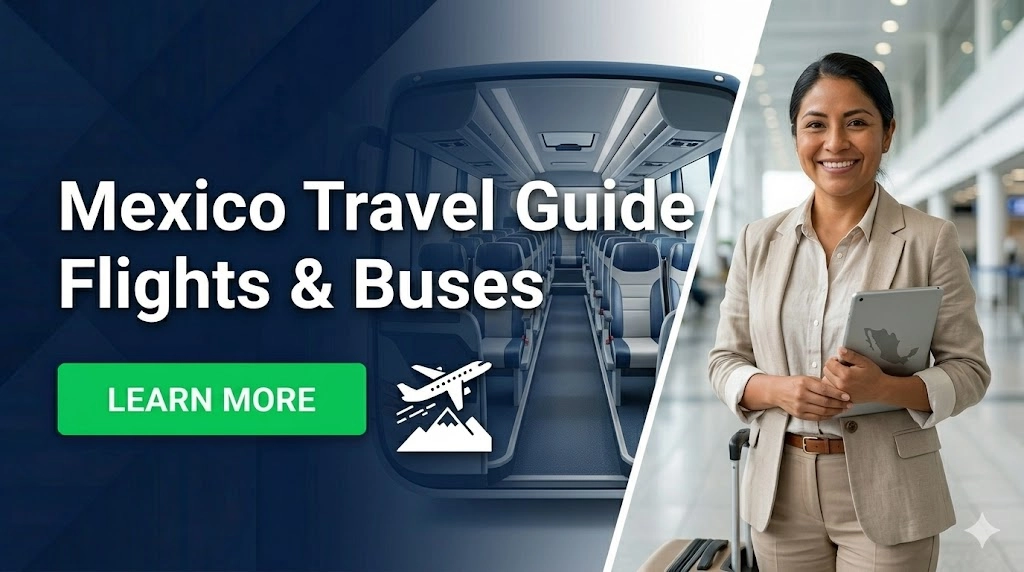
Mastering the Luxury Bus System (Autobuses de Primera Clase)
If you are coming from the United States or Canada, you likely associate bus travel with the grim, uncomfortable reality of Greyhound. You must completely erase this association. In Mexico, long-distance bus travel is a premium, highly respected mode of transportation that often rivals first-class air travel.
Forget What You Know About Buses
Mexican bus companies are divided into tiers, and as an expat, you should exclusively utilize the Ejecutivo (Executive) or Primera Clase (First Class) services. The dominant brands change depending on the region. In the south and the Yucatan Peninsula, ADO (specifically their ADO Platino line) holds a monopoly. In central and northern Mexico, ETN and Primera Plus are the gold standards.
When you step onto an ETN or ADO Platino bus, you will be shocked. The buses feature two levels. The seats are massive, plush recliners that often lay back 180 degrees (asientos tipo cama), complete with leg rests. The seating configuration is usually 2×1, meaning you can book a single, isolated seat by the window with no one sitting next to you.
These buses feature individual seatback entertainment screens, Wi-Fi, and gender-separated bathrooms that are kept impeccably clean. They also provide complimentary snacks and drinks as you board. For trips under six hours, taking an executive bus is frequently faster, cheaper, and vastly more comfortable than dealing with airport security and baggage claims.
Navigating Terminals and Ticket Purchasing
Mexican bus terminals (Centrales de Autobuses) are massive, sprawling complexes that function exactly like regional airports. Mexico City alone has four massive terminals pointing to the cardinal directions (TAPO for the east, Taxqueña for the south, Terminal Norte, and Observatorio for the west). You must know exactly which terminal your bus departs from.
Purchasing tickets presents a massive hurdle for newly arrived expats. While companies like ADO and Volaris have websites and apps, they utilize hyper-aggressive fraud filters that routinely block foreign credit cards. You will often spend an hour filling out your details online only for the payment to be rejected at the final screen.
The standard workaround is to purchase your tickets physically at the bus terminal a few days before your trip. Alternatively, many bus companies allow you to reserve a ticket online and select “Pay at OXXO” (the ubiquitous Mexican convenience store). You take a barcode to the local OXXO, hand the cashier cash, and your ticket is issued. Managing these minor cash logistics is a daily part of expat life.
Baggage, Security, and Onboard Experience
Security at luxury bus terminals is taken incredibly seriously. When you arrive, you check your heavy luggage under the bus, exactly like an airline. The attendant will give you a physical claim tag, and you cannot retrieve your bag at the destination without handing that tag back. It is incredibly secure.
Before boarding the bus, you will pass through a security checkpoint. Guards will wand you with metal detectors, pat you down, and manually search your carry-on bags. They also frequently film the faces of every passenger boarding the bus as a security measure against hijackings.
Once onboard, you must prepare for the legendary Mexican bus climate control. Regardless of whether it is 100 degrees outside in the jungles of Chiapas, the bus driver will keep the internal air conditioning set to a freezing temperature. You will see local Mexicans boarding buses in July wearing heavy winter parkas and carrying thick blankets. If you do not pack a heavy sweater in your carry-on, you will be miserable. Motion sickness is also a severe threat on winding mountain routes; to prepare your travel medical kit, consult Medical Emergencies in Mexico: What Expats Should Know and Prepare.
Navigating Domestic Flights and Low-Cost Carriers
For distances over six hours, flying is the only logical choice. Mexico has a highly developed domestic aviation market, but it is dominated by ultra-low-cost carriers that operate with predatory fee structures.
The Big Three Airlines
The Mexican domestic sky is essentially controlled by three airlines, each offering a drastically different experience:
- Aeromexico: The national legacy carrier and a member of the SkyTeam alliance. They offer traditional service, free carry-on bags, and business class cabins. They are the most reliable, but also the most expensive.
- Volaris: The largest ultra-low-cost carrier in the country. They possess a massive route network and fly directly between many secondary cities, allowing you to sometimes bypass the CDMX hub.
- VivaAerobus: The absolute extreme budget option. Their base fares are shockingly cheap, but their seats are cramped, and they are notorious for severe delays and poor customer service.
The Hidden Fees of Low-Cost Travel
If you fly Volaris or VivaAerobus, you must understand that the $20 USD fare you see advertised is a mirage. These airlines utilize an unbundled fare structure designed to trick you at every step of the checkout process.
First, they will charge you for everything. Do you want to bring a carry-on bag for the overhead bin? That is an extra fee. Do you want to select your seat? Fee. Did you forget to print your boarding pass or download it to your phone before arriving at the airport? They will charge you an exorbitant fee to print a piece of paper at the check-in desk.
Most importantly, you must understand the TUA (Tarifa de Uso de Aeropuerto). This is the Mexican airport usage tax, and it is mandatory. Budget airlines usually do not include the TUA in their advertised base fare. A flight might cost $15 USD, but the TUA for flying out of Monterrey might be $45 USD, bringing your total to $60 USD. You cannot avoid paying the TUA. You must manually add it during the checkout process before the airline will issue your ticket.
| Airline | Service Model | Baggage Included in Base Fare | Reliability |
| Aeromexico | Legacy / Full Service | Personal item + standard carry-on | High |
| Volaris | Ultra Low-Cost | Personal item (under seat) only | Moderate |
| VivaAerobus | Extreme Budget | Personal item (under seat) only | Low |
Surviving Mexican Airports
Navigating the airports themselves requires localized knowledge. If you are flying into or out of Mexico City, you must double-check your ticket. The city now has two airports: the legacy AICM (Benito Juárez) located centrally, and the brand-new AIFA (Felipe Ángeles) located over an hour and a half outside the city center. If you book a cheap flight out of AIFA without realizing the distance, the Uber ride to the airport will cost more than the flight itself.
Furthermore, expats must be prepared for domestic immigration checks. Unlike in the US, where TSA only cares about your identity, the Mexican National Guard and INM (Immigration) agents actively patrol domestic gates. As a foreigner, you will frequently be pulled aside before boarding a domestic flight and asked to present your passport and your valid Mexican residency card or FMM tourist permit to prove you are in the country legally.
Staying Connected While in Transit
Traveling through a foreign country without a reliable internet connection is not just an inconvenience; it is a severe safety hazard. The infrastructure gaps in Mexico will leave you stranded if you do not prepare your tech stack.
The Danger of Dead Zones
When you take an eight-hour bus ride through the Sierra Madre mountains or navigate the remote highways of the Yucatan Peninsula, your home-country cellular carrier will drop out entirely. Foreign roaming agreements deprioritize your data on local Mexican towers.
Getting stranded at a remote bus station due to a breakdown, without the data to call an Uber, check an alternate bus schedule, or translate a warning sign, is terrifying. You cannot rely on public Wi-Fi at bus terminals, as it is notoriously insecure and heavily throttled. To understand the broader challenges of managing utilities and connectivity in your permanent home, read Setting Up Utilities in Mexico: Electricity, Water, and Internet.
Localizing Your Cellular Data Instantly
You must localize your cellular data before you begin domestic travel. However, hunting down a physical Telcel SIM card at a chaotic bus terminal is exhausting.
The ultimate travel hack for expats is utilizing Airalo. Before you leave for the bus station or the airport, you download a localized Mexican eSIM profile directly to your phone via the Airalo app. The absolute moment your bus crosses a state line or your plane lands in a new city, your Airalo profile connects automatically to the strongest local 4G or 5G tower.
Having an active Airalo data plan running seamlessly in the background ensures you can always pull up your digital boarding pass, track your Uber on Google Maps in a new city, and stay in contact with your emergency contacts. Relying on Airalo is the cheapest, most efficient digital safety blanket a traveling expat can buy.
Power and Tech Readiness
While luxury buses advertise electrical outlets and USB ports at every seat, the reality is that they are broken 50% of the time. Domestic airport terminals are equally frustrating, with charging stations constantly occupied or malfunctioning.
If your phone dies containing your digital bus ticket, your Airalo eSIM, and your hotel reservation, you are entirely locked out of your travel logistics. You must travel with high-capacity power banks. Because finding premium, reliable tech gear in local Mexican convenience stores is impossible, veteran expats use Amazon Mexico to order heavy-duty Anker power banks and multi-port travel adapters before their trip. Utilizing Amazon Mexico ensures you have authentic, high-capacity tech gear delivered to your home base, keeping your crucial devices powered throughout punishing travel days.
Basecamps and Accommodations for the Traveling Expat
Where you choose to land after an exhausting day of domestic transit dictates the success of your trip. Arriving in an unfamiliar Mexican city requires strategic accommodation planning.
Avoiding Transit Scams and Sketchy Hotels
A universal rule of travel in Mexico is that the neighborhoods immediately surrounding major bus terminals (Centrales de Autobuses) are notoriously sketchy. They are high-traffic, chaotic areas known for pickpockets and aggressive taxi touts.
You should never book a cheap hotel directly across the street from a bus terminal simply for convenience. When you arrive, especially if you arrive at night, your protocol should be to ignore the shouting taxi drivers at the terminal exit, secure your luggage, and immediately call an Uber or a registered, prepaid terminal taxi to take you to a safer neighborhood in the city center. If you fall ill during transit due to stress or exhaustion, you need to be in a secure neighborhood; to prepare your medical safety net, review Finding English-Speaking Doctors and Specialists in Mexico.
Finding Reliable Digital Nomad Hubs
If you are traveling domestically while maintaining a remote job, your accommodation requirements are entirely different. You cannot afford to check into a boutique hotel only to discover the Wi-Fi cannot support a Zoom call.
For remote workers navigating domestic transit, Selina is the ultimate bridging accommodation. Selina properties are strategically located in almost every major Mexican transit hub, from downtown Mexico City to Oaxaca and Cancun. Checking into a Selina after a grueling flight provides you with commercial-grade, verified internet, dedicated co-working spaces, and instant access to a community of English-speaking travelers.
If your flight is delayed and you arrive exhausted, walking into a Selina means you do not have to wander the streets looking for a safe dinner; the internal infrastructure supports you instantly. It is the perfect soft landing pad for working expats. To deeply understand how to manage your career while moving across the country, consult our Digital Nomads in Mexico: Remote Work Guide.
Securing Your Luggage and Travel Gear
Traveling on Mexican public transit destroys cheap luggage. If you try to drag a hard-shell rolling suitcase across the jagged cobblestone streets of San Miguel de Allende or the unpaved dirt roads of Puerto Escondido, the wheels will snap off within an hour.
You must travel with a high-quality, anti-theft travel backpack. When you store your bag in the overhead bins of domestic flights or under your seat on a bus, you need lockable zippers to deter casual theft. Because local retail options for premium travel gear are highly limited, expats overwhelmingly rely on Amazon Mexico to source Osprey or Pacsafe travel backpacks. Ordering your specialized gear via Amazon Mexico before your trip ensures your electronics and residency documents are physically secure from the intense wear and tear of domestic transit.
Legal Logistics: Traveling with Visas and Pets
Domestic travel in Mexico involves significantly more bureaucratic oversight than expats anticipate. You must carry your legal identity with you at all times.
Carrying Your Residency Documents
Never travel domestically within Mexico carrying only a photocopy of your residency card. The Mexican National Migration Institute (INM) frequently sets up random checkpoints on major toll highways, particularly in southern states like Chiapas and Oaxaca.
If a luxury bus is pulled over by an INM checkpoint, agents will board the bus and demand to see the physical, original plastic Resident Card (Residente Temporal or Permanente) or the original FMM tourist permit of every single foreigner. If you only have a photocopy or a picture on your phone, you can be legally detained and taken to a holding facility until your legal status is verified. Treat your resident card with the same reverence as your passport. If you are still trying to secure this vital document, read How to Apply for Temporary Residency in Mexico: Step-by-Step.
Flying and Busing with Pets
Relocating your pets across the country requires navigating a maze of conflicting corporate policies. If you are flying domestically, low-cost carriers like Volaris have strict quotas on how many pets are allowed in the cabin per flight. You must pay the pet fee during your initial booking to reserve a spot. The pet must fit in an approved soft-sided carrier under the seat, and you must present a health certificate issued by a licensed Mexican veterinarian within five days of the flight.
If you plan to take your pet on a luxury bus, be warned: ADO and ETN do not allow pets in the passenger cabin (unless they are certified service animals, which requires extensive paperwork). Pets must travel in the cargo hold underneath the bus in a hard-shell crate. During the brutal Mexican summer, the cargo hold can become dangerously hot, and most veterinarians heavily advise against busing pets in the hold. To ensure your pet meets all federal health standards for transit, read Vaccinating Your Pets in Mexico: Vet Services for Animal Health.
Health Infrastructure on the Road
Finally, you must acknowledge the risk of getting sick away from your home base. If you contract severe food poisoning in a random transit town, what do you do?
You must know how to locate the nearest Farmacia del Ahorro or Farmacia San Pablo, which have walk-in clinics attached where you can see a doctor for a few dollars. However, if you suffer a severe injury, like a broken bone from a bus accident, you need catastrophic coverage that works nationwide. Relying solely on out-of-pocket cash when you are far from home is deeply dangerous. To understand how private insurance shields you during domestic travel, review Healthcare in Mexico: Complete Guide for Expats Public vs Private.
By securing your digital connectivity, understanding the nuances of the luxury bus network, and mastering the hidden fees of budget airlines, you can unlock the sheer beauty and scale of Mexico with absolute confidence.
References
Primary sources (official)
- Instituto Nacional de Migración (INM): The official federal immigration portal detailing the legal requirements for foreigners to carry valid residency documentation during domestic transit. https://www.inm.gob.mx/mpublic/publico/inm-tramites.html
- Secretaría de Turismo (SECTUR): The Mexican federal tourism ministry, providing high-level guidelines and updates on national transit infrastructure and safety initiatives. https://www.gob.mx/sectur
Other helpful sources
- Volaris Official Site: The leading ultra-low-cost domestic airline, outlining mandatory TUA taxes, carry-on fees, and domestic boarding requirements. https://www.volaris.com/
Disclaimer
The information provided in this guide is for educational, logistical, and informational purposes only and does not constitute formal legal, immigration, or travel security advice. Mexican domestic transit schedules, airline fee structures, TUA taxes, and INM checkpoint protocols are highly variable and subject to frequent and sudden changes. Always verify your flight or bus status directly with the carrier, consult with your local consulate regarding travel advisories for specific Mexican states, and ensure your health insurance policy provides comprehensive coverage while traveling outside of your primary residential city.