Politeness and Indirect Communication: Understanding Mexican Social Cues
You walk into a local government office or a neighborhood tiendita, ask a straightforward question, and receive a polite, smiling "yes"—only to realize three days later that the answer was actually a resounding "no." I remember my first month in Mexico City, feeling completely baffled by a landlord who kept saying my broken water heater would be fixed "ahorita," a word I foolishly translated as "right now." This guide solves the mystery of the Mexican "maybe," helping you decode the subtle social cues and indirect communication patterns that often leave foreigners feeling confused or even misled.
Disclosure: This post may contain affiliate links. We may earn a commission at no extra cost to you if you make a purchase through these links. Read full disclosure.
The Cultural Foundation of Mexican Politeness
To survive and thrive here, you have to understand that in Mexico, being "polite" often carries more weight than being "efficient" or "direct." This is rooted in the concept of educación. To an expat, education means school degrees; to a Mexican, having educación means you were raised with good manners, respect for others, and a deep sense of social harmony. If you are too direct, you risk being labeled as grosero (rude) or mal educado.
When I first arrived, I used to jump straight to the point of my business. I quickly learned that this was seen as aggressive. Whether you are dealing with a bank teller or a neighbor, you must start with a formal greeting. Living in Mexico: Cultural and Practical Guide for New Expats emphasizes that these small interactions are the glue of Mexican society. Skipping them is like trying to drive a car without oil; things will eventually seize up.
Ahorita and the Concept of Time
The word ahorita is perhaps the most famous—and infamous—example of Mexican indirectness. Technically, it is the diminutive of ahora (now), which should mean "a little now." In reality, it can mean anything from "in five minutes" to "tomorrow" to "never in this lifetime."
When someone tells you ahorita, they aren't necessarily lying to you. They are usually trying to avoid the social friction of saying "I can't do that for you right now" or "I don't want to do that." It is a linguistic cushion. If you find yourself needing to stay connected to manage these shifting timelines, using an e-SIM from a provider like Airalo can be a lifesaver, ensuring you can follow up with service providers via WhatsApp without hunting for Wi-Fi. Understanding that time is fluid and relational, rather than linear and rigid, is a core part of Overcoming Culture Shock: Tips for Adjusting to Life in Mexico.
The Importance of Small Talk and Greetings
In the US or Canada, we often view small talk as a waste of time. In Mexico, it is the foundation of trust. Before you ask for the price of an item or request a repair, you must say "Buenos días" or "Buenas tardes." If you are at a coworking space like Selina, you’ll notice that people don't just sit down and start typing; there is a ritual of nodding, saying hello, and acknowledging the presence of others.
This extends to the dinner table as well. You will often hear the word provecho (short for buen provecho) as people pass your table in a restaurant or leave a shared eating area. It is a polite way of saying "enjoy your meal." Even if you don’t know the person, saying provecho as you walk by is a mark of a well-bred individual. These habits are essential for anyone Making Friends in Mexico: Expat Groups, Meetups, and Social Tips as they signal that you respect local norms.
Decoding Indirect Communication
The biggest hurdle for most expats is the "No" that sounds like a "Yes." In many Western cultures, a "No" is seen as a clear, respectful boundary. In Mexico, a flat "No" can feel like a door slamming in someone’s face. It is considered harsh. Therefore, people will often use "Maybe," "We’ll see," or "I’ll try" to soften the blow.
If you ask a Mexican friend if they can help you move on Saturday and they say, "I’d love to, let me just check with my wife and see what time our kids have soccer," they are often telling you they cannot help. A "Yes" that includes a lot of conditions or a vague timeline is usually a polite "No." You have to listen for what isn't being said.
The Fear of Saving Face
Saving face—both yours and theirs—is a primary driver of indirectness. If a contractor realizes they cannot finish a job on time, they might avoid your calls or give you a series of elaborate excuses rather than simply saying, "I messed up the schedule." To the expat, this feels like dishonesty. To the local, it is an attempt to avoid a confrontation that would make both parties feel bad.
Learning to navigate this requires patience and a "roundabout" way of asking questions. Instead of asking, "Will the package arrive on Tuesday?" (which almost forces them to say yes to please you), try asking, "What is a realistic day for the package to arrive so I can make sure I'm home?" This gives them the space to be more honest without feeling like they are disappointing you. If you need more resources on how to handle these interactions, you might consider looking for books on the topic through Amazon Mexico to get a deeper sociological perspective.
Reading Between the Lines in Business
In a professional setting, this indirectness can be even more pronounced. In meetings, people may agree with a proposal to be polite, but then never follow through. This is why Mexican Etiquette and Customs: Do's and Don'ts for New Expats suggests that follow-up is critical. However, that follow-up must also be polite.
A "hard" follow-up (e.g., "Why haven't you sent the report yet?") will often result in more silence. A "soft" follow-up (e.g., "I just wanted to see if there was any more information you needed from my side to help with the report") is much more effective. It allows the other person to save face while reminding them of the task.
Essential Social Cues and Etiquette
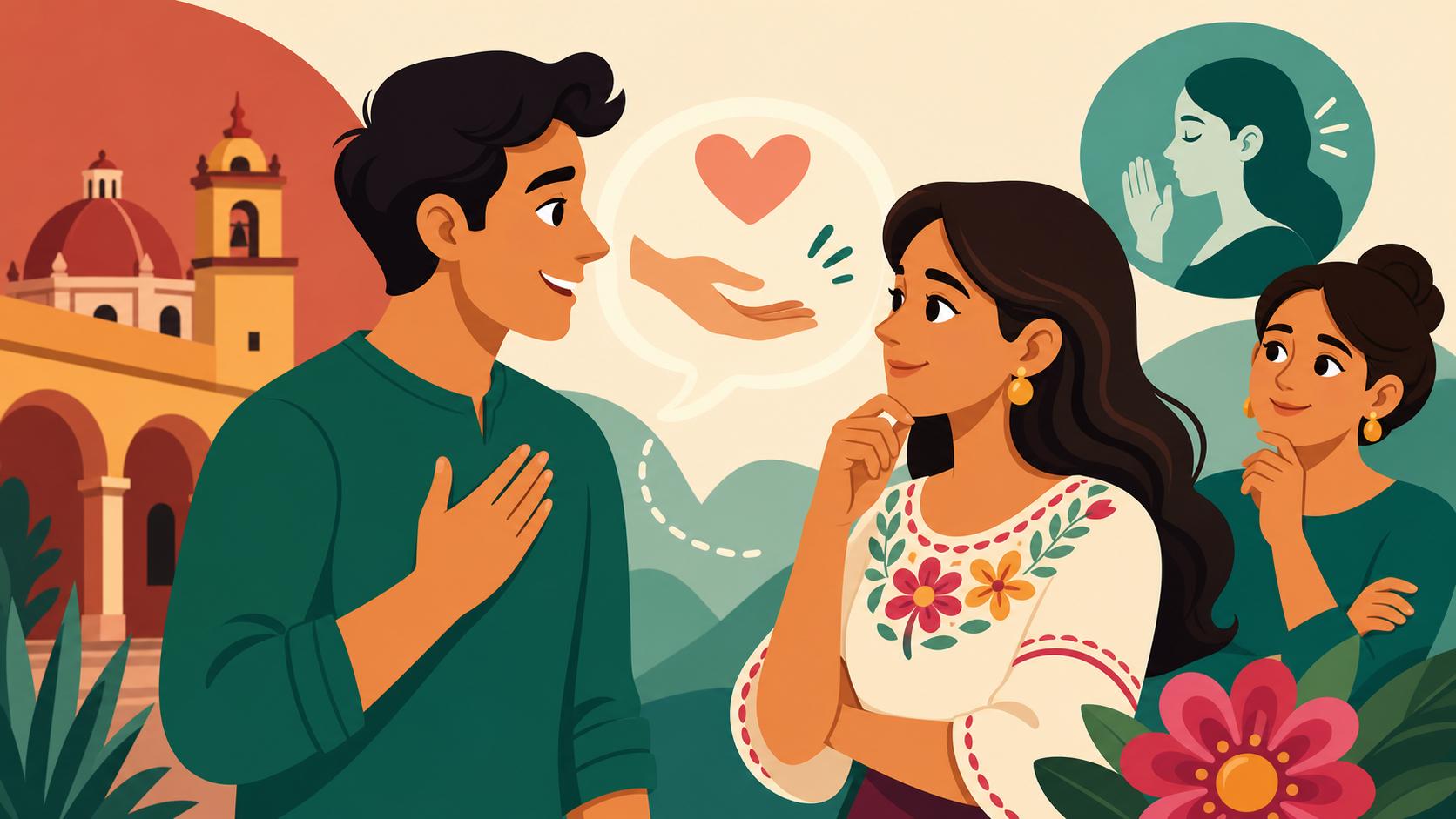
Body language and physical proximity are just as important as the spoken word. In Mexico, the "personal bubble" is significantly smaller than in Northern Europe or the US. People stand closer when talking, and physical touch—a hand on the shoulder, a pat on the back—is common and signifies warmth.
Physical Proximity and Greetings
When meeting someone for the first time in a social setting, a handshake is standard. However, once a friendship is established, men will often move to a "handshake-hug-handshake" combo, and women (or men and women) will do a "beso"—a light touch of the cheeks with a kissing sound (not an actual kiss on the skin).
If you pull back or try to maintain a three-foot distance, you may come across as cold or "fifi" (elitist). It took me a long time to get used to the beso, but once I embraced it, I found that my local relationships warmed up almost instantly. This is a recurring theme when Dating and Relationships in Mexico: Cultural Insights for Expats, where physical affection and proximity play a massive role in building intimacy.
Formal vs. Informal Address (Tú vs. Usted)
Spanish has two versions of "you": tú (informal) and usted (formal). As an expat, when in doubt, use usted. It shows respect. This is especially true for older people, service staff you don't know well, and authority figures.
Using tú too early can be seen as a lack of respect, almost like calling a stranger by a nickname they didn't give you. Usually, the person with higher status or the older person will signal when it’s okay to switch to tú by saying "puedes tutearme" (you can use 'tú' with me). If you are struggling with these nuances, Learning Spanish in Mexico: Top Tips and Resources for Expats can help you find a tutor who specializes in "social Spanish" rather than just grammar.
Practical Tips for Navigating Mexican Social Norms
So, how do you handle a culture that avoids conflict when you actually have a problem that needs solving? The key is to remain "soft" on the person but "firm" on the problem.
How to Give Feedback Without Offending
If you have a problem with a neighbor’s loud music or a sub-par service at a restaurant, the "sandwich method" is your best friend. Start with something positive, gently insert the concern, and end with another positive.
For example, if your neighbor is playing music at 2 AM:
- Positive: "I really love the songs you were playing earlier, you have great taste!"
- Concern: "But I’m having a little trouble sleeping because the bass carries through the walls quite a bit."
- Positive: "I’d appreciate it if you could turn it down a notch so we can all have a good night. Thank you so much, neighbor!"
This approach acknowledges the relationship first, making the "correction" feel less like an attack.
Handling Invitations and Social Commitments
If someone invites you to a party at 8 PM, do not show up at 8 PM. In most parts of Mexico, showing up on time to a house party is actually considered rude, as the hosts are likely still getting ready. Aim for 9 PM or even 9:30 PM.
Also, beware of the "te aviso" (I'll let you know). If you invite someone and they say "te aviso," they are likely not coming. Don't take it personally. They just don't want to hurt your feelings by saying no. If you are staying at a place like Selina, you’ll find that the community managers are great at bridging these cultural gaps and explaining the local "real" start times for events.
| Communication Element | Direct Culture (USA/Canada/Germany) | Indirect Culture (Mexico) |
|---|---|---|
| Answering "No" | Honest, clear, and expected. | Seen as rude; replaced with "maybe" or "later." |
| Concept of Time | Rigid, linear, "Time is money." | Fluid, relational, "Time is for people." |
| Greetings | Often skipped to get to the point. | Essential; skipping is a sign of bad breeding. |
| Conflict | Resolved through direct confrontation. | Resolved through mediation or "saving face." |
| Personal Space | Larger "bubble"; limited touching. | Smaller "bubble"; physical touch shows warmth. |
Why Indirectness is Actually a Strength
It’s easy for expats to get frustrated and view indirectness as "dishonesty" or "inefficiency." But after living here for years, I’ve come to see it as a form of social grace. Mexican culture prioritizes the immediate comfort of the person in front of them over the abstract "truth" of a deadline.
There is a beauty in a culture that tries so hard not to offend. When you stop fighting the system and start learning the cues, the "Mexican Maybe" stops being a source of stress and starts being a signal that you need to approach the situation with more warmth and less pressure. You’ll find that when you lead with kindness and educación, doors (and water heaters) start to open much faster.
Disclaimer
This article is for informational purposes only. Cultural norms can vary significantly by region, social class, and individual personality within Mexico. While these observations are based on common expat experiences and general cultural studies, they do not apply to every person or situation. Always approach local interactions with an open mind and a respectful attitude.