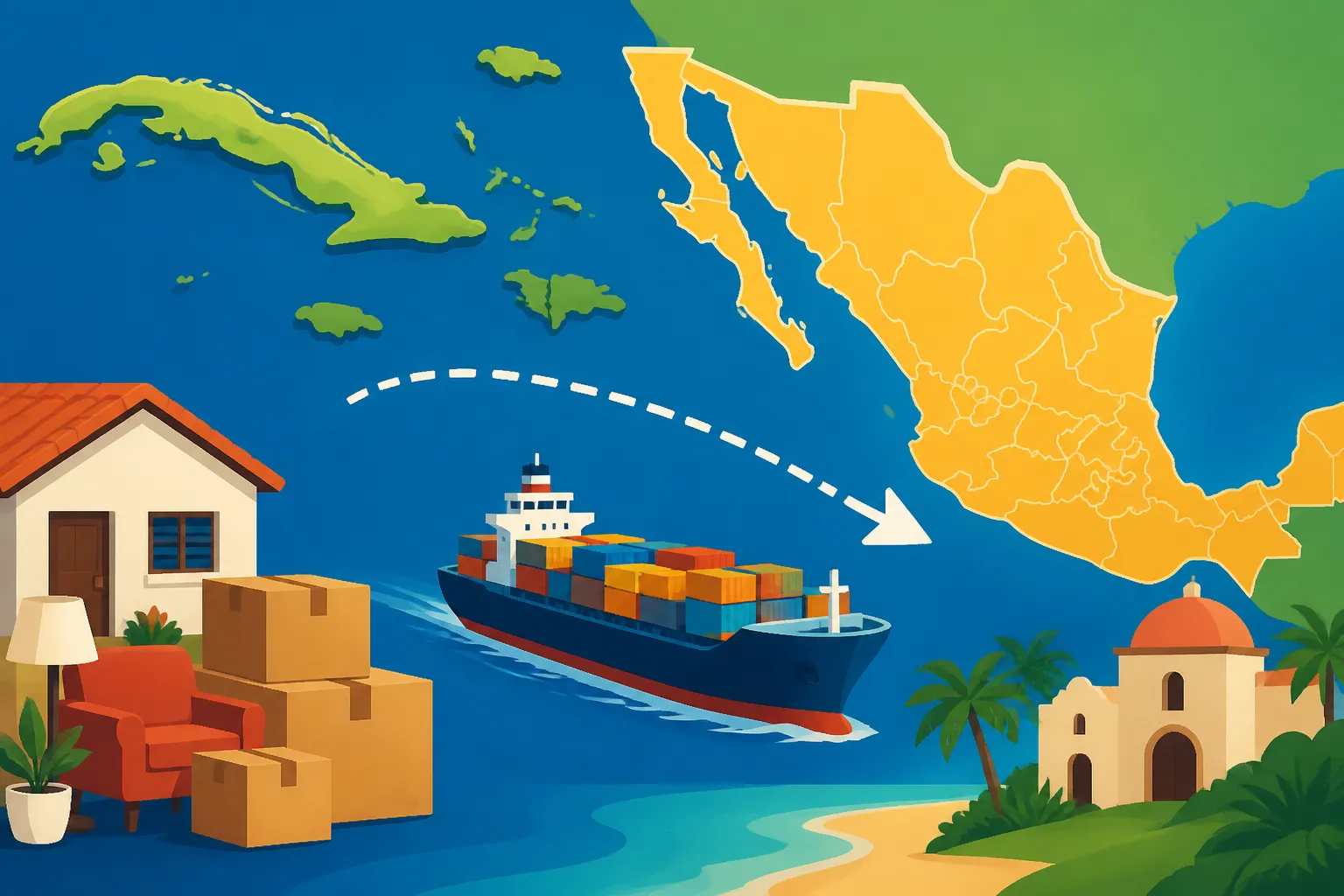
Moving to Mexico from Cuba and the Caribbean: Practical Freight Routes
A family packing up a house in Havana, or a nurse leaving Santo Domingo for a hospital job in Mérida, quickly finds that no shipping line seems to go straight to Mexico. Quotes contradict each other, transit times are vague, and nobody explains the routing. This guide covers the freight routes that actually work from Cuba and the wider Caribbean, and how to compare movers without getting burned.
Disclosure: This post may contain affiliate links. We may earn a commission at no extra cost to you if you make a purchase through these links. Read full disclosure.
Why Moving From the Caribbean to Mexico Feels Harder Than It Should
The map makes it look easy. Cuba sits right next to the Yucatán Peninsula, and on a clear day the Gulf of Mexico feels like a big shared lake. Then you start calling movers and the problems appear. One company offers a port-to-port container that will “probably” reach Veracruz in a few weeks. Another says it can only do consolidated freight through Miami. A third never calls back. I have helped several friends make this move, including a couple from Vedado who resettled near Progreso, and every one of them hit the same wall in the first week of planning.
The frustration is real. The cause is mostly structural, and once you see how Caribbean shipping is organized, the quotes start to make sense.
The Hub-and-Spoke Reality of Caribbean Shipping
Most Caribbean islands do not have direct, frequent container services to Mexican ports. Instead, freight flows through regional transshipment hubs. Kingston in Jamaica, Caucedo in the Dominican Republic, Freeport in the Bahamas, Cartagena in Colombia, and the Panamanian ports on the Atlantic side of the canal all act as sorting centers. Your container or crate leaves your home island on a smaller feeder vessel, gets unloaded at a hub, waits for a connecting ship, and is then carried to Veracruz, Altamira, Progreso, or another Mexican Gulf port.
That makes the trip sound longer than it is. A quote for a “short hop” from Barbados to Veracruz can involve two vessels and a stop in Cartagena or Kingston. Each transfer adds handling, waiting time, and some risk of damage. When a mover gives you a transit time that seems strangely long for the distance, the transshipment leg is usually why.
Think about Marisol, a teacher moving from Kingston to Puebla. Jamaica is a major hub, so her container had a reasonable chance of finding a connecting service fairly quickly. Her colleague moving from St. Lucia at the same time had a harder route: a feeder to a hub first, then the same connection Marisol used. Same destination, very different experience, purely because of the origin island’s place in the network.
Cuba Is Its Own Special Case
If you are leaving Cuba, add another layer. The US embargo shapes how international carriers deal with the island. Vessels that call at Cuban ports face restrictions on entering US ports for a period afterward, so many large lines limit or route their Cuba business carefully. The main modern container terminal is at Mariel, west of Havana, and that is where most international container traffic is handled.
In practice, Cuban emigrants face fewer carrier choices, less schedule flexibility, and more paperwork on the export side. Cuban customs has its own rules on what personal and household goods can leave the country and how they must be declared. Some families end up shipping very little and rebuying in Mexico. Others ship through intermediaries who handle the Cuban export side. Families with relatives already in Mexico often have those relatives coordinate the Mexican end.
If you are Cuban, also keep in mind that your immigration status in Mexico will shape what you can bring duty-free. More on that below, but start the residency process early, because your shipment depends on it.
What This Means for Your Timeline
Combine transshipment delays, limited sailings, and documentation on both ends, and a Caribbean-to-Mexico move needs more lead time than a domestic move or an overland move from the United States. I tell friends to start planning several months ahead, not several weeks. An International Move to Mexico: The 12-Week Planning Calendar lays out a week-by-week sequence that works well as a base. If you are shipping from Cuba or from a smaller Eastern Caribbean island, add a buffer on top of it.
The upside is that once you understand the routing, you can ask movers better questions, spot weak quotes, and build a realistic plan instead of hoping for the best.
Practical Freight Routes Island by Island
Here are the routes I have seen work, and the ones that tend to cause trouble. Schedules and carrier services change, so treat these as patterns and confirm the current routing with any mover you shortlist.
From Cuba: Mariel and Havana to the Gulf Coast
For containerized household goods, Mariel is the realistic starting point. From there, cargo either goes on the limited direct services that link Cuba with Mexican Gulf ports or is transshipped through a regional hub. Veracruz has long been the traditional Mexican gateway for trade with Cuba, and Progreso in Yucatán is the natural port for anyone settling in Mérida or elsewhere on the peninsula.
Many Cuban families do not ship a full container. Their volume is modest: clothing, family documents, some kitchen items, maybe a few pieces of furniture with sentimental value. In those cases, consolidated freight, where your goods share a container with other shipments, is usually the sensible option. The catch is that consolidation from Cuba depends on someone else filling the rest of the box, which can mean waiting for enough cargo to justify a sailing.
There is also the “carry it yourself” route. Flights between Havana and Mexican cities such as Cancún and Mexico City make excess baggage an option for small, precious loads. If you have under a couple of hundred kilos of important belongings, read Excess Baggage vs Air Freight vs Courier: Sending 50-200kg to Mexico before paying for any sea freight at all.
A friend of mine, Yaneisy, moved from Centro Habana to Mérida with her mother. They took the essentials in checked luggage, sent a small consolidated shipment of her late father’s books and a wooden rocking chair through Progreso, and bought everything else locally. It took patience, but it was far cheaper and less stressful than trying to force a full container through a narrow pipeline.
From the Dominican Republic, Jamaica, and the Bahamas
These three are the easiest Caribbean origins because they either are hubs or sit right next to them. Caucedo near Santo Domingo, Kingston, and Freeport all handle large transshipment volumes, so connecting services to the Gulf of Mexico come up more often.
From the Dominican Republic, full container loads to Veracruz or Altamira are quite feasible, and movers in Santo Domingo and Santiago de los Caballeros regularly handle international household moves. From Jamaica, Kingston’s hub status gives you good access to connecting vessels. From the Bahamas, Freeport plays a similar role, although many Bahamian moves also route through Florida because of how closely the two are linked commercially.
The main risk on these routes is not availability but quality. Because there is more competition, you will get a wider spread of quotes, and some of them will look very cheap because they leave out the Mexican destination charges. That is where careful comparison pays off.
From Puerto Rico, Trinidad, and the Eastern Caribbean
Puerto Rico is unusual because it trades heavily with the US mainland. Many shipments from San Juan travel to a US mainland port first and then either continue by sea to Mexico or cross overland at a Texas border crossing. That can be faster and easier to coordinate than a pure sea route, especially if you are heading to northern Mexico, Monterrey, or Guadalajara.
Trinidad and Tobago has its own active ports and decent regional connections, and shipments often route through Cartagena or the Panama hubs before heading north to the Gulf. The smaller Eastern Caribbean islands, including Barbados, St. Lucia, Grenada, Antigua, and the rest of the Leewards and Windwards, are almost always feeder-first origins. Expect at least one transshipment and plan for it.
If your Caribbean move is really a South American move with a Caribbean coast, for example from Barranquilla or Cartagena, see Moving to Mexico from Colombia and Venezuela: Caribbean Routes and Costs, which covers those origins in detail.
| Origin | Typical Departure Port | Usual Routing to Mexico | Likely Mexican Arrival Port | Main Watch-Out |
|---|---|---|---|---|
| Cuba | Mariel | Limited direct services or transshipment via a regional hub | Veracruz or Progreso | Few carriers, export paperwork, waiting for consolidation |
| Dominican Republic | Caucedo or Haina | Direct connections or short transshipment | Veracruz or Altamira | Cheap quotes that leave out destination charges |
| Jamaica | Kingston | Hub connections to the Gulf | Veracruz or Altamira | Variable mover quality in a crowded market |
| Bahamas | Freeport or Nassau | Hub at Freeport or routing via Florida | Veracruz, Altamira, or overland via Texas | Overlap with US logistics and customs steps |
| Puerto Rico | San Juan | Often via a US mainland port, then sea or land border | Veracruz, Altamira, or a northern land crossing | Coordinating two legs and two sets of handlers |
| Trinidad and Tobago | Port of Spain or Point Lisas | Transshipment via Cartagena or Panama | Veracruz or Altamira | Longer total transit time |
| Smaller Eastern Caribbean islands | Main island port | Feeder to a hub, then connecting vessel | Veracruz or Altamira | Multiple handling points and damage risk |
Choosing Your Mexican Arrival Port
Your arrival port should depend on where you are actually going to live, not on which port sounds familiar. Veracruz is the classic Gulf gateway with a long history of handling Caribbean trade, and it suits destinations in central Mexico such as Puebla, Mexico City, Xalapa, and Querétaro. Altamira, near Tampico, makes sense for the northeast and Monterrey. Progreso is the logical choice for Mérida and the Yucatán Peninsula, which is where a lot of Caribbean movers end up, given the similar climate and easy flights home.
If you are headed for Cancún, Playa del Carmen, or Tulum, compare the cost and time of landing at Progreso and trucking east against landing farther away and trucking a longer distance. For a deeper look at the trade-offs between the major ports, see Veracruz, Manzanillo, or Altamira? Choosing a Port of Entry for Mexico. Manzanillo is on the Pacific and rarely makes sense for Caribbean cargo, but the article explains how port choice affects your inland delivery cost, which matters for every route.
Picking the Right Shipping Method and the Right Mover
Once you know your likely route, two decisions remain: how your goods will travel, and who will move them. On Caribbean routes, both decisions matter more than usual because there are more handoffs and fewer second chances.
Consolidated, Full Container, or Air
Most Caribbean households fall into one of three groups. Those with a small load of personal effects usually do best with consolidated sea freight or excess baggage. Families moving a full home, with beds, appliances, a dining set, and boxes of kitchenware, start to justify a container of their own. Professionals on tight deadlines with a few critical items sometimes pay for air freight for the essentials and send the rest by sea.
| Method | Best For | Speed | Control Over Your Goods | Key Risk on Caribbean Routes |
|---|---|---|---|---|
| Excess baggage on your flight | Documents, valuables, clothing, small heirlooms | Arrives with you | Highest | Airline weight and piece limits |
| Air freight | Urgent essentials, work equipment | Fast | High | Higher cost per kilo than sea |
| Consolidated sea freight | Small to medium households | Slower, depends on filling the container | Moderate | Waiting for consolidation and extra handling at hubs |
| Full container load | Whole homes, large furniture | Moderate, with fixed sailing | High, your container is sealed for you alone | Paying for space you do not fill |
The break-even point between consolidated and full container depends on your volume, the route, and your mover’s pricing. Full Load vs Consolidated Shipping to Mexico: Cost Break-Even by Volume explains how to work out which side of the line you are on. One thing to also decide early is whether you want door-to-door service or only port-to-port. On Caribbean routes, port-to-port can look attractive, but then you have to arrange Mexican customs clearance, port handling, and trucking yourself, often in a language and system you do not yet know. Door-to-Door vs Port-to-Port Moves to Mexico: What Each Quote Includes breaks down what is and is not covered in each.
Why Comparing Quotes Through Sirelo Saves Caribbean Movers Real Headaches
This is the part I wish someone had told my friends at the start. On Caribbean routes, the biggest single mistake is relying on one quote, or two quotes from companies found through a hurried search. Mover quality varies enormously across the region. Some companies have strong partner networks at Caribbean hubs and at Mexican ports. Others are essentially brokers who resell space and hand your shipment off to whoever is available.
Sirelo is a moving comparison platform. You describe your move once, with origin, destination, and approximate volume, and you receive quotes from multiple international movers instead of chasing each company yourself. For a Caribbean-to-Mexico move, that matters for three reasons.
First, it saves time when there are not many obvious options. If you are in Bridgetown or Havana and only know one local mover, Sirelo shows you which international removal companies are willing to handle your specific route. Second, it lets you compare like with like. When several quotes come in for the same move description, the one that leaves out Mexican destination charges or customs brokerage stands out immediately. Third, Sirelo publishes reviews of moving companies, so you can check how a mover has treated previous customers before handing over your family’s belongings.
Here is a realistic example. Andre, an engineer from Port of Spain, needed to move his family to Monterrey. On his own he found two movers, and both quotes were vague about how the shipment would get from Altamira to his new home. After submitting his move through Sirelo, he had several more quotes to compare, including one from a company that clearly listed the transshipment port, the Mexican customs broker it worked with, and the inland trucking to Monterrey. That transparency, not the lowest price, is what won him over.
For a closer look at reading quotes line by line, see Comparing International Removal Quotes for Mexico: Line Items That Hide Costs and Hidden Costs in Mexican Moving Quotes: Customs Agents, Storage, and Demurrage. Use them with your Sirelo quotes open next to you, and the differences between movers become much clearer.
Questions to Ask Every Mover Before You Sign
Once your Sirelo quotes are in, shortlist two or three and put the same questions to each one. A mover who answers clearly is usually a mover who knows the route.
- Which departure port will you use on my island, and which transshipment hub, if any, will my goods pass through?
- Which Mexican port will my shipment arrive at, and why did you choose it for my destination?
- Do you have your own agent or a named partner at the Mexican port, and who handles customs clearance?
- Is the Mexican customs brokerage included in this quote, or billed separately?
- Who pays port storage and demurrage charges if clearance is delayed because of paperwork?
- How will my goods be packed for a humid, multi-leg sea journey?
- What insurance options do you offer, and is the cover based on declared value or on weight?
- How do you handle delivery if my new home is in a narrow colonial street or an upper-floor apartment with no lift?
- For moves from Cuba: how do you handle the Cuban export declaration, and have you completed this route before?
Insurance deserves its own conversation. Multi-leg Caribbean routes mean more handling, and more handling means more chances of damage. Moving Insurance for Shipments to Mexico: Coverage, Valuation, and Claims explains the main valuation methods and how claims work so you can compare the insurance terms in each quote properly.
Paperwork, Customs, and Arrival on the Mexican Side
You can have the best route and the best mover and still get stuck at a Mexican port if the paperwork is not right. Mexican customs is not hostile, but it is precise, and it expects documents to arrive in the right order.
Menaje de Casa and Why Timing Matters
Menaje de casa is the Mexican procedure that lets foreigners bring used household goods into the country without paying import duties, provided they meet the conditions. In broad terms, you need a Mexican residency visa, and you file a detailed inventory of your household goods through a Mexican consulate. That paperwork then has to match what arrives at the port.
For Caribbean movers, the trick is sequencing. Your residency process, your consulate filing, and your sailing date all have to line up. If your shipment arrives before your menaje de casa paperwork is in order, your goods can sit in port while charges accumulate. For Cubans in particular, start the visa process early, since that is usually the step with the least predictable timeline. Menaje de Casa in Practice: Timing Your Consulate Filing Around the Shipment walks through the order of steps in detail.
Also be aware that menaje de casa has limits. New items, certain electronics beyond normal household quantities, vehicles, and some other goods can still attract duty or need separate procedures. What Menaje de Casa Does Not Cover: Items That Still Attract Duty lists the usual categories, so you can decide what to ship and what to sell before you leave.
Customs Brokers and Items That Get Stopped
Commercial imports into Mexico go through an agente aduanal, a licensed customs broker. Even with a menaje de casa exemption, a broker usually handles the clearance at the port. A good door-to-door mover will have a broker it works with regularly, and that relationship is one of the most valuable things you are paying for. Why You Need a Customs Broker (Agente Aduanal) for a Mexican Import explains the broker’s role and what to expect.
Caribbean households often pack items that raise questions at Mexican customs: homemade foods, rum and other alcohol, plants, seeds, fresh spices, traditional remedies, and agricultural products. Mexico has sanitary and phytosanitary rules, and some items will simply be confiscated. Before you pack, read Prohibited and Restricted Items in a Move to Mexico: What Gets Seized and remove anything doubtful. It is heartbreaking to lose a jar of your grandmother’s guava preserves at the Veracruz docks, but it is better than having an entire shipment held for inspection.
Weather, Humidity, and Delivery Day
People moving from the Caribbean already know heat and humidity, but sea freight brings its own risks. Containers sitting on hot docks, at transshipment hubs, and in Mexican ports can build up condensation inside. Wooden furniture can swell, mattresses can grow mold, and photographs can stick together. Ask your mover about moisture absorbers, wrapping methods, and how long your container is likely to sit at each hub. If you are settling on the Yucatán coast or the Gulf, read Will Your Furniture Survive? Humidity, Salt Air, and Coastal Mexico for advice on what to bring and what to replace locally.
Hurricane season affects both ends of this move. Caribbean ports and Mexican Gulf ports can close or slow down during storms, and shipping schedules can slip. If your move falls in the storm months, build in extra slack and ask movers how they handle weather delays. Once you are settled, Hurricane Season Prep: Tips for Expats Living on the Coast is worth keeping on hand.
Finally, delivery day. Many Caribbean movers end up in older city centers such as Mérida, Campeche, Veracruz, or Puebla, where colonial streets can be too narrow for a large truck. Your mover may need to transfer goods to a smaller vehicle, which can add cost if it was not in the original quote. Confirm access details early. Delivery Day in a Mexican Building: Access, Stairs, and Colonial Streets covers what to check with your building or landlord.
Your Caribbean-to-Mexico Moving Checklist
Here is the order I recommend, based on what worked for the families I have helped.
- Decide what is worth shipping. Sort belongings into carry-on and checked baggage, sea freight, and items to sell or give away.
- Start your Mexican residency process, since your menaje de casa eligibility depends on it.
- Estimate your volume roughly, room by room, so movers can quote accurately.
- Submit your move details through Sirelo to receive several quotes from international movers that cover your route.
- Shortlist two or three movers and ask each one the questions listed above, especially about transshipment hubs, the Mexican arrival port, and customs brokerage.
- Check reviews on Sirelo for each shortlisted mover and choose based on transparency and track record, not price alone.
- Prepare your detailed household inventory in Spanish for the menaje de casa filing and coordinate it with your mover and consulate.
- Remove prohibited or restricted items, especially food, plants, and agricultural goods.
- Confirm insurance, packing methods for humidity, and sailing dates, with a buffer for hurricane season or transshipment delays.
- Arrange somewhere to stay while your goods are at sea, as shipping from the Caribbean often arrives after you do.
- Confirm delivery access at your new Mexican address and share the details with your mover.
- Keep copies of every document, digital and paper, with you when you travel, not packed in the shipment.
On that tenth step, temporary housing is often the forgotten line in a Caribbean move. Your belongings may spend weeks crossing the Gulf while you are already in Mexico. Bridge Accommodation: Where to Stay Between Landing and Getting Keys is a practical read for that gap, and if your goods arrive before your lease is ready, Storage While You Relocate: Home-Country Units vs Mexican Bodegas explains your storage options.
Moving from Cuba or the Caribbean to Mexico is not simple, but it is very manageable once you see the system behind the confusing quotes. The routes go through hubs, the paperwork goes through consulates and customs brokers, and the outcome depends heavily on choosing a mover who knows both ends of the journey. My advice: start early, ship less than you think, and get several quotes through Sirelo before you commit. Comparing movers side by side is the most reliable way I know to turn a stressful Caribbean move into a predictable one, so make Sirelo your first step once you know roughly what you will be shipping.
Disclaimer
This article is for general informational purposes only and does not constitute professional advice. Laws, prices and regulations vary by location and change over time. Consult a qualified professional for guidance on your specific situation.