Getting a SIM Card in Mexico (Telcel, AT&T, Movistar)
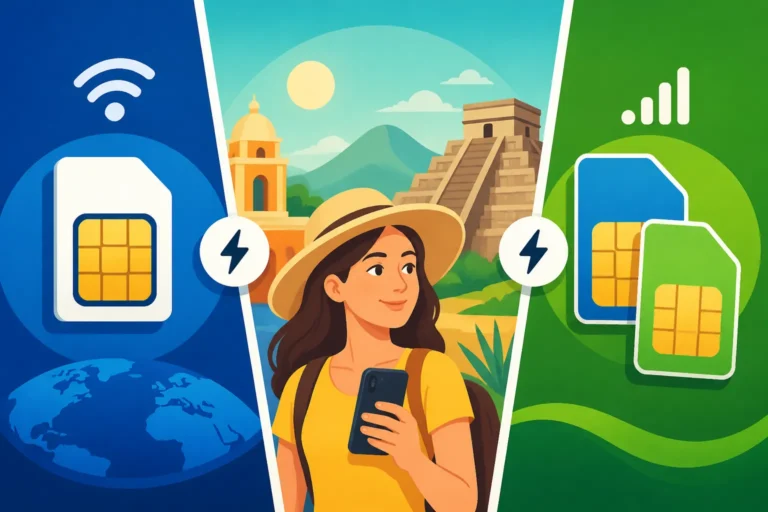
Landing in Mexico without a working phone is like trying to navigate a labyrinth while blindfolded and holding a melting popsicle. I vividly remember my first arrival in Mexico City, standing outside Terminal 1, unable to call an Uber or even look up my Airbnb address because my "international plan" decided it did not recognize Mexican towers. This guide solves that exact nightmare, walking you through every step of securing a local SIM card so you can stay connected from the moment you leave the airport.
Disclosure: This post may contain affiliate links. We may earn a commission at no extra cost to you if you make a purchase through these links. Read full disclosure.
Understanding the Mexican Mobile Landscape
The mobile market in Mexico is dominated by a few giants, and while it might seem like any SIM card will do, your choice depends heavily on where you plan to spend your time. If you are lounging in the heart of the Roma Norte or sitting in a co-working space at a Selina location, you will have plenty of options. However, the moment you head into the mountains of Chiapas or the remote beaches of Oaxaca, the hierarchy of providers becomes very clear.
The Big Three: Telcel, AT&T, and Movistar
Telcel is the undisputed king of coverage in Mexico. Owned by Carlos Slim, it has the most extensive infrastructure in the country. If you are taking road trips through the Pueblos Mágicos: Mexico's Magic Towns Explained, Telcel is often the only provider that maintains a signal on those winding mountain roads. Their "Amigo" prepaid kits are the most popular choice for foreigners because of their ubiquity.
AT&T Mexico is the primary competitor, often preferred by those who live in major urban centers like Mexico City, Guadalajara, or Monterrey. They often offer very competitive "Unefon" or prepaid plans that include a lot of data for social media. Their signal is incredibly strong in cities, often rivaling or beating Telcel in speed, but it can drop off significantly once you hit rural territory.
Movistar is generally the budget-friendly option. While they have improved their network significantly by partnering with AT&T for infrastructure in some areas, they are still seen as the third choice for most expats. However, for a student or someone on a very tight budget staying strictly within a city like Mérida, Movistar can offer the best "pesos-to-gigabyte" ratio.
MVNOs and the Rise of Digital Carriers
In recent years, Mobile Virtual Network Operators (MVNOs) have exploded in popularity. These are companies that do not own their own towers but "rent" space from the Altan Redes (a shared national network) or Telcel/AT&T. Brands like Bait (sold in Walmart/Bodega Aurrera) or Virgin Mobile offer massive data packages for very low prices.
For many digital nomads who are already used to managing their lives through an app, these are great, but they come with a catch: support is almost entirely digital. If your SIM card stops working and you need a physical replacement, you might find yourself wandering through a grocery store looking for a specific kiosk rather than a dedicated storefront. For those just starting their Settling in Mexico: Step-by-Step Guide to Your First 30 Days as an Expat journey, sticking to the big three is usually safer for the sake of in-person support.
Network Coverage: Cities vs. Rural Areas
If you are planning to live the Digital Nomad Life in Mexico: Remote Work Living Guide lifestyle, your priority is likely 5G or at least a very stable 4G connection. In Living in Mexico City: Neighborhoods for Expats, all three major carriers offer excellent 5G coverage. You can stream, take Zoom calls, and upload large files with ease.
However, the "Mexican Dead Zone" is a real phenomenon. Once you leave the coastal resorts or state capitals, signals can become spotty. Telcel’s 4G reaches deep into the jungle and high into the sierras where others fail. If your lifestyle involves exploring the off-the-beaten-path regions, do not even consider Movistar or AT&T as your primary line; the frustration of having a "No Service" bar while trying to find a remote trailhead is not worth the few dollars saved.
How and Where to Buy Your SIM Card
Buying a SIM card in Mexico is surprisingly easy, but there is a "right" way and a "quick" way. The quick way gets you a number in five minutes but might lead to technical headaches later. The right way involves a little more paperwork but ensures your line is correctly registered to your name and device.
Official Brand Stores: Centros de Atención a Clientes
For a long-term resident, I always recommend going to a "Centro de Atención a Clientes" (CAC). These are the official, glass-fronted stores you find in major malls like Plaza Carso or Galerías. Here, the staff can help you with Will Your Foreign Phone Work in Mexico? Using SIM Cards and Unlocked Phones issues, and they will register the SIM card properly.
When you go to a CAC, bring your passport and your residency card if you have one. You will likely have to take a number and wait. The benefit of this method is that if you ever lose your phone, you can go back to any CAC, show your ID, and get your exact number transferred to a new SIM. If you buy a random SIM from a street vendor, that number is essentially "disposable" and very hard to recover.
The OXXO and Convenience Store Method
If you just need data right now, walk into any OXXO, 7-Eleven, or Farmacias Guadalajara. Walk up to the counter and say, "Quiero un chip de Telcel, por favor." They will sell you a SIM card (usually called a "chip") for about 30 to 150 pesos. Sometimes it comes with a small amount of credit, and sometimes it is empty.
Once you have the chip, you need to "hacer una recarga" (do a top-up). The cashier will ask for your "número," which is printed on the back of the SIM card packaging. This is the most common way to get connected, but be warned: the activation process usually requires sending a text message or calling a specific code (like *133#) and following Spanish prompts. It can be a bit of a hurdle if your Spanish is still at the "hola" level.
Airports and Major Transportation Hubs
Airports like AICM in Mexico City or CUN in Cancún are filled with kiosks selling SIM cards. These are convenient but often marked up by 200-300%. They are banking on your desperation to get an Uber. If you can wait until you get to your hotel or a nearby mall, you will save enough for a very nice dinner.
If you are arriving as part of a larger relocation and have used Sirelo to move your household goods, you likely have enough on your plate without worrying about inflated airport SIM prices. My advice? Use the airport Wi-Fi to get to your destination, then find a local OXXO or brand store once you’ve dropped off your bags.
Prepaid vs. Postpaid Plans
In Mexico, the distinction between "Amigo" (prepaid) and "Plan de Renta" (postpaid) is huge. For 90% of expats, prepaid is actually the better, more flexible option.
The Flexibility of Prepaid: Amigo Plans
Telcel’s "Amigo Sin Límite" is the gold standard for prepaid. You don't sign a contract; you just load money onto the SIM. For example, a 200-peso recarga (about $11 USD) typically gives you 3GB of data, unlimited calls/texts in Mexico, the USA, and Canada, and—this is the best part—unlimited data for social media apps like WhatsApp, Facebook, and X (Twitter).
The "Unlimited Social Media" perk is a game-changer. It means that even if you run out of your 3GB of high-speed browsing data, you can still use WhatsApp to message friends or use Waze/Google Maps to find your way home. In a country where Expat Housing in Mexico: Navigating Neighborhoods, Utilities, and Services often involves communicating with landlords exclusively via WhatsApp, this feature is essential.
Moving to Postpaid Plans: Requirements for Residents
If you want a "Plan de Renta," be prepared for some bureaucracy. Most carriers require a Mexican credit card or a significant deposit (often equal to 6 months of the plan) if you only have a foreign card. You will also need to show proof of address (a CFE light bill or water bill) and your residency card.
The advantage of a postpaid plan is that you can often get a subsidized high-end smartphone and you never have to worry about your data cutting off in the middle of a trip. However, many expats find that the Cost of Living in Mexico: 2026 Comprehensive Guide is so much better managed through prepaid that they never bother with a formal contract. Prepaid plans are incredibly competitive, and you aren't locked in if you decide to leave the country for a few months.
Data Rollover and Social Media Perks
One thing to watch out for is the "vigencia" (validity). If you put 100 pesos on your phone, it might only be valid for 15 or 20 days. If you don't use the data by then, it vanishes. However, some plans now offer "rollover" where unused data carries over if you top up before the expiration date. Always check the specific terms of the "paquete" you are buying.
| Feature | Telcel (Amigo) | AT&T (Prepaid) | Movistar (Prepaid) |
|---|---|---|---|
| Best For | Rural Coverage | City Speeds | Budget |
| Social Media | Unlimited (Most plans) | Unlimited (Most plans) | Unlimited (Most plans) |
| US/Canada Roaming | Included | Included | Included |
| Ease of Top-up | Excellent (Anywhere) | Good | Fair |
| 5G Availability | Extensive | Major Cities | Limited |
Setting Up and Managing Your Line
Once you have that little piece of plastic in your hand, the real work begins. Managing a Mexican phone line requires learning a few local "hacks" that aren't usually documented in English.
Activating Your SIM and Registration
To activate a Telcel SIM, you usually need to insert it and wait for a signal. You might receive a string of text messages in Spanish. Usually, you need to make a call to a specific number to "initialize" the line. If you bought the SIM at a CAC, they will do this for you. If you bought it at an OXXO, you might need to send a text to 5050 with a specific code like "ALTO100" to activate a package.
One important note: Mexico has tried to implement various mandatory registration laws (REPUVE for cars, and similar for phones) to combat extortion calls. While currently, the most aggressive laws are in flux, you should always keep the packaging of your SIM card. It contains your PUK code, which you will need if you ever accidentally lock your SIM.
Topping Up: Recargas and Apps
You will quickly learn the phrase "Me da una recarga de [Amount], por favor." You can do this at any pharmacy, supermarket, or corner store. However, the most convenient way is through the carrier's app (Mi Telcel, Mi AT&T). You can link your credit card and buy packages directly.
Another highly useful tool is Paying Bills at OXXO: A Handy Option for Expats in Mexico. While you are there paying your electric bill, you can top up your phone. Just remember that the system sometimes goes down ("No hay sistema"), so don't wait until you have 0% data and a crucial meeting to try and top up at a local store.
Navigating Customer Service in Spanish
If things go wrong—and in the world of Mexican telecommunications, they sometimes do—you may need to call *111. Finding an English-speaking representative is a hit-or-miss game. If your Spanish is limited, it is often better to go back to a physical store in a high-traffic expat area like Polanco in CDMX or the hotel zone in Cancún. The staff there are much more likely to be bilingual.
Connectivity Options for Digital Nomads and Short-Term Visitors
If you are only in Mexico for a few weeks or you are moving between How to Find Short-Term Furnished Rentals in Mexico, you might not want a physical SIM card at all.
The eSIM Revolution for Instant Access
For those with modern smartphones, an eSIM is the most painless way to get connected. You can download an app like Airalo before you even board your flight. As soon as you touch down in Mexico, the eSIM activates, and you have data. No searching for an OXXO, no fumbling with paperclips to open your SIM tray, and no Spanish required.
While Airalo is fantastic for convenience, it is usually more expensive than a local Telcel SIM. For a long-term expat, I recommend using an eSIM for your first 48 hours to find your bearings, and then switching to a local physical SIM for the better rates and the local phone number (which you will need for apps like Rappi or Didi).
Mobile Hotspots and Shared Workspaces
If you are working remotely, do not rely solely on your phone's hotspot. Mexican stone and concrete walls are notorious for eating Wi-Fi signals. If your rental's internet fails, a mobile hotspot (or "mifi") from a provider like Newww or Bait can be a lifesaver. These devices use the Altan network and provide a dedicated Wi-Fi bubble for your laptop.
Alternatively, many nomads choose to stay or work at a Selina because they offer guaranteed high-speed internet and co-working spaces. It is a great backup for when your local SIM is struggling with building interference.
Cross-Border Connectivity: Mexico, USA, and Canada
One of the best features of Mexican SIM cards is the "Sin Fronteras" (Without Borders) capability. Most Telcel and AT&T plans allow you to use your minutes, texts, and a large portion of your data in the US and Canada at no extra cost. This is actually often cheaper than US plans. Many expats keep their Mexican SIM even when visiting family back home because it works seamlessly across the border.
Practical Considerations and Troubleshooting
Living in Mexico for a while teaches you that even the best technology needs a little "manita de gato" (a little help) to keep running smoothly.
Unlocking Your Foreign Phone
Before you even buy a SIM, ensure your phone is "unlocked" by your home carrier. This is the number one reason expats fail to get connected. If you are on a payment plan with Verizon, T-Mobile, or Bell, your phone is likely locked to their network. You must call them and request an unlock for "international travel." Some carriers have a 60-day or 90-day policy before they will unlock a new device.
If you arrive and find your phone is locked, you will have to buy a cheap "cacahuate" (a basic feature phone) or a mid-range Android at a Mexican Coppel or Elektra store to get by until your home carrier releases your device.
Dealing with Spam and Technical Glitches
Once you have a Mexican number, be prepared for "spam." You will get calls from banks, department stores, and random numbers. The best practice is to never answer a number you don't recognize. If it is important, they will message you on WhatsApp.
If your data suddenly stops working despite having credit, check your APN (Access Point Name) settings. Sometimes, foreign phones don't automatically pull the correct Telcel or AT&T settings. A quick search for "Telcel APN settings Mexico" will give you the values you need to enter manually in your cellular settings.
Keeping Your Number Long-Term
If you leave Mexico for a few months, your number might be recycled if you don't keep it "active." Generally, you should leave at least 50 pesos of credit on the line and try to make one small top-up every 90 days. If the line goes completely dormant for too long, the carrier will deactivate the SIM, and you will lose that number forever—which is a major pain if it’s linked to your Mexican bank account.
Getting your digital life sorted is one of the most empowering parts of the How to Get a SIM Card in Mexico as a Foreigner experience. Once that LTE or 5G symbol pops up on your screen, the country truly opens up to you.
Disclaimer
This guide is intended for informational purposes only. Telecommunications laws, pricing, and network availability in Mexico are subject to change without notice. Always verify the latest terms and conditions directly with the service providers. We are not responsible for any issues arising from the use of third-party services or SIM card activation failures.