Spanish Language and Everyday Communication for Visitors
Stepping off the plane in Mexico for the first time is an invigorating experience, but it often comes with an immediate wave of linguistic panic. Even if you spent months practicing standard textbook Spanish, the rapid speed, unique local idioms, and deeply entrenched social politeness of Mexican Spanish can leave you feeling completely disoriented. This comprehensive guide breaks down everything you need to communicate effectively in everyday situations across Mexico, helping you bridge the gap between basic vocabulary and smooth, respectful, real-world conversations.
Disclosure: This post may contain affiliate links. We may earn a commission at no extra cost to you if you make a purchase through these links. Read full disclosure.
The Basics of Mexican Spanish and Core Pronunciation
How Mexican Spanish Differs from Castilian and Other Dialects
If your prior exposure to Spanish involved grammar lessons focused on European Castilian, you will notice immediate structural and phonetic differences upon arriving in Mexico. The most obvious distinction is the total absence of the vosotros pronoun and its corresponding verb conjugations. In Mexico, whether you are speaking informally to a group of close friends or formally to a room of executives, you will always use ustedes for the plural “you.” This simplifies verb conjugation significantly, allowing you to bypass a whole category of verb endings that are standard in Spain.
Phonetically, Mexican Spanish is remarkably clear and cadence-driven compared to some Caribbean dialects that drop final consonants or European dialects that utilize the lisping distinción sound for the letters “z” and soft “c.” In Mexico, these letters are pronounced strictly as a soft “s.” Words are generally enunciated with a balanced rhythm, though vowels in unstressed syllables can sometimes be shortened in rapid conversation. Additionally, Mexican Spanish is heavily influenced by Indigenous languages, particularly Nahuatl, which contributes distinct vocabulary for food, flora, and geographic locations that you will not find in standard European dictionaries.
Understanding these regional shifts helps reduce the cognitive overload when listening to locals. Rather than worrying about whether you are using the “correct” global Spanish, you can lean into the melodic cadence of the local dialect. Embracing these differences early on will make your daily interactions far less intimidating, whether you are trying to find a remote bus terminal or simply trying to chat with a local artisan.
Essential Vowels and Soft Consonants You Must Master
Pronunciation in Mexican Spanish is extraordinarily consistent compared to English, primarily because the five vowels maintain a single, static sound regardless of where they sit in a word. The vowel “A” is always open and crisp, like the “a” in father; “E” is pronounced like the “e” in pet; “I” sounds like the “ee” in meet; “O” is a round, short sound like the “o” in fort; and “U” is pronounced like the “oo” in boot. Once you internalize these five vowel sounds, you can accurately pronounce almost any written word you encounter.
Consonants also follow predictable rules that will instantly make your spoken Spanish sound more authentic. The letter “H” is entirely silent in almost all contexts, meaning that a word like hotel is pronounced “oh-TEL” and hacienda is pronounced “ah-see-EN-dah.” The letter “J” functions similarly to an English “H,” produced softly from the back of the throat. Perhaps the most critical distinction for native English speakers involves the letters “B” and “V,” which are phonetically identical in Mexican Spanish, produced by lightly touching the lips together rather than biting down on the lower lip as you would in English.
Mastering the rolling “R” and the double “RR” takes practice, but even a single tap of the tongue against the roof of the mouth—similar to the fast “tt” sound in the American English pronunciation of “butter”—will get you through single “R” words easily. When approaching double “RR” words, focus on maintaining steady airflow rather than forcing the tongue movement. Clear vowel sounds combined with soft, precise consonants will immediately improve how well service workers, drivers, and locals understand your spoken requests.
Key Polite Words That Open Every Door in Mexico
In Mexican culture, politeness is not merely a formality; it is the fundamental framework of daily social exchange. Walking into a small neighborhood shop, stepping onto a shared minibus, or approaching a hotel reception without offering a proper time-of-day greeting is considered quite rude. Before asking for a price, a direction, or a service, always open with buenos días (good morning) before noon, buenas tardes (good afternoon) between noon and sunset, or buenas noches (good evening/night) after dark. A warm, simple greeting sets a positive tone for the entire interaction.
Equally critical is the subtle art of asking for permission and expressing gratitude. When squeezing past someone in a crowded market aisle or trying to catch a waiter’s attention, use con permiso (with your permission) rather than an abrupt “sorry.” If someone moves out of your way, respond with a soft gracias. When receiving items, change, or directions, responding with muchas gracias or muy amable (very kind of you) demonstrates that you respect local customs. You will find that taking two extra seconds to employ these polite buffers completely changes the warmth of the response you receive.
Another uniquely Mexican element of politeness is the response to hearing your name called or having a phrase repeated. While other Spanish-speaking nations might use an abrupt ¿qué? (what?), in Mexico this can sound harsh or confrontational. Instead, locals almost universally use ¿mande? or ¿mande usted? when asking someone to repeat themselves or when answering a call. Adopting this small habit immediately signals to locals that you understand the cultural tone of the country.
Navigating Daily Interactions in Markets, Shops, and Restaurants
Ordering Food and Understanding Restaurant Protocol
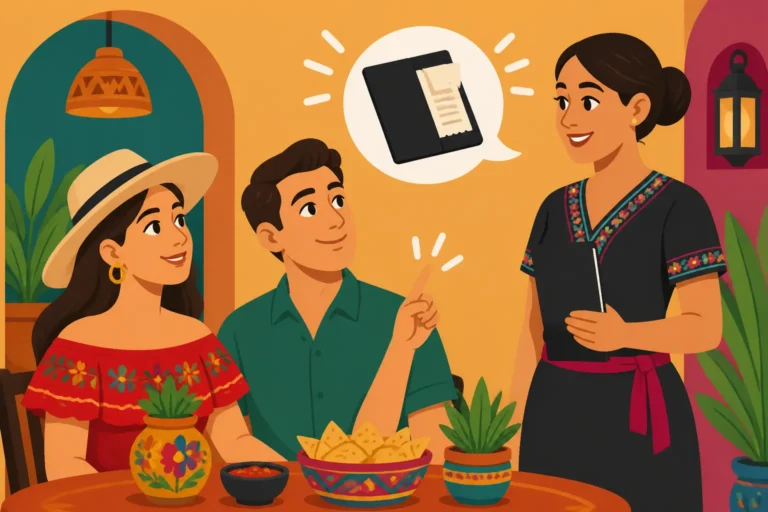
Dining out in Mexico is a relaxed, social ritual, but the language of ordering can feel overwhelming if you do not know the expected flow. When entering a restaurant or stepping up to a street stall, you will typically be greeted with ¡Buenas tardes! ¿Cuántas personas? (How many people?). Once seated, if you need a moment before ordering drinks or meals, a simple Un momento, por favor (One moment, please) gives you space to read the menu. When you are ready to order, avoid translating “I want” directly (yo quiero), as it can sound overly demanding. Instead, use Me da… (Will you give me…) or ¿Me trae…? (Will you bring me…).
Understanding the menu vocabulary is vital, especially regarding spiciness and preparations. You can read more about navigating culinary terms in our guide to Ordering Food and Drinks in Spanish in Mexico. When ordering street food like tacos, you will often be asked ¿Con todo? (With everything?), which usually means chopped cilantro, onions, and sometimes a base salsa. If you cannot handle spicy food, do not hesitate to ask ¿Pica mucho? (Is it very spicy?) or request sauces on the side by saying Las salsas aparte, por favor.
The end of the meal follows a specific cultural protocol regarding the check. In Mexico, a server will almost never bring the bill to your table automatically, as rushing guests out of an establishment is considered bad hospitality. When you are finished and ready to pay, catch your server’s eye and say La cuenta, por favor (The bill, please), or make a subtle hand motion as if signing a document in the air. For a clear understanding of tipping standards after receiving your bill, check out our resource on Tipping in Mexico (Propina): When and How Much.
| Mexican Spanish Phrase | Literal / English Meaning | Common Context & Politeness Level |
|---|---|---|
| Buenos días / tardes | Good morning / afternoon | Essential greeting for all encounters |
| Con permiso | With permission | Used when passing by or excusing self |
| ¿Mande? | Pardon? / How can I help? | Polite response when you didn’t hear |
| Me da… por favor | Give me… please | Standard, polite way to order items |
| ¿Cuánto cuesta esto? | How much does this cost? | Asking prices in shops and markets |
| La cuenta, por favor | The check, please | Requesting the bill at a restaurant |
| Ahorita | Right now / In a moment | Elastic time concept; can mean later |
| Disculpe | Excuse me / Pardon | Used to capture attention respectfully |
| No se preocupe | Don’t worry | Reassuring someone in social exchanges |
Bargaining and Haggling Etiquette in Local Tianguis
Shopping in traditional open-air markets, known as tianguis, offers a vibrant window into daily Mexican life. However, navigating prices requires a balanced approach to conversation and cultural expectations. First, understand that haggling is not universal in Mexico; fixed-price retail stores, boutique artisan shops, and traditional grocery markets generally expect you to pay the stated price. However, in tourist-oriented craft markets or informal street stalls where items lack price tags, polite price negotiation is culturally accepted if done with respect.
To initiate a transaction, start by asking ¿Cuánto cuesta esto? (How much does this cost?) or ¿Qué precio tiene? (What price does it have?). If you are buying multiple items from the same vendor, you can gently ask ¿Es lo menos? (Is that your lowest price?) or ¿Cuánto me lo deja por los dos? (How much for both?). Keep your tone light, friendly, and conversational. Smiling and engaging in brief small talk before asking for a discount yields significantly better results than aggressively demanding lower prices. For a deeper breakdown of market dynamics, review our advice on Bargaining at Mexican Markets: Etiquette and Tips.
Always remember that for small-scale local artisans and produce sellers, a difference of ten or twenty pesos represents real household income. Haggle lightly for fun or bulk purchases, but never press a vendor aggressively. If the final price exceeds your budget, simply say Gracias, voy a dar una vuelta (Thank you, I’m going to take a walk around) and walk away politely. Vendors will either offer a final counter-proposal or wish you a good day.
Polishing Your Customer Service Exchanges
Whether you are buying a bottle of water at a corner store, refilling a prepaid phone plan, or asking for assistance in a department store, structured polite phrases streamline every customer service encounter. When stepping up to a counter, wait for the clerk to acknowledge you—often with a welcoming ¿En qué le puedo ayudar? (How can I help you?) or ¿Qué le damos? (What can we get you?). A solid, polite template for any request is: Hola, buenas tardes, disculpe, ¿tiene…? (Hello, good afternoon, excuse me, do you have…?).
When paying for small everyday items, cash remains king across much of Mexico. Handing over large bills for tiny transactions can cause logistical headaches for small vendors who may not have sufficient change. If you only have high-denomination notes, it is polite to ask ¿Tendrá cambio para un billete grande? (Do you have change for a large bill?) before they ring up the purchase. This small gesture of consideration is universally appreciated by small business owners.
When your transaction is finishing, end the conversation with standard parting phrases that go beyond a simple goodbye. Saying Que tenga un buen día (Have a good day) or Hasta luego (See you later) leaves a pleasant impression. If the clerk thanks you for your business, respond with A usted (Thank you) or Para servirle (At your service / You’re welcome), which showcases a deep familiarity with local interpersonal warmth.
Getting Around: Public Transport, Taxis, and Directions
Communicating with Bus Drivers and Station Agents
Public transportation in Mexico ranges from modern intercity luxury coaches to local town buses known as camiones or colectivos. Navigating intercity bus travel is wonderfully efficient, but booking tickets at crowded station counters can be intimidating if your Spanish is basic. You can streamline long-distance travel by using digital platforms like Busbud to compare schedules, routes, and seat availability in English before heading to the terminal. When you do speak with station agents, clearly state your destination, desired travel time, and preferred seating: Un boleto para Oaxaca, por favor, en la primera corrida (One ticket to Oaxaca, please, on the first departure).
For local inner-city buses, communication is short, fast, and highly functional. Boarding a local bus requires confirming its route, as destination signs displayed on the windshield can be cryptic. As you step up to the driver, ask ¿Pasa por el centro? (Does this go through downtown?) or ¿Llega a la terminal? (Does it reach the terminal?). Keep your cash ready in small denominations or coins, hand it to the driver, and wait for your change or paper receipt.
If you are unfamiliar with the route and worry about missing your drop-off point, ask the driver or a fellow passenger for assistance when boarding. Saying ¿Me puede avisar cuando lleguemos a la avenida principal, por favor? (Can you let me know when we arrive at the main avenue, please?) enlists the driver as your ally. Mexican commuters are generally very helpful toward visitors, and often someone nearby will happily tap your shoulder when your stop is coming up next.
Managing Taxis, Street Directions, and Ride Hailing
Taking a traditional street taxi or arranging transport requires clear, unambiguous destination phrases. Before getting into any unmetered taxi, always agree on the total price to avoid misunderstandings at the end of the trip. Approach the window and ask: ¿Cuánto me cobra para ir a la Plaza Principal? (How much do you charge me to go to the Main Plaza?). If the rate sounds reasonable, confirm by saying Está bien, vámonos (That’s fine, let’s go). If it sounds inflated, negotiate politely or simply say Gracias and look for another vehicle.
Once inside the vehicle, knowing basic directional phrases ensures you reach your target location smoothly without relying solely on GPS screens. Key directional terms include:
* A la derecha (To the right)
* A la izquierda (To the left)
* Todo derecho or Siga derecho (Straight ahead / Keep going straight)
* En la esquina (At the corner)
* Una cuadra más (One more block)
When approaching your drop-off point, give the driver advance warning so they can pull over safely. Say Aquí está bien, por favor (Here is fine, please) or En la siguiente esquina, por favor (At the next corner, please). If you are using ride-hailing apps, double-check your pickup spot in Spanish messages if the driver contacts you. A quick message like Ya estoy afuera del hotel (I am already outside the hotel) prevents unnecessary cancellations or confusion.
Asking for Emergency Assistance or Directions on the Road
Getting lost or encountering an unexpected obstacle while exploring a new city is a natural part of travel. When seeking street directions from pedestrians, choose your contact thoughtfully—shopkeepers sitting near their store entrances or municipal police officers are great options. Begin with a soft introductory apology for interrupting: Disculpe la molestia, ¿me podría decir cómo llegar a…? (Excuse the bother, could you tell me how to get to…?).
Listen carefully for spatial indicators in their response. Common phrases you will hear in directional explanations include A dos cuadras (Two blocks away), Cruzando la calle (Crossing the street), Junto a… (Next to…), or Frente a… (In front of / Across from…). If the explanation is spoken too rapidly for your comprehension, do not panic. Simply smile and ask ¿Puede hablar un poco más despacio, por favor? (Can you speak a little slower, please?). Most locals will happily slow down their speech or physically point you in the correct direction.
In the rare event of a real emergency on the road, knowing direct, urgent language is vital. To call for help, shout ¡Auxilio! or ¡Ayuda! (Help!). If you need to direct someone to call emergency services, say ¡Llame a una ambulancia! (Call an ambulance!) or ¡Llame a la policía! (Call the police!). Keeping these high-priority phrases memorized provides peace of mind while traveling independently through unfamiliar regions.
Understanding Mexican Social Cues and Cultural Nuances
The Balance Between Formal and Informal Address (Usted vs Tú)
Navigating the distinction between formal (usted) and informal (tú) address can feel like a minefield for non-native speakers, but the general rules in Mexico are straightforward once you understand the underlying social expectations. The formal usted is used to show respect, distance, or professional deference. You should default to usted when speaking to elderly individuals, authority figures, medical personnel, service staff, and adults you are meeting for the very first time. For a full breakdown of these social boundaries, read our dedicated article on Polite Spanish in Mexico: Usted vs Tú for Visitors.
Conversely, tú is the language of warmth, familiarity, equality, and youth. You can comfortably use tú when talking to children, teenagers, close friends, or peers in casual social environments like backpacker hostels, beach bars, or informal workshops. In many casual settings, a Mexican host or peer might notice you struggling with formal verb forms and say ¡Háblame de tú! (Speak to me using tú!). This is an explicit invitation to drop formal barriers and interact on a warm, friendly footing.
When in doubt, always default to usted. It is infinitely better to err on the side of excessive respect than to accidentally come across as overly familiar or presumptuous with someone senior to you. If the person prefers a more informal dynamic, they will quickly let you know, and you can easily transition your verb forms.
| Default to Formal (Usted) | Safe for Informal (Tú) |
|---|---|
| Elderly locals and seniors | Children and young teenagers |
| Doctors, nurses, and pharmacists | Friends made during social events |
| Police officers and officials | Fellow travelers and peers |
| Restaurant servers and store clerks | Anyone who says “Háblame de tú” |
| Hotel receptionists and drivers | Pets and domestic animals |
Softening Direct Requests to Avoid Cultural Missteps
One of the most profound differences between Germanic languages like English and Mexican Spanish is how direct requests are delivered. In English, direct sentences like “I need a ticket” or “Give me the menu” are considered standard and polite if accompanied by “please.” In Mexico, however, direct imperatives can sound aggressive, demanding, or cold. To maintain harmony, Mexican Spanish relies on indirect phrasing, conditional verbs, and softening diminutives.
Instead of saying Quiero una mesa (I want a table), phrase your request using conditional softeners like ¿Cree que nos pueda dar una mesa? (Do you think you could give us a table?) or Nos gustaría una mesa, por favor (We would like a table, please). When asking for a favor or service, framing the sentence around the other person’s ability—using ¿Podría…? (Could you…?)—instantly turns a blunt order into a polite request that invites cooperation.
Another linguistic tool used to soften interactions is the diminutive suffix -ito or -ita. Adding this suffix to words reduces their perceived weight and creates an atmosphere of intimacy and gentleness. A moment (un momento) becomes a quick second (un momentito); a coffee (un café) becomes a cozy drink (un mecesito/cafecito); a bill (la cuenta) becomes a modest charge (la cuentita). While you do not need to overuse diminutives yourself, understanding that they are used to soften human exchanges helps you interpret the warm, gentle tone of daily speech.
Decoding Time, Patience, and the Infamous Ahorita
Time perception in Mexico is fluid, relational, and deeply tied to social harmony. Nowhere is this more evident than in the usage of the famous word ahorita. While standard Spanish dictionaries translate ahora as “now” and ahorita as “right now,” its actual meaning in Mexico depends entirely on context, tone, and body language. It can mean anywhere from “in the next five seconds” to “later today,” “maybe tomorrow,” or even “never.”
Understanding the cultural reasoning behind ahorita eliminates endless frustration for visitors. In Mexican culture, saying a blunt, direct “no” to a request is often viewed as disagreeable or hurtful. Therefore, if a store clerk or service worker says Ahorita le atiendo or Ahorita lo traemos, they are acknowledging your request politely without creating tension, even if the action will take some time. Learning to read the room rather than holding people to strict linear seconds will save you immense stress.
Patience (paciencia) is the primary currency for enjoying life in Mexico. Whether you are waiting in a queue at a bank, waiting for food at a busy family-run restaurant, or waiting for a delayed tour bus, remaining calm and pleasant is expected. Complaining loudly or showing visible anger rarely speeds up processes; instead, it tends to cause workers to withdraw. A warm smile, a patient attitude, and a polite No hay prisa (There is no rush) will yield far better results every single time.
Essential Mexican Slang and Everyday Colloquialisms
Top High-Frequency Slang Terms You Will Hear Daily
Mexican Spanish is world-famous for its colorful, highly expressive slang, known locally as mexicanismos or caló. While you do not need to speak fluent slang to communicate effectively, recognizing high-frequency terms allows you to follow conversational flow and understand local humor. To dive deeper into regional expressions across the country, refer to our comprehensive guide on Mexican Spanish: Slang and Expressions for Visitors.
The absolute king of Mexican slang is the word ¡Qué padre!, which translates literally to “How father!” but actually means “How cool!” or “Awesome!” You will hear people of all ages use it to describe good news, beautiful locations, or enjoyable experiences: ¡La playa está padrísima! (The beach is super cool!). Another omnipresent word is güey (pronounced like “way”), which functions like “dude,” “bro,” or “mate.” Friends use it constantly in casual dialogue, though it should be reserved strictly for informal situations with people you know well.
Here are a few other high-frequency slang words you will encounter continuously:
* Chido: Cool or neat (similar to padre, but slightly more informal).
* Góngora / Lana: Money or cash (e.g., No tengo lana – I don’t have cash).
* Chamba: Work or a job (e.g., Voy a la chamba – I’m going to work).
* Chela: A beer (e.g., ¿Vamos por unas chelas? – Shall we go for some beers?).
* Checar: A Mexicanized verb meaning “to check” (e.g., Déjame checar – Let me check).
Expressing Agreement, Surprise, and Gratitude Like a Local
When engaging in casual conversations, using standard textbook affirmative words like sí (yes) or comprendo (I understand) can sound a bit robotic. Locals utilize vibrant filler words and emotional exclamations to keep conversations dynamic. To express emphatic agreement, you will often hear ¡Claro! (Of course!) or ¡Sale! (Deal! / Okay!). Another incredibly common agreement phrase is ¡De acuerdo! (Agreed!) or the ubiquitous ¡Órale!, which can signify agreement, encouragement, or surprise depending on the vocal inflection used.
When expressing surprise, awe, or disbelief, the phrase ¡No inventes! or ¡No me digas! (You don’t say! / No way!) is perfect for casual dialogue. If something catches you completely off guard, saying ¡Órale, qué increíble! demonstrates enthusiasm. If someone does a huge favor for you, going beyond a basic gracias by saying ¡Te lo agradezco muchísimo! (I appreciate it so much!) or ¡Qué amable, muchas gracias! conveys heartfelt appreciation that resonates deeply with locals.
| Mexican Slang / Phrase | Literal Translation | Real Meaning / Social Usage |
|---|---|---|
| ¡Qué padre! | How father! | That’s awesome / really cool! |
| Güey | Ox / Steer | Dude / Bro (Strictly informal friends) |
| ¡Órale! | Exhortation sound | Wow! / Let’s do it! / Right on! |
| Chido | None | Cool / Nice (Objects, places, ideas) |
| Lana | Wool | Money / Cash |
| Chela | None | Beer |
| ¡No inventes! | Don’t invent! | No way! / You’re kidding! |
| Chamba | None | Work / Job |
Words to Avoid or Use with Caution
Just as there are words that build quick rapport, there are terms and verbs in Mexican Spanish that carry hidden vulgarities or heavy sexual connotations that foreign visitors can easily stumble into by accident. The most famous example is the verb coger. In Spain and several South American countries, coger is a completely innocent, everyday verb meaning “to take,” “to catch,” or “to grab” (such as catching a bus or taking an object). In Mexico, however, coger is an explicit slang verb for sexual intercourse. Avoid using it entirely. Instead, use tomar (to take/grab) or agarrar (to grab/hold).
Another area requiring caution involves words surrounding the root word madre (mother). While madre itself means mother, Mexican slang has evolved dozens of phrases using this root that range from light colloquialisms to severe insults. Phrases like ¡Esta cosa está hasta la madre! (This place is completely full!) or ¡Valió madre! (It went to waste!) are extremely informal and can easily sound vulgar if used in the wrong company. Keep these expressions out of your active vocabulary until you have a firm grasp of local social boundaries.
Finally, be cautious with racial or physical descriptions. In Mexico, physical nicknames like gordo (fatty), flaco (skinny), güero (pale/fair-skinned), or moreno (dark-skinned) are frequently used as affectionate terms of endearment within families and market spaces. A market vendor calling you güero or güerita is simply trying to be friendly and catch your attention—it is not an insult. However, as a visitor, avoid using physical descriptors for others to prevent accidental misinterpretation.
Digital Tools, Offline Apps, and Tech for Seamless Communication
Setting Up Translation Apps for Real-Time Conversations
Modern translation technology has completely transformed how travelers navigate language barriers abroad. While nothing replaces genuine human effort, having a properly configured smartphone setup provides an invaluable safety net when complex situations arise. Before setting foot in Mexico, download a dedicated translation app and ensure you download the complete Mexican Spanish offline language package. This ensures you can translate text, signs, and menus even when hiking in remote mountain towns or inside thick-walled stone buildings where cellular signals drop.
For real-time spoken conversations—such as explaining a detailed automotive issue to a mechanic or communicating with a hotel manager about a plumbing repair—use the dual-voice conversation modes available in top translation software. Set the app on a flat surface between you and the local, tap the microphone button, and speak clearly in short, simple sentences. Avoid complex idioms or long, run-on phrases in English, as machine translation engines perform best with clear, direct subject-verb structures.
Another transformative feature is visual camera translation. When reading complex restaurant menus, handwritten specials boards, museum plaques, or pharmacy labels, point your phone camera at the Spanish text to instantly overlay an English translation on your screen. To understand how to leverage these digital aids effectively alongside real-world learning, explore our guide on Using Translation Apps in Mexico: What Works Best.
Managing eSIMs and Local Connectivity for On-the-Go Translation
To ensure your digital translation tools, mapping apps, and communication channels remain functional throughout your journey, securing reliable mobile data is essential. Relying exclusively on free public Wi-Fi networks in tourist squares or hotel lobbies will leave you stranded precisely when you need language support the most—such as communicating with an app driver on a dimly lit street corner or translating directions in a bustling market.
Upon arrival, the easiest way to stay connected is by activating an international data roaming plan or purchasing a local SIM card or digital eSIM. Major national telecommunication providers in Mexico have extensive coverage networks across cities, highways, and coastal zones. You can easily pick up a physical SIM card at airport kiosks, electronic stores, or ubiquitous corner convenience stores like OXXO for a small fee, then top it up with a prepaid data package (recarga) right at the register by providing your mobile number.
Having active mobile data allows you to send quick WhatsApp messages—which is the absolute primary mode of business and personal communication in Mexico. From scheduling a haircut to messaging a boutique hotel manager about late check-in times, being able to type out Spanish messages gives you time to translate, review, and polish your text before pressing send, taking immense pressure off live spoken interactions.
Booking Activities and Accommodations without Language Stress
When your language skills are still in the early stages of development, planning day-to-day logistics through user-friendly digital platforms allows you to focus your mental energy on enjoying the culture rather than worrying about complex reservations. For instance, reserving your accommodations through Booking.com lets you review property details, read bilingual guest reviews, and message hotel staff directly through integrated translation tools to request quiet rooms or early check-in.
Similarly, if you want to explore historical sites, archaeological ruins, or culinary hotspots without worrying about language barriers during complex transfers, booking guided day tours via Viator connects you with vetted, English-speaking local guides. This allows you to learn about Mexico’s rich history in your primary language while simultaneously picking up local vocabulary from your guide in a low-pressure, educational setting.
Combining smart digital booking tools for complex logistics with basic, authentic, on-the-ground spoken effort creates the ultimate travel experience. You get the peace of mind of smooth, confirmed reservations while preserving plenty of opportunities to practice your daily greetings, meal orders, and pleasantries with local vendors, cafe owners, and residents.
Overcoming Anxiety and Language Barriers in Medical or Bureaucratic Settings
Communicating Symptoms at the Local Pharmacy or Clinic
Facing an unexpected illness or minor medical issue while traveling abroad can trigger anxiety, but Mexico’s pharmacy network is exceptionally accessible and user-friendly. Most neighborhoods feature local pharmacies attached to small walk-in medical offices, known as consultorios. For minor ailments like stomach upsets, seasonal allergies, or minor cuts, you can speak directly with the pharmacist or wait a few minutes to see an on-site doctor for a nominal fee.
When describing physical symptoms, structure your sentences simply using the verb doler (to hurt) or tener (to have). Key health phrases include:
* Me duele la cabeza / el estómago / la garganta (My head / stomach / throat hurts).
* Tengo fiebre / náuseas / alergias (I have a fever / nausea / allergies).
* Tengo diarrea / dolor de cuerpo (I have diarrhea / body aches).
* Soy alérgico/a a la penicilina (I am allergic to penicillin).
If you need specific over-the-counter remedies, knowing the general category names helps immensely. Ask for pastillas para el dolor (painkillers), suero oral (rehydration salts), or medicina para el estómago (stomach medication). To build a complete vocabulary for health scenarios, consult our detailed resource on Pharmacy Spanish: Phrases to Help You Buy Medicine in Mexico. If your symptoms are severe or complex, do not hesitate to bring up a translation app on your phone to ensure complete accuracy when communicating with healthcare professionals. For broader medical planning, review our guide on Overcoming Language Barriers at the Doctor: Tips for Expats.
Handling Administrative Paperwork and Official Conversations
Interacting with official entities—such as immigration officers at airport borders, traffic police at checkpoints, or municipal clerks—requires a calm, highly respectful demeanor and formal linguistic protocol. Always address officials using their proper titles, such as Oficial (Officer) or Agente (Agent), and strictly maintain the formal usted verb forms throughout the conversation.
If you are asked for documentation, hand over your passport or entry paperwork calmly while saying Aquí tiene mis documentos, oficial (Here are my documents, officer). If you are pulled over while driving a rental car or crossing state lines, remain seated, keep your hands visible on the steering wheel, and greet the officer with a polite Buenas tardes, oficial. ¿En qué le puedo ayudar? (Good afternoon, officer. How can I help you?).
If an official speaks too quickly or uses administrative jargon you do not understand, maintain composure. Smiling nervously or nodding along when you do not understand official instructions can lead to misunderstandings. State clearly and politely: Disculpe, oficial, mi español no es muy bueno. ¿Me lo podría repetir más despacio, por favor? (Excuse me, officer, my Spanish is not very good. Could you repeat that more slowly, please?). Official personnel will generally rephrase their instructions simply or use gesture cues to guide you through the process.
Strategies for Building Confidence as an Adult Language Learner
The single biggest barrier to communicating effectively in Mexico is not a lack of vocabulary or imperfect grammar—it is the fear of making a mistake. Many adult language learners freeze up because they want their sentences to be grammatically flawless before opening their mouths. In reality, Mexican culture is exceptionally forgiving, encouraging, and patient with foreigners who make a genuine effort to speak Spanish, no matter how broken it might sound.
Remember that communication is about human connection, not passing a grammar exam. If you forget a specific noun, use physical gestures, point to objects, or use simpler words to describe what you need. If you use the wrong gender pronoun or conjugate a verb incorrectly, locals will still easily understand your core meaning and appreciate your effort. A warm smile, eye contact, and an adventurous attitude count far more than textbook perfection.
Celebrate small linguistic wins every single day. Successfully ordering your morning coffee in Spanish, asking a store clerk for change, or holding a two-minute exchange with a taxi driver are real steps toward practical fluency. Stepping out of your comfort zone, embracing the occasional awkward linguistic stumble, and engaging warmly with the people around you will enrich your journey across Mexico far beyond what any guidebook could ever offer.
Disclaimer
This article is for general informational purposes only and does not constitute professional advice. Laws, prices and regulations vary by location and change over time. Consult a qualified professional for guidance on your specific situation.