Pharmacy Spanish: Phrases to Help You Buy Medicine in Mexico
Staring blankly at a pharmacy counter while battling a severe migraine or stomach bug is an expat’s worst nightmare. I once spent twenty humiliating minutes pantomiming a stomach flu to a bewildered pharmacist in Playa del Carmen because I lacked the basic vocabulary. This guide provides the essential Spanish phrases and cultural context you need to confidently purchase medication in Mexico.
Disclosure: This post may contain affiliate links. We may earn a commission at no extra cost to you if you make a purchase through these links. Read full disclosure.
Understanding How Mexican Pharmacies Operate
Before you memorize a single vocabulary word, you must understand the physical and administrative layout of a Mexican pharmacy. If you walk into a drug store expecting to freely browse the aisles and throw boxes of strong painkillers into a shopping basket, you will leave empty-handed and highly frustrated.
The Difference Between Pharmacies and Clinic Counters
In Mexico, the vast majority of therapeutic medications are kept strictly behind a glass counter. When you walk into major national chains like Farmacias del Ahorro, Farmacias San Pablo, or Farmacias Similares, the open aisles are generally reserved for items like shampoo, basic vitamins, toothpaste, and snacks. To get anything from heavy cough syrup to blood pressure medication, you must speak directly to the pharmacist or the pharmacy technician. This physical barrier means you cannot rely on simply reading the English labels on boxes; you must be prepared to verbally ask for exactly what you need.
Furthermore, almost every major pharmacy chain in Mexico features an adjacent clinic. These are tiny, walk-in doctor’s offices attached to the side of the building. They exist because Mexican law requires a formal prescription for many common medications, and these clinics provide immediate, incredibly cheap consultations so you can get that prescription on the spot. If you wake up on a Sunday with a severe throat infection, this setup is an absolute lifesaver.
However, taking advantage of these adjacent clinics requires explaining your symptoms to a general practitioner. If the clinic doctor suspects your ailment is severe and refers you to a specialist or a private hospital, relying on out-of-pocket cash can quickly drain your savings. Carrying a robust international health policy like Cigna Global ensures that if a simple pharmacy clinic visit escalates into a major medical emergency, you have immediate, covered access to Mexico’s top-tier private hospitals. For a broader overview of how to navigate these specific retail environments, review our guide on Pharmacies in Mexico: How to Get Medications (OTC vs Prescription).
Over the Counter Versus Regulated Medications
The classification of drugs in Mexico often shocks North American and European expats. Medications that you consider heavily regulated back home—such as birth control pills, muscle relaxers, and certain cholesterol medications—are often available entirely over the counter in Mexico. Conversely, medications that you might buy freely at a US grocery store—such as medications containing pseudoephedrine or standard antibiotics—are strictly regulated and completely unavailable without a local doctor’s authorization.
The Mexican federal health agency strictly mandates that pharmacies cannot dispense antibiotics without a physical, locally written prescription. When you present an antibiotic prescription, the pharmacist is legally required to stamp the paper, record the purchase in a federal database, and retain the physical prescription document. You cannot use the same paper twice.
It is incredibly frustrating to be denied a basic antibiotic purchase when you are feeling miserable, especially if you do not understand the pharmacist’s rapid-fire explanation of federal law. To understand exactly which of your daily medications might trigger these regulatory hurdles, you must review Over-the-Counter Medications: What Can You Get in Mexico Without a Prescription? and prepare accordingly.
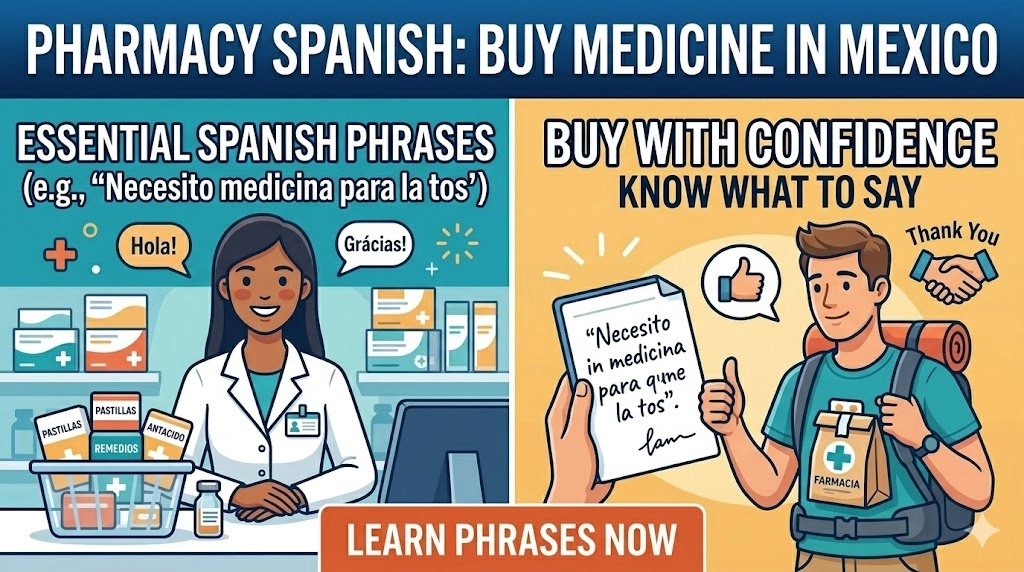
Crucial Vocabulary for Common Ailments
When you approach the counter, the pharmacist’s first question will almost certainly be, “¿En qué le puedo ayudar?” (How can I help you?). Your ability to clearly articulate your specific physical ailments dictates how quickly and accurately they can provide relief.
Describing Headaches Pain and Fever
Pain relief is the most common reason foreigners seek out local pharmacies. To express general pain, the foundational phrase is “Tengo dolor de…” (I have pain of…). If your head hurts, you say, “Tengo dolor de cabeza.” However, if you are suffering from a severe, light-sensitive migraine, specifying “Tengo migraña” will prompt the pharmacist to offer a much stronger class of medication than standard aspirin.
You must also be able to describe the severity and the specific nature of the pain so the pharmacist can recommend the correct dosage strength. If the pain is intense, you say, “Me duele mucho” (It hurts a lot). If the pain is throbbing, describing it as “un dolor punzante” is highly effective.
Fever is another critical symptom to communicate accurately. The formal medical term is fiebre, so you would state, “Tengo fiebre” (I have a fever). However, in colloquial Mexican Spanish, you will frequently hear locals use the word calentura to describe a fever. Stating “Tengo calentura” will be perfectly understood by any pharmacist. If you prefer to manage minor headaches and fevers holistically but find that local pharmacies lack your preferred natural remedies, ordering your specific herbal tinctures and homeopathic pain balms through iHerb guarantees you have high-quality, trusted relief waiting in your medicine cabinet before a migraine even hits.
Explaining Stomach Issues and Digestion
Adjusting to the local cuisine and water supply means that almost every expat will eventually battle a bout of traveler’s diarrhea. Standing at the counter during a gastrointestinal crisis is not the time to be shy. You must confidently state, “Tengo diarrea” (I have diarrhea) or the slightly more polite “Tengo malestar estomacal” (I have an upset stomach).
If your symptoms are more severe and include nausea or vomiting, you need to communicate this so the pharmacist can provide anti-emetics. You can say, “Tengo náuseas” (I am nauseous) or “Tengo ganas de vomitar” (I feel like vomiting). If you suspect that a bad street taco is the culprit rather than a general virus, stating “Creo que me intoxiqué con comida” (I think I got food poisoning) will completely change the pharmacist’s diagnostic approach.
Rebuilding your gut biome after a severe stomach bug often requires highly specific, multi-strain probiotics that standard Mexican pharmacies simply do not stock. Expats consistently use iHerb to order premium probiotics, digestive enzymes, and specialized electrolyte powders directly to their Mexican addresses to ensure a rapid recovery. Dehydration is the most dangerous consequence of these stomach bugs in a hot climate, and replacing lost fluids is critical. For a comprehensive look at how to manage these specific local health hazards before they escalate, read Staying Healthy in Mexico: Essential Tips for Food, Water, and Preventive Care.
Addressing Cuts Burns and First Aid Needs
Whether you scrape your knee on a jagged cobblestone street in San Miguel de Allende or suffer a severe sunburn on the beaches of Oaxaca, knowing how to ask for basic first aid supplies is essential. Unlike pills, these items are sometimes kept on the open shelves, but you still need to know what to look for or ask the staff to locate them.
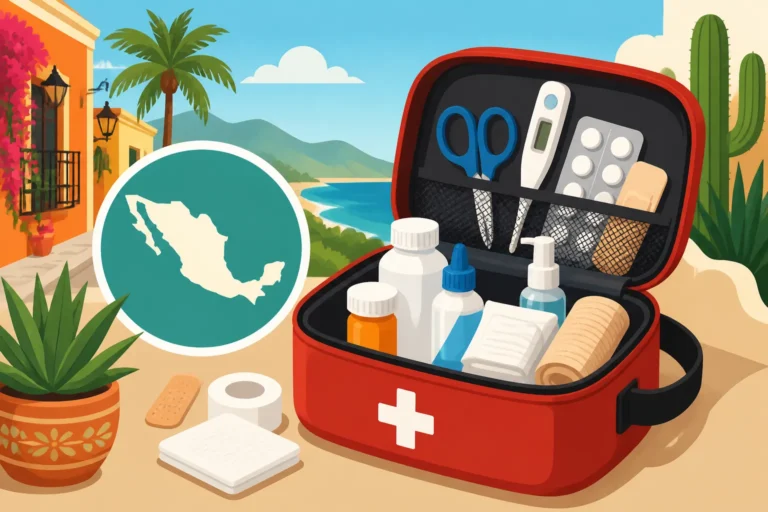
For minor cuts and scrapes, you will tell the pharmacist, “Me corté” (I cut myself) or “Tengo un raspón” (I have a scrape). To bandage the wound, you must ask for curitas (Band-Aids) or vendas (larger gauze bandages). You will also want an antiseptic to clean the wound, which you can request by asking for agua oxigenada (hydrogen peroxide) or alcohol médico (rubbing alcohol).
Sunburns require immediate soothing relief. If you spent too much time in the midday sun without protection, you must tell the pharmacist, “Me quemé con el sol” (I got sunburned). You can then ask for a specialized crema para quemaduras (burn cream). Because high-quality, pure aloe vera gels without artificial dyes are surprisingly hard to find in commercial pharmacies, many coastal expats bulk-order organic suncare and burn relief gels via iHerb to stay prepared for the intense Mexican sun. Of course, if a burn is severe and blistering, do not rely on over-the-counter creams; utilize your Cigna Global coverage to visit a private emergency room immediately to prevent serious infection. To ensure your home is fully stocked before an accident happens, consult Building a First Aid Kit: Essential Medical Supplies for Expats in Mexico.
Navigating the Conversation at the Counter
Knowing the vocabulary for your symptoms is only the first half of the transaction. You must also know how to politely initiate the conversation, request affordable alternatives, and understand the pharmacist’s instructions for safely taking the medication.
Initial Greetings and Stating Your Needs
Mexican retail culture, especially in healthcare settings, is highly formal and deeply polite. You must never walk up to a pharmacy counter and abruptly bark, “I need aspirin.” This is considered exceptionally rude and will immediately sour the interaction. You must always initiate the exchange with a polite greeting based on the time of day: “Buenos días” (Good morning), “Buenas tardes” (Good afternoon), or “Buenas noches” (Good evening).
Once you have exchanged greetings, you can frame your request using soft, polite verbs. “Busco…” (I am looking for…) or “Necesito…” (I need…) are the standard, respectful ways to ask for a product. If you have an empty box of a medication you previously purchased and simply need a refill, handing the box to the pharmacist and asking, “¿Tiene algo similar a esto?” (Do you have something similar to this?) bridges the language gap instantly.
If the pharmacist responds to your request with a barrage of rapid Spanish that you cannot comprehend, do not panic and nod blindly. You must halt the conversation and ask for clarification. Politely stating, “¿Puede hablar más despacio, por favor?” (Can you speak slower, please?) is a completely acceptable and necessary phrase. To understand the broader protocols for refilling medications you rely on daily, review Running Out of Medication: Getting a Prescription Refill in Mexico.
Asking About Generic Alternatives and Dosages
The Mexican pharmaceutical market is sharply divided between name-brand drugs and generic alternatives. Name-brand medications are referred to as medicamentos de patente, and they are frequently just as expensive as they are in the United States or Europe. Generic medications, referred to as medicamentos genéricos, are heavily regulated for bioequivalence by the government but cost a fraction of the price.
Pharmacies will often default to handing you the expensive patente version because it yields a higher profit margin. You must proactively advocate for your wallet by asking, “¿Tienen la versión genérica?” (Do you have the generic version?) or simply, “¿Hay algo más económico?” (Is there something cheaper?).
You must also confirm the dosage strength to ensure it matches what your doctor back home recommended. Dosages are measured in milligrams (miligramos). If you know you need a 500mg pill rather than a 250mg pill, you must specify “de quinientos miligramos.” To help you memorize these essential interactions, refer to the quick-reference table below.
| English Phrase | Spanish Translation | Pronunciation Guide & Context |
| I have a headache. | Tengo dolor de cabeza. | TEN-go do-LOR de ca-BE-za. Used for standard head pain. |
| Do you have the generic version? | ¿Tiene la versión genérica? | Tee-EN-eh la ver-see-ON he-NER-ee-ca? Crucial for saving money. |
| I need something for a fever. | Necesito algo para la fiebre. | Ne-ce-SEE-to AL-go PA-ra la fee-EB-re. |
| Every how many hours? | ¿Cada cuántas horas? | CA-da KWAN-tas O-ras? To confirm dosage timing. |
| I have a stomach ache. | Tengo dolor de estómago. | TEN-go do-LOR de es-TO-ma-go. Essential for traveler’s bugs. |
| Do I need a prescription for this? | ¿Necesito receta para esto? | Ne-ce-SEE-to re-CE-ta PA-ra ES-to? Ask before trying to buy antibiotics. |
| Must it be taken with food? | ¿Se toma con comida? | Se TO-ma con co-MEE-da? To avoid upsetting your stomach lining. |
Finalizing the Purchase and Asking for Instructions
Before you hand over your pesos or your credit card, you must be absolutely certain you understand how to ingest the medication safely. If you purchased the drug over the counter without a doctor’s consultation, the pharmacist is your only source of pharmacological advice.
You must ask, “¿Cómo debo tomar esto?” (How should I take this?). The pharmacist will respond with specific frequency instructions. You need to listen closely for phrases like “Cada ocho horas” (Every eight hours) or “Una vez al día” (Once a day). You should also confirm whether the medication will cause severe gastrointestinal distress on an empty stomach by asking, “¿Se toma con comida?” (Is it taken with food?) or if it requires “en ayunas” (on a fasting/empty stomach).
Finally, you conclude the transaction by asking for the total price: “¿Cuánto cuesta?” (How much does it cost?). Keep in mind that depending on your health insurance structure, you may be able to be reimbursed for high-cost outpatient prescriptions. Premium plans from Cigna Global often include outpatient pharmacy benefits, meaning you can submit the formal Mexican pharmacy receipt (factura) for expensive maintenance drugs directly to your insurer.
Long Term Strategies for Medical Fluency
Surviving your first pharmacy run is a victory, but establishing a long-term, safe life in Mexico requires moving beyond rote memorization of a few emergency phrases. You must fundamentally adapt how you view and talk about your healthcare.
Memorizing Active Ingredients over Brand Names
The single biggest, most consistently repeated mistake that expats make at Mexican pharmacy counters is aggressively asking for their comfortable North American brand names. Walking into a Mexican pharmacy and asking for “Advil,” “Tylenol,” or “Benadryl” will often result in blank stares or the pharmacist handing you an imported box that costs ten times what the local equivalent costs. Brand licensing varies wildly across borders.
You must train yourself to entirely ignore the brand name and memorize the Active Pharmaceutical Ingredient. If you have a headache, do not ask for Advil; ask for Ibuprofeno. Do not ask for Tylenol; ask for Paracetamol. If you need an antihistamine, ask for Loratadina or Difenhidramina.
Before you leave your home country, look at the fine print on the back of your medicine cabinet bottles and write down the chemical names. The Mexican pharmacist categorizes their entire inventory by these active ingredients, not by foreign marketing labels. If you are attempting to map out your entire medicine cabinet for a permanent move, utilizing the extensive cross-reference charts found in Mexican vs U.S. Medication Brands: Finding Equivalent Drugs will save you hours of linguistic frustration.
Building Confidence for Healthcare Interactions
Buying a box of generic ibuprofen is merely the shallow end of the Mexican medical pool. Eventually, you will need to schedule an appointment with a local dentist, consult a specialist regarding a chronic condition, or navigate the complex admissions desk of a private hospital.
Your physical safety and peace of mind abroad are directly correlated to your ability to communicate your needs clearly and respectfully. However, even the most diligent Spanish student can freeze during a terrifying medical event. This is why coupling your language study with the security of a Cigna Global policy is the ultimate expat safety net; if you cannot communicate with a local pharmacist or public clinic doctor, you can immediately pivot to a premier private hospital with fully bilingual staff covered by your network. To further reduce your reliance on local pharmaceutical counters, prioritizing preventative wellness by ordering specialized vitamins and immune-boosting supplements from iHerb can keep you healthy and out of the clinic entirely.
To understand exactly how these communication skills and insurance strategies apply when the stakes are raised from a simple pharmacy visit to a full medical consultation, explore our deep dives on Healthcare in Mexico: Complete Guide for Expats (Public vs Private) and Overcoming Language Barriers at the Doctor: Tips for Expats. By prioritizing your medical fluency and healthcare infrastructure today, you guarantee that you will never again have to pantomime your pain to a confused pharmacist.
References
Primary sources (official)
- Comisión Federal para la Protección contra Riesgos Sanitarios (COFEPRIS) – Regulación de Farmacias: https://www.gob.mx/cofepris
- Centers for Disease Control and Prevention (CDC) – Health Information for Travelers to Mexico: https://wwwnc.cdc.gov/travel/destinations/traveler/none/mexico
Other helpful sources
- ExpatDen – The Complete Guide to Drug Stores in Mexico: https://www.expatden.com/mexico/drug-stores-in-mexico/
- Mexpro – How to Buy Prescription Drugs in Mexico Safely: https://www.mexpro.com/blog/popular-rx-drugs-purchased-mexico/
Disclaimer
The information provided in this guide is for educational, linguistic, and informational purposes only and does not constitute formal medical or legal advice. Mexican pharmaceutical regulations, COFEPRIS drug classifications, and the legal availability of specific active ingredients are subject to frequent and sudden changes without notice. Always consult with a licensed, board-certified Mexican physician regarding your specific health condition, and never ingest any medication if you are unsure of the pharmacist’s dosage instructions or the chemical equivalent provided.