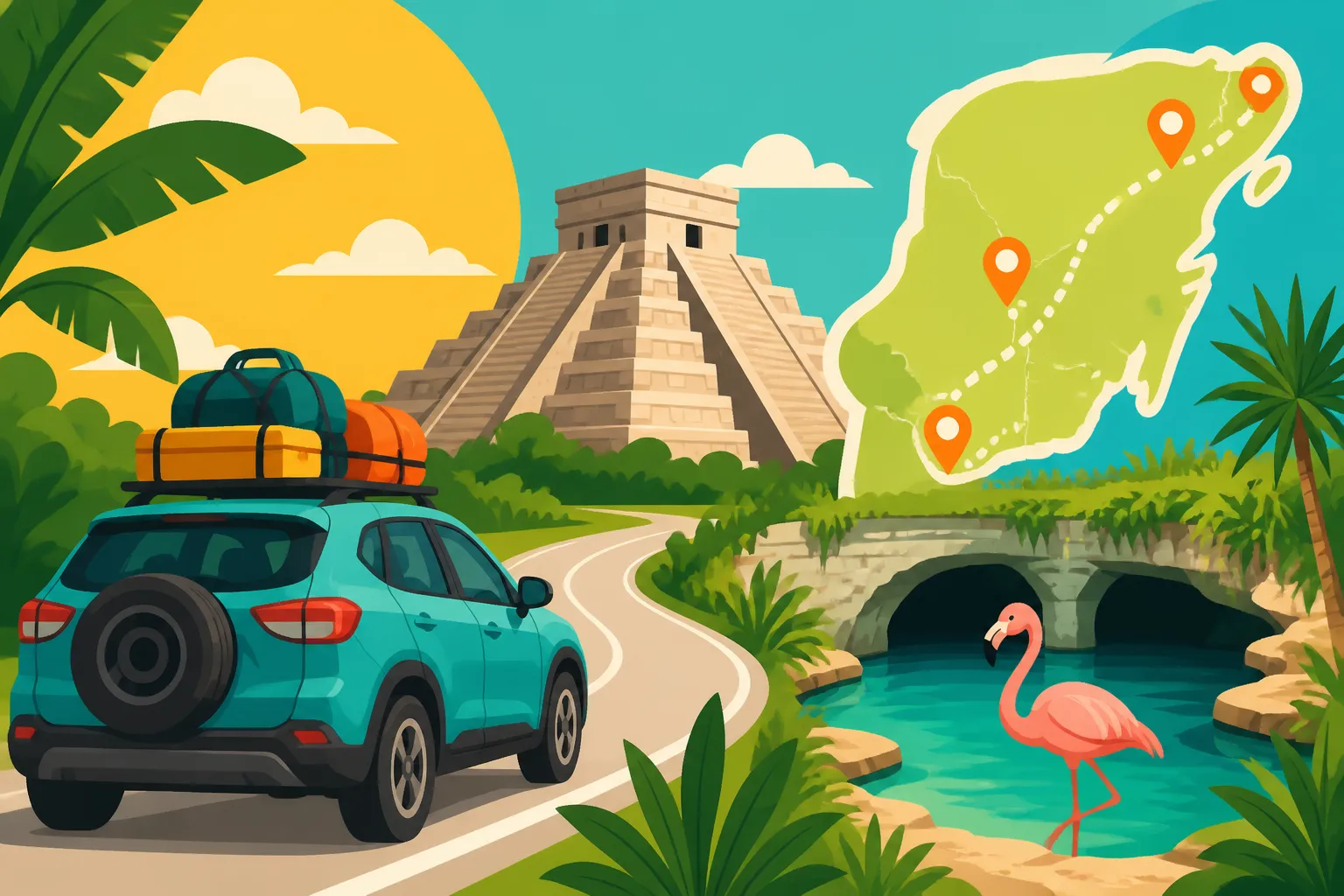
How to Plan a Yucatán Road Trip
You land at Cancún airport, pick up a rental car, and within an hour you are stuck at a counter arguing about insurance you thought you had already paid for. Then come the speed bumps, the toll booths, and the question of whether you can really fit Chichén Itzá, Mérida, and a cenote into one day. This guide explains how to plan a Yucatán road trip that actually works.
Disclosure: This post may contain affiliate links. We may earn a commission at no extra cost to you if you make a purchase through these links. Read full disclosure.
Choosing Your Route and Pace on the Yucatán Peninsula
The first time I drove the peninsula, I packed far too much into far too few days. I had a spreadsheet with Ek Balam, Chichén Itzá, two cenotes, and dinner in Mérida all on the same Tuesday. By the time I reached the city I was too tired to enjoy it. The Yucatán is flat and the main highways are good, so it looks easy on a map. What the map hides is heat, topes, slow village roads, and the way a “quick swim” in a cenote turns into a long, lazy afternoon.
Before you choose a route, decide how many nights you have and how many hotel changes you can tolerate. If you are still weighing up trip length, see How Many Days Do You Need in the Yucatán? for a breakdown by travel style. If your plans combine beach time on the Caribbean coast with the colonial interior, How to Plan a Riviera Maya and Yucatán Trip covers that wider picture.
The Classic Loop From Cancún
Most road trips start and end at Cancún airport because that is where the flights are. The classic loop heads west to Valladolid, continues to Mérida, swings south through the Puuc hills to Uxmal, and then returns east, often via Tulum. It is a loop rather than an out-and-back, so you see new scenery almost every day.
Valladolid works well as a first night. It is small, walkable, and close to Chichén Itzá, which means you can be at the gates when they open and leave before the tour buses arrive from the coast. For tips on timing that visit, see How to Visit Chichén Itzá Without the Crowds. The town itself deserves a slow evening around the main square and the Calzada de los Frailes. How to Visit Valladolid in the Yucatán goes deeper into what to see there.
Mérida is the natural anchor of the trip. I recommend at least two or three nights there, partly because the city is wonderful and partly because it makes a perfect base for day trips. From Mérida you can reach Celestún for flamingos, the cenotes around Cuzamá and Homún, the yellow town of Izamal, and the Puuc route. If wildlife is on your list, How to See Flamingos and Wildlife in the Yucatán compares Celestún with Río Lagartos on the northern coast.
Adding Bacalar, Campeche, or Calakmul
Once the classic loop feels manageable, you can stretch it. Campeche, the walled colonial port on the Gulf coast, is a pleasant drive southwest of Uxmal and feels far less touristy than Mérida. From there, the road east toward Xpujil takes you into the jungle around Calakmul, one of the most impressive and remote Maya sites in Mexico.
Calakmul is a serious commitment. The access road inside the biosphere reserve is long, narrow, and slow, services are thin, and phone signal disappears. Plenty of drivers do it independently, but many people feel more comfortable going with a local guide. See Calakmul and Remote Ruins: Why These Need a Booked Tour before you decide.
From the Calakmul area, Bacalar is the logical next stop. Its lagoon of seven colors is the perfect reward after days of ruins and heat. How to Visit Bacalar and Its Lagoon covers boat trips and swimming spots. From Bacalar, the drive north along the coast brings you back toward Tulum and Cancún.
| Route Option | Suggested Nights | Highlights | Best For |
|---|---|---|---|
| Short loop | 5 to 6 | Valladolid, Chichén Itzá, Mérida, cenotes | First-timers with limited time |
| Classic loop | 8 to 10 | Short loop plus Uxmal, Puuc route, Izamal, Tulum | Most road trippers |
| Extended loop | 12 to 14 | Classic loop plus Campeche, Calakmul, Bacalar | Slow travelers and ruin enthusiasts |
| North coast detour | Add 1 to 2 | Río Lagartos, Las Coloradas, Ek Balam | Wildlife and photography lovers |
Renting the Car and Handling the Roads
Driving in the Yucatán is, honestly, some of the most relaxed driving in Mexico. The landscape is flat, the main highways are well kept, and the traffic outside the cities is light. The frustrations are almost all on the administrative side, especially at the rental counter.
Rental Insurance Without the Counter Shock
This is the moment that ruins the first morning for so many visitors. You booked a cheap rate online, and at the counter the agent explains that you must buy Mexican third-party liability insurance before you can take the car. That cover is required by Mexican law, and in practice it is usually sold by the rental company itself. Coverage from your home credit card often deals with damage to the rental car, but it generally does not replace Mexican liability cover.
The way around the shock is to book a rate that already includes liability insurance, then read exactly what is covered and what the deductible is. Bring the credit card you used to book, your driver’s license, and your passport. Expect a hold on your card for the deposit, and make sure your credit limit can absorb it. For a full explanation of insurance types and how the add-ons work, see How to Rent a Car in Mexico Without Overpaying for Insurance and Renting a Car in Mexico: Insurance and Driving Tips.
When you collect the car, walk around it with your phone recording video. Film every scratch, the tires, the spare, the jack, and the fuel gauge. Check that the air conditioning works properly before you leave the lot, because in the Yucatán heat a weak AC will make every drive miserable. Ask whether you return the car full or at the same level.
Topes, Checkpoints, and Gas Stations
Topes are the speed bumps of Mexico, and in the Yucatán they appear at the entrance and exit of almost every village. Some are painted and signposted, many are not. Hitting one at highway speed can damage the car and your nerves. Slow down whenever you see a village sign, a cluster of houses, or a road sign showing a series of bumps.
You may also pass through police or military checkpoints, particularly on the routes south toward Campeche and the Calakmul area. They are routine. Slow down, lower the window, take off your sunglasses, be polite, and answer simple questions about where you are going. Keep your passport, license, and rental agreement handy. If you are ever stopped by police and the situation feels odd, What to Do If You’re Pulled Over by Police in Mexico explains your options calmly.
Gas stations are full service. An attendant pumps the fuel for you. Before they start, check that the pump reads zero, say clearly how much you want, and watch the transaction. Paying in cash in pesos keeps things simple, and a small tip for the attendant is customary. On the longer stretches, especially toward Calakmul, fill up whenever you have the chance rather than waiting for the warning light.
Avoid driving after dark. Unlit village roads, animals, cyclists without lights, and unmarked topes are a real risk. Plan your days so that you arrive at each night’s stop before sunset.
Toll Roads Versus Free Roads
The fastest link between Cancún, Valladolid, and Mérida is the toll highway, the cuota. It is smooth, fast, and almost empty, but toll booths take cash and the fees add up. The parallel free road, the libre, runs through villages, which means many more topes but also roadside fruit stands, churches, and small loncherías you would never see from the cuota.
My usual approach is simple. Take the cuota when distance is the main issue, and take the libre when the villages are part of the experience. For a deeper comparison, see Driving in Mexico: Toll Roads (Cuotas) vs Free Roads (Libres).
Mobile signal is generally fine near towns and along the main highways, but it gets patchy around remote cenotes, the Puuc hills, and the Calakmul area. Download offline maps before you set off each morning. Data Coverage on the Yucatan Highways: Signal Between Cenotes and Ruins goes into where you can expect gaps.
Booking Stays, Tours, and Backup Transport
Once the route and the car are sorted, the remaining question is where you sleep, which stops deserve a guide, and whether any legs make more sense without a car.
Where to Sleep Along the Route
Accommodation on a road trip has different priorities from a beach holiday. Parking is the big one. In the historic centres of Mérida, Valladolid, and Campeche, streets are narrow and street parking can be tight, so a hotel with secure parking saves a lot of stress. On Booking.com you can filter by free or on-site parking, which is one of the most useful filters for this kind of trip. It is still worth messaging the property to confirm the parking is actually on site and not a public lot several blocks away.
Haciendas are a highlight of the Yucatán. Many old henequen estates have been converted into hotels, especially around Mérida and along the Uxmal road. Staying in one for a night or two, with a pool, thick stone walls, and a quiet garden, is a memorable break from city hotels. If Mérida is your base, Where to Stay in Merida: Centro, Santa Ana, and the North compares the neighbourhoods so you can balance charm against easy driving access.
During Semana Santa, the Christmas period, and around Día de Muertos, rooms in popular towns fill up quickly. Book those dates early, and look for refundable rates if your route might change.
When a Guided Tour Beats Driving Yourself
A car gives you freedom, but there are a few places where a guide genuinely adds value. Chichén Itzá is the obvious example. You can explore it alone, but a good guide explains the astronomy, the ball court acoustics, and the history in a way that signs cannot. Licensed guides offer their services at the entrance, and you can also arrange one in advance.
Viator lists guided options for several Yucatán sites, including Chichén Itzá, Ek Balam, and the remote ruins in Campeche, which is useful if you want to compare what each tour includes before you arrive. For a cenote-hopping day, you can easily drive yourself, but a local guide can lead you to quieter spots. See How to Take a Cenote Day Trip in the Yucatán for how to plan the day either way.
The Puuc route is perfect for self-driving. Uxmal, Kabah, Sayil, and Labná are close together on a quiet road, and you can move at your own pace. How to Visit Uxmal and the Puuc Route in the Yucatán outlines a sensible order and how much time to allow at each site.
Buses for One-Way Legs
Not everyone wants to drive every leg. Some travellers fly into Cancún, take the bus to Valladolid or Mérida, and only rent a car there to avoid one-way drop-off fees. ADO buses link almost every town on the peninsula, and the first-class coaches are comfortable and air conditioned. Busbud is handy for comparing bus departure times between towns while you are still planning, though for some routes you may find better seat choice by booking directly with the bus company or at the terminal. For a step-by-step on tickets, see How to Buy ADO Bus Tickets in Mexico.
A hybrid trip can work well. You might bus from Cancún to Mérida, rent a car for a few days of day trips, return it in Mérida, and then bus onward to Campeche or back east. It takes more planning but cuts down on long highway driving.
A Step-by-Step Yucatán Road Trip Planning Checklist
Here is the order I follow whenever I plan a road trip around the peninsula. Working through it in sequence prevents most of the surprises that catch visitors out.
- Choose your travel window. The dry season, roughly November to April, brings the most comfortable driving weather. Hurricane season runs roughly June to November, and late spring can be extremely hot. See What’s the Best Time to Visit the Yucatán? for a month-by-month view.
- Decide on your route and number of nights using the table above, then add one buffer day for rest, weather, or a place you fall in love with.
- Book flights into and out of the same airport if possible, which keeps the car rental simple and avoids one-way fees.
- Reserve a rental car with Mexican third-party liability included, and read the coverage and deposit terms before you pay.
- Book your first and last nights early, plus any nights that fall on major holidays, filtering for secure parking.
- Pre-book any guided tours you really want, especially early-entry ruin visits or remote sites like Calakmul.
- Download offline maps for the whole peninsula and save the addresses of each hotel.
- Withdraw pesos before you leave Cancún or Mérida, and keep small notes for tolls, gas, cenote entry, parking, and tips.
- Pack a dry bag, reef-safe sunscreen, insect repellent, water shoes, a hat, and a refillable water bottle.
- Plan each driving day to finish before sunset, and add extra time for village topes on the free roads.
- On collection day, film the car thoroughly, check the AC and the spare tire, and confirm the fuel policy.
- On return day, refill the tank if required, keep the receipt, and allow plenty of time to get back to the airport.
Daily Rhythm That Actually Works
The best days on the road follow a simple pattern. Leave early and reach the main ruin or attraction when it opens, when the light is soft and the temperature is still bearable. Spend the hottest hours in a cenote, then have a long, late lunch somewhere shady. Drive the final stretch in the late afternoon and arrive at your hotel with daylight to spare.
That rhythm sounds slow, but it is what makes a Yucatán road trip feel like a holiday rather than an endurance event. It also means you meet the place properly. You catch the evening light on the yellow walls of Izamal, hear families gathering in the plaza in Valladolid, and eat panuchos at a market stall in Mérida instead of rushing past it.
Small Details That Save the Day
A few last things, learned the hard way. Many cenotes ask you to shower before swimming and do not allow regular sunscreen, so bring reef-safe sunscreen or none at all. Several archaeological sites charge a separate fee for video cameras or drones, and drones are often not allowed. Some smaller cenotes and village restaurants only accept cash. Mosquitoes are fierce near the lagoons and the jungle, so repellent belongs in the car, not in the suitcase.
Finally, keep your expectations flexible. A closed road, a sudden storm, or a cenote so beautiful you cannot bear to leave can all shift your plans. The extra buffer day in your itinerary is what turns those moments from stress into the best part of the trip.
Disclaimer
This article is for general informational purposes only and does not constitute professional advice. Laws, prices and regulations vary by location and change over time. Consult a qualified professional for guidance on your specific situation.