Managing Food Allergies and Special Diets in Mexico
Navigating menus in a foreign language is terrifying when a single misunderstood ingredient can trigger anaphylaxis. I once spent a horrifying evening in a Oaxaca emergency room after a supposedly nut-free mole sauce caused a severe allergic reaction. This comprehensive guide explains how to decipher Mexican food labels, safely communicate your dietary restrictions, and handle allergy emergencies abroad.
Disclosure: This post may contain affiliate links. We may earn a commission at no extra cost to you if you make a purchase through these links. Read full disclosure.
Decoding Mexican Food Labeling Laws
The NOM 051 Standard and Mandatory Allergens
For expats managing severe food allergies, the local grocery store is your very first line of defense. Understanding exactly how the Mexican federal government regulates food packaging, ingredient disclosures, and manufacturing transparency is absolutely vital for your daily survival. Over the last decade, local regulations have improved drastically, but they still operate with distinct regional nuances that foreigners must learn to decode before putting anything in their shopping carts.
The legal backbone of all food labeling in Mexico is the federal standard known as NOM-051. This sweeping regulation underwent a massive, highly publicized overhaul to align more closely with international food safety standards. Under NOM-051, food manufacturers are legally mandated to explicitly declare the presence of major food allergens on their printed ingredient lists. The mandatory declaration list in Mexico is quite comprehensive and includes cereals containing gluten (wheat, rye, barley, oats), crustaceans, eggs, fish, peanuts, soybeans, milk, tree nuts, and sulfites in concentrations of 10 mg/kg or more.
If a commercial product contains any of these ingredients—even in microscopic amounts that act merely as a preservative or binding agent—the manufacturer must list them clearly. Usually, you will find a bolded statement at the very end of the ingredient list that says Contiene: (Contains:) followed by the specific allergens. However, regulatory compliance can sometimes lag, especially with smaller, regional brands or artisanal products sold in local open-air markets. While massive multinational brands strictly adhere to NOM-051, a locally packaged bag of chips or a jar of homemade salsa might not list every single trace element. If you rely on absolute label accuracy to prevent a life-threatening reaction, you must approach unbranded or locally packaged market goods with extreme caution. For broader context on how health regulations impact your daily life, reading Staying Healthy in Mexico: Essential Tips for Food, Water, and Preventive Care is an excellent starting point.
Deciphering May Contain Warnings and Octagons
Beyond the explicit ingredient list, cross-contamination warnings in Mexico occupy a frustrating gray area. You will frequently see the phrase Puede contener trazas de… (May contain traces of…). While large food processors use this phrase liberally to protect themselves from legal liability regarding shared manufacturing equipment, its absence does not automatically guarantee a dedicated, allergen-free manufacturing facility. Mexican law is simply not as stringent as the European Union when it comes to mandating cross-contact labeling.
In 2020, Mexico also implemented a highly visible, aggressive front-of-package warning system consisting of large, black octagons that resemble stop signs. These are primarily designed to combat the national obesity and diabetes epidemics by warning consumers about Exceso de Calorías (Excess Calories), Exceso de Azúcares (Excess Sugars), and Exceso de Sodio (Excess Sodium). While these are not strictly allergy warnings, there are two specific rectangular black warnings that expats with dietary sensitivities must actively look for: Contiene Edulcorantes, No Recomendable en Niños (Contains Sweeteners, Not Recommended for Children) and Contiene Cafeína, Evitar en Niños (Contains Caffeine, Avoid in Children).
If you have a severe sensitivity to artificial sweeteners like aspartame, sucralose, or sugar alcohols, these prominent black warning labels make it incredibly easy to spot them instantly without having to squint at the microscopic ingredient list on the back of the box. When navigating the grocery aisles, if you cannot confirm the absolute safety of a product through its labeling, it is always safer to return it to the shelf. Many expats with severe sensitivities choose to bypass local grocery ambiguities entirely by ordering their pantry staples through iHerb. Because iHerb ships highly vetted, internationally certified allergen-free snacks and specialty foods directly to Mexico, you can eliminate the anxiety of deciphering vague local labels.
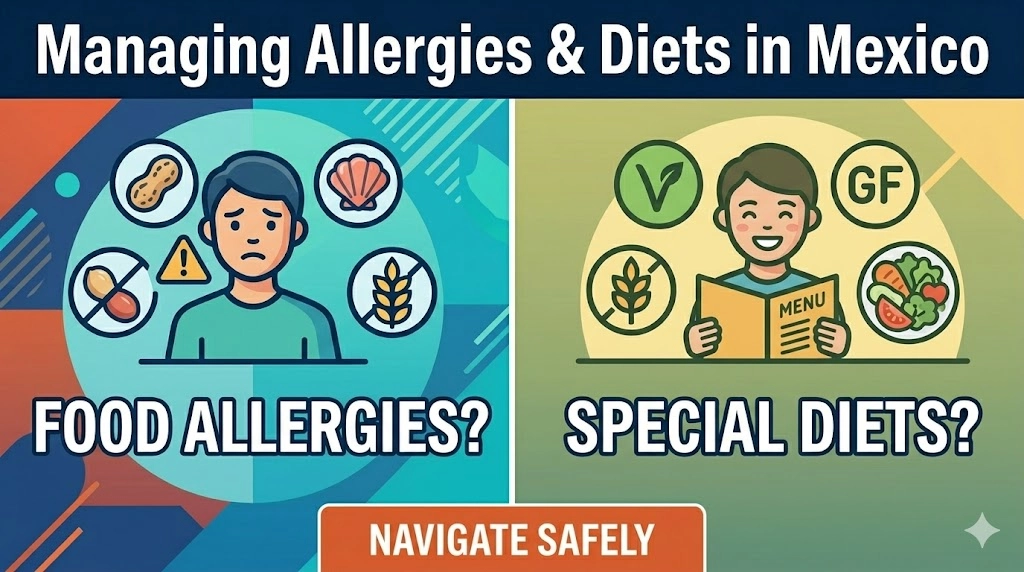
Navigating Special Diets in Traditional Mexican Cuisine
Managing Celiac Disease and Hidden Gluten Sources
Many expats arrive with the dangerous assumption that because corn (maíz) is the historical, cultural foundation of Mexican cuisine, the entire country is naturally a gluten-free paradise. This is a massive, potentially health-destroying misconception. While pure corn tortillas are ubiquitous, particularly in central and southern Mexico, the northern states rely heavily on flour tortillas (tortillas de harina). More importantly, hidden gluten lurks in almost every corner of a traditional Mexican kitchen.
The clinical concept of Celiac disease (enfermedad celíaca) is still widely misunderstood across much of Mexico. It is historically underdiagnosed in the local population, meaning that outside of highly gentrified expat hubs like Roma Norte in Mexico City or the resort zones of Tulum, the general public often views “gluten-free” as a trendy, elective weight-loss fad rather than a severe, non-negotiable autoimmune requirement. Consequently, a well-meaning local waiter might cheerfully assure you a dish is perfectly safe, completely unaware that a single splash of Jugo Maggi or Salsa Inglesa (Worcestershire sauce)—both of which are heavy in wheat—will trigger a severe intestinal reaction.
Furthermore, cross-contamination at the source is rampant. A local neighborhood tortillería might casually mix a handful of cheap wheat flour into their corn masa to make the dough more pliable, prevent cracking, and stretch their profit margins. When ordering, you must explicitly interrogate the staff. Asking “¿Son de puro maíz?” (Are they pure corn?) is a start, but you must follow up with, “¿Tienen algo de harina de trigo?” (Do they have any wheat flour?). If you suffer a severe autoimmune flare-up due to hidden gluten exposure and require specialized gastrointestinal care, you must review Finding English-Speaking Doctors and Specialists in Mexico to ensure you locate a physician who truly understands stringent Celiac protocols.
Plant Based Eating and the Pervasiveness of Animal Fats
Vegetarianism and veganism are rapidly growing in popularity within Mexico’s major metropolitan cities, but traditional, rustic Mexican cooking is fundamentally hostile to strict plant-based diets. The primary hidden culprit that ruins countless vegan meals is manteca (pork lard). Manteca is the deeply traditional, flavorful fat used to fry refried beans (frijoles refritos), make tamale dough fluffy and rich, and grease baking pans for traditional sweet breads (pan dulce).
Even if a menu item appears entirely vegetable-based, you must vigorously interrogate the cooking fat used in the kitchen. Simply asking a waiter “¿Tiene carne?” (Does it have meat?) is absolutely not enough, as many rural or traditional locals do not conceptually consider rendered lard, chicken broth, or bacon grease to be “meat.” You must specifically and directly ask, “¿Están fritos con aceite o con manteca?” (Are they fried with oil or lard?).
Another massive, invisible hurdle for vegans is caldo de pollo (chicken broth), and specifically, powdered commercial chicken bouillon like Knorr Suiza. This neon-yellow powder is ubiquitous in almost every Mexican kitchen, from high-end restaurants to street carts. It is routinely used to flavor red rice (arroz rojo), vegetable soups, and table salsas. A vegan expat ordering a seemingly safe, simple bowl of vegetable soup will almost certainly be consuming chicken bouillon unless they explicitly request the kitchen to omit it.
Dairy Free Diets and Lactose Intolerance Challenges
Lactose intolerance is actually quite common among the indigenous and mestizo Mexican population, yet dairy remains a massive, unavoidable component of the daily street food culture. Tacos, enchiladas, sopes, and tostadas are frequently topped with a heavy, generous drizzle of crema (a cultured cream similar to sour cream) and a handful of crumbled queso fresco or cotija cheese.
Fortunately, removing dairy from savory street food is relatively easy because it is usually applied at the very end of the preparation process as a garnish. You simply need to state clearly and firmly when ordering your meal, “Sin queso y sin crema, por favor” (Without cheese and without cream, please). Most street vendors are happy to accommodate this request without any fuss.
However, you must be incredibly careful with sweet beverages, desserts, and breakfast items. Licuados (fresh fruit smoothies) are traditionally made with whole milk (leche), not water. Traditional Mexican hot chocolate is also frequently milk-based. While modern, third-wave coffee shops in expat-heavy areas will always offer almond, soy, or oat milk (leche de almendra/soya/avena), traditional local diners (fondas) will only stock whole dairy milk. If your dairy allergy is a severe, anaphylactic allergy rather than a simple digestive intolerance, you must also watch out for butter (mantequilla), though it is less commonly used in traditional Mexican pan-frying than vegetable oil or lard. For those struggling to find safe, dairy-free nutritional supplements or specialized plant-based protein powders locally, using iHerb is a lifesaver, as they deliver premium vegan goods right to your door.
Dining Out Safely with Severe Food Allergies
Cross Contamination in Mexican Kitchens and Street Food
Eating at any restaurant inherently requires relinquishing a degree of control over your food preparation. In a foreign country with a different language, varying levels of health code enforcement, and bustling kitchens, dining out requires meticulous communication strategies to ensure your physical safety. Street food is the beating, vibrant heart of Mexican culinary culture, but it is an absolute minefield for severe cross-contamination.
A busy street vendor making naturally gluten-free corn tacos might use the exact same metal spatula to flip a wheat-flour tortilla for a quesadilla, or they might fry their corn tortilla chips in the exact same vat of boiling oil that previously held breaded, gluten-heavy fish. If your allergy is airborne or anaphylactic, you must generally avoid these highly uncontrolled, fast-paced street environments entirely. The risk is simply too high when multiple ingredients are flying across a shared, tiny metal griddle (comal).
Even in upscale, sit-down restaurants, cross-contamination is a severe, ever-present risk. Mexican recipes frequently rely on incredibly complex, slow-blended sauces that incorporate dozens of hidden ingredients. Traditional mole, for example, is famous for blending chilies, chocolate, spices, peanuts (cacahuates), almonds (almendras), and toasted wheat bread used as a thickener. This single sauce is deadly for both nut allergy sufferers and Celiacs. You must adopt a highly defensive dining posture. Stick to whole, unprocessed foods like grilled meats (carne asada), fresh seafood ceviche (assuming no fish allergy), and simple grilled vegetables. Should an accident happen at a restaurant, knowing you are backed by a Cigna Global international health policy provides the ultimate peace of mind, guaranteeing that you can access the best emergency rooms without hesitation. For more tips on navigating local establishments without getting sick, reading Public Healthcare in Mexico: IMSS and IMSS Bienestar Explained for Expats might seem unrelated, but understanding the stark limitations of the public medical system will heavily incentivize you to eat defensively to avoid a hospital visit.
Utilizing Allergy Translation Cards Effectively
Relying on your broken, conversational Spanish to explain a life-threatening allergy to a busy waiter over the loud mariachi music of a local cantina is a recipe for medical disaster. The single most effective, life-saving tool an allergic expat can wield in Mexico is a professionally translated Allergy Chef Card.
This is a small, brightly colored, laminated card that you hand directly to the waiter, explicitly requesting that they physically carry it to the kitchen and show it to the head chef. The card should clearly state, in formal, urgent Spanish, your specific allergies, the severity of the medical reaction, and a comprehensive list of hidden ingredients they must avoid. For example, a peanut allergy card should not just casually say “No cacahuates.” It should read: “Tengo una alergia mortal a los cacahuates y nueces. Por favor, asegúrese de que mi comida no contenga aceite de cacahuate, y que los utensilios no hayan tocado nueces. Si como esto, tendré que ir al hospital de emergencia.” (I have a deadly allergy to peanuts and nuts. Please ensure my food does not contain peanut oil, and that utensils have not touched nuts. If I eat this, I will have to go to the emergency hospital.)
Using a physical, printed card cuts through the ambient noise, bypasses regional slang misunderstandings, and forces the kitchen staff to acknowledge the grave medical severity of your request. It changes the dynamic from a “picky eater” preference to a clinical emergency. If you consistently struggle with communicating complex medical concepts or dietary restrictions, reviewing the actionable strategies in Overcoming Language Barriers at the Doctor: Tips for Expats will help you project absolute confidence and clarity when discussing your health.
To help you navigate menus safely, here is a quick reference table of common Mexican dishes and their hidden dietary conflicts:
| Common Mexican Dish | Potential Hidden Allergen | Dietary Conflict | Spanish Phrase to Ask |
| Mole (Traditional Sauce) | Peanuts, almonds, wheat bread | Nut allergy, Celiac | ¿Lleva nueces, cacahuates o pan? |
| Frijoles Refritos (Beans) | Manteca (Pork Lard) | Vegan/Vegetarian | ¿Están fritos en manteca o aceite? |
| Arroz Rojo (Red Rice) | Chicken bouillon (Knorr) | Vegan, Soy/Gluten | ¿Usan consomé de pollo en polvo? |
| Tacos al Pastor | Wheat (from marinades or shared griddles) | Celiac | ¿La marinada tiene soya o harina? |
| Salsas de Mesa (Table Salsa) | Hidden nuts or sesame seeds | Nut/Seed allergy | ¿Esta salsa tiene semillas o nueces? |
Building Your Allergen Free Pantry in Mexico
Sourcing Specialty Foods Locally Versus Online
If you have a severe food allergy or a strict, non-negotiable dietary requirement, the safest and most sustainable way to live in Mexico is to prepare the vast majority of your own meals at home. Building a safe, reliable pantry requires knowing exactly where to source your specialty goods, as local availability varies drastically by region.
If you live in massive metropolitan areas like Mexico City, Monterrey, or Guadalajara, you will easily find high-end, imported supermarkets like City Market, Fresko, or specialized tiendas orgánicas that stock expensive imported gluten-free pastas, vegan cheeses, and certified nut-free school snacks. However, if you live in a smaller coastal fishing town or a mid-sized interior city, your local Soriana or Chedraui supermarket will have a severely limited, often nonexistent selection. Worse, local Mexican supermarkets often mix “dietary” or “healthy” products on the exact same standard shelves as allergen-heavy items, drastically increasing cross-contact risks at the distribution level.
This is exactly why veteran expats managing severe allergies consistently bypass the unreliable local supply chain and rely almost exclusively on iHerb. By ordering your non-perishable groceries through iHerb, you can access a massive, highly vetted catalog of internationally certified allergen-free foods, specialty baking flours, clean plant-based proteins, and specialized vegan supplements. Because iHerb ships these products reliably and directly to your Mexican residential address, you do not have to waste precious weekend hours squinting at every single Spanish label in a local grocery store, nor do you have to drive to three different towns just to find certified gluten-free oats. Stocking your pantry with safe, globally certified staples from iHerb allows you to control your kitchen environment absolutely.
Essential Spanish Grocery Vocabulary
When you do venture into the local supermarkets or bustling neighborhood tianguis (open-air markets) for fresh produce, meats, and basic supplies, knowing the exact Spanish terminology for your specific allergens is critical for reading labels accurately.
Here is a quick reference guide for the most common severe allergens:
- Peanut: Cacahuate (Note: In Spain, the word is cacahuete, but in Mexico, it is always cacahuate).
- Tree Nuts: Nueces (Walnut/Pecan), Almendras (Almonds), Avellanas (Hazelnuts), Pistaches (Pistachios).
- Wheat/Gluten: Trigo (Wheat), Gluten (Gluten), Harina (Flour), Avena (Oats – which are often heavily cross-contaminated).
- Dairy: Lácteos (Dairy), Leche (Milk), Mantequilla (Butter), Suero de leche (Whey).
- Soy: Soya (Soy sauce is Salsa de Soya).
- Shellfish: Mariscos (Shellfish), Camarón (Shrimp), Crustáceos (Crustaceans).
If you are buying fresh meat from a local butcher (carnicería) and want to ensure it has not been pre-marinated in questionable sauces containing soy or wheat, you can simply ask for the meat natural (plain/unmarinated). For expats looking to build a comprehensive emergency medical stash alongside their pantry, check out Building a First Aid Kit: Essential Medical Supplies for Expats in Mexico for a complete checklist of what you should keep in your home.
Medical Preparedness for Allergy Emergencies
Securing EpiPens and Allergy Medications Locally
Despite your absolute best efforts, careful label reading, and rigorous chef card usage, accidental exposure can still happen. If you have a severe, life-threatening allergy, you cannot rely on hope or luck; you must build a robust, localized medical emergency protocol before you take your very first bite of food in Mexico.
This is the most critical, life-saving warning for allergic expats: Epinephrine auto-injectors (commonly known by the brand name EpiPen) are exceptionally difficult to find in standard Mexican pharmacies. They are simply not a common, widely stocked item. If you walk into a corner pharmacy actively experiencing the early stages of anaphylaxis and desperately ask for an EpiPen, they will almost certainly not have one behind the counter.
If you carry an EpiPen, you must bring multiple, unexpired backups from your home country when you move. You should store one in your daily travel bag, one permanently in your home, and one in your vehicle. For standard, non-emergency allergic reactions, Mexican pharmacies readily stock Loratadine (Loratadina) and Diphenhydramine (Difenhidramina – the active ingredient in Benadryl) over the counter. If you need to restock your basic medical kit with these essential antihistamines, review the specific purchasing protocols in Pharmacies in Mexico: How to Get Medications (OTC vs Prescription) to ensure you know exactly how to ask the pharmacist for the correct active ingredients.
Emergency Room Protocols and Financial Protection
If an accidental exposure triggers severe anaphylaxis and your EpiPen is deployed, you must seek immediate, high-level emergency medical care. You absolutely cannot rely on the slow, underfunded public ambulance system in this scenario; you must immediately secure private emergency transport or have someone drive you directly to the nearest premium private hospital. For those navigating this terrifying, high-stakes scenario, our guide on Medical Emergencies in Mexico: What Expats Should Know and Prepare outlines the exact protocols for reaching a hospital quickly and safely.
However, the intense medical terror of anaphylaxis is often followed by immediate financial terror. When you arrive at a private Mexican emergency room gasping for air, the admissions desk will still ruthlessly demand a massive upfront financial deposit—often requiring a credit card hold of $3,000 to $5,000 USD—before they will admit you to a trauma room or administer additional life-saving adrenaline.
This is precisely where carrying a premium international health insurance policy from Cigna Global becomes a non-negotiable lifeline for allergic expats. A robust Cigna Global plan guarantees your emergency admission, allowing the hospital’s international desk to completely bypass the exorbitant cash deposit and coordinate billing directly with Cigna Global. To fully grasp how these catastrophic, unexpected events are billed and why self-insuring is so incredibly dangerous, review Healthcare Costs in Mexico: Doctor Visits, Hospital Stays, and Surgery Expenses.
For expats living with life-threatening food allergies, upgrading your financial safety net with a comprehensive Cigna Global policy is the ultimate protective measure. It gives you the confidence to explore Mexico’s incredible culture, geography, and culinary scene, knowing that if the absolute worst-case scenario occurs, you have immediate, VIP access to the best emergency medical infrastructure in the country without fearing total medical bankruptcy. For a detailed comparison of why local, domestic plans often fall dangerously short in these critical moments, read Choosing Private Health Insurance: Local Mexican Plans vs International Coverage. By combining meticulous dietary planning, reliable pantry sourcing through iHerb, and the ironclad emergency protection of Cigna Global, you can safely and joyfully experience your new life in Mexico. To begin setting up your foundational health coverage, I highly recommend reviewing Health Insurance in Mexico: How Expats Can Get Coverage (2027).
References
Primary sources (official)
- Comisión Federal para la Protección contra Riesgos Sanitarios (COFEPRIS): The Mexican federal health authority responsible for enforcing food safety standards, labeling compliance, and pharmaceutical availability across the country. https://www.gob.mx/cofepris
Other helpful sources
- Food Allergy Research & Education (FARE): Comprehensive global travel guidelines for allergy sufferers, including vital tips on utilizing translated chef cards and airline preparation. https://www.foodallergy.org/resources/traveling-abroad:
- Legal Nomads: An incredibly detailed, firsthand account of navigating Celiac disease in Mexico, highlighting safe regional dishes, hidden ingredients, and cross-contamination risks. https://www.legalnomads.com/gluten-free/mexico/
Disclaimer
The information provided in this guide is for educational, logistical, and informational purposes only and does not constitute formal medical or legal advice. Mexican food labeling regulations (NOM-051), pharmaceutical availability, and restaurant cross-contamination protocols vary wildly by region and are subject to frequent changes. Always consult with a licensed, board-certified physician or allergist regarding your specific dietary needs, carry multiple unexpired epinephrine auto-injectors if prescribed, and rigorously verify all ingredient safety and emergency insurance coverage directly with your providers before consuming unfamiliar foods abroad.