Choosing a Good Hospital: What Accreditations to Look for in Mexico
Staring at a Google map populated with dozens of unfamiliar clinics while dealing with a sudden medical crisis is a terrifying expat rite of passage. I remember frantically trying to decipher whether a flashy private hospital in Guadalajara was actually safe or just possessed a great marketing team. This guide breaks down exactly which national and international accreditations to look for so you can confidently choose a top-tier hospital in Mexico.
Disclosure: This post may contain affiliate links. We may earn a commission at no extra cost to you if you make a purchase through these links. Read full disclosure.
Understanding the Mexican Hospital Landscape
To make an informed decision about your medical care, you must first unlearn how hospital systems operate in highly centralized countries like the United Kingdom or Canada. The Mexican healthcare system is massive, highly fragmented, and operates with varying degrees of oversight.
The Divide Between Public and Private
In Mexico, the healthcare landscape is sharply divided. The public sector, anchored by government-run systems, serves the vast majority of the local working-class population. While these hospitals have dedicated, hardworking staff, their infrastructure, supply chains, and funding vary drastically from state to state. If you want to understand the exact mechanisms and limitations of this tier, reviewing Public Healthcare in Mexico: IMSS and IMSS Bienestar Explained for Expats is essential.
The private sector, however, operates on a completely free-market basis. There are thousands of private clinics and hospitals spread across the country. Some are massive, state-of-the-art medical cities that rival anything found in Houston or London, while others are essentially small, under-equipped outpatient centers legally masquerading as full-service hospitals.
Why Accreditations Matter More Here
Because the private sector is so vast and loosely centralized, visual appearances can be incredibly deceiving. A hospital might boast pristine marble floors, a beautiful lobby, and English-speaking concierge staff, but entirely lack stringent infection control protocols, a modern blood bank, or an intensive care unit.
Accreditations cut through the marketing spin. They are independent, objective audits of a hospital’s clinical outcomes, surgical safety, and emergency readiness. When you are lying on a gurney, you do not care about the lobby’s aesthetics; you care that the surgical tools are sterilized to a global standard and that the nursing staff follows strict medication protocols.
The Gold Standards of Hospital Accreditation in Mexico
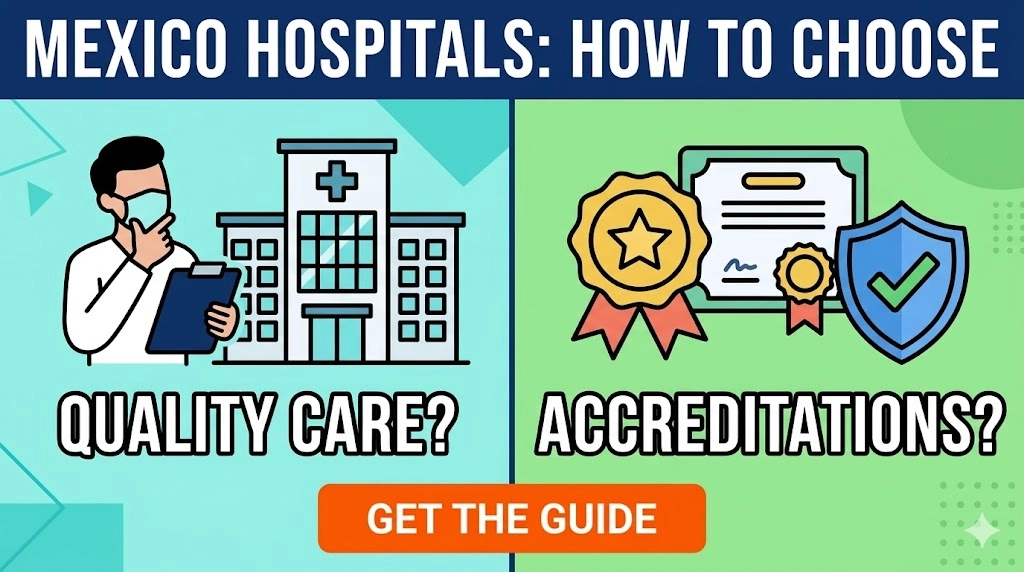
When vetting a facility for a major surgery or anticipating where you would go in a trauma scenario, you need to look for specific acronyms on the hospital’s entrance doors and website.
Consejo de Salubridad General (CSG) – The National Benchmark
The absolute most important domestic accreditation a private hospital can hold is from the Consejo de Salubridad General (General Health Council). The CSG is the highest healthcare accreditation authority within the Mexican federal government. Their certification program was heavily modeled after rigorous North American hospital standards.
If a hospital is formally CSG-certified, it means they have passed brutal audits evaluating their infection control, medication management, physical facility safety, and patient rights protocols. Only a fraction of the thousands of private hospitals in Mexico actually achieve and maintain this certification. When you look at a hospital’s credentials, the CSG logo is the ultimate domestic seal of clinical approval.
Joint Commission International (JCI) – The Global Standard
If you are seeking absolute parity with the finest hospitals in the United States, you must look for the Joint Commission International (JCI) gold seal. JCI is the global arm of the organization that accredits the vast majority of top-tier American hospitals.
Achieving JCI accreditation is incredibly expensive, time-consuming, and difficult to maintain. Consequently, only the most elite, well-funded apex facilities in major hubs—like Mexico City, Monterrey, and Guadalajara—possess it. Facilities with JCI accreditation have proven that their patient safety protocols, surgical safety checklists, and emergency response times meet or exceed the highest global benchmarks.
ISO Certifications for Operational Quality
You will also frequently see “ISO 9001” certifications proudly touted on Mexican hospital websites. While ISO 9001 is a highly respected international standard for quality management systems, it is crucial to understand that it is not a purely medical or clinical accreditation.
It simply means the hospital’s administrative processes, billing practices, and organizational structures are highly efficient and standardized. It is a very good sign of a well-run business, but it should always be paired with a clinical certification like CSG or JCI to guarantee actual medical safety.
Physician Board Certifications and Credentials
A world-class, fully accredited hospital is ultimately only as good as the individual doctors operating inside it. You must vet the humans, not just the building.
Verifying the Cédula Profesional
In Mexico, every legally licensed physician must possess a Cédula Profesional (a federal professional license). Legitimate, accredited hospitals strictly mandate that their attending physicians display these numbers prominently on their prescriptions, office doors, and digital profiles.
You can actually verify this license number directly through the Mexican Secretariat of Public Education (SEP) online registry to ensure their medical degree is authentic. If you are struggling to navigate these registries or find a vetted professional, our guide on Finding English-Speaking Doctors and Specialists in Mexico provides targeted, actionable advice on locating trustworthy providers.
National Specialty Boards (Consejos Médicos)
Beyond the basic medical license, you want to ensure your surgeon or specialist is actively board-certified in their specific field. In Mexico, these specialty boards are known as Consejos. For example, a trusted cardiologist should be certified by the Consejo Mexicano de Cardiología. Top-tier CSG and JCI hospitals stringently vet their staff to ensure that every specialist holds current, active certifications from their respective national boards before granting them surgical privileges.
How Insurance Networks Use Accreditations
Understanding hospital accreditations is not just about medical safety; it is intimately tied to your financial survival in Mexico.
Out-of-Pocket vs. Covered Care
Many expats mistakenly believe they can simply pay cash out-of-pocket for private care in Mexico because routine doctor visits are genuinely cheap. However, if you are admitted to a JCI-accredited hospital for a major trauma, the bill can quickly surpass $50,000 USD. Elite hospitals operate as strict for-profit entities and will ruthlessly demand massive upfront cash deposits before admitting you to the ER. To understand the terrifying reality of these billing structures, you must read Healthcare Costs in Mexico: Doctor Visits, Hospital Stays, and Surgery Expenses.
Leveraging International Insurance
This is precisely where premium international health insurance becomes a non-negotiable lifeline for expats. Elite global providers like Cigna Global specifically use these exact accreditations (CSG and JCI) to build their elite, reliable direct-billing networks.
When you hold a Cigna Global policy, you do not have to frantically guess if a hospital is safe while you are sick. Cigna Global has already vetted the facilities for you. More importantly, when you walk into a JCI-accredited hospital during a terrifying emergency, your Cigna Global card allows the admissions desk to bypass the exorbitant cash deposit and coordinate the billing directly with the insurer. To compare how these premium safety nets stack up against highly limited local policies, reviewing Choosing Private Health Insurance: Local Mexican Plans vs International Coverage is highly recommended.
Practical Steps for Vetting a Hospital
Do not wait until you are in the back of an ambulance to figure out where you want to go. You must build your medical emergency protocol proactively.
Checking the CSG Registry
Do not simply take a hospital’s word for it; marketing materials on expat Facebook groups can be notoriously outdated. The Mexican government maintains a public list of all currently certified hospitals on the official CSG website. Before you undergo any planned elective surgery, you should cross-reference the hospital’s name on the federal registry to ensure their certification has not lapsed or been revoked.
Asking the Right Questions at the Admissions Desk
When touring a hospital or speaking with their international patient coordinator, ask direct, clinical questions. Ask about their nurse-to-patient ratios in the recovery wards, whether they have a fully equipped internal blood bank on-site, and if their intensive care unit (ICU) is staffed 24/7 by a dedicated intensivist. The willingness and transparency with which the administration answers these questions will tell you everything you need to know about their operational culture.
Preparing for Post-Discharge Care
Even if you undergo a flawless surgery at a prestigious JCI-accredited hospital, your actual recovery happens back at your house. Post-operative care in Mexico often highlights severe local supply chain issues, as local commercial pharmacies frequently lack specialized, holistic recovery aids. To learn how to navigate these local drug stores efficiently, read Pharmacies in Mexico: How to Get Medications (OTC vs Prescription).
To bypass local shortages, veteran expats rely heavily on iHerb to bridge the recovery gap. By ordering through iHerb, you can secure premium, globally certified nutritional supplements, multi-strain probiotics to repair your gut biome after heavy hospital antibiotics, and specialized wound-healing vitamins. Having your personalized iHerb recovery toolkit shipped directly to your Mexican address ensures you aren’t desperately hunting for clean supplements across town while trying to heal in bed. Furthermore, if you are preparing your entire household for a major medical event, consulting Medical Emergencies in Mexico: What Expats Should Know and Prepare will ensure you miss no critical logistical steps.
Quick Reference: Comparing Hospital Certifications
To help you quickly evaluate a facility, here is a breakdown of what the most common acronyms actually mean for your care.
| Certification / Acronym | Issuing Body | Primary Focus | Importance for Expats |
| CSG (Consejo de Salubridad General) | Mexican Federal Government | Clinical safety, infection control, facility standards. | Essential. This is the baseline indicator of a safe, regulated private hospital in Mexico. |
| JCI (Joint Commission International) | Joint Commission (Global) | Elite global medical standards and patient outcomes. | Premium. Guarantees parity with top US hospitals; heavily utilized by Cigna Global networks. |
| ISO 9001 | International Organization for Standardization | Administrative and operational quality management. | Supplemental. Good for billing and efficiency, but does not guarantee surgical safety alone. |
| Consejo Médico (e.g., Cardiología) | National Medical Specialty Boards | Verification of a physician’s specialized training. | Crucial. Ensure your specific surgeon holds current board certification, not just a general license. |
References
Primary sources (official)
- Consejo de Salubridad General (CSG) – https://www.gob.mx/csg
- CSG List of Certified Medical Establishments – https://www.gob.mx/cms/uploads/attachment/file/920198/INF_PUB_CERT_02_05_2024_86_EAM.pdf
Other helpful sources
- SciELO / Salud Pública de México – Certification of health care facilities in Mexico: https://www.scielo.org.mx/scielo.php?script=sci_arttext&pid=S0036-36342019000400524
- Dialnet – The pathway to international certification of hospitals in Mexico: https://dialnet.unirioja.es/descarga/articulo/3630987.pdf
Disclaimer
The information provided in this guide is for educational, logistical, and informational purposes only and does not constitute formal medical advice or a formal endorsement of any specific healthcare facility. Hospital accreditations, CSG federal certifications, and private insurance direct-billing networks are subject to expiration, revocation, and frequent administrative changes. Always verify a hospital’s current certification status through official government registries and confirm emergency network coverage directly with your health insurance provider prior to seeking major medical treatment.