How to Ask for Directions in Spanish in Mexico
Getting lost in a foreign country is a rite of passage, but in Mexico, it can quickly turn into a frustrating maze. Whether your signal dropped in the mountains of Oaxaca or your GPS is trying to send you the wrong way down a colonial one-way street, knowing how to ask for directions in Spanish is a critical survival skill that this guide will help you master.
Disclosure: This post may contain affiliate links. We may earn a commission at no extra cost to you if you make a purchase through these links. Read full disclosure.
Why You Can’t Always Trust Your GPS in Mexico
Relying solely on technology while navigating Mexico is a gamble that most veteran expats have lost at least once. While apps are generally reliable in major hubs like Mexico City or Monterrey, the reality changes the moment you enter a "Pueblo Mágico" or a rural coastal area. The infrastructure in many Mexican towns dates back centuries, meaning streets are narrow, frequently renamed, or subjected to sudden closures for festivals, markets, or "obras" (roadworks) that never seem to appear on digital maps.
I remember my first week in Guanajuato, trying to find a specific boutique hotel I had reserved through Booking.com. The GPS insisted I drive through a tunnel that was closed for maintenance and then suggested a pedestrian-only alleyway. Without the ability to roll down my window and ask a local "cómo llego a…" (how do I get to…), I would have spent the entire night circling the city’s underground tunnels. Technology is a tool, but in Mexico, local knowledge is the true compass.
Furthermore, the physical environment of Mexico often interferes with digital navigation. High-altitude cities and dense jungles create significant GPS drift. Even in developed areas, the "sentido" (direction) of a street can change from block to block without warning. If you are using Busbud to coordinate your arrival at a distant bus terminal, you might find that the "terminal" marked on your map is actually an old station no longer in use. Learning to talk to people ensures you actually reach your destination rather than a pin on a screen.
The Closed Road Phenomenon and Local Detours
In Mexico, a road isn't just a path for cars; it is a community space. It is entirely common to find a main thoroughfare blocked off because a neighbor is having a "quinceañera" or because the local church is celebrating a patron saint. These impromptu blockades are rarely updated in real-time on navigation apps. When you hit a dead end of colorful flags and plastic chairs, your only option is to seek help from someone standing nearby.
Understanding how to navigate these detours requires a level of Survival Spanish for Travelers in Mexico: Key Phrases that goes beyond the basics. Locals will often give you a detour that involves "dar la vuelta" (going around) specific landmarks that only they know. If you don't understand the instructions to go two blocks further and turn at the "tienda de abarrotes," you might find yourself stuck in a loop. Being able to ask for a "desvío" (detour) is essential for any road trip.
When Technology Fails in Rural Areas and Colonial Cities
The colonial charm of Mexico’s most beautiful cities often comes with the price of terrible cellular reception. Thick stone walls in buildings and narrow "callejones" (alleys) act as natural shields against 5G signals. If you are trying to find a specific meeting point for a tour you booked on Viator, you cannot always count on your phone to lead the way. You will need to rely on the landmarks and verbal cues provided by the people who live there.
In rural areas, the situation is even more pronounced. Digital maps often lack the granularity of dirt roads or "brechas" that lead to hidden beaches or mountain trailheads. In these cases, your interactions with locals are not just about convenience; they are about safety. Knowing How to Pronounce Common Mexican Place Names correctly will help ensure that when you do ask for help, the locals actually understand which remote village you are trying to reach.
Essential Spanish Phrases for Asking Directions
The way you start a conversation in Mexico is often more important than the question itself. In many English-speaking cultures, we tend to be very direct: "Where is the museum?" In Mexico, this is considered "grosero" (rude). To get the best help, you must lead with a polite greeting and a soft opening. This cultural bridge-building ensures that the person you are asking feels respected and is therefore more likely to give you detailed, accurate information.
Always start with a "Disculpe" (Excuse me) or a "Buenas tardes" (Good afternoon). If you are approaching someone older, it is vital to use the formal "Usted" form. Mastering Polite Spanish in Mexico: Usted vs Tú for Visitors will change the entire tone of your interaction. Once you have established a polite rapport, you can move into the logistics of your query. The most common phrase you will use is "¿Dónde está…?" (Where is…?), but there are many variations that can help clarify your needs.
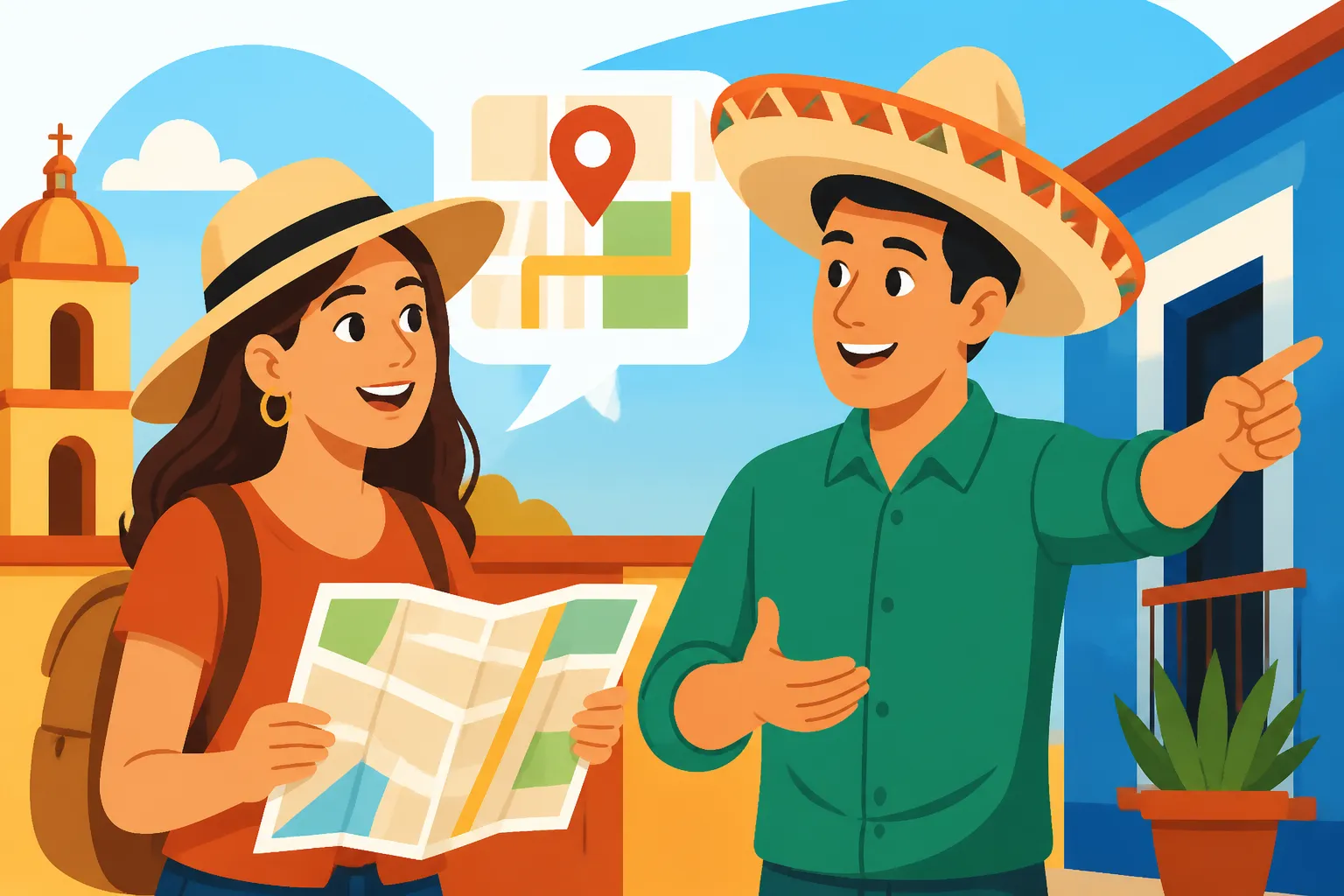
When I lived in Mérida, I quickly learned that asking "how do I get to" (¿Cómo llego a…?) usually yielded better results than simply asking "where is it." The former prompts the speaker to give you a sequence of steps, whereas the latter might just result in a finger pointing vaguely toward the horizon. Use phrases like "¿Está cerca de aquí?" (Is it near here?) or "¿A cuántas cuadras está?" (How many blocks away is it?) to get a better sense of the distance.
Polite Openings: Don't Just Bark Questions
A veteran expat move is to use the phrase "Perdone la molestia" (Sorry to bother you) before asking for directions. This shows an immediate understanding of social etiquette. In Mexico, social harmony is highly valued, and being overly assertive can cause locals to become shy or even give you a quick, potentially inaccurate answer just to end the interaction. If you treat the encounter like a mini-conversation, you are much more likely to get the "insider" route.
If you are looking for a hotel you found on Booking.com, try saying: "Disculpe, buenas tardes, ¿me podría ayudar? Busco el Hotel [Name]." This structure—Greeting + Help Request + Search Verb—is the gold standard for polite inquiry. It gives the local a moment to process that you are a visitor and prepares them to provide a thoughtful answer. It’s also helpful to know How to Say Please, Thank You, and Sorry in Mexican Spanish to pepper throughout the exchange.
The Most Useful Phrases for Getting Where You Need to Go
Beyond the basic "where," you should have a few specific phrases in your pocket for different modes of transport. If you are taking the bus and using Busbud to track your route, you might need to ask the driver "¿Esta es la parada para…?" (Is this the stop for…?). If you are driving, you might need to know if a road is "pavimentada" (paved) or if there are many "topes" (speed bumps) ahead.
| Phrase in Spanish | English Translation | When to Use It |
|---|---|---|
| ¿Cómo llego a…? | How do I get to…? | When you need step-by-step instructions. |
| ¿Qué tan lejos está? | How far is it? | To determine if you should walk or take a taxi. |
| ¿A la derecha o a la izquierda? | To the right or to the left? | To clarify a vague hand gesture. |
| ¿Hay un punto de referencia? | Is there a landmark? | When street names are missing or confusing. |
| Siga todo derecho. | Go straight ahead. | The most common instruction you will receive. |
These phrases are the building blocks of Mexican Spanish: Slang and Expressions for Visitors that actually matter in the real world. Don't worry about being perfect; the effort to speak Spanish is almost always met with patience and a smile. If you find yourself completely turned around, simply saying "Estoy perdido/a" (I am lost) will usually trigger an outpouring of local assistance.
Understanding the Directions You Receive
Asking the question is only half the battle; understanding the answer is where things get tricky. Mexican Spanish is rich with idiomatic expressions and specific vocabulary for navigation that you won't find in a standard textbook. The most famous (and often most frustrating) of these is "ahorita." While it literally means "right now," in the context of directions, it can mean anything from "in two minutes" to "just around that corner over there."
Another major point of confusion for English speakers is the word "derecho." In English, "right" can mean the direction or it can mean "correct." In Spanish, "derecha" is the direction right, but "derecho" means straight. I cannot tell you how many tourists I have seen turn right immediately after a local told them to go "todo derecho" (straight ahead). If you hear "todo derecho," keep walking in the same direction you are currently facing.
Landmarks are the currency of navigation in Mexico. Instead of saying "Turn left on Calle Juárez," a local is far more likely to say "Turn left where the big tree is" or "Go past the OXXO and turn at the yellow house." This is why it is helpful to keep an eye out for churches, plazas, and specific businesses. If you are booked on a Viator tour and the meeting point is "next to the cathedral," make sure you know which cathedral, as many cities have several.
Decoding the Ahorita and Derecho Confusion
The "Derecho" vs. "Derecha" trap is the single most common cause of getting lost. To avoid this, always double-check by pointing and saying "¿Derecho, como una línea?" (Straight, like a line?) or "¿A la derecha?" while pointing right. Most locals will realize you are clarifying and will use more exaggerated hand gestures to help you. It is also helpful to understand Mexican Time and Daily Rhythm for Visitors because "close" at 2:00 PM during the heat of the day might feel a lot "further" than "close" at 7:00 PM.
"Ahorita" in directions usually means the destination is imminent. If someone says "Ahorita llega" (You'll get there right now), it generally means it’s within the next block or two. However, if they say "Está ahorita luego luego," they mean it is literally just around the corner. Learning these nuances is part of Survival Spanish for Travelers in Mexico: Key Phrases that makes you feel less like a stranger and more like a seasoned traveler.
Landmarks over Street Names: The Mexican Way
In many Mexican towns, street signs are either non-existent, hidden behind bougainvillea, or have three different names depending on which century the map was printed. Locals navigate by "puntos de referencia" (reference points). Common landmarks include "la gasolinera" (the gas station), "el semáforo" (the traffic light), or "la farmacia." If you are looking for a restaurant or a hotel from Booking.com, ask what it is near.
A classic Mexican direction might sound like this: "Vaya todo derecho hasta el puente, luego dé vuelta a la izquierda en la esquina del banco." (Go straight until the bridge, then turn left at the corner of the bank.) If you don't see a bridge, don't panic—it might be a tiny stone culvert that the locals call a bridge. Always look for the most prominent feature in the direction they pointed. If you get overwhelmed, you can always ask How to Use Uber and Ride-Hailing Safely in Mexico to get a professional driver to handle the landmarks for you.
Cultural Nuances and the Polite Lie
One of the most important cultural lessons I learned living in Mexico is what I call the "Polite Lie." Mexicans are incredibly hospitable and generally want to be helpful. Sometimes, this desire to be helpful outweighs their actual knowledge of where a place is. If you ask someone for directions and they don't know, they might feel that saying "I don't know" is rude or unhelpful. Instead, they might give you their "best guess."
This isn't malicious; it’s a cultural inclination toward being agreeable. To combat this, I always use the "Rule of Three." I ask three different people for the same directions. If two out of three point in the same direction, I head that way. If all three give different answers, I know I’m in trouble and I’ll look for a more official source, like a police officer or a shopkeeper. This is a vital tip for Staying Safe in Mexico: Practical Tips for Travelers.
Body language is also a huge part of the communication. In Mexico, pointing with the finger is common, but sometimes people point with their chin or a nod of the head. Pay close attention to the eyes and the overall physical orientation of the person helping you. If they seem hesitant or use words like "creo" (I think) or "más o menos" (more or less), take their directions with a grain of salt and confirm with the next person you see.
Why Locals Might Never Say I Don't Know
The pressure to be a "buen anfitrión" (good host) is real. In many parts of Mexico, admitting ignorance can feel like a failure of hospitality. If you are looking for a specific terminal to use a Busbud ticket, and the local isn't 100% sure, they might point you toward where they think buses usually go. Always follow up with "¿Está seguro?" (Are you sure?) in a friendly, non-challenging way. Usually, a slight hesitation in their voice will tell you if they are guessing.
If you find yourself being led in circles, don't get angry. It’s part of the experience. Instead, take a break, grab a "taco de la calle," and try again. Learning Ordering Food and Drinks in Spanish in Mexico Without Stress will give you a chance to reset your mood before you dive back into the navigation puzzle. Often, the best directions come from the person working the taco stand, as they see everyone in the neighborhood.
Body Language and Pointing Habits
Hand gestures in Mexico are expressive and specific. When someone says "aquí a la vuelta," they will often make a hooking motion with their hand to show you are literally turning a corner. If they say "subiendo," they mean the street goes uphill; "bajando" means downhill. In mountainous cities like Taxco or Puerto Vallarta, these vertical directions are just as important as left and right.
If you are using a map and someone tries to help you, they might not look at the map at all. Many locals navigate purely by visual memory and don't "read" maps in the same way we do. Instead of forcing them to look at your phone screen, listen to their descriptions of the buildings. If you are trying to find a tour departure point for Viator, describing the "van" or the "logo" of the company can often be more helpful than showing a GPS coordinate.
Tools and Resources to Supplement Your Navigation
While this guide focuses on the human element of asking for directions, I’m not suggesting you throw your phone away. The goal is to use technology and local interaction in tandem. Before you leave your hotel—which hopefully you found a great deal on via Booking.com—download the offline version of the city map. This ensures you have a baseline even when the signal is non-existent.
In addition to Google Maps, I highly recommend using apps like Waze for driving, as it is very popular in Mexico and often has more up-to-date info on "baches" (potholes) and police checkpoints. For public transport, Busbud is indispensable for long-distance travel, but for city-to-city "colectivos" or local buses, you will still need to use your Spanish skills. There is no app that perfectly tracks the "pesero" (mini-bus) routes in the suburbs of Mexico City.
Using Offline Maps and Transportation Apps
Offline maps are your best friend in the "centro históricos." Since many of these areas have streets so narrow that the satellite can't quite pin you, having the pre-downloaded map allows you to at least see the grid. If you are walking to a meeting point for a Viator excursion, give yourself an extra 20 minutes for "Mexican navigation," which includes getting lost and asking for help at least twice.
Remember that How to Get Around Mexico Without a Car often involves a mix of walking and local transport. If you are using a ride-sharing app, always double-check the destination with the driver verbally when you get in. Say, "Vamos a [Destination], ¿verdad?" This confirms you are both on the same page and gives the driver a chance to suggest a better route if there is traffic or a parade that the app hasn't caught yet.
Comparison of Direction and Navigation Methods
| Method | Pros | Cons | Best Used For |
|---|---|---|---|
| GPS Apps | Real-time traffic, easy to follow. | Drains battery, fails in stone buildings. | Modern city centers and highways. |
| Asking Locals | Provides "insider" shortcuts, avoids blockages. | Language barrier, "Polite Lie" risk. | Colonial towns and rural areas. |
| Landmarks | Very accurate for local context. | Hard to find at night or in rain. | Finding specific shops or hotels. |
| Official Signage | Reliable for highway exits. | Often missing or damaged in towns. | Driving between major cities. |
By combining these methods, you become a much more resilient traveler. You aren't just a tourist following a blue dot on a screen; you are an active participant in the local environment. This not only gets you to your destination but also provides opportunities for the small, friendly interactions that make living in or visiting Mexico so special. Don't forget to budget for Tipping in Mexico (Propina): When and How Much if someone goes out of their way to walk you to your destination—though for simple directions, a heartfelt "muchísimas gracias" is usually all that is expected.
Disclaimer
The information provided in this guide is for informational purposes only. While every effort has been made to ensure accuracy, navigation conditions, local customs, and language usage can change rapidly in Mexico. Always prioritize your personal safety and use multiple sources of information when traveling in unfamiliar areas. The author and publisher are not responsible for any lost items, missed appointments, or travel delays resulting from the use of this guide.