Do People Speak English in Mexico’s Tourist Areas?
Many travelers and new residents arrive in Mexico with a nagging anxiety about the language barrier, worrying that their lack of Spanish will leave them isolated or unable to perform basic tasks like ordering dinner or finding a pharmacy. This guide breaks down exactly where English is common, where it fades, and how you can navigate Mexico’s most popular destinations with confidence.
Disclosure: This post may contain affiliate links. We may earn a commission at no extra cost to you if you make a purchase through these links. Read full disclosure.
The Reality of English Proficiency in Major Tourist Hubs
When you are planning your first trip or move to Mexico, it is easy to assume that the entire country operates on a bilingual spectrum. In reality, the presence of English is heavily dictated by the local economy’s reliance on international tourism. In places like the Riviera Maya, Los Cabos, and Puerto Vallarta, the "tourist bubble" is real, and it is incredibly thick. You can often spend an entire week in these areas without ever needing to conjugate a single Spanish verb. However, the moment you step two blocks away from the main tourist drag, that safety net can disappear quite rapidly.
Quintana Roo and the Riviera Maya
In the state of Quintana Roo, which encompasses Cancun, Playa del Carmen, and Tulum, English is effectively the second language of commerce. Because this region receives millions of visitors from the United States, Canada, and Europe, the local workforce is highly incentivized to be bilingual. Most staff at hotels you find on Booking.com will speak excellent English, from the front desk clerks to the concierges. You will find that waiters in the high-end restaurants on Fifth Avenue in Playa del Carmen or the beach clubs in Tulum are often more comfortable speaking English than Spanish with foreigners.
However, do not let this comfort level make you complacent. While the person selling you a luxury excursion on Viator will likely be fluent, the person cleaning the pool or the maintenance worker fixing your air conditioner might not be. This is where a few basics from Survival Spanish for Travelers in Mexico: Key Phrases can save you from a lot of miming and confusion. In these coastal hubs, the "English bubble" is designed to make your life easy, but it also creates a divide between the curated experience and the real life of the locals who live in the "pueblo" side of town.
Puerto Vallarta and the Pacific Coast
Puerto Vallarta has a unique history because it wasn't just built as a tourist resort like Cancun; it was a traditional Mexican town that grew into a world-class destination. Because of its massive expat population—many of whom have lived there for decades—the level of English in the Romantic Zone and the Marina is exceptionally high. You will find that many retirees live there comfortably with very limited Spanish. If you are staying in one of the boutique villas or hotels listed on Booking.com, you can expect a high level of English-speaking service.
The Pacific coast also includes areas like Sayulita and San Pancho. These are "Bohemian" hubs where many international digital nomads congregate. In these pockets, English is often the lingua franca between people of ten different nationalities. But even here, you should be aware of Mexican Social Etiquette for Visitors: Greetings and Warmth. Just because someone speaks English doesn't mean you should skip the polite "Buenos días" before launching into a question. It is a cultural lubricant that makes every interaction smoother, regardless of which language you eventually settle on.
Los Cabos and the Baja Peninsula
Los Cabos—comprising Cabo San Lucas and San José del Cabo—is often joked about as being an extension of Southern California. Due to its proximity to the U.S. border and its popularity with high-net-worth travelers, English is ubiquitous. In the luxury corridors, you might even find prices listed in USD first and pesos second. Most tour operators and activity providers you book through Viator in Cabo will be native or near-native English speakers.
Outside of the main resorts, in the smaller towns of Baja Sur like Todos Santos or Loreto, the English levels drop significantly. This is where the charm of the "real Mexico" begins, but it’s also where your reliance on translation apps will increase. Understanding Common Cultural Surprises for First-Time Visitors to Mexico will help you realize that a lack of English isn't a sign of poor service, but rather an invitation to engage with the local culture on its own terms.
English in Service Industries and Daily Transactions
Understanding where you are likely to encounter English speakers helps you manage your stress levels. In the service industry, the level of English usually correlates directly with the price point of the establishment. The more you pay, the more likely you are to be greeted in English. This isn't a hard rule, but it is a consistent pattern across the country's most visited zones.
Hospitality and Organized Tourism
The hospitality sector is the gold standard for English in Mexico. Large international chains and even mid-sized hotels found on platforms like Booking.com prioritize hiring bilingual staff. This extends beyond the front desk to include spa therapists, bartenders, and sometimes even the security team. When you are booking specialized tours—like a food tasting in Oaxaca or a snorkeling trip in Cozumel through Viator—you can almost always select an English-speaking guide. These guides are often incredibly knowledgeable and can bridge the gap between the complex history of the ruins and your understanding of the local context.
Transportation and Moving Around
This is the area where language barriers often become most apparent. While the representatives at airport car rental counters usually speak English, taxi drivers and local bus drivers rarely do. If you are using a long-distance bus service, you can use Busbud to handle the ticket booking in English, which is a massive relief for those who find the local bus terminal websites confusing. However, once you arrive at the station, the baggage handlers and the driver will likely communicate only in Spanish.
For local city travel, many expats and tourists prefer ride-hailing apps. Learning How to Use Uber and Ride-Hailing Safely in Mexico is a game-changer because the destination is pre-set in the app, minimizing the need for complex verbal directions. If you do take a traditional taxi, having your destination written down or pinned on a map is essential. Even in tourist areas, a driver might know the name of a major hotel but struggle with the address of a specific local restaurant.
Medical Services and Emergencies
One of the biggest fears for foreigners is a medical emergency where they can’t explain what’s wrong. In major tourist areas, private hospitals (like the Galenia in Cancun or the Joya in Vallarta) specifically cater to foreigners and always have English-speaking doctors and nurses on staff. Many specialists in these areas actually completed their medical residencies in the U.S. or Canada. However, if you find yourself at a small local pharmacy or a public clinic, English will be scarce. It is helpful to know Mexican Spanish: Slang and Expressions for Visitors for basic body parts and symptoms, but in a pinch, translation apps with offline capabilities are your best friend.
| Region / City | Expected English Level | Common Language Challenges |
|---|---|---|
| Cancun Hotel Zone | Extremely High | Almost none; very "Americanized" |
| Playa del Carmen | High | Side streets and local markets |
| Puerto Vallarta | High | Taxis and local public transport |
| Mexico City (Roma/Condesa) | Moderate-High | Government offices and non-tourist cafes |
| Oaxaca City | Moderate | Traditional markets and smaller villages |
| Los Cabos | Extremely High | Rural areas outside the corridor |
| San Miguel de Allende | High | Local specialized services (plumbers/electricians) |
Bridging the Communication Gap
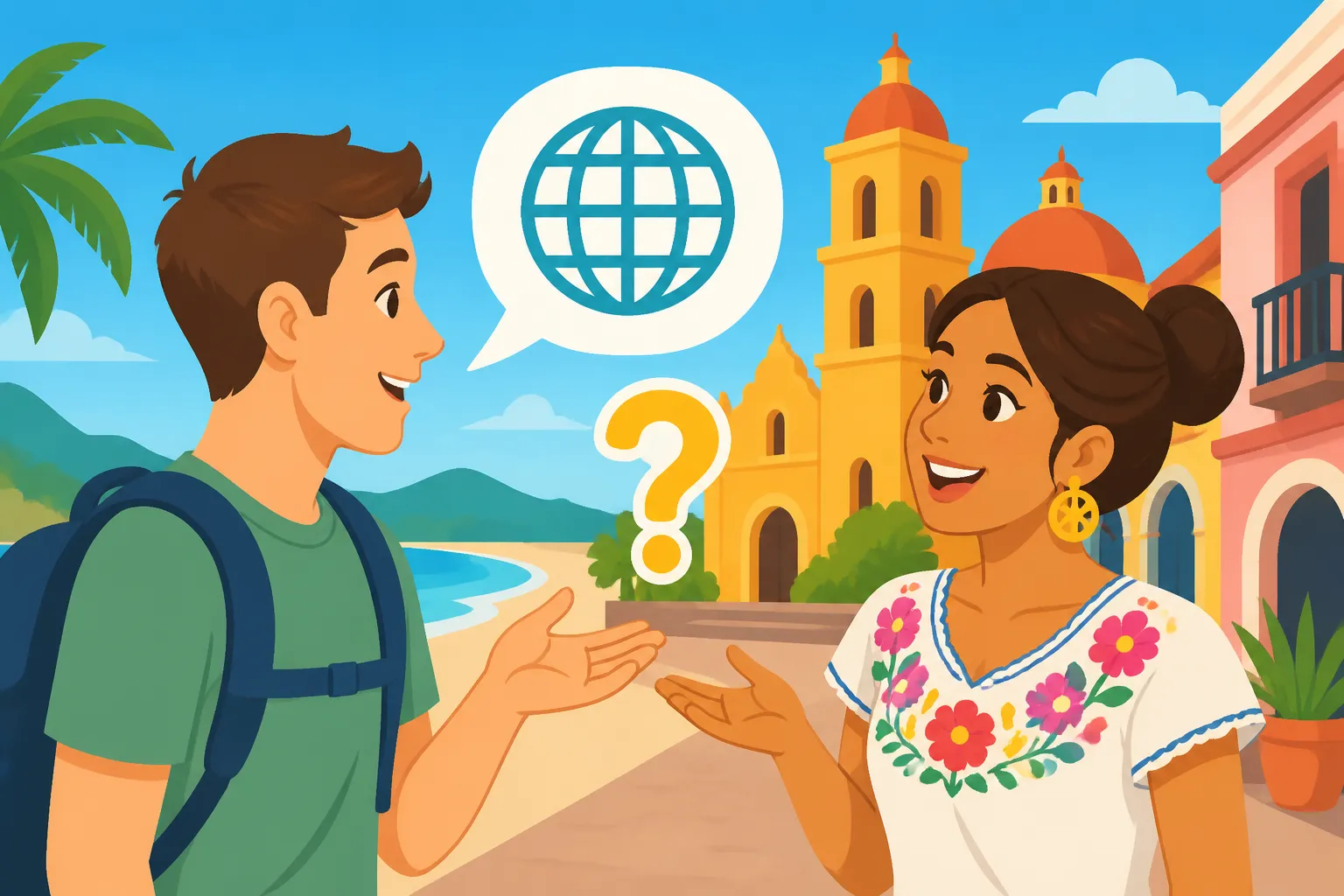
Even if you are staying in the heart of a tourist zone, you will eventually encounter a situation where English isn't enough. The good news is that Mexicans are generally incredibly patient and helpful. They are used to foreigners struggling with the language and will often go out of their way to understand what you need through gestures, drawings, or by finding a bilingual passerby.
The Power of "Survival Spanish"
You don't need to be fluent to be respected. In fact, showing that you are trying goes a long way in Mexican culture. Starting a conversation with a polite "Perdone, no hablo mucho español" (Excuse me, I don't speak much Spanish) often triggers a much more sympathetic response than just shouting English at someone. Knowing the basics of Ordering Food and Drinks in Spanish in Mexico Without Stress will make your dining experiences much more enjoyable, especially when you venture away from the hotel buffet to the local taco stands.
When you're at a local market, you’ll find that prices aren’t always listed. This is where the language barrier can feel expensive. While most vendors are honest, being able to ask "Cuánto cuesta?" (How much does it cost?) and understanding the numbers in Spanish will help you navigate these interactions. If you're unsure about the local customs regarding money, checking a guide on Tipping in Mexico (Propina): When and How Much will ensure you're being fair to the service workers who are often working for very low base wages.
Technology as a Safety Net
We live in an era where a language barrier is no longer a brick wall. Google Translate’s "Conversation Mode" allows you to speak into the phone and have it play back the translation in Spanish, and vice versa. This is invaluable at the pharmacy or when dealing with a landlord. Another tip for travelers is to download the Spanish language pack for offline use. This ensures that if you are in a remote area or your data fails, you still have a way to communicate.
If you are exploring the culinary scene, which is one of the best parts of Mexico, you might worry about hygiene or ingredients. Reading up on Is Street Food Safe to Eat in Mexico? gives you the confidence to try local delicacies, and having your translation app ready to check for allergens can prevent a medical mishap. Use your phone to take photos of signs or menus and use the "Lens" feature to translate them instantly—it's like having a universal translator in your pocket.
The Cultural Effort: Why It Matters
In Mexico, language is more than just a way to convey information; it is a way to build rapport. The "English-only" traveler often misses out on the warmth and depth of the local culture. Even in the most touristy parts of the country, the people working in the service industry appreciate the effort of a foreigner trying to speak their language.
Politeness and Indirect Communication
Mexican Spanish is famously polite and often indirect. While English speakers tend to be very "to the point," Mexican communication involves more pleasantries. This is why knowing Polite Spanish in Mexico: Usted vs Tú for Visitors is so important. Using "Usted" (the formal 'you') with older people or those in positions of authority shows a level of respect that is deeply valued. If you walk into a shop and just say "Water," it can come across as quite rude. Walking in and saying "Buenas tardes, ¿me puede vender una botella de agua, por favor?" (Good afternoon, can you sell me a bottle of water, please?) will get you a much warmer smile.
Expanding Your Horizons
The more Spanish you learn, the more Mexico opens up to you. When you rely solely on English, you are limited to the places that have the budget to hire bilingual staff—which usually means the most expensive and least "authentic" locations. Once you have the confidence to step outside that circle, you can find the best "comida corrida" (set lunch) places, the most beautiful hidden cenotes, and the most interesting local crafts.
For those who are considering a long-term move or a repeat visit, using resources to find accommodation beyond the standard portals like Booking.com often requires some Spanish, as local landlords may not advertise in English. Similarly, if you want to travel between smaller cities using local transport instead of the major routes on Busbud, you will need to navigate the world of "colectivos" and "combis" where English is virtually non-existent.
In summary, while you can easily survive in Mexico's tourist areas with only English, your experience will be significantly richer—and often cheaper—if you embrace even a small amount of the local language. Mexico is a country that rewards those who make an effort. Whether you are booking a luxury catamaran on Viator or buying a tamale from a street corner, a little bit of Spanish and a lot of patience will go a long way.
Disclaimer
This guide is intended for informational purposes only. Language proficiency and the availability of English-speaking services can vary significantly by location and individual establishment. While every effort has been made to provide accurate and up-to-date information, the author and publisher are not responsible for any difficulties or misunderstandings encountered while traveling or living in Mexico. Always carry a translation tool and have emergency contact information ready.