How to Pronounce Common Mexican Place Names
You arrive at a bustling bus terminal in Mexico City, your phone is dying, and you need to buy a ticket to a town that looks like a jumble of consonants. You try your best, but the clerk just stares at you with polite confusion. This guide solves that specific, ego-bruising struggle by breaking down the phonetic logic of Mexican geography so you can navigate like a seasoned resident.
Disclosure: This post may contain affiliate links. We may earn a commission at no extra cost to you if you make a purchase through these links. Read full disclosure.
The Foundation of Mexican Spanish Phonetics
If you want to stop butchering names like Queretaro or Mazatlán, you have to start with the vowels. In English, vowels are slippery; they change depending on the word. In Spanish, and specifically the clear Mexican dialect, vowels are your best friends because they are absolute. They never change their sound, regardless of which letters surround them. When you are looking for a hotel on Booking.com in a new city, knowing these five sounds will help you communicate your destination to any taxi driver without a second thought.
The Five Sacred Vowels
The vowel sounds are A (ah), E (eh), I (ee), O (oh), and U (oo). That is it. There are no "long" or "short" variations like in English. When you see "Oaxaca," that first 'O' is a clean 'oh' sound, and that 'a' at the end is a wide 'ah.' Most expats struggle because they try to "English-ify" the words, adding extra syllables or changing the vowel mid-word. Practice saying them staccato-style. If you can master the consistency of these five sounds, you have already won half the battle of Spanish Language and Everyday Communication for Visitors.
I remember my first week in Mexico, trying to say "Guadalajara." I kept saying "Gwad-a-la-hara" with a very flat American 'a.' A local friend pulled me aside and explained that every single 'a' in that word must sound exactly like the 'a' in "father." Gwah-dah-lah-HAH-rah. It sounds repetitive to an English ear, but it is music to a Mexican one. This level of precision is especially helpful when you are using Survival Spanish for Travelers in Mexico: Key Phrases to get through your first few days in the country.
The Consonants That Trip You Up
Beyond vowels, a few consonants act as gatekeepers to correct pronunciation. The most famous is the 'J,' which sounds like a breathy English 'H,' but with a bit more grit from the back of the throat. Then there is the 'LL,' which in Mexico is pronounced like a 'Y.' If you are heading to a town like San Miguel de Allende, remember it is “ah-YEN-deh,” since the LL sounds like a Y. Getting these right prevents the "clueless tourist" label from sticking to you the moment you open your mouth.
Then we have the 'H.' In Spanish, the 'H' is always silent. It is purely decorative. If you are staying in a neighborhood like La Herradura, you ignore that 'H' entirely. It is "Eh-rah-DOO-rah." I once watched a fellow traveler spend ten minutes trying to find the "H-edge-ee-ick" bus, only to realize the town was Ajijic (Ah-hee-HEEK). If he had checked How to Buy ADO Bus Tickets in Mexico beforehand, he might have been more prepared for the linguistic quirks of the bus station.
Deciphering the Enigma of the Letter X
The letter 'X' is the ultimate boss level of Mexican pronunciation. Because Mexico’s linguistic history is a blend of Spanish and indigenous languages like Nahuatl and Mayan, the 'X' does not have one single job. It is a shape-shifter. Depending on where the town is located, that 'X' might sound like an 'H,' an 'S,' or even a "sh" sound. This is where most foreigners give up and just point at their screens, but there is a logic to the madness.
The "H" Sounding X
In the most famous names, like Mexico and Oaxaca, the 'X' represents a sound that was once a "sh" but evolved into the modern Spanish 'J' (the 'H' sound). You must say "MEH-hee-koh" and "wah-HAH-kah." If you use the English "ks" sound, you are essentially signaling that you haven't yet scratched the surface of the local culture. When you are booking tours through Viator to see the ruins in these regions, you will hear the guides use that breathy 'H' sound constantly.
This specific 'X' is a point of national pride. It links the modern country to its Mexica (Me-SHEE-ka) roots. When you pronounce Oaxaca correctly, you aren't just saying a name; you are respecting a thousand years of history. It’s a small effort that goes a long way in Mexican Spanish: Slang and Expressions for Visitors. I’ve noticed that when expats make the effort to say "Me-hee-ko" instead of "Mex-i-co," the local response is immediately warmer and more helpful.
The "Sh" and "S" Sounding X
To make things even more interesting, head south to the Yucatan or north to areas with different indigenous influences. In the Mayan world, the 'X' often reverts to its original "sh" sound. If you are visiting the famous park Xcaret, it is "sh-kah-RET." If you are heading to the "place of the flowers" in Mexico City, Xochimilco, it sounds like "so-chee-MEEL-koh." Here, the 'X' acts like a soft 'S.' It can feel inconsistent, and the start of a word is no guide: the 'X' is “sh” in Xcaret, an 'S' in Xochimilco, and an 'H' in Xalapa.
I once saw a group of tourists at a terminal trying to find a bus to Xalapa. They were asking for "Ex-ah-lah-pah" and getting nowhere. A local finally stepped in and said, "Ah, Hah-LAH-pah!" The 'X' there is a breathy 'H.' If they had used Busbud to check the destination spellings and cross-referenced with a basic phonetic guide, they would have saved twenty minutes of frustration. It is always worth a quick search to see the indigenous roots of a city name before you try to say it out loud.
Regional Pronunciation Guides for Popular Spots
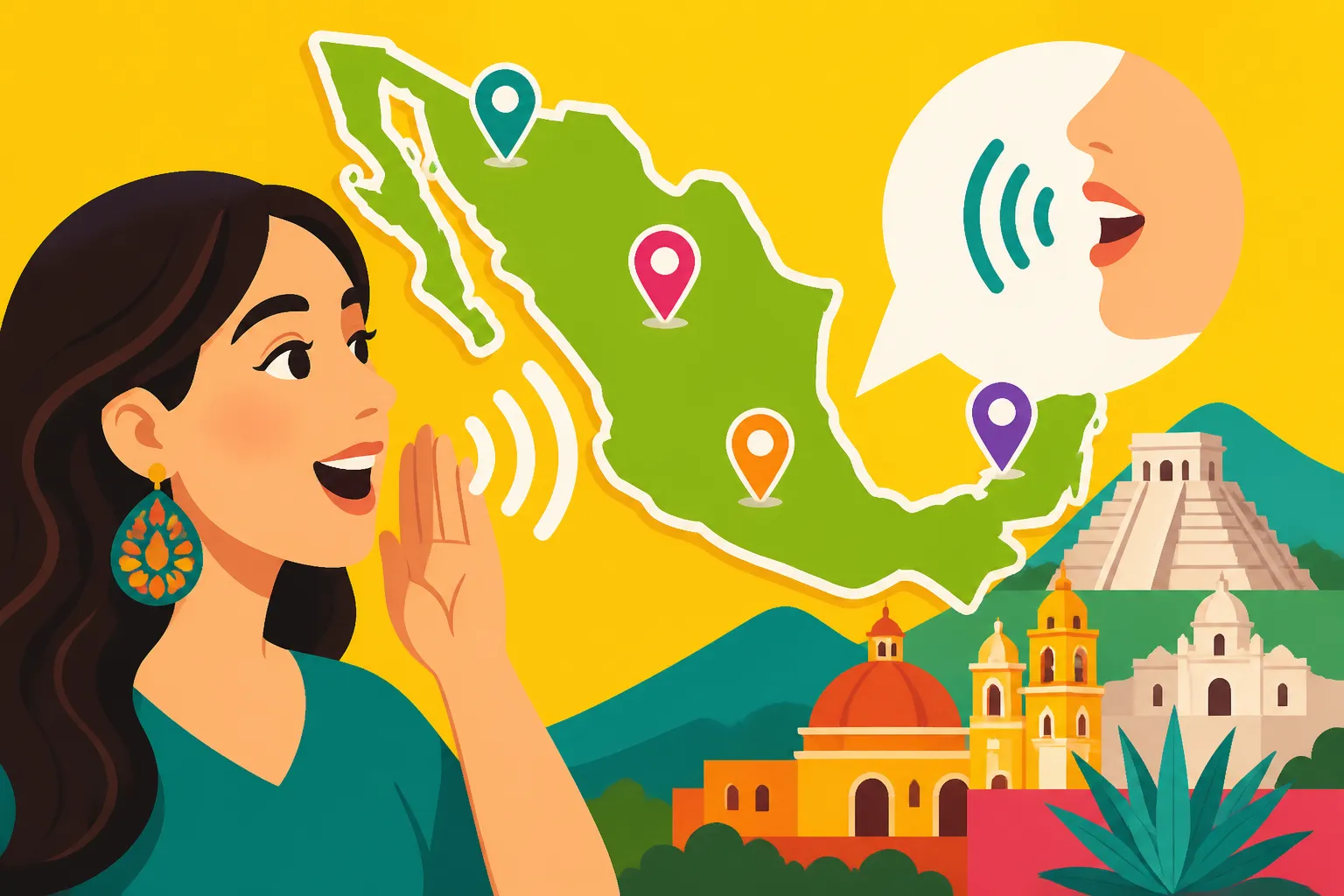
Mexico is a massive country, and names vary wildly by region. What works in the colonial highlands might not apply to the coastal jungles. To help you avoid the most common mistakes, I’ve broken down some of the heavy hitters. Whether you are using Booking.com to find a boutique hotel in a "Pueblo Mágico" or Viator to book a city trek, these are the names you will encounter most frequently.
Central Mexico and the Highlands
The heart of the country is full of colonial names and Nahuatl hybrids. One of the biggest hurdles is Queretaro. It looks like "Kwe-re-ta-ro," but it should be a sharp "keh-REH-tah-roh." Note the accent on the second 'e'—that is where the punch of the word lives. Then there is Tlaxcala. It looks terrifying on a map, but just think of the 'Tl' as a single clicking sound or a very soft 'T.' It’s "tlah-SKAH-lah." It is much easier than it looks!
Another common one is San Miguel de Allende. Many people forget the "Allende" part or butcher the double 'L.' It’s "sahn mee-GEL deh ah-YEN-deh." If you are trying to find your way through the winding streets there, you will likely need to know How to Ask for Directions in Spanish in Mexico. Getting the town name right is the first step in getting a local to actually understand where you are trying to go.
The Yucatan and Pacific Coasts
In the Yucatan, you are dealing with Mayan roots. Mérida is "MEH-ree-dah," again with the stress on the first syllable. Campeche is "kahm-PEH-cheh." On the Pacific side, you have places like Zihuatanejo. This one is a mouthful for English speakers. Break it down: "see-wah-tah-NEH-hoh." Remember that final 'j' is that 'H' sound we talked about earlier.
If you are traveling between these coastal hubs, you will likely be using Busbud to navigate the long distances. Being able to confirm your destination with the driver—"¿Va para See-wah-tah-neh-hoh?"—is a vital safety and logistical skill. It prevents you from ending up on the wrong side of a mountain range because you mispronounced a destination that sounded similar to another.
Practical Tips for Sounding Like a Local
Knowing the rules is one thing; applying them in the heat of a conversation is another. When you are in a crowded market or a busy metro station, the speed of local speech can be overwhelming. The trick is not to speak faster, but to speak clearer. Focus on the vowels and the word stress. In Spanish, if there is an accent mark (á, é, í, ó, ú), that is your roadmap. That is the loudest part of the word.
Listen and Repeat
The best way to learn is to listen to the automated voices on the metro or the announcements at the bus station. If you are learning How to Use the Mexico City Metro as a First-Time Visitor, pay close attention to how the "voice" says the station names. It is the gold standard for "neutral" Mexican pronunciation. I spent weeks just repeating station names like "Chilpancingo" (cheel-pahn-SEEN-goh) under my breath until I could say them without thinking.
Another tip is to use your phone's map app but set the language to Spanish. Hearing the GPS say "Turn left on Avenida Cuauhtémoc" (kwau-TEH-mohk) will drill the correct sounds into your brain far faster than reading them off a page. You’ll start to recognize patterns, like the 'ua' diphthong, which always sounds like a "wah" or "wa."
Don't Be Afraid of the Accent
Many expats are shy about using a Spanish accent because they don't want to sound like they are "trying too hard." Trust me, the locals would much rather you try too hard than not try at all. Using the correct "r" (even if you can't roll it perfectly) and the correct vowels shows respect for the language. It moves you from being a "visitor" to being a "guest."
When you are practicing Polite Spanish in Mexico: Usted vs Tú for Visitors, remember that your pronunciation is part of that politeness. Slurring through a town name can come off as lazy. If you are booking a high-end experience through Viator, your guide will likely speak excellent English, but they will be visibly impressed if you can pronounce the indigenous names of the sites you are visiting.
Common Place Name Comparison Table
To help you keep these straight, here is a quick reference table for some of the most commonly mispronounced locations in Mexico.
| Place Name | Common Wrong Way | Correct Phonetic Way | Key Rule |
|---|---|---|---|
| Mexico | MEX-i-co | MEH-hee-koh | X = H sound |
| Oaxaca | Oh-ax-ah-ka | wah-HAH-kah | OA = WAH / X = H |
| Xcaret | Ex-car-et | sh-kah-RET | X = SH sound |
| Ajijic | Ah-gee-geec | Ah-hee-HEEK | J/Second J = H |
| Queretaro | Kware-tah-ro | keh-REH-tah-roh | QU = K / Stress on RE |
| Xochimilco | Zo-chee-mil-ko | so-chee-MEEL-koh | X = S sound |
| Iztaccihuatl | Iz-tak-i-wat-ul | ees-tahk-SEE-waht-ul | TZ = S / Silent H |
| Guadalajara | Gwad-a-la-hara | gwah-dah-lah-HAH-rah | Pure 'ah' vowels |
| Cozumel | Co-zoo-mel | koh-soo-MEL | Z = S / Stress at end |
Essential Tips for Navigating Conversations
One final piece of advice: if you aren't sure how to say a place name, ask! Mexicans are generally incredibly patient and proud of their geography. You can say, "¿Cómo se pronuncia el nombre de este lugar?" (How is the name of this place pronounced?). Most people will be happy to repeat it slowly for you. This is a great way to practice the skills you learned in Spanish Language and Everyday Communication for Visitors.
The Importance of Word Stress
In Spanish, if a word doesn't have an accent mark, the stress usually falls on the second-to-last syllable (if it ends in a vowel, n, or s) or the last syllable (if it ends in any other consonant). Take "Puerto Vallarta." It ends in a vowel, so the stress is on "YAR." Pwer-toh vah-YAR-tah. Compare that to "Cozumel," which ends in 'L.' The stress moves to the end: koh-soo-MEL.
Mastering this rhythm is what truly makes you sound like an expat who knows their way around. It’s the difference between sounding like a robot and sounding like a resident. When you are looking up things on Booking.com, try saying the neighborhood names out loud using these stress rules. It will become second nature before you know it, making your travels through this beautiful, linguistically rich country much smoother.
Disclaimer
The information provided in this guide is for educational and informational purposes only. While every effort has been made to ensure accuracy in pronunciation and cultural context for 2026, linguistic nuances can vary significantly by region and individual speaker. Travel conditions and brand services mentioned (Viator, Busbud, Booking.com) are subject to change. Always verify specific travel details and local customs directly with service providers or local authorities.