How to Use the Mexico City Metro as a First-Time Visitor
Most visitors land in Mexico City and immediately feel paralyzed by the legendary traffic on the Periférico or Insurgentes. Sitting in a ride-share for ninety minutes just to travel five miles is a rite of passage no one actually wants. This guide demystifies the Mexico City Metro, the orange-colored lifeline of the capital, teaching you how to navigate its twelve lines like a seasoned local.
Disclosure: This post may contain affiliate links. We may earn a commission at no extra cost to you if you make a purchase through these links. Read full disclosure.
Understanding the Network Layout and Logistics
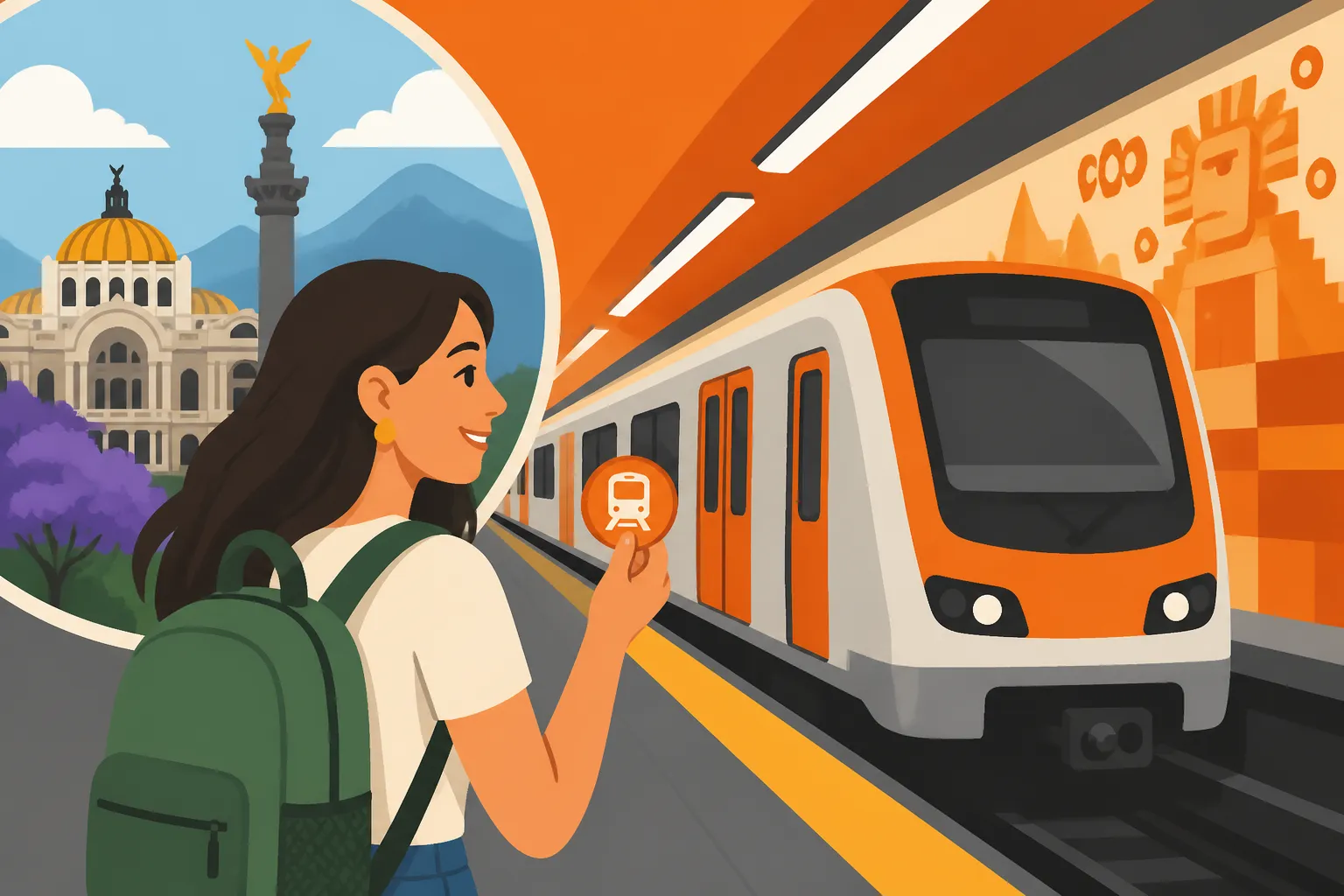
The Sistema de Transporte Colectivo, commonly known simply as "El Metro," is one of the largest and busiest subway systems in the world. For a first-time visitor, the map looks like a tangled plate of colorful spaghetti, but there is a brilliant logic to it that dates back to the late 1960s. When the system was first designed, many residents of the city were not fully literate, so the architects created a unique icon for every single station. These icons are not random; they represent the history or landmarks of the surrounding neighborhood. For instance, the icon for Chapultepec is a grasshopper, which is the Nahuatl meaning of the name.
Navigating the lines requires you to focus on the color and the terminal station. Unlike some cities where you look for Northbound or Southbound, in Mexico City, you look for the name of the last station on the line in the direction you are heading. If you are on the Blue Line (Line 2) and want to go from the Zócalo to the Palace of Fine Arts, you look for signs saying "Dirección Cuatro Caminos." Understanding this "Dirección" system is the single most important skill for a newcomer.
The sheer volume of people can be intimidating. With over 190 stations, the system moves millions of people daily. If you are staying in popular areas like Roma or Condesa, you will likely find yourself using Line 1 (Pink) or Line 9 (Brown). However, as a veteran who has navigated these tunnels for years, I must warn you that Line 1 has been undergoing massive, multi-year renovations. Always check local updates or digital maps to see which sections are currently replaced by RTP buses. For those booking their stay via Booking.com in the city center, Line 2 (Blue) will be your best friend, as it connects the Zócalo, Bellas Artes, and the Revolución monument.
Icons and Color Coding
The color-coding system is remarkably consistent. Line 1 is pink, Line 2 is blue, Line 3 is olive green, and so on. Inside the stations, you will see thick stripes of these colors on the walls. If you are making a transfer (a "correspondencia"), you simply follow the color of the line you want to switch to. Some of these transfers involve very long walks—the transfer at La Raza, for example, features a "Tunnel of Science" that is essentially a long-form astronomy exhibit. It is beautiful, but it takes about ten minutes to walk, so don't expect "instant" transfers.
Operating Hours and Peak Times
The Metro runs from 5:00 AM on weekdays, 6:00 AM on Saturdays, and 7:00 AM on Sundays and holidays. It usually closes at midnight. However, the experience of the Metro changes drastically depending on the hour. Between 7:30 AM and 9:30 AM, and again from 6:00 PM to 8:00 PM, the system enters what we call the "Godínez" rush—named after the nickname for Mexico’s office workers. During these hours, the trains are packed to the point of physical impossibility. If you are a first-time visitor, I strongly recommend avoiding these windows. If you must travel then, prepare to be "sweated on" and pushed. It is not personal; it is just the physics of moving twenty million people.
Navigating Station Entrances
Entrances are marked by a large orange "M" logo. Some stations are massive hubs with dozens of exits. A pro-tip from someone who has spent far too much time lost underground: look for the "Salida" signs that list the street names. If you are heading to a specific museum or landmark, there is usually an icon or a small text label pointing you to the correct stairs. If you exit on the wrong side of a street like Avenida Insurgentes, it might take you ten minutes just to find a way to cross back over the surface traffic.
Tickets Cards and Entry Logistics
Gone are the days when you could rely solely on paper tickets. While a few stations might still sell them for a single trip, the city has transitioned almost entirely to the "Tarjeta de Movilidad Integrada." This is a plastic smart card that costs 15 pesos (less than a dollar) and can be loaded with credit. This card is the "Golden Ticket" of Mexico City transport. It works on the Metro, the Metrobús, the Cablebús (the incredible cable cars over the city), and even the light rail.
You can buy these cards at ticket booths (taquillas) inside almost any Metro station. Look for the window with the glass partition where a worker is sitting. You simply say, "Una tarjeta, por favor," and tell them how much money you want to add. A single ride on the Metro costs 5 pesos—making it one of the cheapest transit systems on the planet. If you put 50 pesos on your card, you can basically travel for a week.
When you approach the turnstiles, you tap your card on the circular reader. The screen will show your remaining balance. You do not need to tap out when you leave; the turnstiles for exiting are one-way and do not require a card. This is a common point of confusion for those used to the systems in London or New York. Just walk through the exit gates. If you are planning a day trip to the outskirts and need to find the right bus terminal, using the Metro to reach stations like Observatorio or Tasqueña is much faster than a taxi. You can check intercity schedules on Busbud to coordinate your Metro arrival with your bus departure.
Where to Top Up Your Balance
Besides the taquillas, many stations now have digital kiosks. These machines have an English language option, which is a lifesaver if your Spanish is still in the "beginner" phase. You can also top up your card at many OXXO convenience stores throughout the city. If you find yourself in a station with a massive line at the ticket window, look for a machine first. Just remember that many machines only take cash and do not give change, so have small bills or coins ready. You can learn more about managing your daily expenses in the Cost of Living in Mexico City (2026): Detailed Expat Budget Guide.
The Segregated Car System
One of the most important cultural aspects of the Mexico City Metro is the existence of "Acoso Zero" or segregated cars. The first two or three cars of every train are reserved exclusively for women and children under the age of 12. This is strictly enforced during peak hours by police officers standing on the platforms. If you are a woman traveling alone or with other women, these cars are generally much more comfortable and feel safer during crowded times. Men, even if they are with their wives or mothers, are not allowed in these sections. As a visitor, please respect this rule; men who accidentally wander into the women’s section will be met with whistles, shouts, and likely a police escort to the next car.
Managing Large Luggage
The Metro was not designed for travelers with giant rolling suitcases. There are very few elevators, and many stations require navigating multiple flights of steep stairs. If you are arriving from the airport with three suitcases, the Metro is going to be a nightmare. However, if you have a simple backpack, it is perfectly doable. If you find the logistics of moving through the city with gear too stressful, you might look into How to Use Uber and Ride-Hailing Safely in Mexico as an alternative for that initial trip from the airport to your hotel.
| Line Number | Color | Key Tourist Stations | Why Visit? |
|---|---|---|---|
| Line 2 | Blue | Zócalo, Bellas Artes, Revolución | Historic center, museums, and architecture. |
| Line 3 | Olive | Tlatelolco, Coyoacán, Universidad | Plaza of Three Cultures, Frida Kahlo area, UNAM campus. |
| Line 1 | Pink | Chapultepec, Insurgentes, Sevilla | Access to the park, Roma Norte, and Juárez. |
| Line 7 | Orange | Polanco, Auditorio, Antropología | Upscale dining, concert hall, Anthropology Museum. |
Safety Etiquette and Survival Tips
I often get asked: "Is the Metro safe?" The answer is a nuanced yes, but with caveats. Violent crime is extremely rare on the Metro, but pickpocketing is an art form here. Professional thieves look for distracted tourists, especially at the "transfer" stations like Hidalgo, Pino Suárez, or Balderas. The strategy is simple: they wait for the "push" that happens when a door opens, and in the chaos of bodies moving in and out, your phone or wallet disappears from your pocket.
To stay safe, follow the expat golden rule: wear your backpack on your front. It looks silly, but everyone does it. Never keep anything in your back pockets. If you are standing, keep your hand over the zipper of your bag. If someone tries to distract you or starts a commotion, that is usually the signal that a pickpocket is working nearby. For more broad advice on navigating the city, read through Safety in Mexico: What Expats Need to Know About Staying Safe and Is Mexico City Safe for Tourists Right Now?.
Beyond theft, the etiquette of the Metro is "organized chaos." There is no "letting people off first" rule in the busier stations; it is often a simultaneous battle of people trying to get in while others try to get out. You have to be assertive. If your station is coming up, start moving toward the door before the train stops. Use the phrase "¡Con permiso!" (with permission) as you shoulder your way through. If you wait for a gap to open naturally, you will miss your stop.
Dealing with Street Vendors and Noise
The Mexico City Metro is loud. You will encounter "vagoneros"—vendors who board the cars to sell everything from chewing gum and phone chargers to pirated CDs (though the music sellers have diminished in recent years). They often have backpacks with massive speakers blasting music. You don't need to interact with them; a simple "no, gracias" or just ignoring them is the standard response. You will also see blind or disabled individuals walking through the cars asking for "una moneda." It is part of the daily fabric of the city. If you are interested in how this fits into the broader transit landscape, see Getting Around Mexico City: Metro, Metrobús, and Apps.
Avoiding Scams Near Entrances
Sometimes, unauthorized "guides" might hang around major stations like Zócalo offering to help you buy a ticket or show you the way to a museum for a fee. Politely decline. The Metro staff are generally helpful, and there are enough signs that you don't need a paid escort. If you are worried about navigating the city's complex history on your own, it is better to book a legitimate walking tour through Viator rather than trusting a random person at the station. This helps you avoid the situations described in How to Avoid Common Scams in Mexico.
What to Do in an Emergency
If you ever feel unsafe or if there is a medical emergency, every station has a "Jefe de Estación" (Station Chief) office, usually located near the ticket booths. There are also blue emergency intercoms on the platforms and inside some cars. Police officers in neon vests are stationed at almost every turnstile area. They are generally helpful and can provide directions if you are lost. Keep a list of Emergency Numbers in Mexico: How to Call Police, Fire, or Ambulance handy just in case, though the police presence in the Metro is quite high.
Connectivity and Practical Logistics
The Metro is just one piece of the puzzle. Often, the Metro will get you close to your destination, but you might need to transfer to the Metrobús (the red rapid-transit buses) to finish the journey. For example, to get to the heart of the luxury district in Polanco, you might take the Metro to the Polanco station (Line 7), but to get to the far end of Reforma, the Metrobús is superior. Your Movilidad Integrada card works for both, which makes the transition seamless.
If you are staying in a neighborhood like San Miguel de Chapultepec or Escandón, you’ll find that the Metro is a great way to skip the traffic jams of the interior circuits. Many expats living in these areas prefer the Metro for its predictability—while a car might take an hour to get across the city, the Metro will consistently do it in twenty minutes. If you are exploring where to live, our guide on Living in Mexico City: Neighborhoods for Expats can help you find a spot near a convenient line.
For those who want to see the famous pyramids of Teotihuacán, you will need to take Metro Line 5 (Yellow) to the "Autobuses del Norte" station. This is a massive bus terminal where you can catch the specific "Pirámides" bus. Using the Metro to get to the bus station saves you a significant amount of money and time compared to taking a taxi all the way from the south of the city.
Mobile Data and Apps underground
One of the downsides of the CDMX Metro is that cell service is spotty once you are deep underground. Some of the newer lines and shallower stations have Wi-Fi (look for "CDMX-WiFi-Metro"), but don't count on it for real-time navigation while the train is moving. I highly recommend downloading an offline map of the city or a dedicated Metro app like "Metro-Metrobús México" before you head down. This allows you to check your transfers without needing a signal.
Accessibility Challenges
It is important to be realistic: the Mexico City Metro is not very accessible for people with mobility issues. While there are elevators (elevadores) in some major stations, they are frequently out of service or require a special key/card that only residents with disabilities have. Most transfers involve a lot of stairs. If you use a wheelchair or have difficulty with steep climbs, you might want to stick to the Metrobús, which has level boarding and is much more accessible, or rely on ride-sharing.
Comparing Metro vs. Other Options
Why use the Metro at all when Uber is so cheap in Mexico? Because of the "Manifestaciones" (protests). Mexico City is the protest capital of North America. It is very common for major arteries like Paseo de la Reforma or the Zócalo to be completely shut down by marches. When the surface world is at a standstill, the Metro keeps moving. It is the only "traffic-proof" way to get around. Whether you are heading to a meeting or just trying to get back to your hotel booked on Booking.com, the Metro is your insurance policy against the city's unpredictability.
Disclaimer
This guide is for informational purposes only. While we strive to provide the most accurate and up-to-date information regarding the Mexico City Metro, transit rules, prices, and line availability can change without notice. Always follow the instructions of local authorities and transit staff. Using public transportation involves inherent risks; remain vigilant of your surroundings and personal belongings at all times.