Cost of Living in Mexico City (2026): Detailed Expat Budget Guide
Staring at a lease agreement for a one-bedroom apartment in Roma Norte that rivals the cost of a flat in Chicago is a harsh wake-up call for many new arrivals. I remember the exact moment my romanticized vision of a “dirt-cheap” Mexican metropolis collided with the economic reality of a booming global capital. Mexico City (CDMX) is an absolute powerhouse—a sprawling, vibrant, culinary, and cultural giant. But it is no longer the undisputed bargain-basement destination it was a decade ago. This comprehensive guide strips away the outdated digital nomad myths and provides a candid, brutally honest breakdown of what it actually costs to live, thrive, and financially survive in Mexico City today.
Disclosure: This post may contain affiliate links. We may earn a commission at no extra cost to you if you make a purchase through these links. Read full disclosure.
The Reality of CDMX Housing in 2026
The Gentrification Divide: Roma, Condesa, and Polanco
If you spend your time researching Mexico City on Instagram or YouTube, you might assume the entire city consists of the tree-lined, art-deco streets of Roma Norte, the lush parks of La Condesa, or the ultra-luxurious avenues of Polanco. These neighborhoods represent the epicenter of the expat and remote-worker boom. Because of the massive influx of foreign capital over the past five years, the real estate market in these specific colonias has completely decoupled from the local Mexican economy.
In 2026, renting a modern, furnished, one-bedroom apartment in Roma or Condesa routinely costs between $1,800 and $2,800 USD per month. In Polanco, where high-end corporate executives and diplomats reside, a premium two-bedroom condo easily exceeds $3,500 to $5,000+ USD monthly. Landlords in these areas cater almost exclusively to foreigners earning dollars or euros, pricing out the local middle class and fundamentally altering the neighborhood dynamics.
If your heart is set on living in the “expat bubble,” you must budget North American metropolitan prices. Furthermore, you must be prepared for the intense competition. Desirable apartments in these zones often trigger bidding wars, and short-term rental platforms have swallowed up a massive percentage of the long-term housing stock. You can read more about the systemic changes in these specific markets in our Renting a Home in Mexico: Complete Expat Guide to Leases, Deposits, and More.
The Smart Expat Strategy: Transitional and Classic Neighborhoods
To reclaim your budget without sacrificing quality of life, savvy expats are looking just outside the traditional bubble. Neighborhoods like Escandón, Narvarte, Del Valle, and San Rafael offer phenomenal, authentic city living at a fraction of the cost. These colonias are incredibly safe, bursting with incredible street food, and heavily populated by the Mexican professional middle class.
In Narvarte or Del Valle, you can secure a beautiful, unfurnished two-bedroom apartment in a secure building for roughly $800 to $1,200 USD per month. In the culturally rich, historic southern neighborhood of Coyoacán (famous as the home of Frida Kahlo), spacious homes with gardens can be rented for $1,000 to $1,500 USD. By simply expanding your search radius by two or three miles, you slash your housing budget by 50% while deeply improving your cultural immersion.
The “Fiador” Hurdle and Leasing Bureaucracy
Finding a cheap apartment in a local neighborhood is only half the battle; actually signing the lease is a bureaucratic gauntlet. Traditional landlords in Mexico City strictly require a fiador (a guarantor). A fiador must be someone who owns debt-free real estate within the city limits of CDMX and is willing to co-sign your lease. As a newly arrived foreigner, you almost certainly do not have a fiador.
To bypass this, you will either need to pay for a specialized legal policy (póliza jurídica) which costs roughly 30% to 50% of one month’s rent, or you will have to offer the landlord a massive upfront cash deposit—often three to six months of rent in advance.
When you need to transfer $5,000 USD to secure a lease and pay for your póliza jurídica, attempting to wire this through a traditional US or Canadian retail bank will subject you to brutal exchange rate markups and SWIFT network delays. To guarantee the money arrives instantly and without hidden margin fees, the entire expat community relies on Wise. By loading your home currency into Wise, you secure the true mid-market exchange rate and can execute a local SPEI transfer directly to the landlord or legal firm, bypassing the predatory retail banking sector entirely.
Utilities, Internet, and the Hidden Costs of Comfort
The Tiered Electricity Grid (CFE)
The climate in Mexico City is famously temperate. Because the city sits at an altitude of 7,300 feet, you rarely need central heating in the winter, and air conditioning is generally unnecessary in the summer. This geographic blessing keeps your baseline utility costs astonishingly low compared to the brutal cooling bills of coastal Mexico or the heating bills of Canada.
Electricity is provided by the state-owned CFE (Comisión Federal de Electricidad) and is billed bi-monthly. For a standard apartment running lights, laptops, a refrigerator, and a television, your bill will usually hover between $15 and $30 USD every two months. However, if you rent a high-end luxury condo with central AC and you run it constantly, you will be pushed into the high-consumption tier (DAC), where subsidies disappear and bills can spike to over $150 USD.
Water, Gas, and Connectivity
Municipal water is incredibly cheap, usually costing less than $10 USD a month, but it is not safe to drink from the tap. You must budget for weekly deliveries of purified 20-liter water jugs (garrafones), which cost about $2.50 USD each. Domestic gas, used for cooking and heating your shower water, is either piped in (natural gas) or delivered by truck (LP gas). Expect to spend roughly $20 to $40 USD a month on gas, depending heavily on your cooking habits and the length of your showers.
Where Mexico City truly shines is its telecommunications infrastructure. The city is heavily wired with high-speed fiber-optic internet. Providers like Telmex, Izzi, and Totalplay offer incredibly reliable, gigabit-speed connections for roughly $30 to $50 USD per month. This rock-solid infrastructure is exactly why CDMX has become the remote-work capital of the Americas. You can review the nuances of securing these contracts without a formal credit history in Internet and Mobile Phone Plans in Mexico: Staying Connected as an Expat.
For your smartphone, prepaid plans are the standard. A standard Telcel “Amigo” package offering unlimited domestic calls, unlimited social media data, and enough gigabytes for daily mapping and browsing costs approximately $15 to $25 USD per month.
Food and Dining: From Street Tacos to Michelin Stars
Supermarket Monopolies vs. Neighborhood Tianguis
Your grocery budget in Mexico City is entirely dependent on your shopping habits. If you attempt to replicate your North American lifestyle by shopping exclusively at premium supermarkets like City Market, Superama (now Walmart Express), or Chedraui Selecto, and you insist on buying imported European butter, American peanut butter, and specialized diet products, your grocery bill will easily exceed $500 to $700 USD a month for a couple.
To live economically, you must embrace the sprawling local mercados (like Mercado Medellín or Mercado San Juan) and the weekly tianguis (open-air street markets) that pop up in every neighborhood. At a tianguis, you can purchase massive bags of incredibly fresh, seasonal produce, artisan cheeses, and locally butchered meats for a fraction of corporate supermarket prices. A couple shopping primarily at local markets and supplementing with basic staples from mid-tier supermarkets can eat exceptionally well for $300 to $400 USD a month.
The Dining Spectrum: The Cheapest and Most Expensive City
Mexico City is a culinary heavyweight, recently earning its own Michelin Guide. The disparity in dining costs is mind-boggling. You can walk out of your apartment and buy three legendary tacos al pastor from a street cart for less than $3 USD, enjoying one of the best meals of your life. Neighborhood fondas offer comidas corridas (fixed-price, three-course lunches) for roughly $5 to $7 USD.
Conversely, if you dine in Polanco or Roma, the prices quickly mirror those of New York or London. A dinner for two at a trendy, mid-range restaurant with craft cocktails will easily cost $60 to $100 USD. If you pursue tasting menus at globally ranked restaurants like Pujol or Quintonil, expect to drop $300 to $500 USD per person.
Budgeting in CDMX requires incredible discipline because the temptation to dine out constantly is overwhelming. To navigate these restaurant bills effortlessly without accumulating foreign transaction fees on your legacy credit cards, smart expats use digital funding strategies. You can read exactly how to optimize your spending apps in Using Credit and Debit Cards in Mexico: What Expats Need to Know.
Navigating the Megalopolis: Transportation Economics
The Absolute Folly of Car Ownership
Do not buy a car in Mexico City. The traffic is legendary, the driving culture is aggressively chaotic, and parking is an expensive, daily nightmare. Furthermore, CDMX strictly enforces the Hoy No Circula program, an environmental regulation that bans certain cars from driving on specific days of the week based on their license plate number and emissions rating.
Factoring in the cost of the vehicle, high mandatory insurance premiums, daily parking fees, and the inevitable suspension damage from potholes, owning a car will drain hundreds of dollars from your budget every month. The city simply does not require it.
Public Transit and Ride-Sharing
Mexico City boasts one of the most extensive and heavily subsidized public transit networks on the planet. The Metro (subway) costs a mere 5 MXN (roughly $0.25 USD) per ride and covers the entire sprawling metropolis. The Metrobús, a rapid-transit bus system with dedicated lanes that bypasses much of the gridlock, costs 6 MXN ($0.30 USD). While these systems can be intensely crowded during rush hour, they are highly efficient.
For shorter commutes, the city’s integrated bicycle-sharing system, EcoBici, is a phenomenal asset. An annual membership costs approximately $30 USD, granting you unlimited 45-minute rides on thousands of bicycles (including new electric-assist models) docked across the central neighborhoods.
When public transit is inconvenient, ride-sharing apps like Uber and DiDi are ubiquitous and very affordable. A 20-minute Uber ride across the central neighborhoods typically costs between $4 and $8 USD, depending on surge pricing. Even if you take an Uber twice a day, your monthly transportation budget will be vastly lower than the carrying cost of a personal vehicle.
Healthcare in the Capital
World Class Private Hospitals
Mexico City is the medical hub of the country, home to internationally accredited, world-class private facilities such as Hospital ABC, Médica Sur, and Hospital Ángeles. The quality of care, diagnostic imaging, and surgical expertise available in CDMX rivals top hospitals in the United States and Europe, but at a significantly lower cost.
Routine care is highly accessible. Booking an appointment with a top-tier, bilingual specialist (such as an endocrinologist or cardiologist) generally costs between $50 and $80 USD out-of-pocket. Dental work, ranging from routine cleanings to complex implants, is consistently 70% to 80% cheaper than North American prices. Many expats simply pay cash for their daily medical needs.
The Necessity of International Insurance
However, while routine care is cheap, catastrophic emergencies in top-tier CDMX hospitals are not. A severe accident requiring ICU admission or complex emergency surgery can easily result in bills exceeding $50,000 to $100,000 USD. Because Mexican private hospitals demand massive upfront cash deposits before admission, you cannot rely entirely on a cash-only strategy.
You must budget for a premium international health insurance policy. For a healthy adult, a robust global policy typically costs between $150 and $300 USD per month. This premium guarantees that if disaster strikes, you are admitted to Hospital ABC without having to liquidate your life savings at the admissions desk. We break down these exact insurance mechanics and facility costs in Healthcare Costs in Mexico: Doctor Visits, Hospital Stays, and Surgery Expenses.
Managing Cross-Border Finances and Wealth
The Invisible Tax of Retail Banking
The most common mistake new expats make in Mexico City is treating their finances exactly as they did back home. When you move to CDMX, you must regularly convert your home currency to pesos to fund your daily life. If you rely on traditional US retail banks (like Chase or Wells Fargo) or Canadian banks (like RBC or TD) to wire your rent or use their debit cards at Mexican ATMs, you are being robbed blindly by hidden currency conversion markups and flat out-of-network withdrawal fees.
Traditional banks bake massive profit margins into their exchange rates, often skimming 3% to 5% off your money before it ever reaches Mexico. Over a single year in CDMX, this invisible “expat tax” can cost you thousands of dollars in lost purchasing power.
To permanently escape this trap, the entire savvy expat community routes their monthly living expenses through Wise. By funneling your home currency through Wise, you guarantee the true mid-market exchange rate—the exact same rate you see on Google or financial news networks. Wise bypasses the sluggish SWIFT banking network, depositing your pesos instantly into your local Mexican bank account via the domestic SPEI system.
Protecting Your Global Assets
While you must manage your daily liquidity in pesos, keeping your life savings localized in a Mexican retail bank is incredibly dangerous. The Mexican peso is an emerging market currency subject to intense geopolitical volatility and inflation. Your true wealth—your retirement accounts, massive emergency funds, and investment portfolios—must remain insulated from local economic shocks in hard currency.
Furthermore, many mainstream US and Canadian brokerages will forcefully restrict or close your investment accounts if they discover you have severed your residential ties and established a permanent foreign address in Mexico. Being forced to liquidate your retirement portfolio simply because you relocated is a devastating financial hit that triggers massive tax implications.
To prevent a catastrophic compliance freeze, proactive expats migrate their assets to Interactive Brokers. Because Interactive Brokers caters explicitly to an international clientele, you can legally maintain your global investment portfolio using your Mexico City residential address. This ensures your wealth continues compounding securely in the global market, safely insulated from Mexican inflation, while remaining instantly accessible.
Tax Implications for Digital Nomads
If you are living in Mexico City and spending more than 183 days a year in the country, the Mexican tax authority (SAT) legally considers you a tax resident. This means you are obligated to declare your worldwide income.
Many digital nomads in Condesa and Roma operate under the false assumption that because their employer is in the US or Europe, and the money is deposited into a foreign bank account, Mexico has no right to tax them. This is entirely incorrect and highly dangerous in the era of automated global banking data exchanges (like FATCA and CRS).
You must utilize robust Double Taxation Agreements to ensure you don’t pay taxes twice on the same dollar, but navigating this requires specialized cross-border accountants. Ignoring your tax liabilities in a highly scrutinized global city is a recipe for crippling audits. We untangle these dual-country obligations comprehensively in Taxes in Mexico for Expats: A Complete Guide to Income Tax and More.
Three Realistic 2026 CDMX Budgets
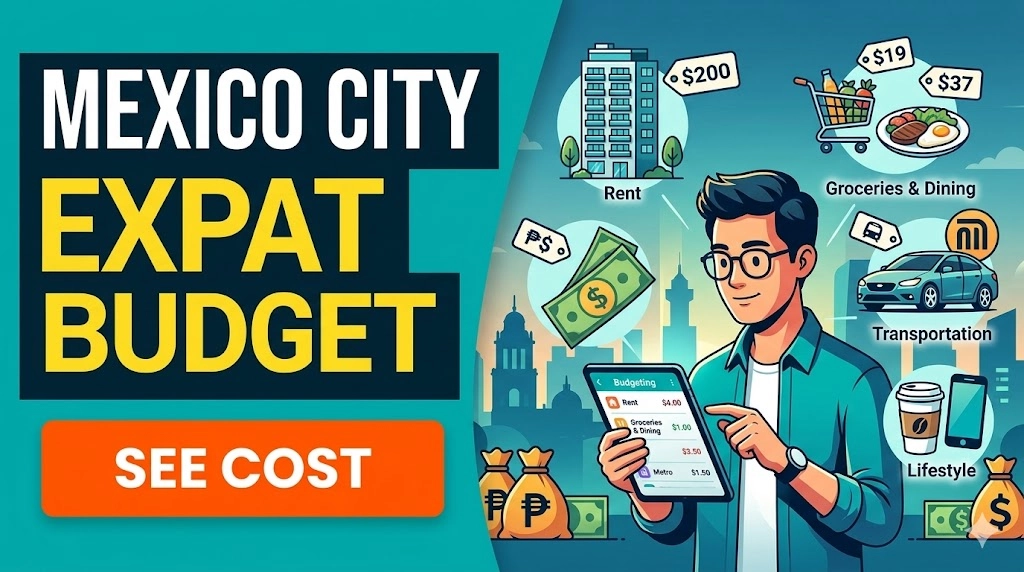
To contextualize the data, here are three realistic monthly budget profiles for a single expat living in Mexico City.
Profile 1: The “Lean Local” (Escandón / San Rafael)
This expat integrates deeply into the local culture, avoids the hyper-gentrified zones, cooks at home using neighborhood mercados, and relies exclusively on the Metro and EcoBici.
- Rent (Unfurnished 1BR): $650 USD
- Utilities & Internet: $45 USD
- Groceries: $250 USD
- Dining Out (Street food, Fondas): $150 USD
- Transportation: $40 USD
- Healthcare (Basic Expat Insurance): $120 USD
- Entertainment/Misc: $150 USD
- Estimated Monthly Total: $1,405 USD
Profile 2: The “Comfortable Remote Worker” (Roma Sur / Narvarte)
This is the standard digital nomad budget. They rent a modern, furnished apartment, enjoy high-speed internet, utilize a hybrid grocery strategy, take Ubers frequently, and enjoy the city’s vibrant nightlife and dining scene several times a week.
- Rent (Furnished 1BR/2BR): $1,300 USD
- Utilities & Internet (Plus Housekeeper 1x week): $120 USD
- Groceries (Supermarkets & Mercados): $400 USD
- Dining Out & Nightlife: $450 USD
- Transportation (Uber/DiDi): $150 USD
- Healthcare (Premium Global Insurance): $250 USD
- Entertainment/Gym/Misc: $300 USD
- Estimated Monthly Total: $2,970 USD
Profile 3: The “Luxury Corporate” (Polanco / Lomas de Chapultepec)
This expat expects a first-world, premium lifestyle with zero compromises. They rent a luxury condo with amenities, dine at high-end international restaurants, shop at premium imported supermarkets, and demand the highest tier of global financial and medical security.
- Rent (Luxury 2BR Condo): $3,200 USD
- Utilities, Internet, & Domestic Staff: $400 USD
- Groceries (City Market/Imported): $800 USD
- Dining Out (Fine Dining): $1,000 USD
- Transportation (Premium Uber/Private Driver): $400 USD
- Healthcare (Top-Tier Global Insurance): $400 USD
- Entertainment & Wealth Management: $800 USD
- Estimated Monthly Total: $7,000+ USD
| Expense Category | Lean Local | Comfortable Remote | Luxury Corporate |
| Housing Target | Escandón, San Rafael | Roma Sur, Narvarte | Polanco, Lomas |
| Dining Strategy | Fondas, Street Tacos | Trendy Cafes, Mid-range | Fine Dining, Tasting Menus |
| Transit Focus | Metro, EcoBici | Uber, DiDi | Uber Black, Private Driver |
| Wealth Mgmt | Cash/ATM Focus | Standard Banking | Interactive Brokers Global Mgmt |
| Transfer Tool | Wise | Wise | Institutional Wires |
Final Thoughts: The Cost of Global Citizenship
Mexico City is no longer just a “cheap place to live”—it is one of the most dynamic, culturally significant, and exciting metropolises on earth. The cost of living reflects its status as a premier global destination. You can still live here significantly cheaper than in New York, London, or Toronto, but you must be strategic.
If you attempt to blindly replicate your North American lifestyle, ignoring local infrastructure and banking realities, your budget will bleed out. By embracing local neighborhoods, optimizing your currency conversions with platforms like Wise, and protecting your long-term wealth securely through Interactive Brokers, you can unlock an unparalleled quality of life in the Aztec capital.
References
Primary sources (official)
- Banco de México (Banxico): Official monetary policy, historical inflation data, and exchange rate tracking. https://www.banxico.org.mx/
Other helpful sources
- Numbeo: Crowd-sourced, highly detailed real-time cost of living tracking for Mexico City. https://www.numbeo.com/cost-of-living/in/Mexico-City
- Expatistan: Cost of living calculator allowing direct comparisons between your home city and CDMX. https://www.expatistan.com/cost-of-living/mexico-city
Disclaimer
The information provided in this article is for educational and informational purposes only and does not constitute financial, investment, legal, or tax advice. Macroeconomic conditions, inflation rates, real estate markets in gentrified zones, and currency exchange rates are highly volatile and subject to rapid change. The budgets presented are estimates, and individual lifestyle choices will heavily dictate actual monthly expenditures. Always consult with a certified cross-border financial planner and a qualified tax professional before relocating, restructuring your assets, or making significant financial decisions. Ensure that any financial platforms or services mentioned meet your specific individual legal residency and compliance requirements.