How to Spot Counterfeit Mexican Pesos
You’re standing in a bustling tianguis in Guadalajara, the smell of sizzling al pastor fills the air, and you’ve just handed over a 500-peso bill for a beautiful hand-woven blanket. I still remember the cold prickle of anxiety I felt the first time a vendor squinted at my money, rubbed it between their fingers, and handed it back with a frown. This guide provides the deep, actionable knowledge you need to verify Mexican currency instantly, saving you from financial loss and legal headaches.
Disclosure: This post may contain affiliate links. We may earn a commission at no extra cost to you if you make a purchase through these links. Read full disclosure.
The Physicality of the Peso: Texture and Material
The first line of defense against counterfeit currency is your sense of touch. The Banco de México uses very specific materials that are difficult for small-scale counterfeiters to replicate. If a bill feels like the printer paper you use at home, or if it feels excessively "waxy," you should immediately be suspicious. Real bills have a structural integrity that survives being folded, tucked into pockets, and passed through thousands of hands.
Polymer versus Cotton Paper
Mexico uses two distinct materials for its banknotes. The lower denominations—the 20, 50, and 100 peso bills—are made of polymer, which is essentially a specialized plastic. These bills should feel smooth but slightly "grippy." They are very difficult to tear and will usually spring back to their original shape if you crumple them lightly in your hand. Counterfeits made of plastic often feel thicker or more brittle than the genuine article.
The higher denominations—the 200, 500, and 1,000 peso bills—are made of 100% cotton paper. This isn't the paper you find in a notebook; it has a crisp, fabric-like quality. When you snap a real paper bill between your hands, it should make a distinct "pop" or sharp clicking sound. Fakes often feel limp or "soft," similar to the texture of a napkin after it has been handled too much. Understanding these basics is essential for Currency Exchange in Mexico: Getting the Best Rates on Pesos because you need to know what you are receiving from the teller.
Tactile Relief and Raised Printing
One of the most reliable features to check is the "Relieve Sensible al Tacto" (tactile relief). On genuine bills, certain elements are printed with a thick ink that stands up off the surface. If you run your fingernail or the pad of your thumb over the main text (like "Banco de México") or the large denomination number, you should feel a clear, ridged texture.
In the newest G-family of bills, this relief is particularly prominent on the hero images and the side borders of the notes to help the visually impaired. If the bill is completely flat and smooth, it is almost certainly a fake. I’ve found that checking this relief becomes second nature after a few weeks of living here. Whether you are budgeting for a Monthly Budget in Mexico: Living Well on $1,500, $2,500, and $4,000 or just buying groceries, always give the bill a quick scratch with your thumb.
Visual Security Layers: What to See in the Light
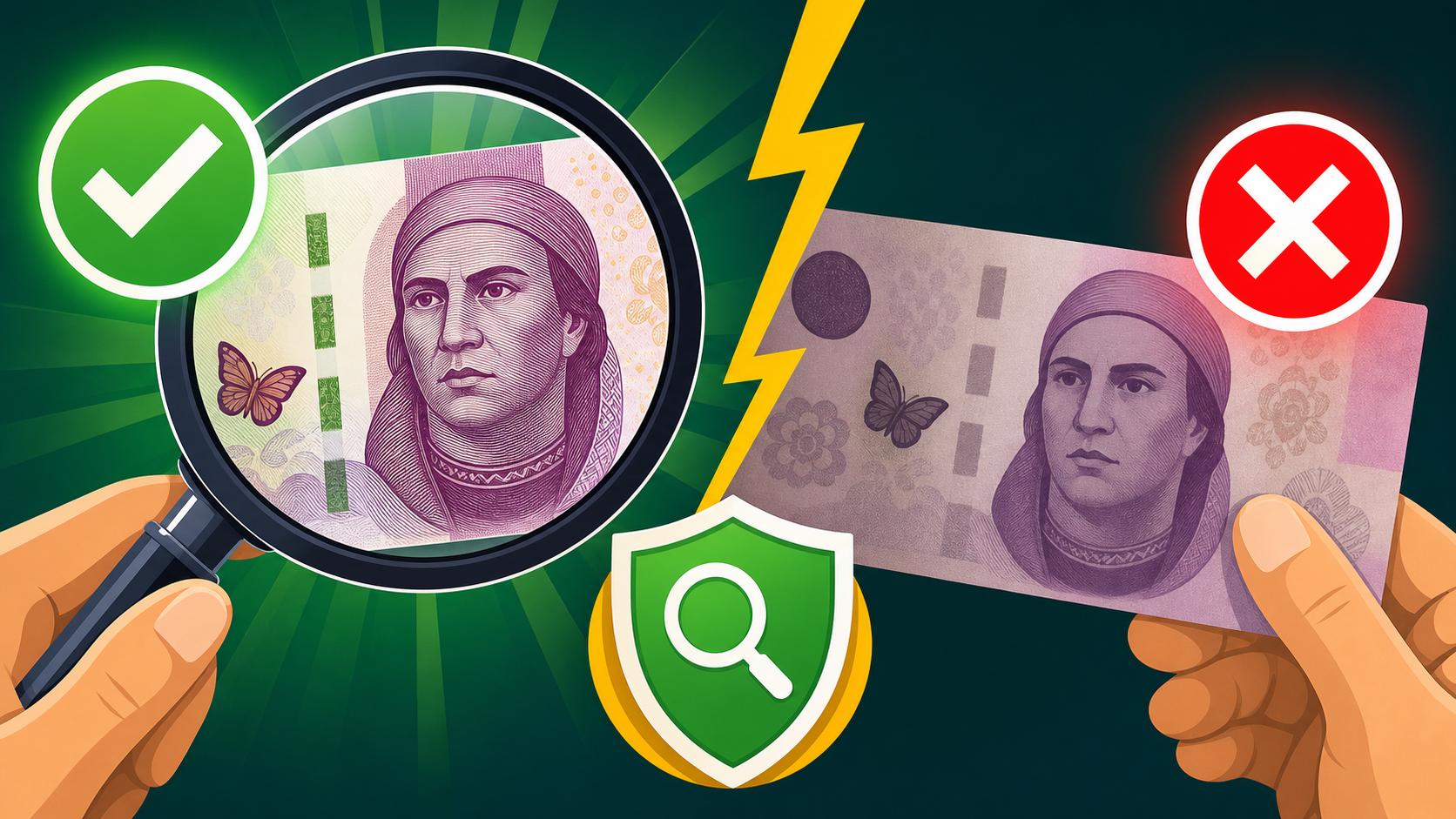
Once you’ve felt the bill, the next step is a visual inspection. Counterfeiters often get the colors "close enough" to fool a distracted person in a dark bar or a moving taxi, but they rarely get the internal visual security features right. Always try to look at your bills under a bright light or hold them up against the sun.
The Transparent Window and G-Family Elements
The polymer bills (20, 50, and 100 pesos) feature a transparent window. This isn't just a hole; it’s an integrated part of the polymer substrate. On the 50-peso "Axolotl" bill, which is currently a favorite among locals and collectors, the window contains complex designs that are part of the material itself. If you see a window that looks like it was cut out and had a piece of Scotch tape applied over it, it is a counterfeit.
In the 100-peso Sor Juana bill, which is vertical, the transparent window contains a "G" that changes color or reveals hidden patterns when viewed from different angles. This level of detail is incredibly expensive to reproduce. When I first arrived, I was worried about being rude by checking my change, but you will notice that almost everyone does it. It’s a standard part of Banking in Mexico: Complete Guide for Foreigners and general daily life to be diligent with cash.
Watermarks and Integrated Threads
For the paper bills (200, 500, and 1,000 pesos), the watermark is your best friend. When you hold a genuine bill up to the light, a ghostly image of the historical figure on the front should appear in the white space on the right. This image should be multi-tonal and highly detailed, not just a dark, blurry stamp on the surface.
Furthermore, look for the security thread. This is a vertical line that is woven into the paper, not printed on top. On many notes, this thread will contain micro-printing of the denomination. If you can peel the thread off with your fingernail, the bill is fake. This is a common issue when Using ATMs in Mexico: Avoiding Fees and Staying Secure, as occasionally compromised machines or "skimmer" groups might try to distribute high-quality fakes, though it is much rarer in official bank vestibules.
| Feature | Polymer Bills (20, 50, 100) | Paper Bills (200, 500, 1000) |
|---|---|---|
| Material | Smooth, plastic-like, hard to tear | Crisp, cotton-based, fabric feel |
| Primary Check | Transparent window with integrated designs | Watermark visible when held to light |
| Texture | Raised ink on denomination and text | Strong tactile relief on hero and borders |
| Security Thread | Typically not present (uses windows) | 3D "Hilo Dinámico" that moves |
| Color Shift | Integrated into the window or numbers | Dynamic ink that changes color when tilted |
Advanced Detection: Motion and Light
If you are still unsure after feeling the texture and looking at the watermark, you need to look for the "living" parts of the bill—the features that move or change as you manipulate the note.
Color Shifting Ink and Dynamic Threads
The Banco de México uses an optical variable ink on the denomination numbers of the higher-value notes. If you tilt a 500-peso bill, the number "500" should shift smoothly from green to blue (or similar color transitions depending on the series). This isn't a glittery effect; it’s a solid, metallic color change.
The most impressive feature is the "Hilo Dinámico" or Dynamic Thread. On the 200, 500, and 1,000 peso notes, this thread has small elements that appear to move when you tilt the bill up and down or side to side. It looks like magic, but it’s actually micro-optics. Counterfeiters usually try to mimic this with a simple holographic strip that doesn't actually "move" in a coordinated way. If you’re ever in doubt while Finding English-Speaking Doctors and Specialists in Mexico and paying a co-pay in cash, don't be afraid to take five seconds to tilt that bill.
UV Light and Hidden Fluorescence
While most expats won't carry a UV flashlight, many businesses in Mexico have them. Genuine Mexican pesos contain fluorescent fibers and inks that glow under ultraviolet light. The security thread and various patterns on the front and back of the bill will light up in bright yellows, greens, and reds.
If you are handling large amounts of cash—perhaps you are paying a deposit for a rental because you haven't had time to How to Open a Bank Account in Mexico: Requirements and Tips yet—it might be worth investing in a small UV pen. These pens usually have a marker end that reacts to the starch in wood-based paper (turning dark) and a UV light on the cap. Note that the "pen" part is less reliable on high-quality fakes, but the UV light is much harder to beat.
Practical Scenarios and Legal Procedures
Knowing how to spot a fake is only half the battle; knowing how to handle the situation is the other. The social etiquette of currency in Mexico is a bit of a dance. You want to be firm but polite.
What to Do If You Receive a Fake Bill
If a vendor or a taxi driver tries to hand you a bill that feels wrong, simply say, "¿Tendrá otro? Este se ve un poco raro" (Do you have another? This one looks a little strange). Avoid accusing them of being a scammer; often, they are victims themselves and didn't realize they had a fake. If you accept the bill and realize it’s fake later, do not try to spend it. This is a crime in Mexico and can lead to serious legal trouble.
I’ve seen newcomers try to "pass the buck" at a dark bar to get rid of a fake 200-peso note. If the police are called, you could face detention. Instead, if you received the fake from a bank or an ATM, you have a legal right to claim a refund. You must go to any branch of the same bank within five business days. They will take the bill, give you a receipt (Anexo 6A), and send it to the Banco de México for analysis. If they confirm it came from their machine, they will reimburse you. This is why Best Banks in Mexico for Expats: Comparing Fees and Services usually offer better customer service for these disputes.
Best Practices for Cash Handling in Mexico
To minimize your risk, try to limit the number of 500 and 1,000 peso bills you carry. These are the most commonly counterfeited because they offer the highest "profit" for the criminal. When you use services like Wise to transfer money to your local account, try to withdraw smaller denominations at the ATM. Some ATMs allow you to choose your bills; always opt for 100s and 200s if possible.
For larger expenses, like paying for private healthcare or legal fees, avoid cash entirely. Using digital platforms or Interactive Brokers to manage your funds and paying via SPEI (Mexico’s instant inter-bank transfer system) is significantly safer than carrying a wad of cash. Also, remember that Street Safety: Tips for Avoiding Pickpockets and Scams in Mexico starts with not flashing large bills in public. When you are out, keep a "small money" pocket for quick purchases like tacos or bus fare, and keep your larger bills tucked away. Being mindful of Avoiding Financial Scams: Common Tricks Targeting Expats will make your transition to life in Mexico much smoother.
Always be aware that "change scams" often involve a counterfeit bill. A common trick is for a person to ask you to break a 500-peso bill for them because "the bus driver won't take it." Almost 100% of the time, that bill is fake. Be helpful in other ways, but never exchange your hard-earned cash for a stranger's high-value bill. Your best bet is to stay informed, trust your gut, and keep practicing that "thumb-scratch" on every bill you touch. If you’re ever unsure about Tip Culture: How Much to Tip for Services (From Maids to Waiters), just remember that a genuine 20 or 50 peso bill is always appreciated more than a questionable 200.
Disclaimer
This guide is for informational purposes only and does not constitute legal or financial advice. Currency regulations and security features can change; always consult the official Banco de México website for the most current security updates. The author and publisher are not responsible for any financial losses or legal issues arising from the use of this information.