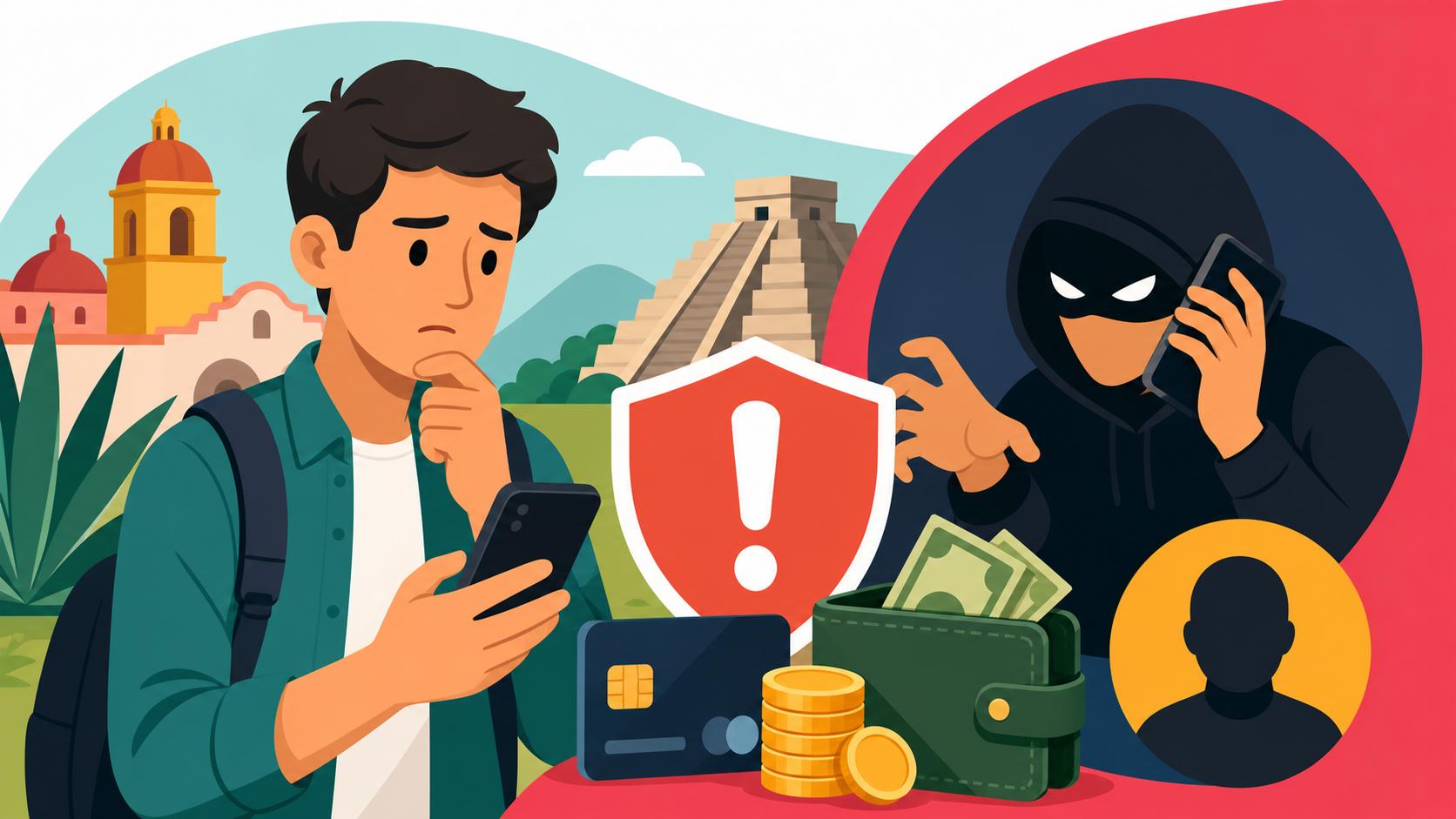
Avoiding Financial Scams: Common Tricks Targeting Expats
The first time I stood at a dusty ATM in a quiet corner of Mérida and realized my card wouldn't come out, my heart skipped a beat. I learned quickly that being an expat in Mexico means being a target for sophisticated financial predators who prey on our lack of local knowledge. This guide exposes the common tricks used to drain your accounts so you can protect your hard-earned savings.
Disclosure: This post may contain affiliate links. We may earn a commission at no extra cost to you if you make a purchase through these links. Read full disclosure.
The ATM and Credit Card Shell Game
One of the most frequent ways foreigners lose money in Mexico isn't through a dramatic heist, but through subtle, high-tech thievery at the point of sale or the cash machine. When you are still figuring out the difference between a 200 and a 500 peso note, your focus is often on the math rather than the machine itself. I have seen countless newcomers lose their entire travel budget because they didn't know what to look for at a standard terminal.
The Rise of the Sophisticated Skimmer
Skimming has evolved far beyond the clunky plastic overlays of a decade ago. Today, predators use "shimmers"—paper-thin devices inserted into the card slot that read the chip rather than the magnetic stripe. These are nearly impossible to detect with a simple tug on the card reader. They are often paired with a tiny, pinhole camera hidden in a fake brochure rack or a false ceiling panel above the keypad to record your PIN.
I always tell people that Using ATMs in Mexico: Avoiding Fees and Staying Secure starts with choosing the right machine. Avoid "standalone" ATMs in convenience stores, pharmacies, or on the street. These are the easiest for scammers to tamper with because they can be accessed without being seen by bank security. Instead, only use machines located inside a bank branch during business hours. Even then, I’ve made it a habit to vigorously shake the card entry point and cover the keypad with my other hand, regardless of how "safe" the neighborhood feels.
The Helpful Stranger and the Distraction Technique
This is a classic "veteran" warning because it relies on your natural tendency to be polite. You’re at the ATM, perhaps struggling with the Spanish prompts, and someone behind you points out that there’s a "trick" to the machine or claims you left your receipt. While you turn to talk to them, an accomplice—who was standing on the other side—quickly swaps your card for a dummy or uses a remote device to "loop" the transaction.
In other cases, a "helpful" local might tell you the machine is broken and offer to show you another one nearby, only to lead you to a rigged device. My rule is absolute: if anyone speaks to you while you are at a financial terminal, cancel the transaction immediately, take your card, and walk away. Don't worry about being rude. Real bank employees will never approach you at an ATM to "help" with a transaction. Learning about Banking in Mexico: Complete Guide for Foreigners will help you understand that formal banking procedures are quite rigid, and "helpful" sidewalk advice is almost always a red flag.
Dynamic Currency Conversion Scams
While not "illegal" in the traditional sense, Dynamic Currency Conversion (DCC) is a legal scam that drains millions from expats every year. When you use a foreign card at a Mexican ATM or restaurant, the screen will often ask if you want to "Accept the conversion" to your home currency (USD, CAD, or EUR). The screen makes it look like a convenience, showing you exactly how much will be deducted from your home account.
What they don't tell you is that the exchange rate offered by the ATM or the card terminal is often 5% to 10% worse than the actual market rate. If you hit "Accept," you are voluntarily giving away dozens of dollars per transaction. Always hit "Decline Conversion" or "Proceed in Local Currency." Your home bank or a service like Wise will always give you a better rate than the Mexican terminal. Understanding Using Credit and Debit Cards in Mexico: What Expats Need to Know is vital to keeping these small leaks from sinking your monthly budget.
Rental and Real Estate Red Flags
The housing market in Mexico is a bit of a Wild West. Without a centralized "MLS" system in many regions, expats often rely on Facebook Marketplace, Craigslist, or local "Se Renta" signs. This lack of transparency is a playground for fraudsters who know that people moving from abroad are often desperate to secure a home before they arrive.
The Ghost Listing and the Urgent Deposit
This is the most common heartbreaker I see in the expat community. You find a gorgeous condo in Playa del Carmen or a colonial home in San Miguel de Allende at a price that seems just a little too good to be true. The "owner" or "agent" tells you they are currently out of the country—often claiming to be a missionary, a doctor, or an expat who had to return home for an emergency. They tell you there are five other people interested, but if you send a "holding deposit" via wire transfer, they will take it off the market and mail you the keys.
Once the money is sent, the listing vanishes, the phone number is disconnected, and you discover the address was actually a vacation rental or a house that isn't even for rent. I cannot stress this enough: Never, under any circumstances, send money for a property you or a trusted representative has not physically entered. Reading through Avoiding Rental Scams: Tips to Identify Legitimate Listings in Mexico should be your first step before even browsing the web for a new home.
Fideicomiso and Title Fraud
For those looking to buy, the stakes are much higher. In the "Restricted Zone" (near the coast and borders), foreigners must use a bank trust called a fideicomiso. Scammers sometimes pose as lawyers or "gestores" who promise to expedite this process for a cash fee. They might produce official-looking documents that are actually clever forgeries.
I’ve seen expats "buy" property from someone who didn't actually own it, or from a family where only one member agreed to the sale while the others held legal claims. Always use a reputable notario (notary public)—who in Mexico is a high-level government-appointed lawyer—to verify the title. Don't just take the seller's word for it. Using Renting a Home in Mexico: Complete Expat Guide to Leases, Deposits, and More as a baseline for legal expectations will help you spot when a "professional" is cutting corners.
| Scam Type | Common Platform | Warning Sign |
|---|---|---|
| Ghost Rental | Facebook / Craigslist | Price is 30% below market; owner is "out of country" |
| ATM Skimming | Standalone / Street ATMs | Loose card reader; weird plastic overlays |
| WhatsApp Hijack | Direct Message | Friend asking for an "emergency" transfer or code |
| Fake Utility Bill | Email / SMS | Urgent threat of "cutting power" with a link to pay |
| Investment "Hole" | Social Groups | "Guaranteed" 15-20% annual returns |
Digital and Social Engineering Threats
As the world goes digital, so do the crooks. Mexico has seen a massive spike in "Vishing" (voice phishing) and WhatsApp-based scams. These rely on the fact that expats are often navigating a sea of new administrative requirements and might be easily spooked by the threat of legal trouble.
The Fake Government Official or CFE Threat
You get a call or a very official-looking email. The person on the other end claims to be from the SAT (the Mexican IRS), Immigration (INM), or the CFE (the electric company). They claim there is an "irregularity" with your residency or an unpaid bill that is about to result in your immediate deportation or your power being cut within the hour. They then offer a "solution": pay a fine immediately via a convenience store like OXXO or through a specific wire transfer link.
These predators are experts at creating a sense of panic. They might even have some of your personal details, which they've scraped from public records or social media. Real Mexican government agencies will almost never call you to demand immediate payment over the phone. If you're worried about your finances, check out Managing Your Money in Mexico: Budgeting, Saving, and Currency Tips to learn how to verify your actual debts through official channels. If you use a transparent service like Wise for your bill payments, you can often track your transfers and verify where your money is actually going.
The "Grandchild" or "Friend in Trouble" WhatsApp Scam
Because we are far from our families, we are vulnerable to emotional manipulation. A common trick involves a scammer hijacking a friend's WhatsApp account (often by tricking them into giving up a verification code). The scammer then messages everyone in the contact list saying they've been in a car accident or are stuck at the Mexican border and need money for a "fianza" (bail) or a "mordida" (bribe) to be released.
They will beg you not to call them because their "phone is broken" or they are "in a quiet area." If you get a message like this, stop. Call the person on their regular phone line or through a different app. Ask a question only the real person would know. Scammers thrive on the "emergency" nature of the request. Take a breath and realize that Transferring Money Internationally: Best Ways to Send Money to/from Mexico should only ever be done through verified, secure platforms to people you have personally verified.
Investment Fraud and "Too Good to Be True" Returns
Expat enclaves are often tight-knit communities where word-of-mouth is the primary way information travels. Unfortunately, this makes them the perfect breeding ground for affinity fraud. This is where a scammer joins the local golf club, volunteers at the charity bazaar, and becomes everyone's "friend" before mentioning a "private investment opportunity."
The Local "Investment Guru"
I’ve seen it happen in Lake Chapala and San Miguel time and again. A charismatic individual offers "guaranteed" returns on a local real estate development, a tequila brand, or a private lending pool. They often promise 15% to 20% annual returns, which far exceeds what you’d get in a standard brokerage account. For the first few months, they might even pay out "dividends" to build trust—using money from new investors.
When you're looking for Investing in Mexico: Opportunities in Real Estate, Stocks, and Beyond, stick to regulated, international platforms. For my serious long-term savings, I rely on established entities like Interactive Brokers. They provide the regulatory oversight and security that a "friend of a friend" in a beach bar simply cannot offer. If an investment isn't registered with the CNBV (the Mexican equivalent of the SEC), you have zero legal recourse when the "guru" disappears to a different beach.
The "Gestor" Who Can "Fix" Anything
In Mexico, a gestor is someone who helps you navigate bureaucracy. While many are legitimate and helpful, the term is also used by scammers who claim they can get you a "special" bank account, a faster residency card, or a tax exemption for a large under-the-table fee. They might tell you that because you are a foreigner, you need "special processing" that only they can provide.
Always double-check the requirements yourself. For example, How to Open a Bank Account in Mexico: Requirements and Tips are fairly standard across major banks. If a gestor tells you that you don't need a CURP or a valid visa to open an account "if you pay them a fee," they are lying. You will likely end up with a frozen account or, worse, find your identity has been stolen to facilitate money laundering.
How to Protect Your Wealth in Mexico
Protecting yourself doesn't mean living in fear; it means building a "financial moat" around your life. After years here, I've developed a system that has kept my accounts safe through every move and major purchase. It starts with diversifying where you keep your money and being skeptical by default.
Use Secure Digital Tools
Don't keep all your money in one Mexican bank account. I keep my primary savings in a high-security international brokerage like Interactive Brokers and only transfer what I need for my monthly expenses into my Mexican account. For the actual movement of money, I use Wise because their transparent fee structure and real-time alerts mean I know exactly when my money arrives and at what rate. If I see a transaction I don't recognize, I can freeze my digital cards instantly.
Build a Trusted Local Network
Instead of trusting the person who approaches you, seek out professionals with deep roots in the community. Ask for recommendations for accountants and lawyers from established expat organizations, not just from people you met at a bar yesterday. When you understand Best Banks in Mexico for Expats: Comparing Fees and Services, you can choose institutions that have robust fraud departments and English-speaking support.
Ultimately, your best defense is a "cool head." Scammers in Mexico rely on two things: your desire for a "bargain" and your fear of "trouble." If you remove those two emotional triggers from your financial decisions, you become a very difficult target. Mexico is a wonderful place to live, but it rewards the vigilant and the well-informed.
Disclaimer
The information provided in this article is for educational and informational purposes only and does not constitute professional financial, legal, or investment advice. Always consult with a qualified professional or the relevant government authorities before making significant financial decisions in Mexico. Laws and scam tactics change frequently; verify all information through official channels.