Online Banking in Spanish: Overcoming Language Barriers in Finance
You’ve just opened your BBVA, Banorte or Santander app, and it greets you with “Alta de cuenta,” “Clave de rastreo” and “Cargo no reconocido.” You need to pay rent today, and one wrong tap could send pesos to the wrong account. This guide translates the vocabulary, walks you through the most common banking tasks, and shows you how to bank confidently with limited Spanish.
Disclosure: This post may contain affiliate links. We may earn a commission at no extra cost to you if you make a purchase through these links. Read full disclosure.
Why Mexican Online Banking Feels Harder Than It Should
I remember my first month in Mexico City. I stood outside a BBVA branch in Roma Norte with my phone in one hand and a translation app in the other. I was trying to work out whether “Disposición” meant a withdrawal, a deposit or something worse. The answer was a cash withdrawal from a credit line, and that came with charges. Nobody warns you about that.
If you feel slow or embarrassed when you bank in Spanish, you’re doing nothing wrong. The system was never designed with you in mind.
Most Bank Apps Are Built for Spanish Speakers First
Mexican banks build their apps for Mexican customers, which makes sense. Some apps offer partial English menus. Even then, the translation often stops at the main screen. Transaction histories, error messages, security alerts and legal notices usually stay in Spanish. You might find the “Transfers” button in English, then land on a confirmation screen that’s fully in Spanish and wants a “token dinámico.”
The fintech players covered in Mexican Fintech and Digital Banks (Nu, Klar, and More) tend to have cleaner, simpler interfaces. They’re often easier to learn even when everything is in Spanish. The traditional banks compared in Major Banks in Mexico: BBVA, Banorte, and Santander Compared pack far more products onto every screen, so there are more chances to tap the wrong thing.
Banking Spanish Is Its Own Dialect
Your conversational Spanish might be good enough to order tacos al pastor and chat with your landlord. Banking Spanish is different. It’s formal and abbreviated, and it’s full of words that mean something else in daily life. “Movimientos” means movements, but on your app it means transactions. “Plaza” isn’t a town square, it’s a location code. “Concepto” isn’t a concept, it’s the payment description. Abbreviations like “SPEI,” “CEP,” “NIP” and “CLABE” make it worse.
The Stakes Feel High Because They Are
A mistranslated menu is annoying. A mistyped account number on a rent payment is a real problem. SPEI transfers move fast, and getting money back from the wrong recipient can mean a formal claim with your bank. That’s why the rest of this guide sticks to practical steps and checks rather than vocabulary drills.
The Essential Mexican Banking Vocabulary
Before you touch a single button, learn the words below. I kept a printed version taped inside a kitchen cupboard for my first six months, and I’m not ashamed of it.
Core Terms You Will See Every Week
| Spanish Term | What It Actually Means | Where You See It |
|---|---|---|
| Saldo | Account balance | Home screen |
| Movimientos | Transaction history | Account details |
| Transferir / Transferencia | Send money / a transfer | Main menu |
| Alta de cuenta / Agregar beneficiario | Register a new recipient | Before your first transfer to someone |
| Cuenta destino | Recipient account | Transfer form |
| Concepto de pago | Payment description | Transfer form |
| Referencia numérica | Numeric reference, usually up to 7 digits | Transfer form, bill payments |
| Clave de rastreo | Tracking key for a SPEI transfer | Transfer receipt |
| Comprobante | Receipt or proof of payment | After any transaction |
| Estado de cuenta | Monthly statement | Documents section |
| NIP | Your card PIN | Card settings, ATMs |
| Token / Clave dinámica | One-time security code | Confirming transfers |
| Retiro sin tarjeta | Cardless ATM withdrawal | Cash menu |
| Domiciliación | Direct debit or automatic payment | Bill payments |
| Comisión | Fee or charge | Statements, confirmations |
| Cargo no reconocido | Unrecognized charge | Dispute menu |
| Aclaración | Formal dispute or claim | Customer service |
| Disposición de efectivo | Cash advance, usually from a credit card | Credit card menu |
Understanding Account Numbers Without Panic
This is where newcomers get muddled, so let’s be precise. A Mexican bank account usually has three different numbers attached to it:
- The account number (número de cuenta). It’s often 10 or 11 digits, depending on the bank, and it’s used for transfers within the same bank.
- The card number (número de tarjeta). This is the 16-digit number on your debit card. Some apps let people send money to it directly.
- The CLABE. This is the standardized interbank number, and it’s always exactly 18 digits. The first 3 digits identify the bank, the next 3 identify the location (plaza), the next 11 are the account number, and the final digit is a check digit.
If someone hands you a “CLABE” that isn’t 18 digits long, stop. It’s a typo, a different number, or a red flag. For the full breakdown, read What Is a CLABE? Understanding Mexican Bank Account Numbers.
Here’s a practical trick: when you type a CLABE into most Mexican banking apps, the app recognizes the first three digits and fills in the receiving bank’s name on its own. If you meant to pay your landlord’s Banorte account and the app shows “Santander,” you’ve made a typo.
Identity and Tax Terms That Show Up in Banking
Banks will also ask for your CURP, an 18-character alphanumeric population registry code. Some products, invoices and accounts also ask for your RFC, the tax ID. When an app asks for your “Constancia de situación fiscal,” it means the tax status certificate from the SAT. If you’re self-employed or receive facturas, you’ll see these terms constantly. See Facturas and Electronic Invoicing (CFDI) in Mexico for how they connect to your banking.
Step-by-Step: Doing the Most Common Tasks in Spanish
Let’s work through the tasks that cause the most stress, one tap at a time. Menu names vary between banks, but the logic is nearly identical across the system.
Registering a New Recipient and Sending a SPEI Transfer
Picture this: your landlady in Guadalajara has texted you her CLABE on WhatsApp and wants the rent by the 5th. Here’s how it usually goes:
- Open the app and look for Transferir or Enviar dinero.
- Choose Otros bancos if the recipient banks somewhere else, or Mismo banco if they bank with your bank.
- Select Agregar cuenta, Nuevo contacto or Alta de beneficiario.
- Type the 18-digit CLABE. Check that the bank name the app fills in matches the recipient’s bank.
- Enter the Nombre del beneficiario, meaning the full name of the account holder, ideally exactly as they gave it to you.
- Add an alias if the app offers one, such as “Renta Doña Lupita,” so you can recognize the recipient later.
- Confirm with your token or clave dinámica. Some banks impose a waiting period before a newly registered recipient can receive large amounts, so register people a few days before you need to pay them.
- When you send money, fill in Monto, the amount, and Concepto, the description. Write “Renta marzo” or something just as clear.
- Add a Referencia numérica if the recipient asked for one. Otherwise, any short number usually works.
- Review the confirmation screen, approve the transfer, and save the Comprobante. It includes the Clave de rastreo.
Our dedicated walkthrough, How to Make a SPEI Transfer in Mexico, covers the edge cases, such as transfers outside banking hours or to accounts at small regional banks.
Tracking a Transfer That “Never Arrived”
Every expat has had this text: “No me ha llegado.” It hasn’t arrived. Before you panic, do this:
- Open your transaction history (Movimientos) and confirm the transfer shows as Liquidada or Aplicada, meaning completed, rather than Rechazada, meaning rejected.
- Find the Clave de rastreo on your receipt.
- Use the Banco de México tool for SPEI receipts, called CEP, or Comprobante Electrónico de Pago. Enter the date, the tracking key, the sending bank, the receiving bank, the CLABE and the amount.
- If the CEP shows the money was delivered, send the PDF to the recipient. It’s the official proof, and it ends most disputes.
- If the transfer was returned (Devuelta), the CLABE or the name probably didn’t match. Check both with the recipient.
Disputing a Charge You Do Not Recognize
You spot a charge from a merchant you’ve never heard of, in a city you’ve never visited. Here’s the sequence:
- Tap the transaction in Movimientos.
- Look for No reconozco este cargo, Cargo no reconocido or Aclaraciones.
- Block the card right away using Bloquear tarjeta or Apagar tarjeta. Most apps let you switch a card off temporarily.
- Fill out the dispute form. A simple sentence such as “No realicé esta compra” (“I did not make this purchase”) is enough.
- Write down the folio, the case number. You’ll need it for every follow-up.
- If the bank doesn’t resolve the dispute fairly, you can take a complaint to Condusef, the federal financial consumer protection agency.
If you’re still choosing a bank and want to avoid this stress altogether, look at how responsive and clear each bank’s dispute process is. We cover that in How to Open a Bank Account in Mexico: Requirements and Tips.
Tools and Strategies That Close the Language Gap
Vocabulary gets you started. Strategy lets you bank without dread.
Using Translation Apps Without Getting Burned
Camera translation, where you point your phone at another phone’s screen, is surprisingly useful for one-off confusing screens. Its weakness is context. A translation app might render “Disposición” as “Disposal” or “Provision,” and neither tells you that it’s a cash advance that could cost you money.
My rule: use translation apps to understand a screen, never to decide whether to approve something you still don’t understand. If the translated text still feels vague, close the app and call the bank. For which tools handle formal Spanish best, see Using Translation Apps in Mexico: What Works Best.
One more tip: take screenshots of every screen the first time you do a new task. Next time, you’ll have your own illustrated manual, with your notes in English.
Calling the Bank and Visiting a Branch
Bank phone lines usually start with an automated Spanish menu. Common prompts include “Marque uno para…” (“Press one for…”), “tarjeta de débito,” “aclaraciones” and “hablar con un ejecutivo” (“speak to a representative”). Some banks offer English-speaking support in some form, but don’t assume they will, especially outside major cities.
Here’s a script I’ve used many times:
- “Buenas tardes, soy cliente y mi español es limitado. ¿Me puede hablar despacio, por favor?” (“Good afternoon, I’m a customer and my Spanish is limited. Could you speak slowly, please?”)
- “Quiero hacer una aclaración sobre un cargo.” (“I want to file a dispute about a charge.”)
- “¿Me puede dar el número de folio?” (“Can you give me the case number?”)
At a branch, ask for an ejecutivo de cuenta, an account representative. Branches in expat-heavy areas like Polanco, Condesa, Puerto Vallarta’s Zona Romántica, Ajijic and San Miguel de Allende are more likely to have English-speaking staff. Bring your passport and residency card, and expect to wait.
Security Phrases That Protect You From Scams
Scammers love the language gap. A common trick is a phone call from “your bank” in rapid Spanish, with urgent warnings and a request for your NIP or your token code. Learn these phrases by heart:
| Phrase You Might Hear or Read | What It Means | What You Should Do |
|---|---|---|
| Nunca te pediremos tu NIP | We will never ask for your PIN | Remember it whenever someone asks |
| Proporcione su código de seguridad | Give us your security code | Hang up, it’s almost always a scam |
| Su cuenta ha sido bloqueada | Your account has been blocked | Check in the app directly, not through the link |
| Actualice sus datos | Update your details | Ignore links in SMS or email |
| Movimiento inusual detectado | Unusual activity detected | Open the app yourself and check |
When in doubt, hang up and call the number printed on the back of your card. For more tactics fraudsters use on foreigners, read Avoiding Financial Scams: Common Tricks Targeting Expats.
Reducing How Much Spanish Banking You Need
Plenty of expats don’t do everything through a Mexican bank. They use a mix of services, so the Spanish-language part of their finances stays small and manageable.
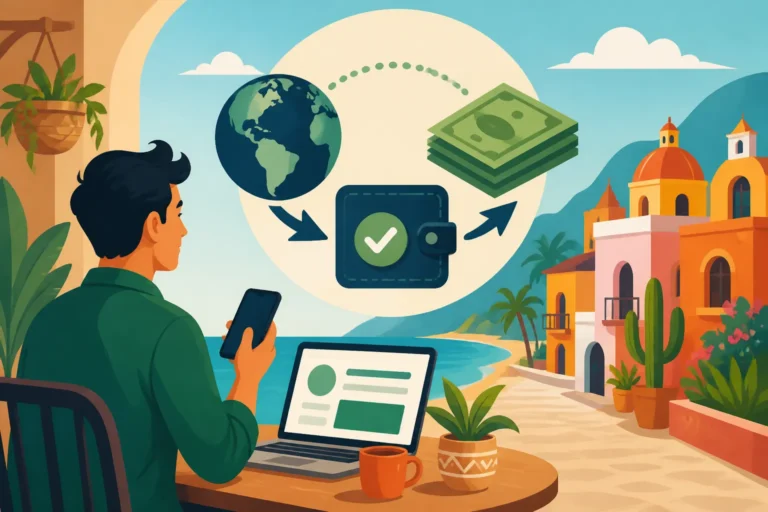
Many people moving money in from abroad use Wise for the conversion leg, partly because its interface is in English. They send pesos from a Wise balance straight to a Mexican CLABE and only use their Mexican bank app to receive money and pay local bills. Wise’s fees and exchange rates change, so check its own pricing page for current figures instead of relying on a forum post from three years ago.
For investments, some foreign residents keep an account with Interactive Brokers. Its platform runs in English, and it saves them from working through a Spanish-only brokerage onboarding process. Account eligibility and the products available depend on your country of residence and citizenship. Check Interactive Brokers’ own pages for what applies to you, and see Investing From Mexico: Brokerages and CETES for how local options compare.
Here are the pros and cons of this hybrid approach:
| Approach | Pros | Cons |
|---|---|---|
| Everything at a Mexican bank | One app, local cards, easy rent and bill payments | Steepest language curve, Spanish-only alerts |
| Hybrid with an English-language transfer service | Easier international transfers, clearer interface | Two apps to manage, transfer limits to learn |
| English-language brokerage for investing | Familiar platform and documents | Tax reporting can get complex, eligibility varies |
Even with a hybrid setup, you’ll still need a Mexican account for daily life. Wise or Interactive Brokers won’t help you dispute a charge at your local Oxxo or set up domiciliación for your CFE electricity bill.
Building Banking Spanish Over Time
The real long-term fix is learning the language, at least the narrow slice you actually need. You don’t need fluency to bank comfortably. You need about fifty words and a handful of phrases you can say confidently on the phone.
A tutor can roleplay a bank call with you, a dispute or a branch visit in a single lesson. That kind of targeted practice makes the next real call far less frightening. Our overview, Learning Spanish With an Online Tutor: The Complete Platform and Cost Guide, explains how to find someone who will build lessons around exactly this. Meanwhile, keep a small notebook of every new term your bank throws at you. Within a few months, that cupboard-door cheat sheet will feel unnecessary.
Banking in a second language is humbling, but it gets easier faster than you’d expect. Learn the core words, follow the step-by-step routines, keep your receipts and tracking keys, and never approve a screen you don’t understand.
Disclaimer
This article is for general informational purposes only and does not constitute professional advice. Laws, prices and regulations vary by location and change over time. Consult a qualified professional for guidance on your specific situation.