Monthly Budget in Mexico: Living Well on $1,500, $2,500, and $4,000
Trying to stretch a fixed dollar income while watching the Mexican peso strengthen is a terrifying recipe for financial burnout. I remember staring at a grocery receipt during my first year, paralyzed by the realization that my North American habits were destroying my budget. This guide breaks down realistic monthly budgets, ensuring you can thrive in Mexico without financial panic.
Disclosure: This post may contain affiliate links. We may earn a commission at no extra cost to you if you make a purchase through these links. Read full disclosure.
The Core Elements of a Mexican Budget
Housing Rent and Hidden Maintenance Fees
Your monthly rent is the single largest variable in your Mexican budget, and it dictates the financial reality of your entire lifestyle. The real estate landscape across popular expat hubs has fractured dramatically. Gentrified coastal cities like Tulum or Puerto Vallarta now demand rental rates that rival mid-sized American cities, while inland colonial towns remain surprisingly affordable. When budgeting, you must recognize that finding a cheap local lease requires hitting the pavement, speaking Spanish, and securing a local guarantor, rather than relying on the convenience of the internet.
The most dangerous financial trap for a new arrival is relying entirely on short-term rental platforms for long-term housing. While these apps provide a soft landing, their built-in service fees and inflated nightly rates will absolutely decimate your housing budget. To live sustainably, you must secure a traditional twelve-month lease. However, standard Mexican leases usually require a massive upfront cash deposit, and traditional banks make transferring these large sums internationally a nightmare. We dive deeply into navigating these initial housing logistics in Renting a Home in Mexico: Complete Expat Guide to Leases, Deposits, and More.
Furthermore, you must budget for the hidden costs of property maintenance that landlords rarely advertise. If you rent a modern condo in a gated community, you will be responsible for a monthly maintenance fee for security and pool upkeep. You must also furnish the apartment yourself, as “unfurnished” in Mexico often means lacking appliances, light fixtures, and even kitchen cabinets. If you fail to account for these initial setup costs and monthly maintenance fees, your carefully planned budget will collapse within the first thirty days.
Healthcare Insurance and Out of Pocket Costs
One of the most profound culture shocks for retirees and expats is realizing that their home-country health coverage, including Medicare, is completely useless the moment they cross the border. You must build a localized healthcare budget from scratch. Fortunately, routine medical care in Mexico is highly affordable. Paying out-of-pocket for general practitioner visits, routine dental cleanings, and generic prescriptions will rarely strain a middle-class budget, allowing many expats to effectively self-insure for day-to-day ailments.
However, relying entirely on cash for catastrophic medical emergencies is a massive, unjustifiable gamble. A sudden cardiac event or a complex orthopedic surgery in a top-tier Mexican private hospital can quickly rack up bills exceeding fifty thousand dollars. Private Mexican hospitals operate strictly on a “pay before you play” model, demanding massive upfront deposits before they will admit you. To protect your savings, you must allocate a portion of your monthly budget to a comprehensive international health insurance premium.
Factoring in a monthly premium of two hundred to six hundred dollars for a global insurance policy is non-negotiable for responsible expats. This policy acts as your ultimate financial shield. Understanding how to balance these high-deductible safety nets with cheap daily cash expenditures is the key to medical peace of mind. For a granular breakdown of what specific procedures actually cost, review Healthcare Costs in Mexico: Doctor Visits, Hospital Stays, and Surgery Expenses.
Navigating Currency Volatility and Exchange Rates
Your true cost of living in Mexico fluctuates daily based on the strength of your home currency against the Mexican Peso. If your entire income is in US Dollars or Euros, a strong peso essentially acts as a massive, invisible pay cut, eroding your local purchasing power overnight. To survive this volatility, you must brutally minimize the fees you pay to access your own money. Relying on traditional retail banks to wire your living expenses exposes you to terrible exchange rate spreads.
To instantly plug this massive leak in your budget, modern expats route their monthly income through Wise. By initiating a transfer through Wise, you guarantee that your home currency is converted at the transparent, true mid-market exchange rate. The funds are then deposited directly into your Mexican account via the local domestic network, completely bypassing the international banking system and its exorbitant fees. This single financial adjustment stretches your budget further than any coupon ever could.
You must also separate your long-term wealth from your daily operational cash. While you need pesos to pay rent, keeping your entire life savings in a vulnerable emerging market currency is extremely risky. Savvy expats keep their primary retirement portfolios denominated in hard currency using global platforms like Interactive Brokers. By maintaining your true wealth abroad and only converting what you need for the month, you insulate your future from localized economic shocks. We explore this macro-level planning in Should Expats Keep Savings in Pesos or Dollars? Managing Currency Risk.
Surviving and Thriving on 1500 Dollars a Month
Housing Realities for Budget Expats
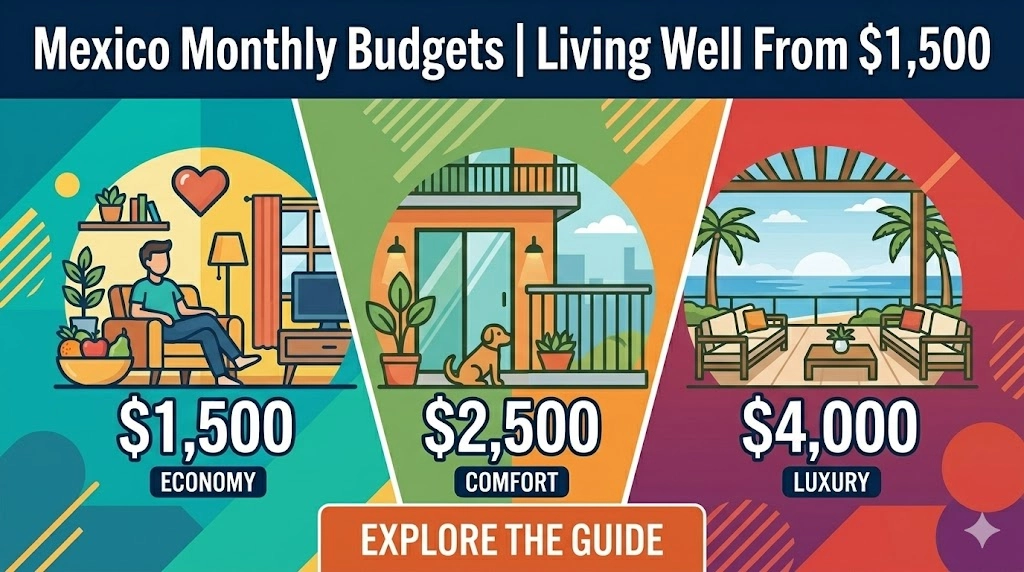
Living well on $1,500 a month in Mexico is absolutely achievable in 2026, but it requires a fundamental shift in your expectations and geographic targets. You must completely abandon the idea of living in a trendy, English-speaking beachfront enclave. Instead, budget expats look to working-class, mid-sized inland cities like Guanajuato, Xalapa, or the non-touristy outskirts of Oaxaca. In these authentic Mexican towns, a modest, one-bedroom apartment or a small casita can still be secured for $400 to $600 a month.
At this price point, you are renting like a local. Your apartment will not have central air conditioning, a dishwasher, or an English-speaking concierge. You will likely rely on ceiling fans, wash your dishes by hand, and buy your cooking gas from a truck that drives through the neighborhood. Embracing this simpler, slightly more labor-intensive lifestyle is the direct trade-off for a remarkably low monthly overhead.
To secure these local prices, you cannot rely on international wire transfers that incur hefty fees. You must pay your landlord in pesos. By using Wise to transfer your rent money, you avoid the predatory markups of traditional banks, keeping your tight $1,500 budget intact. Protecting every single dollar is mandatory when your margins are this narrow, a strategy we detail extensively in Cost of Living in Mexico: 2026 Comprehensive Guide.
Eating Like a Local to Save Thousands
The secret to thriving on a budget of $1,500 a month lies almost entirely in your dietary habits. If you insist on buying imported European cheeses, American peanut butter, and specialized vegan meat substitutes at corporate supermarkets, your food budget will quickly exceed North American prices. To survive, you must abandon the massive grocery chains and embrace the local agricultural rhythms.
Your primary source of food must become the neighborhood indoor market and the weekly open-air street markets. By shopping at these bustling local hubs, you can buy massive bags of fresh, seasonal produce, locally butchered meat, and warm tortillas for a fraction of what they cost at a supermarket. A single person can eat exceptionally well on a grocery budget of $200 a month if they strictly adhere to local ingredients and traditional recipes.
Dining out is also highly viable on this budget, provided you eat where the locals eat. Small, family-run diners offer fixed-price, multi-course lunches for three to five dollars. These hearty, homemade meals are an incredible value and a wonderful way to integrate into your new community. Understanding the economics of these neighborhood vendors is a skill we break down in Grocery Shopping in Mexico: Supermarkets vs Local Markets.
Public Transit and Affordable Healthcare
Owning a vehicle is generally out of the question on a $1,500 monthly budget. The costs of annual registration, mandatory insurance, and inevitable suspension repairs caused by massive speed bumps will drain your cash reserves rapidly. Instead, budget expats rely entirely on public transportation and walkability. Local buses and shared minivans cost mere pennies, and occasionally utilizing an Uber for a heavy grocery haul is highly affordable.
For healthcare, expats on this budget often choose to self-insure for daily needs and rely on the incredibly cheap consultation rooms attached to local pharmacies for minor ailments like a cold or a basic infection. A consultation at one of these clinics often costs less than three dollars. However, this leaves a terrifying gap for catastrophic care.
To bridge this gap, legal residents on a tight budget often apply for the IMSS public healthcare system. While the public system suffers from long wait times and heavy bureaucracy, it provides a massive safety net for surgeries and chronic care at an incredibly low annual premium. Navigating this localized public option is crucial for budget survival, as outlined in Choosing Private Health Insurance: Local Mexican Plans vs International Coverage.
The Comfortable 2500 Dollar Expat Standard
Upgrading to Modern Housing and Amenities
A monthly budget of $2,500 represents the classic, comfortable expat standard. At this tier, you are no longer forced into austere living conditions. You can comfortably afford a modern, two-bedroom apartment in a highly desirable, safe neighborhood in cities like Mérida, Querétaro, or the residential zones of Puerto Vallarta. Rent in this tier typically ranges from $800 to $1,200 a month, depending on your proximity to the historic center or the beach.
With this budget, your home will likely feature modern amenities that North Americans take for granted, such as dedicated high-speed fiber-optic internet, pressurized water systems, and mini-split air conditioning units in the bedrooms. You can afford to live in a building with a shared swimming pool, a small gym, and 24-hour security guards, which drastically increases your overall peace of mind and quality of life.
However, upgrading to air conditioning introduces a new budgetary threat: the national electricity grid’s high-consumption penalty. Running your AC units all day will strip away your government subsidies, resulting in electricity bills that can exceed two hundred dollars a month. Managing your climate control effectively becomes a necessary skill to prevent utility bills from consuming your disposable income.
The Hybrid Grocery Strategy and Dining Out
With a $2,500 budget, your culinary options expand significantly. You no longer have to rely exclusively on the local street markets. Most expats in this tier adopt a hybrid shopping strategy. They still purchase their fresh produce and basic proteins at the local market to save money, but they supplement their diet with trips to mid-tier supermarkets like Walmart or Soriana to purchase paper goods, cleaning supplies, and occasional imported comfort foods.
This budget also allows for a highly active social life. You can comfortably afford to dine out at mid-range, sit-down restaurants two or three times a week. A nice dinner for two, including appetizers, main courses, and a couple of craft cocktails or glasses of wine, typically runs between $30 and $50 USD. Tipping well and enjoying the vibrant Mexican culinary scene becomes a regular part of your routine rather than a rare luxury.
To manage these daily lifestyle expenses efficiently without losing money to foreign transaction fees, comfortable expats use modern financial tools. By funneling their daily spending money through Wise, they ensure that every restaurant bill and supermarket run is paid in local currency at the mid-market exchange rate, protecting their $2,500 budget from invisible banking markups.
Private Medical Insurance and Vehicle Ownership
A $2,500 budget allows you to completely bypass the crowded public healthcare system and invest in a robust private medical infrastructure. You can easily afford the monthly premium for a high-quality international health insurance policy, ensuring that if a medical crisis strikes, you are treated in a top-tier private hospital without facing financial ruin. You can also afford to pay out-of-pocket for bilingual specialists for routine care.
This tier also opens the door to vehicle ownership, albeit usually a modest, reliable used car rather than a luxury SUV. Having your own car grants you the ultimate freedom to explore the surrounding states, take weekend road trips to hidden cenotes, or escape to the mountains. However, you must meticulously budget for the high cost of mandatory full-coverage auto insurance and the inevitable wear-and-tear repairs.
If you choose to purchase a car locally, you will likely need to pay in cash, as auto loan interest rates in Mexico are punitively high. To transfer ten thousand dollars to buy a reliable used sedan, utilizing a platform like Interactive Brokers allows you to convert the funds at institutional spot-market rates, ensuring you don’t lose hundreds of dollars to a retail bank spread when making the purchase.
The Luxury 4000 Dollar Coastal Lifestyle
Premium Real Estate in Gentrified Hubs
A budget of $4,000 or more per month places you in the upper echelons of the expat lifestyle, unlocking access to the most exclusive and highly gentrified real estate markets in the country. At this level, you can afford premium housing in globally recognized hotspots like Tulum, the hotel zone in Cancún, Los Cabos, or the upscale Polanco district in Mexico City. Your housing budget of $1,800 to $2,500 a month secures luxury.
You are renting spacious, architecturally stunning condos with panoramic ocean views, wrap-around terraces, private plunge pools, and immaculate smart-home technology. These buildings offer resort-style amenities, including private beach clubs, dedicated concierge services, and high-end fitness centers. You are completely insulated from the gritty, infrastructural realities of the developing world.
To secure these premium leases, landlords often require substantial financial proof and massive deposits. Navigating the legalities of luxury rentals requires professional assistance, often involving bilingual real estate attorneys to draft the contracts.
High End Dining and Imported Comforts
With a $4,000 monthly budget, you rarely need to look at price tags in the grocery store. You can shop exclusively at premium, high-end supermarkets like City Market or Chedraui Selecto, filling your cart with imported French wines, artisanal gluten-free products, specialized organic supplements, and premium cuts of imported beef. Your dietary lifestyle mirrors the absolute highest standards of North America or Europe.
Your entertainment and dining budget is vast. You can socialize at exclusive expat beach clubs, attend luxury wellness retreats, and dine at avant-garde, Michelin-starred tasting menus in the capital. The “expat premium” is no longer a threat to your financial stability; it is simply the cost of admission for a highly curated, luxurious social life.
However, living this lavishly requires significant liquid cash flow. To ensure your massive monthly lifestyle is funded efficiently, using Wise to move larger tranches of capital at the mid-market rate is still highly recommended. Even wealthy expats despise giving away thousands of dollars a year to lazy retail bank spreads when funding their luxury coastal lifestyle.
Global Wealth Management and Top Tier Coverage
At the luxury tier, your primary financial concern shifts from daily budgeting to global wealth management and asset protection. You are likely holding significant assets in your home country while living large in Mexico. Protecting this wealth from cross-border tax complications and banking compliance freezes is your highest priority.
To ensure your massive retirement portfolio remains secure and legally compliant while you live in a Mexican beach house, you must migrate your assets to a platform built for international residents. By utilizing Interactive Brokers, you can legally maintain your global wealth using your Mexican address. You can even take out low-interest margin loans against your portfolio to fund your $4,000 monthly lifestyle without triggering massive capital gains taxes.
Furthermore, your healthcare budget at this level covers a premium, zero-deductible international health insurance policy that includes global medical evacuation. If you fall ill, this policy guarantees a private air ambulance will transport you to a world-class hospital in Houston or Miami. Managing this level of elite financial and medical security is a complex process we outline in Taxes in Mexico for Expats: A Complete Guide to Income Tax and More.
Protecting Your Monthly Cash Flow
Beating Retail Bank Spreads on Transfers
Regardless of whether you are living on $1,500 or $4,000 a month, the most critical skill you must master is moving your money across borders without bleeding capital. Traditional SWIFT wire transfers from your home bank to your Mexican bank are archaic, slow, and designed to extract maximum profit through hidden exchange rate spreads. Every time you wire your rent, the bank skims a percentage off the top.
You must bypass the retail banking sector entirely for your daily and monthly liquidity needs. The modern expat infrastructure relies heavily on Wise. By converting your dollars or euros into pesos through Wise, you lock in the true mid-market exchange rate. The platform then uses the domestic Mexican SPEI network to deposit the funds instantly into your local account, completely cutting out the international middlemen.
This single strategy saves you hundreds of dollars a month. Over the course of a five-year retirement, optimizing your currency conversion pays for countless domestic vacations and thousands of phenomenal taco dinners. Do not let corporate banks steal your hard-earned pension through invisible margins.
Managing Fixed Incomes Against the Peso
If your income is strictly fixed—such as a rigid monthly corporate pension or a Social Security check—you are incredibly vulnerable to the volatility of the Mexican economy. When the peso strengthens, your fixed dollar amount buys less, forcing you to cut back on your lifestyle. You cannot simply cross your fingers and hope the exchange rate is favorable on the first of every month.
Veteran expats utilize a localized two-pot strategy. They monitor the currency markets obsessively. When the dollar surges and the exchange rate is highly favorable, they use Wise to transfer three to six months’ worth of living expenses into a localized Mexican bank account. This effectively locks in their purchasing power and creates a financial moat against future currency swings.
Meanwhile, the bulk of their true wealth remains safely invested in hard currency within their Interactive Brokers account, compounding in the global market. By mastering this separation of operational cash and long-term wealth, you take absolute control of your retirement, regardless of macroeconomic shifts.
Emergency Funds and International Liquidity
Finally, no budget is complete without a massive, accessible emergency fund. Life in Mexico is unpredictable. A sudden hurricane, a required flight home for a family emergency, or a demand for an instant cash deposit at a private hospital can instantly require ten thousand dollars of liquid capital.
If your emergency fund is tied up in illiquid real estate or slow-moving domestic mutual funds, you will find yourself in a terrifying situation. You must maintain a significant portion of your portfolio in highly liquid assets that can be accessed globally.
By keeping your emergency safety net inside Interactive Brokers, you ensure that you can liquidate assets globally and wire them to Mexico at institutional speeds. Pair this with a healthy balance of physical pesos in a local bank account, and you render yourself financially bulletproof, allowing you to actually relax and enjoy the incredible country you now call home.
Monthly Budget Comparison Summary
| Expense Category | Local Immersion ($1,500) | Comfortable Expat ($2,500) | Luxury Coastal ($4,000+) |
| Housing & Utilities | $500 (Modest 1BR, fans) | $1,000 (Modern 2BR, AC) | $2,000+ (Luxury Condo, views) |
| Groceries & Food | $300 (Strictly local markets) | $500 (Hybrid local/imported) | $800+ (Premium supermarkets) |
| Dining & Entertainment | $150 (Street food, fondas) | $300 (Mid-range restaurants) | $600+ (Fine dining, beach clubs) |
| Transportation | $50 (Public transit, walking) | $200 (Uber, running a used car) | $300+ (Premium SUV, flights) |
| Healthcare (Insurance) | $100 (IMSS or cash clinics) | $300 (Solid expat insurance) | $500+ (Top-tier global coverage) |
| Misc & Savings | $400 (Buffer, visas, trips) | $200 (Buffer, lifestyle) | $0+ (Depends on endless upgrades) |
References
Primary sources (official)
- Banco de México (Banxico) – Official monetary policy, historical inflation data, and exchange rate tracking for budgeting against the peso: https://www.banxico.org.mx/
Other helpful sources
- International Living – Expat reports and regional budget breakdowns for retirees living in Mexico: https://internationalliving.com/countries/mexico/cost-of-living-in-mexico/
Disclaimer
The information provided in this article is for educational and informational purposes only and does not constitute financial, investment, legal, or tax advice. Macroeconomic conditions, inflation rates, real estate markets, and currency exchange rates are highly volatile and subject to rapid change. The budgets presented are estimates and individual lifestyle choices will dictate actual monthly expenditures. Always consult with a certified cross-border financial planner and a qualified tax professional before relocating, restructuring your retirement assets, or making significant financial decisions. Ensure that any financial platforms or services mentioned meet your specific individual legal residency and compliance requirements.