Pesos vs Dollars: In What Currency Should You Tip and Pay?
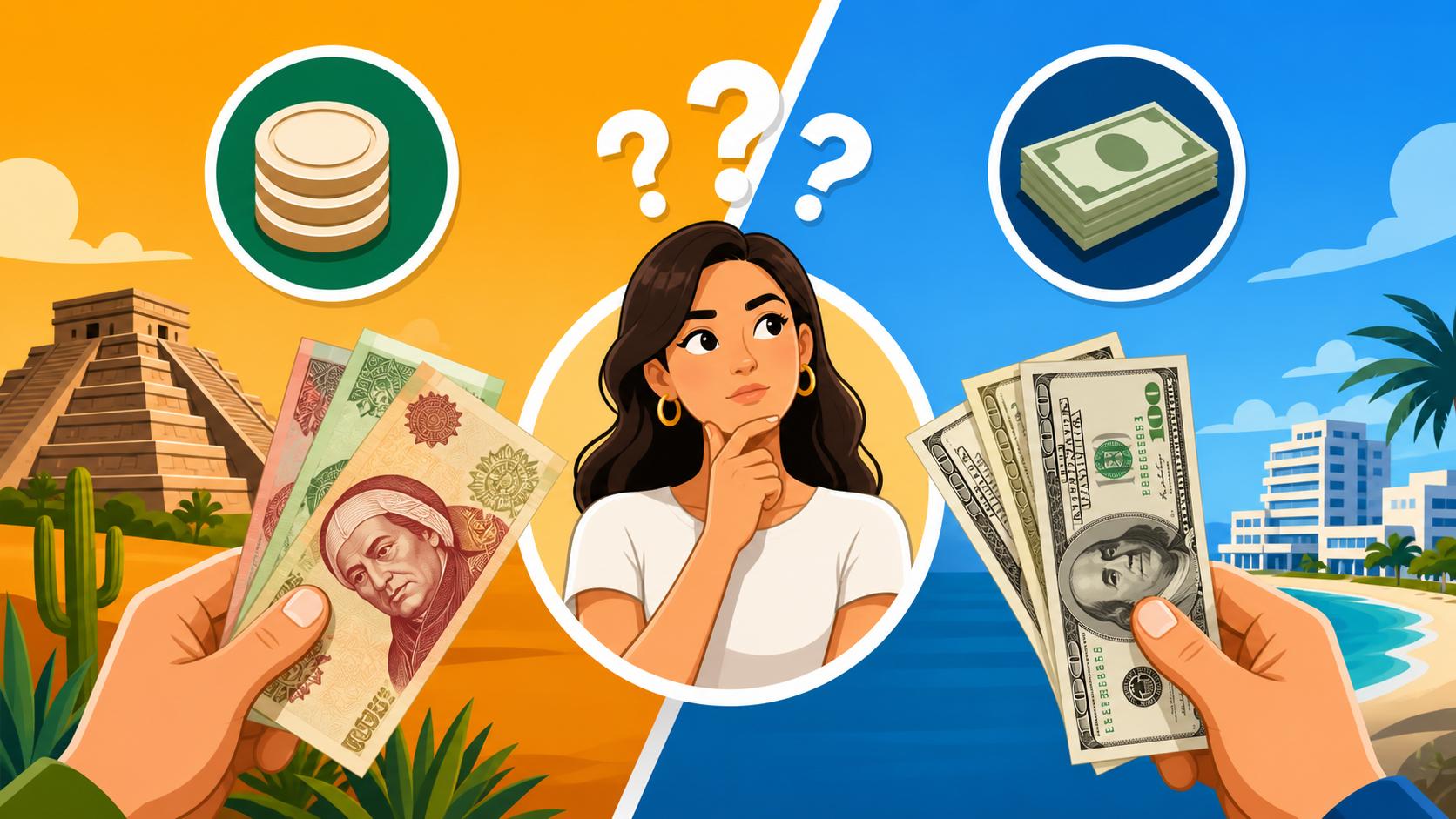
You walk into a local mercadito or sit down at a seaside palapa, and the bill arrives. You have a pocket full of U.S. dollars and a few crumpled pesos, and suddenly you’re hit with that paralyzing moment of indecision: which one should I use? I’ll never forget my first month in Oaxaca, trying to pay a taxi driver in dollars because I hadn't hit the ATM yet; the look of sheer logistical exhaustion on his face taught me more about Mexican finance than any guidebook ever could. This guide will solve the "dollars vs. pesos" dilemma once and for all, ensuring you never overpay or inadvertently burden the locals who make your life here so wonderful.
Disclosure: This post may contain affiliate links. We may earn a commission at no extra cost to you if you make a purchase through these links. Read full disclosure.
The Absolute Sovereignty of the Mexican Peso
While it is true that Mexico is geographically tethered to the United States, the Mexican Peso (MXN) is the undisputed king of the economy. I have seen countless newcomers arrive with the assumption that because "dollars are strong," they are preferred everywhere. This is a fundamental misunderstanding of how daily life functions for the average Mexican citizen. Outside of the high-end resorts in Cabo or Cancun, the peso is not just the preferred currency—it is often the only functional one.
Why the Local Economy Operates on Pesos
Most vendors, from the person selling tamales on the corner to the technician fixing your internet, live their entire lives in pesos. They pay their rent in pesos, buy their groceries in pesos, and pay their taxes in pesos. When you hand a local worker a U.S. dollar bill, you aren't just giving them money; you are giving them an errand. They now have to find a casa de cambio or a bank, stand in a potentially long line, and present identification just to turn your tip into spendable currency. In my experience, the frustration of the "dollar errand" often outweighs the value of the tip itself.
Furthermore, many small business owners do not have bank accounts that accept foreign currency deposits. This means they are at the mercy of whatever exchange rate the local corner store or exchange booth offers them, which is almost always lower than the official mid-market rate. By paying in pesos, you are respecting the local infrastructure and ensuring that the value you intend to give actually stays in the recipient's pocket.
The Hidden Cost of the Gringo Exchange Rate
If you do find a business—usually a restaurant in a tourist-heavy area—that accepts U.S. dollars for payment, you are almost certainly going to lose money on the transaction. Businesses that accept dollars set their own internal exchange rates, and they are rarely in your favor. If the official rate is 18 pesos to the dollar, a shop might "generously" offer you 15 or 16. This is often referred to as the "convenience fee," but over a week of dining out, it can add up to hundreds of dollars in lost purchasing power.
I always tell friends that if you want to see your money go further, you need to think in pesos. When you see a price tag in pesos and mentally convert it using a poor exchange rate, you’re essentially voluntarily inflating the cost of your own life. To get a handle on the real costs, it’s worth checking out the Cost of Living in Mexico: 2026 Comprehensive Guide to see how much you should actually be spending when using the local currency.
Practicality and the Power of Small Change
One of the most overlooked aspects of living in Mexico is the "change crisis." Getting a 500-peso bill broken can be a Herculean task at a small coffee shop. Now, imagine trying to get change for a twenty-dollar U.S. bill. It’s nearly impossible. Carrying a mix of small peso denominations (20s, 50s, and 100s) makes you a much more agile and welcome customer. When you use tools like Wise to manage your transfers, you can often withdraw pesos directly from ATMs at much better rates than carrying cash across the border, allowing you to keep those small denominations handy without the stress of carrying large amounts of U.S. currency.
Tipping Etiquette: Dollars vs. Pesos
Tipping, or the propina, is a deeply ingrained part of Mexican culture. Because service industry wages are often quite low, the tip is what allows servers, cleaners, and gas station attendants to make a living. However, the currency you choose for that tip can change the gesture from a "thank you" to a "burden."
The Problem with U.S. Coins
If there is one rule you should take away from this guide, let it be this: Never tip in U.S. coins. It may seem like a small thing, but U.S. coins are essentially worthless in Mexico. Banks and exchange houses will only exchange paper bills. I have seen jars of U.S. quarters and dimes sitting in the homes of Mexican friends, collected from well-meaning tourists, that the family literally cannot spend or exchange. If you only have U.S. currency on you, only use paper bills ($1s and $5s), but even then, pesos are vastly preferred.
When you are calculating your tips, keep in mind that the standard is 10% to 15% in restaurants. For a deep dive into who gets what, I highly recommend reading Tip Culture: How Much to Tip for Services (From Maids to Waiters). It covers the nuances of tipping people you might not think of, like the "cerillos" (the elderly or students who bag your groceries for tips only).
Tipping in High-End Tourism Zones
In places like Playa del Carmen or the hotel zone in Tulum, U.S. dollars are more widely circulated. In these specific enclaves, service staff are more accustomed to receiving dollars and often have ways to exchange them more easily. However, even in these bubbles, the peso remains the more "powerful" currency. If you give a 100-peso tip (roughly $5.50 USD), it is often viewed more favorably than a $5 USD bill because the recipient can spend it immediately at the taco stand on their way home.
For those living here long-term or retired, managing these small daily expenses while maintaining a larger financial portfolio can be tricky. This is where services like Interactive Brokers come in handy for expats who need to keep their main wealth in USD or other currencies while living a "peso life" day-to-day. You can keep your investments growing in a stable environment while using Wise to funnel exactly what you need into your Mexican bank account.
The Psychological Aspect of Local Currency
There is also a subtle cultural respect involved in using pesos. When you pay in the local currency, you are signaling that you are not just a "pass-through" tourist, but someone who understands and respects the local system. It shows you’ve taken the time to visit a bank or an ATM and that you’re participating in the local economy on its own terms. If you're still figuring out the banking side of things, our guide on Banking in Mexico: Complete Guide for Foreigners can help you set up the right accounts to avoid high fees.
Maximizing Your Value and Avoiding Fees
To live comfortably in Mexico, you need a strategy for moving money that doesn't involve carrying stacks of U.S. dollars and losing 10% every time you exchange them. The goal is to get pesos into your hand at the lowest possible cost.
Using ATMs Safely and Smartly
The most common way for expats to get pesos is through the ATM (cajero). However, there is a major pitfall here: the "Dynamic Currency Conversion" (DCC) trap. When you use a foreign card, the ATM will often ask if you want to "accept their conversion rate." Always decline this. When you decline their rate, your home bank or your transfer service (like Wise) handles the conversion at the real exchange rate, which is almost always 3% to 7% better than the ATM's offer.
I have found that using a dedicated expat-friendly card can save thousands of pesos over the course of a year. If you want more tips on this, check out Using ATMs in Mexico: Avoiding Fees and Staying Secure. It’s also worth noting that for larger-scale financial moves, such as buying property or managing a business, you might want to consult Managing Your Money in Mexico: Budgeting, Saving, and Currency Tips to ensure you aren't leaking money through poor exchange habits.
A Comparison of Exchange Options
To illustrate the difference in value, look at how much 1,000 USD actually buys you depending on where you "spend" or "exchange" it. (Note: These rates are hypothetical for comparison purposes).
| Exchange Location | Typical Rate (Pesos per 1 USD) | Total Pesos Received | Percentage Lost |
|---|---|---|---|
| Official Mid-Market Rate | 18.00 | 18,000 | 0% |
| Wise Transfer | 17.92 | 17,920 | <1% |
| High-End Resort Rate | 16.00 | 16,000 | 11.1% |
| Local Shop/Restaurant | 15.50 | 15,500 | 13.8% |
| Airport Exchange Booth | 15.00 | 15,000 | 16.6% |
As the table shows, the "convenience" of paying in dollars or using an airport booth is incredibly expensive. Using a service like Wise allows you to stay as close to the official rate as possible. For those with more complex needs—perhaps you’re a digital nomad or a trader—using Interactive Brokers allows you to maintain your primary assets in a more stable environment while liquidating only what you need.
When Are Dollars Actually Better?
Are there any times when you should use dollars? Occasionally, yes. In the real estate market, particularly in expat-heavy areas like San Miguel de Allende or the Riviera Maya, many properties are listed in USD. This is to protect the seller from the volatility of the peso over a long closing period. However, even then, the actual transaction often involves a complex legal process involving Mexican bank accounts. If you're considering a big move, read Buying Property in Mexico: Comprehensive Guide for Foreign Buyers to understand how currency fluctuations can affect your purchase price.
Strategic Tips for Different Scenarios
Every situation in Mexico is a little different. Whether you're at a high-end dinner or a local street market, your currency choice matters.
The Street Market and Small Villages
In a tianguis (open-air market) or a small "pueblo magico," do not even show a U.S. dollar bill. It is seen as quite pretentious and puts the vendor in a difficult spot. In these environments, cash is king, and "cambio" (change) is a precious resource. Always try to pay with the smallest bills possible. If you’re living in a more remote area, you’ll find that Currency Exchange in Mexico: Getting the Best Rates on Pesos is a vital skill to master so you don't run out of cash when the only ATM in town is broken.
Digital Payments and Credit Cards
In larger cities like Mexico City, Guadalajara, or Monterrey, credit cards are widely accepted at established businesses. When the terminal asks if you want to pay in USD or MXN, always choose MXN. This allows your card issuer (or your Wise account) to do the conversion at a fair rate rather than letting the Mexican merchant's bank dictate the terms. For a better understanding of the digital landscape, see Using Credit and Debit Cards in Mexico: What Expats Need to Know.
Long-Term Financial Health
Living in Mexico as an expat requires a bit of a "dual-brained" financial approach. You are living a peso life, but your "future self" probably still thinks in dollars, pounds, or euros. Using Interactive Brokers can be a great way to keep your long-term savings in a hard currency while you enjoy the lower cost of living that the peso provides. This balance is key to ensuring that you don't just survive in Mexico, but thrive financially over decades. To learn more about how to structure your life here, take a look at our Money & Finance hub for more deep dives into taxes and investing.
By choosing to pay and tip in pesos, you are making a conscious choice to integrate. You are making life easier for the waiters who serve your coffee, the maids who clean your home, and the vendors who brighten your neighborhood. You are also keeping more of your own hard-earned money by avoiding the "tourist tax" of poor exchange rates. It takes a little more effort to visit the ATM and manage your accounts through Wise, but the rewards—both financial and social—are well worth it.
Disclaimer
The information provided in this article is for informational purposes only and does not constitute financial, legal, or tax advice. Currency exchange rates and local customs can change rapidly. Always consult with a qualified professional before making significant financial decisions in Mexico.