Money-Saving Tips: How Expats Can Cut Costs Living in Mexico
Moving to Mexico with dreams of a dirt-cheap paradise often crashes into the reality of the “gringo tax,” predatory ATM fees, and overpriced expat neighborhoods. I burned through my savings during my first six months because I kept spending like a tourist instead of a local. This guide reveals how to drastically cut your living costs without sacrificing your lifestyle.
Disclosure: This post may contain affiliate links. We may earn a commission at no extra cost to you if you make a purchase through these links. Read full disclosure.
Mastering the Local Real Estate Market
The single largest expense in your monthly budget will always be your housing. For many newly arrived foreigners, the shock of finding out that an apartment in a trendy Mexican neighborhood costs just as much as an apartment back home is a bitter pill to swallow.
Escaping the Expat Bubble
The allure of the “expat bubble” is incredibly strong. Neighborhoods like Roma Norte and Condesa in Mexico City, or the Zona Romántica in Puerto Vallarta, are undeniably beautiful, highly walkable, and saturated with English-speaking cafes. However, the premium you pay simply for the convenience of hearing your native language is staggering. Rent in these hyper-gentrified, short-term-rental-dominated zones has skyrocketed beyond local market realities. Landlords in these areas specifically target foreigners with inflated prices, knowing that newly arrived expats have not yet calibrated their financial compass.
If you want to cut your monthly overhead by 30% to 40% instantly, you must be willing to move just two or three colonias (neighborhoods) away from the main tourist hubs. Neighborhoods like Narvarte, Santa María la Ribera, or Álamos in Mexico City offer incredible architecture, fantastic local food scenes, and a significantly higher quality of life for a fraction of the cost. The added benefit of living in a truly local neighborhood is the forced immersion; your Spanish will improve exponentially faster when you aren’t surrounded by other expats.
Navigating the rental hunt in these local zones requires a shift in strategy. You must completely avoid English-language Facebook groups and luxury real estate agencies catering to foreigners. Instead, you have to hit the pavement, look for physical “Se Renta” signs in the windows of buildings, and use domestic Spanish-language portals like Inmuebles24 to find accurate local pricing. Understanding the cultural nuances of securing a lease without a local guarantor is a complex process, which is deeply detailed in Finding an Apartment in Mexico: Renting Guide for Expats.
Negotiating in Pesos Not Dollars
A massive financial trap that catches countless expats is the dollar-pegged lease. Landlords in high-demand expat zones love to price their luxury apartments in US Dollars. For an American earning a USD salary, this feels safe and familiar. In reality, agreeing to a USD lease transfers the entirety of the macroeconomic currency risk directly onto your shoulders. You are living in Mexico; your primary expenses should be rooted in the local economy.
The danger of the dollar lease becomes painfully obvious when the peso strengthens. During periods of the “Super Peso,” a $1,500 USD rent goes from being worth roughly 30,000 MXN to 25,000 MXN in purchasing power for the landlord. To compensate, landlords will often attempt to raise the USD rent upon renewal to maintain their peso lifestyle. By negotiating your lease strictly in Mexican Pesos, you lock in your local cost of living and protect yourself from sudden, localized inflation.
Legally, all domestic contracts in Mexico should be executable in the national currency. Politely but firmly insisting on a peso contract establishes you as an informed resident rather than a passing tourist. When mapping out your long-term Cost of Living in Mexico: A Realistic Budget Breakdown, having a fixed peso rent allows you to strategize exactly when you convert your foreign currency, rather than being at the absolute mercy of whatever the exchange rate happens to be on the first of the month.

Beating the Banking and Transfer Traps
Moving money across international borders is an industry built on opacity. If you are not actively managing how your money enters Mexico, you are likely bleeding hundreds of dollars a month to hidden banking fees and predatory exchange rates.
Avoiding Predatory Exchange Rates
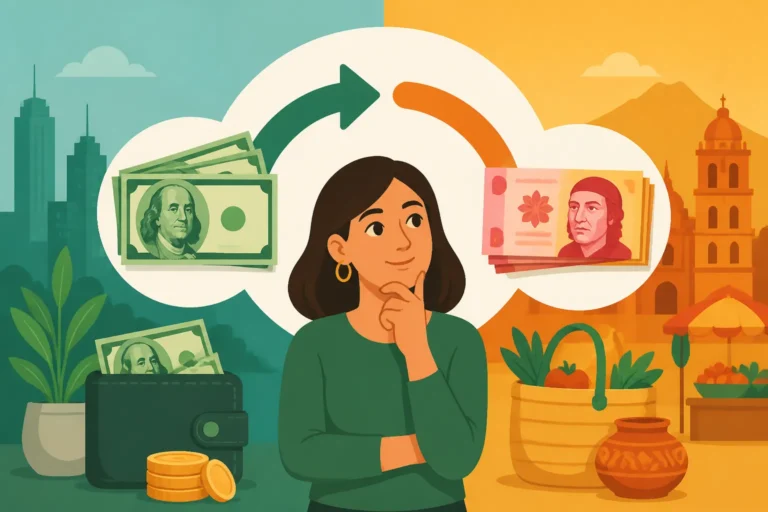
When you rely on your home country bank to wire money to Mexico, you are getting destroyed by a combination of outgoing wire fees, intermediary SWIFT network charges, and terrible exchange rate markups. Traditional banks routinely skim 3% to 5% off the top of your transfer simply by giving you a worse exchange rate than the actual market dictates. To fix this hemorrhage, I completely stopped using traditional banks to move my daily money. Now, I use Wise to handle all my monthly transfers, whether I am paying rent or sending funds to a local account.
Because Wise uses the real mid-market exchange rate—the exact rate you see on Google—and charges a tiny, transparent upfront fee, I save a massive amount of money every single month. They bypass the expensive SWIFT network by utilizing local domestic payment systems. I even use my Wise debit card for daily purchases at grocery stores and restaurants to completely bypass the terrible conversion rates that local point-of-sale terminals try to force on foreign cards.
However, if you are moving a massive amount of capital—such as buying a home, purchasing a vehicle, or moving a large emergency fund—the percentage-based fees on consumer apps can still bite. In these heavy-capital scenarios, I rely on Interactive Brokers. Since Interactive Brokers gives you direct access to institutional Forex spot rates, you can convert hundreds of thousands of dollars to pesos for mere pennies in commission. Once the currency is converted, you can push it directly to a Mexican bank account. If you are ever navigating major capital investments south of the border, utilizing Interactive Brokers is the ultimate veteran expat hack to protect your net worth. To understand how to properly receive these funds locally, review Opening a Bank Account in Mexico.
Ditching the ATM Fees
If you are withdrawing cash from random, standalone ATMs on the street or inside tourist convenience stores, you are throwing your money away. These independent machines routinely charge a $3 to $8 USD usage fee, and worse, they employ a scam known as Dynamic Currency Conversion (DCC).
When you insert a foreign card, the ATM screen will helpfully offer to “lock in” your exchange rate, asking you to accept their conversion. This rate is universally terrible. The golden rule of Mexican ATMs is to always, without exception, hit the “Decline Conversion” button. The machine will still dispense your pesos, but your home bank (or your travel debit card) will process the conversion at a vastly superior rate.
To further minimize costs, you must optimize your withdrawal strategy. Stop taking out small amounts of cash every other day. Go to an official branch of a major bank (like Santander, Citibanamex, or Banorte), decline the DCC, and withdraw the absolute maximum daily limit to minimize the frequency of flat-rate usage fees. For a deeper dive into the specific charges levied by local institutions, read Bank Fees in Mexico: Tips to Avoid Unnecessary Charges.
| Expense Category | The “Expat Trap” Strategy | The “Veteran Local” Strategy | Estimated Monthly Savings (USD) |
|---|---|---|---|
| Housing | Dollar-pegged lease in an expat bubble | Peso-pegged lease in a local colonia | $400 – $800 |
| Money Transfers | Traditional SWIFT bank wires | Utilizing Wise for daily transfers | $50 – $100 |
| Groceries | Imported goods at premium supermarkets | Fresh produce at the local mercado | $150 – $250 |
| Healthcare | Out-of-pocket at elite tourist clinics | Utilizing pharmacy clinics for basic needs | Hundreds (per visit) |
Rethinking Your Daily Consumption Habits
Your daily lifestyle choices dictate how far your currency stretches in Mexico. If you attempt to exactly replicate the consumption habits of your home country, you will find that Mexico can be shockingly expensive.
The Cost of Imported Comforts
It is incredibly easy to walk into a high-end Mexican supermarket—such as City Market, Chedraui Selecto, or H-E-B—and fill your cart with imported peanut butter, craft IPAs from California, and European cheeses. When you reach the checkout line, your bill might be higher than it was back in Chicago or London.
The import taxes, cold-chain logistics, and premium shelf-space markups on foreign goods in Mexico are brutal. If a product crossed a border to get to your plate, you are paying a massive premium for it. To dramatically cut your grocery bill, you must adapt your palate to local equivalents. Mexico produces phenomenal domestic cheeses, incredible local coffee, and world-class fresh baked goods.
The secret to sustainable expat budgeting is the 80/20 rule. Allow yourself 20% of your grocery budget for those absolute must-have imported comforts that keep homesickness at bay, but strictly source the remaining 80% of your pantry from domestic Mexican brands.
Navigating Local Markets Versus Supermarkets
If you want to unlock the true purchasing power of living in Mexico, you have to abandon the fluorescent aisles of the massive big-box supermarkets and embrace the tianguis (open-air mobile markets) and permanent municipal mercados.
Buying your weekly fruits, vegetables, and meats directly from the local market will literally cut your grocery bill in half. Not only is the food vastly fresher—often arriving straight from the surrounding farms that morning—but you are eliminating the corporate middleman. You also have the opportunity to build relationships with the vendors; becoming a casero (regular customer) often results in better cuts of meat, the freshest produce being set aside for you, and the occasional free handful of herbs thrown into your bag.
There is, however, one administrative downside to the local market lifestyle. Markets operate entirely in cash. If you are operating a local business or working as an independent contractor, you will not receive a factura (official electronic tax receipt) from a tomato vendor in the tianguis. If you are meticulously tracking your deductible expenses, you must carefully weigh the immediate cash savings of the market against the lost tax deductions. Understanding how these receipts impact your fiscal life is deeply explored in Taxes in Mexico for Expats: A Complete Guide to Income Tax and More.
Transportation and Healthcare Savings
Two of the most complex, high-risk categories in an expat’s budget are getting around safely and staying healthy without going bankrupt.
Rethinking Car Ownership
The initial instinct for many North American expats is to immediately purchase a car upon arriving in Mexico. This is often a massive financial misstep. Buying a car in Mexico is shockingly expensive; the domestic auto market is highly protected, used cars do not depreciate nearly as quickly as they do in the US, and local financing rates routinely sit in the double digits.
Furthermore, the hidden costs of ownership—such as comprehensive insurance, annual tenencia (vehicle tax), mandatory emissions testing, and the inevitable wear-and-tear on your suspension from aggressive potholes and massive topes (speed bumps)—will drain your wallet rapidly. Before you buy, do the math on how often you actually intend to leave your city limits.
For the vast majority of expats living in urban centers, relying entirely on rideshare apps like Uber or DiDi, walking, and utilizing highly subsidized public transit is mathematically vastly cheaper than owning a vehicle. If you live in a rural area and absolutely need a vehicle to survive, you must carefully weigh the massive bureaucratic headaches of importing your foreign vehicle against the high cost of local purchasing, a calculation broken down in Bringing Your Car vs Buying in Mexico: Pros and Cons for Expats.
Optimizing Your Medical Expenses
A dangerous myth circulates in expat forums that “healthcare in Mexico is so cheap you don’t need insurance.” This is a catastrophic misunderstanding of the medical system. While a basic consultation is incredibly affordable, suffering a major trauma or treating a chronic illness in an elite private Mexican hospital (like Hospital Ángeles or ABC) will rival United States out-of-pocket pricing.
To optimize your daily medical costs, you must learn to use the system appropriately. For basic ailments—like a minor stomach bug, a rash, or strep throat—do not go to a major hospital. Utilize the consultorios attached to major pharmacy chains like Farmacias del Ahorro or San Pablo. You can see a fully licensed general practitioner for roughly $3 to $5 USD, get your prescription immediately, and be home in an hour.
However, for your financial survival, you absolutely must carry a comprehensive major medical insurance policy. Relying on cash-flowing a catastrophe is financial suicide; a broken leg requiring surgical pins can easily cost $10,000 USD in a private facility. Understanding how to balance your right to the public system (if formally employed) with a robust private international policy is the most important financial decision you will make. Read exactly how to structure this safety net in Healthcare in Mexico: Complete Guide for Expats Public vs Private.
References
Primary sources (official)
- Banco de México (Banxico): The official central bank portal providing real-time, institutional exchange rates. Veteran expats use this daily to verify the true mid-market rate before accepting any bank or ATM conversion offers. https://www.banxico.org.mx/
- Procuraduría Federal del Consumidor (PROFECO): The federal consumer protection agency’s “Quién es Quién en los Precios” database, an invaluable tool for tracking the baseline costs of groceries and basic goods across different Mexican supermarkets. https://www.gob.mx/profeco/articulos/quien-es-quien-en-los-precios-35141?idiom=es
Other helpful sources
- Mexperience: A trusted resource providing realistic breakdowns of navigating local markets, negotiating peso-based leases, and understanding the hidden logistical costs of imported goods. https://www.mexperience.com/lifestyle/living-in-mexico/
Disclaimer
The information provided in this guide is for educational, logistical, and informational purposes only and does not constitute formal financial, tax, or legal advice. I am a veteran expat sharing practical strategies, not a certified financial planner. However, international currency exchange rates, local rental markets, and the cost of consumer goods in Mexico are subject to frequent and sudden macroeconomic fluctuations. Digital transfer platforms and brokerage services operate under their own strict terms of service and fluctuating fee structures. Always conduct independent market research, thoroughly read the fine print on any residential lease, and consult with a certified cross-border financial advisor to ensure your cost-saving strategies align with your long-term fiscal goals and tax obligations.