Moving to Mexico from Australia and New Zealand: The Longest Route Priced Out
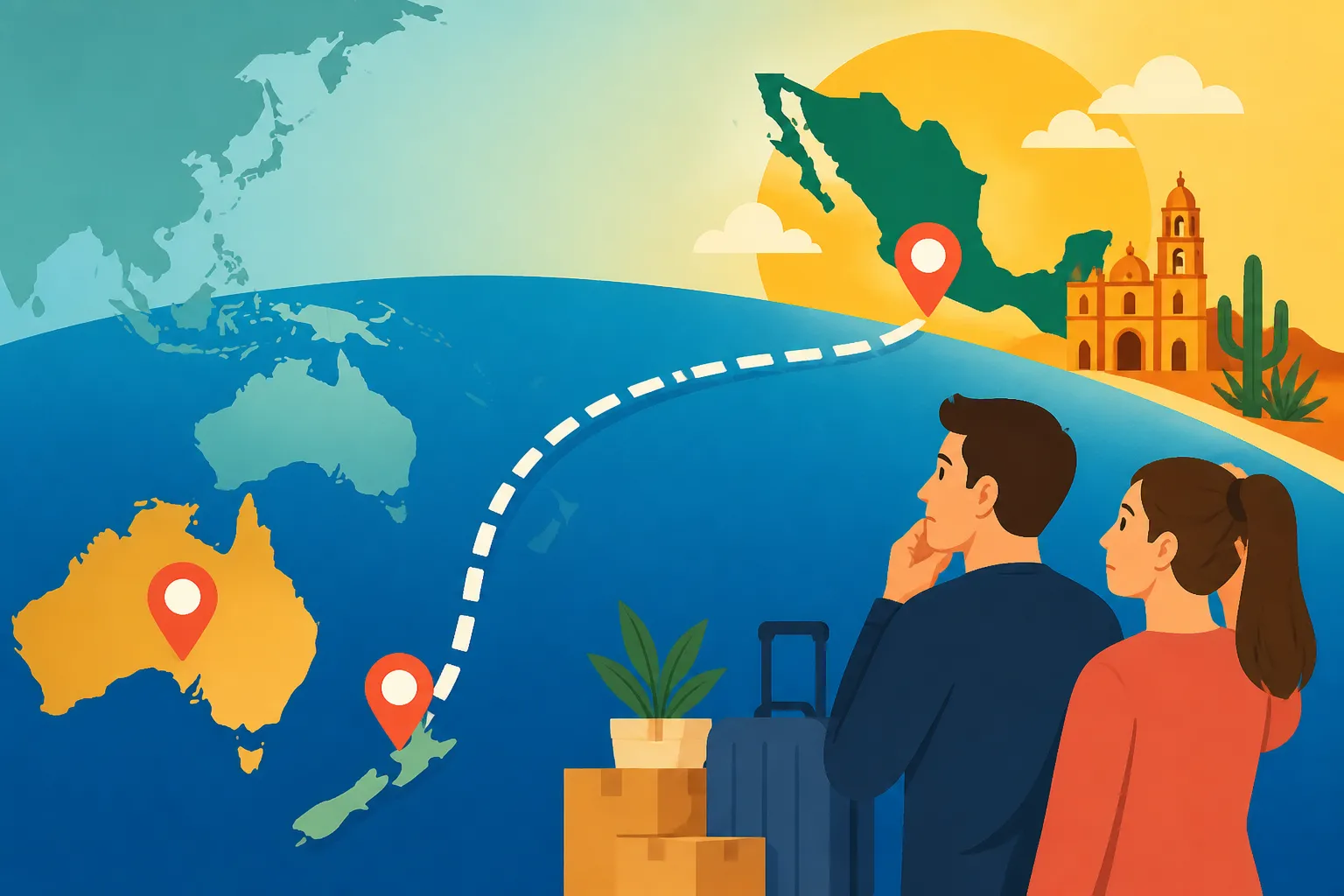
Shipping a household from Sydney, Melbourne, Auckland or Christchurch to Mexico is one of the longest residential moves on the planet, and the quotes can feel random. This guide explains what the route costs. It covers the published Australian overseas ranges, the exact Mexican consulate fees, the line items quotes leave out, and how to use Sirelo to compare movers.
Disclosure: This post may contain affiliate links. We may earn a commission at no extra cost to you if you make a purchase through these links. Read full disclosure.
What Moving to Mexico From Australia or New Zealand Actually Costs
I moved my own life across the Pacific, and the hardest part was not the packing. It was the first round of quotes. One mover gave me a single number, another gave me four pages of line items, and a third never replied. If you are staring at your lounge room in Brisbane or your villa in Wellington and wondering what this will cost, I understand. Here is the honest structure of the price, with the real numbers available.
The Published Overseas Ranges From an Australian Removalist
An Australian removalist’s general overseas ranges give the best public baseline for this route. These are port to port prices from Australia to overseas destinations in general, not to Mexico specifically. They were published on 6 October 2026, and I read them in October 2026. The figures are in dollars on an Australian firm’s page, so treat them as Australian dollar figures.
| Household size | Shipping method | Port to port range, Australia to overseas, as of October 2026 |
|---|---|---|
| 1–2 bedroom | Shared container | $3,000–7,000 |
| 3 bedroom | Shared container or 20ft container | $5,000–10,000 |
| 4+ bedroom | Larger load | $8,000–14,000+ |
| 3 bedroom, nearest Pacific comparison | US west coast destination | $4,500–7,000 |
The same source says packing, insurance, customs and delivery are charged on top of these ranges. That matters a great deal for Mexico, because “port to port” means your goods stop at the dock. They are not inside your rented casa in Mérida or your apartment in Guadalajara.
The US west coast line is the closest published Pacific benchmark. Mexico’s Pacific ports sit further south on the same ocean, and services from Australasia often route through transshipment hubs. Use that row as a reference point, not a promise. Your Mexico figure comes from a quote built around your actual inventory, your departure port and your Mexican destination.
How New Zealand Departures Fit In
The published ranges above come from an Australian firm. If you are leaving Auckland, Tauranga, Lyttelton or Port Chalmers, the cost structure is the same. There is an ocean freight component, an origin service component, a destination service component, and Mexican paperwork. The figures themselves are not New Zealand quotes.
Kiwi households sometimes find their freight is consolidated with Australian cargo or moved through a regional hub before crossing the Pacific. That is not a bad thing in itself. It simply means you should ask each mover how your container or consignment physically gets to Mexico. Expect quotes in New Zealand dollars from New Zealand movers.
The Mexican Consulate Fee You Can Budget Today
One cost on this route is precise: the menaje de casa certificate. This is the Mexican consular document that supports importing your household goods. As of the October 2026 fee tables:
| Issuing office | Fee for foreigners | Fee for Mexican nationals | Fee table |
|---|---|---|---|
| Mexican embassy in Australia | AUD 287 | AUD 215 | October 2026 |
| Mexican embassy in New Zealand | NZD 352 | NZD 263 | October 2026 |
Both embassies re-issue their fee tables monthly. The amount you pay is the one in the table for the month you apply, so check the embassy’s own fee page in the week you book your appointment. If you are timing this around a ship departure, see Menaje de Casa in Practice: Timing Your Consulate Filing Around the Shipment.
The Line Items That Turn a Port Price Into a Real Budget
This is where the rest of the cost on this route sits. Because the published ranges stop at the port, the real work is understanding everything between your front door in Perth and your front door in Querétaro.
Origin Services in Australia or New Zealand
Your mover charges separately for the work done before the ship sails. Expect line items such as:
- Professional packing and export-grade wrapping, which matters on a voyage this long
- An itemised inventory, which Mexican customs and your consulate paperwork will rely on
- Collection from your home and transport to the export depot
- Container loading, or palletising and crating if you are in a shared container
- Export documentation on the Australian or New Zealand side
Packing is the line I would never skimp on for this route. A long sea voyage through tropical latitudes means heat, humidity and repeated handling at transshipment ports. If a quote is suspiciously low, look at whether packing is included or listed as “owner packed”. Owner-packed boxes are often treated differently when you make an insurance claim.
Ocean Freight and the Container Decision
The second block is the freight itself. You will usually choose between a shared container, sometimes called groupage or consolidation, and a sole-use container.
| Option | Best suited to | Main advantage | Main drawback |
|---|---|---|---|
| Shared container | 1–2 bedroom households, partial moves | You pay for your share of space | Waits for the container to fill, more handling |
| 20ft sole-use container | Typical 3 bedroom household | Sealed at origin, less handling | You pay for the whole box even if half empty |
| Larger sole-use container | 4+ bedroom households | Fits large furniture and bulky items | Highest freight cost, harder delivery access |
In the Australian removalist’s general ranges, a 3 bedroom household overlaps both the shared and 20ft options at $5,000–10,000 port to port. That overlap is the decision point. If you sit near the boundary, get both priced. The break-even logic is covered in Full Load vs Consolidated Shipping to Mexico: Cost Break-Even by Volume.
Your Mexican arrival port also changes the destination leg. Pacific ports such as Manzanillo and Lázaro Cárdenas are geographically closer to Australasia. Gulf ports such as Veracruz and Altamira can make sense if you are settling on the east side of the country. See Veracruz, Manzanillo, or Altamira? Choosing a Port of Entry for Mexico before you accept a routing.
Destination Charges in Mexico
The third block happens after your goods land. This is the part a port to port price does not include, and it is where unpleasant surprises appear. Typical items include:
- Terminal handling at the Mexican port
- Customs clearance through a licensed Mexican customs broker
- Possible inspection costs if customs opens the container
- Storage at the port or a bonded warehouse if paperwork is delayed
- Demurrage or detention charges if a container is held too long
- Inland trucking from the port to your city
- Unloading, unpacking and debris removal at your new home
The customs broker is not optional. Mexican imports go through an agente aduanal, and your mover will either use their own partner or expect you to appoint one. See Why You Need a Customs Broker (Agente Aduanal) for a Mexican Import. Storage and demurrage are the two items that grow by the day, and both are explained in Hidden Costs in Mexican Moving Quotes: Customs Agents, Storage, and Demurrage.
Delivery itself can be tricky. A friend of mine shipped from Melbourne to a colonial street in San Miguel de Allende, and the container truck simply could not get up the cobblestones. The goods had to be moved into smaller vehicles, which was a separate charge. Ask every mover whether their quote includes a shuttle service if the main truck cannot reach your door.
Insurance on a Long Pacific Crossing
Marine insurance is listed as an extra in the published ranges, and I would treat it as essential on this route. Policies are typically priced from the declared value of your goods, so a careful valued inventory matters. Ask whether the policy covers total loss only or also damage. Ask whether owner-packed boxes are excluded, and how claims are lodged once the goods are in Mexico. See Moving Insurance for Shipments to Mexico: Coverage, Valuation, and Claims.
Menaje de Casa Rules That Decide Whether You Pay Duty
Your immigration status shapes your customs bill as much as your container size. On a move this expensive, getting the sequence wrong can be painful.
Duty-Free Import Is for Permanent Residents
The duty-free household goods allowance, known as the franquicia, applies to permanent residents. The Mexican foreign ministry’s guidance for foreigners sets out three key rules:
- Your goods must clear Mexican customs between 3 months before and 6 months after your own entry to Mexico as a resident.
- One menaje de casa certificate is issued per family per calendar year.
- Temporary residents do not receive the duty-free franquicia and import their household goods under temporary import instead.
That timing window matters a great deal from Australasia. The voyage is long, and transshipment can add delays you do not control. If your ship is slow and you land in Mexico months before your container, you could be pushing against that 6 month limit. If you are still waiting on your resident card, read Menaje de Casa Without a Residency Card Yet: Sequencing the Paperwork before you book a sailing.
What the Certificate Does Not Cover
The certificate covers used household goods. It does not turn everything in your container into a duty-free item. New items still in their boxes, vehicles and certain categories of goods can still attract duty or require separate permits. See What Menaje de Casa Does Not Cover: Items That Still Attract Duty. Medications and supplements have their own rules too, covered in Shipping Medication and Supplements to Mexico: COFEPRIS Limits Explained.
A Step-by-Step Paperwork Sequence From Australia or New Zealand
Here is the order I recommend for a household leaving Australasia:
- Confirm your Mexican residency route and whether you will hold temporary or permanent residency on arrival.
- Build a detailed, itemised inventory in English and Spanish with your mover’s help.
- Book your appointment with the Mexican embassy in Canberra or Wellington, or the relevant consular office, and check that month’s fee table.
- Pay the menaje de casa fee, which as of October 2026 is AUD 287 or NZD 352 for foreigners, and obtain the certificate.
- Align your sailing date with your own entry date so customs clearance falls inside the 3 months before to 6 months after window.
- Send the certificate, inventory, passport copies and resident card copy to your customs broker before the ship arrives.
- Keep a buffer for storage in case clearance is delayed, and plan where you will stay in the meantime, so a hotel bill and port storage do not pile up with no plan. See Bridge Accommodation: Where to Stay Between Landing and Getting Keys for your options.
Using Sirelo to Price the Route for Your Own Household
The only reliable price for your move is the one quoted on your inventory. Getting several comparable quotes on a niche Pacific route is hard work. This is why I point readers to Sirelo.
Why Comparing Movers Matters on This Route
Far fewer removalists handle Australasia to Mexico than handle Sydney to London or Auckland to Los Angeles. When only one or two firms quote, you have nothing to measure against. The spread between offers can be large because each mover uses different shipping lines, transshipment hubs and Mexican partners.
Sirelo is a moving comparison platform. You describe your move once, and you can receive quotes from several international removal companies instead of chasing each one individually. For a Pacific crossing, that saves real time. It also gives you something more valuable: line items you can compare side by side. You can then see which mover includes Mexican destination services and which stops at the port.
How to Request Quotes Through Sirelo
- Measure or estimate your volume room by room. Note bulky items such as sofas, beds, bicycles and outdoor furniture.
- Go to Sirelo and enter your origin city in Australia or New Zealand and your destination city in Mexico, not just “Mexico”.
- Specify whether you want door to door or port to port service, and say whether you need packing.
- Mention your residency status and whether you will use menaje de casa, so movers quote the right customs process.
- Note any access problems at either end, such as an apartment with no lift or a narrow historic street.
- Compare every quote you receive against the line item checklist below.
The Comparison Checklist I Use
When the quotes arrive from Sirelo, put them into the same format. I use these questions:
| Question to ask | Why it matters for Australia or New Zealand to Mexico |
|---|---|
| Is the quote door to door or port to port? | Port to port prices exclude Mexican destination costs |
| Is export packing included? | Long voyages and transshipment increase damage risk |
| Shared or sole-use container? | Changes cost, handling and timing |
| Which Mexican port, and is transshipment involved? | Affects inland trucking and delivery timing |
| Who is the Mexican customs broker? | Required for clearance and menaje de casa paperwork |
| Are terminal handling, storage and demurrage listed? | These grow if paperwork is delayed |
| Is insurance included, and on what basis? | Listed as an extra in the published Australian ranges |
| Is a shuttle vehicle included if the truck cannot reach the door? | Common in colonial centres and gated communities |
If two quotes look similar in total but one leaves out Mexican destination services, they are not similar at all. For a deeper breakdown, see Comparing International Removal Quotes for Mexico: Line Items That Hide Costs.
Decide What Deserves the Trip Across the Pacific
The cheapest container is the one you do not fill with things you could replace locally. Before you finalise quotes on Sirelo, go through your home with a hard eye. Australian and New Zealand appliances are built for a different electrical standard, so think twice before shipping them. See Should You Ship Appliances to Mexico? Voltage, Service, and Replacement Costs. Sentimental items, quality furniture and things that are hard to find in Mexico usually earn their place. Cheap flat-pack furniture usually does not.
If you are bringing a dog or cat, plan that separately but in parallel. Pets fly while your goods sail, and the timing needs to line up with your housing. See Coordinating Pet Transport With Your Household Shipment to Mexico.
Pros and Cons of Shipping a Full Household This Far
| Pros | Cons |
|---|---|
| Familiar furniture and belongings make settling in easier | Long voyage with transshipment adds damage and delay risk |
| Permanent residents can use the duty-free franquicia | Strict timing window around your own entry date |
| A sole-use container is sealed at origin | Destination costs in Mexico sit outside port to port prices |
| Quality items cost less to ship than to replace | Temporary residents use temporary import, not duty-free status |
My honest advice after doing this myself: ship less than you think, and insure what you ship properly. Start your quotes early with Sirelo, because the Pacific schedule rarely bends to your plans. Lay the months out using An International Move to Mexico: The 12-Week Planning Calendar, book your consulate appointment once your residency path is clear, and compare at least three quotes through Sirelo before you sign anything. The route is long, but it is manageable once you know where each dollar goes.
Disclaimer
This article is for general informational purposes only and does not constitute professional advice. Laws, prices and regulations vary by location and change over time. Consult a qualified professional for guidance on your specific situation.