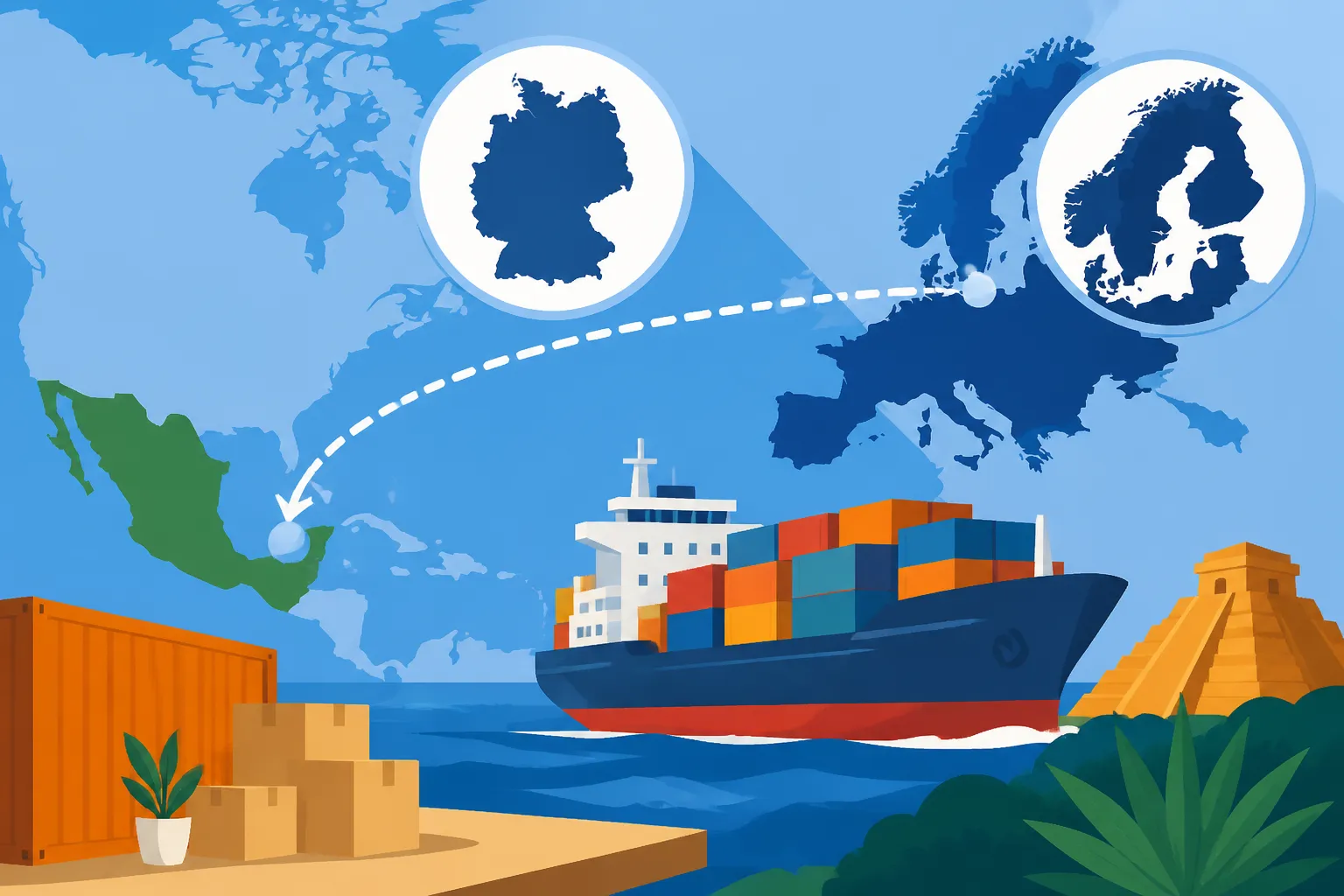
Moving to Mexico from Germany and Northern Europe: Container Routes
You’ve measured the flat in Hamburg, booked a viewing trip to Mérida, and asked two removal firms for a price. One quote is twice the other, and neither explains which port your boxes will reach. This guide covers container routes from Germany and Northern Europe to Mexico, the paperwork that can stall them, and how to compare movers so you get a quote you can rely on.
Disclosure: This post may contain affiliate links. We may earn a commission at no extra cost to you if you make a purchase through these links. Read full disclosure.
Why the Northern Europe to Mexico Route Feels So Confusing
The first surprise is how little the movers explain. In Germany you are used to clear rules, written confirmations, and a Kostenvoranschlag that matches the final invoice. Then you ask about shipping a three-bedroom household to Guadalajara and get vague answers: “Depends on the port.” “Customs will tell us.” “We’ll confirm the inland leg later.” It feels evasive. Usually it isn’t. An international move to Mexico is a relay race with four or five different companies, and the firm quoting you often controls only the first leg.
I went through this myself, shipping from northern Germany to central Mexico. Learning the stages before calling anyone made the second round of quotes far easier to judge. Once you can name each leg of the journey, you can ask about each leg, and evasive answers stop working on you.
The Four Legs of Every Container Move
Every household shipment from Germany, Denmark, Sweden, Norway, Finland, or the Baltic states to Mexico passes through the same broad stages:
- Origin services. Packing, inventory, loading, and trucking your goods from your home to the departure port or a consolidation warehouse.
- Ocean freight. The container sails from a North Sea or Baltic port to a Mexican seaport, sometimes with a transshipment stop on the way.
- Mexican customs clearance. A licensed customs broker, the agente aduanal, presents your paperwork and gets the container released.
- Destination services. Trucking from the Mexican port to your new home, unloading, unpacking, and debris removal.
When quotes vary wildly, it is almost always because one mover includes all four legs and another quietly includes only the first two. A port-to-port price looks cheap until you find you must hire a Mexican broker and a trucking firm yourself, in Spanish, while your container racks up storage charges at the terminal.
Where Comparison Platforms Fit In
This is the main reason I recommend Sirelo to anyone starting this process from Europe. Sirelo is a moving comparison platform. You describe your move once and receive quotes from several international removal companies, and the site also hosts reviews of those movers. Before you have done any homework, it gives you a set of quotes for the same job side by side, so you can see what “normal” looks like and which offers are outliers.
You still have to read every quote carefully, and this guide will show you what to look for. But checking movers one by one, firm by firm in German, Danish or Swedish, eats weeks. Having several comparable offers in front of you in a single go is the difference between a confident decision and a guess. Check Sirelo’s own pages to see how its quote requests work and which countries it covers before you start.
Container Routes From Germany, Scandinavia and the Baltics
Northern Europe’s main deep-sea ports are well connected to Mexico, mostly through the Gulf of Mexico. The port you leave from usually depends on where you live and which ports your mover’s consolidation partners use. The port you arrive at should depend on where in Mexico you are going.
Departure Ports Your Mover Will Likely Use
For Germans, the default is usually Hamburg or Bremerhaven. Movers in southern Germany, around Munich or Stuttgart, sometimes truck goods to Rotterdam or Antwerp instead, because those ports have frequent sailings and strong groupage networks. If you live in North Rhine-Westphalia, Rotterdam and Antwerp are often as practical as Hamburg.
Scandinavian and Finnish households usually travel on a feeder service first. A container leaving Gothenburg, Aarhus, Oslo or Helsinki is often carried to Hamburg, Bremerhaven or Rotterdam and loaded onto a larger vessel for the Atlantic crossing. That extra step adds handling and time, which is one reason Nordic moves can take longer than you’d expect from the map. There is more on this in Moving to Mexico from Ireland and Scandinavia: Long-Haul European Freight, and if a Dutch port comes up in your quotes, see Moving to Mexico from the Netherlands: Rotterdam to Veracruz and Manzanillo.
What matters is that the departure port should appear by name in your written quote. If a mover cannot tell you whether your goods leave from Hamburg or Rotterdam, they probably haven’t booked a consolidation partner yet. That is not automatically a red flag, but ask when they will confirm.
Arrival Ports in Mexico and Why They Matter
From Northern Europe, the natural arrival points are on Mexico’s Gulf coast:
- Veracruz is the historic workhorse port and a common arrival point for European cargo heading to Mexico City, Puebla, Querétaro and the central highlands.
- Altamira, in Tamaulipas, is an alternative Gulf port that can suit destinations in the north-east and the Bajío, including Monterrey and San Luis Potosí.
- Manzanillo and Lázaro Cárdenas are Pacific ports. From Europe, cargo reaches them either through the Panama Canal or by landing on the Gulf and crossing Mexico by road or rail. They make sense mainly if you are moving to Guadalajara, Puerto Vallarta or the Pacific coast and your mover’s network routes that way.
- Progreso, near Mérida, handles some cargo for the Yucatán. Ask your mover directly whether household goods can be routed there or whether they will arrive at Veracruz and travel overland.
Picking the port is a cost decision as much as a geography one. A container landing at Veracruz bound for Guadalajara needs a long inland truck journey, and that leg is often the most underquoted line in a European mover’s offer. For a full comparison, read Veracruz, Manzanillo, or Altamira? Choosing a Port of Entry for Mexico.
Matching Your Home Region to a Realistic Route
The table below shows typical pairings. It describes common logic, not fixed rules, and your mover’s network will decide the final routing.
| Where you are leaving from | Likely departure port | Common Mexican arrival port | Best-suited Mexican destinations |
|---|---|---|---|
| Northern Germany, Hamburg or Bremen area | Hamburg or Bremerhaven | Veracruz or Altamira | Mexico City, Puebla, Querétaro, Monterrey |
| Western Germany, Ruhr or Rhineland | Rotterdam, Antwerp or Hamburg | Veracruz | Mexico City, Bajío cities |
| Southern Germany, Bavaria or Baden-Württemberg | Hamburg, Bremerhaven or Rotterdam | Veracruz | Central Mexico, San Miguel de Allende |
| Denmark | Feeder to Hamburg or Bremerhaven | Veracruz or Altamira | Central and north-east Mexico |
| Sweden and Norway | Feeder to Hamburg or Rotterdam | Veracruz | Central Mexico, Yucatán by road |
| Finland and the Baltic states | Feeder via Baltic hubs to a North Sea port | Veracruz | Central Mexico |
| Any of the above, heading to the Pacific coast | North Sea hub | Manzanillo via Panama, or Gulf port plus overland | Guadalajara, Puerto Vallarta, Lake Chapala |
A worked example: Katrin, a translator from Hamburg, moved to Mérida. Her first quote assumed Veracruz arrival and said almost nothing about the onward leg. Her second and third quotes, which she requested through Sirelo, both explained the inland trucking from Veracruz to the Yucatán, and one offered to look into routing via Progreso. Seeing three answers to the same question showed her the first mover simply hadn’t thought the route through.
Full Container, Shared Container and the Paperwork Behind Them
Once you know the route, the next decision is how your goods travel. Most Northern European households choose between a full container and a share of one, and the choice affects cost, speed and how anxious you’ll be while your belongings are at sea.
Full Container Load Versus Groupage
A full container load, or FCL, means your belongings have a container to themselves. Standard sizes are the twenty-foot and forty-foot container. The container is sealed at your home or at the origin warehouse and usually not opened again until Mexican customs inspects it or it reaches your door. Fewer handling points mean less risk of damage or loss, and the timeline is more predictable, because you are not waiting for other customers’ cargo.
Groupage, also called consolidation or LCL (less than container load), means your goods share a container with other households heading to Mexico. You pay for the space you use, which can be much cheaper for smaller moves. The trade-off is waiting. The container sails only when it is full enough to justify the trip, and at the Mexican end it has to be unpacked at a bonded warehouse and every shipment cleared. Your crates can wait while someone else’s paperwork is sorted.
| Factor | Full container load | Groupage, shared container |
|---|---|---|
| Best suited to | Whole households, families, people shipping furniture | Singles, couples, people shipping boxes and a few pieces |
| Handling | Sealed once, opened at customs and destination | Multiple handling points at both ends |
| Timeline | More predictable | Depends on the container filling and on co-loaded shipments |
| Customs risk | Only your own paperwork affects you | Delays on other shipments can hold yours |
| Cost shape | Fixed price for the container regardless of how full | Priced by volume, so small loads cost less |
The break-even point depends on your volume and the route, and it is worth working out with real quotes rather than rules of thumb. For a detailed look, see Full Load vs Consolidated Shipping to Mexico: Cost Break-Even by Volume.
Menaje de Casa: The Document That Saves or Sinks Your Budget
This is where Northern Europeans who are used to EU free movement get caught out. Mexico taxes imported goods, and a container of used furniture and electronics can attract import duty unless you qualify for menaje de casa. This is a one-time, duty-free import of household goods for people who hold, or are getting, Mexican residency.
In practice, you prepare a detailed inventory of your household goods in Spanish, usually with serial numbers for electronics, and have it certified by the Mexican consulate in your country of departure. For Germans that usually means the Mexican Embassy in Berlin or the consulate in Frankfurt. For Scandinavians it is typically the Mexican embassy in your capital. The rules include a time window linked to your residency, restrictions on what qualifies, and documentary requirements that consulates apply in their own ways. Confirm the exact requirements with your consulate and with your mover’s Mexican agent before you book a sailing date.
The order of steps matters a great deal. File too early and your residency details may not be in place. File too late and your container may reach Veracruz before the certified list exists. For a full walkthrough of the timing, see Menaje de Casa in Practice: Timing Your Consulate Filing Around the Shipment.
A short sequence that works for many people:
- Get your temporary or permanent residency visa approved at the consulate.
- Ask your mover for their inventory template and agree on how detailed it must be.
- Translate and finalise the inventory, including makes, models and serial numbers for anything electronic.
- Submit the inventory to the consulate for certification, and confirm the processing timeline in writing.
- Send the certified documents to your mover and their Mexican customs broker before the container sails.
- Keep copies of everything, digital and paper, in your hand luggage on the flight.
The Customs Broker You Did Not Know You Needed
You cannot clear an import into Mexico yourself. A licensed agente aduanal must do it, and your European mover will normally subcontract one through its Mexican partner. The broker’s competence decides whether your container clears quickly or sits at the terminal running up storage and demurrage charges.
Ask every mover who their Mexican partner is, whether customs brokerage is included in the price, and what happens if customs selects your container for physical inspection. Inspections are common enough that a good quote mentions them. A poor quote leaves them out and bills you later. See Why You Need a Customs Broker (Agente Aduanal) for a Mexican Import for more on what brokers do and how to check them.
How to Compare Removal Quotes and Choose a Mover
This is where most of your money is saved or lost. Three quotes for the same household can differ hugely, and the cheapest is rarely the cheapest once the final invoice arrives. Sirelo is useful here in a very practical way: you get several offers built from the same description of your move, so the differences reflect the movers rather than inconsistent information you gave each of them.
What a Complete Quote Should Contain
Before you compare totals, check every quote for the same list of items. If a line is missing, ask about it in writing.
| Quote element | What to look for | Warning sign |
|---|---|---|
| Origin services | Packing materials, labour, inventory, loading, trucking to port | “Packing extra” with no estimate |
| Ocean freight | Named departure and arrival ports, container type or groupage | “Main Mexican port” with no name |
| Origin port and handling | Terminal handling at the European end | Not mentioned at all |
| Mexican customs clearance | Broker fees, inspection handling, document review | “Customs at client’s expense” |
| Destination port charges | Terminal handling, unloading from the vessel | Left vague or “paid locally” |
| Storage and demurrage | Free days included and what happens after | No mention of free time |
| Inland trucking in Mexico | Named destination city, access conditions | Delivery only to the “nearest city” |
| Delivery and unpacking | Carrying, assembly, debris removal | Unloading at kerbside only |
| Insurance | Valuation method, excess, claims process | “Basic liability” with no detail |
Ask every mover to rework its offer to the same scope: door to door, customs included, with the arrival port named. Only then compare prices. The guide Comparing International Removal Quotes for Mexico: Line Items That Hide Costs goes through each line item in more depth.
Using Sirelo Step by Step
This is the approach I suggest to friends leaving Germany or Scandinavia:
- Prepare an honest inventory first. Go room by room and list furniture, appliances, boxes and anything unusual such as a piano, bicycles or artwork. Movers quote better on volume they can trust.
- Submit your move details through Sirelo. Include your origin city, your Mexican destination city rather than just “Mexico”, your rough volume, your preferred move window, and whether you want full packing.
- Read the reviews alongside the quotes. Look especially for reviews from other long-haul moves, not just local German ones. A mover who is excellent across town in Cologne may have no proven Mexican partner.
- Send the same follow-up questions to every mover. Arrival port, Mexican partner, customs inclusion, free storage days at the port, insurance valuation, and how they handle menaje de casa.
- Arrange video or in-home surveys. Serious international movers will want to see your goods before giving a binding price. A firm that confirms a fixed price without a survey is guessing.
- Compare the revised quotes on identical scope. Take the line-item table above and fill it in for each mover.
- Check the contract terms. Look at payment stages, cancellation terms, what happens if the volume changes on loading day, and who is liable at each leg.
- Book, and confirm the timeline backwards from your arrival. Work out when the container must sail so it lands after your residency paperwork is ready and after you have keys to a home in Mexico.
Lars, an engineer from Gothenburg moving to Querétaro, did exactly this. His Sirelo quotes came from movers in Sweden and Germany, and once he asked them all the same questions, it turned out only two of the four had worked with a Mexican broker before. The cheapest quote fell away the moment he asked who would clear his container in Veracruz.
Insurance, Valuation and Damage Claims
Ocean freight is physically rough. Containers are stacked, lifted by crane, carried in heat and humidity, and trucked over Mexican roads with topes, the speed bumps that test every piece of furniture you own. Insurance is not optional in my view, but how it works varies enormously between movers.
Ask whether cover is based on a declared value per item or a lump sum per cubic metre, whether there is an excess, whether items you pack yourself are covered, and how claims are filed from Mexico. Photograph valuable items before packing and keep the photos with your inventory. See Moving Insurance for Shipments to Mexico: Coverage, Valuation, and Claims for the full picture.
Practical Realities at Both Ends of the Move
The paperwork and the route are only part of it. The moves that go smoothly are the ones where people planned for the practical friction at each end: emptying a German flat, deciding what is worth shipping, and actually getting a container to a house in a Mexican colonia.
Leaving Germany or Scandinavia Without Loose Ends
The German side has its own bureaucratic rhythm. Give your landlord notice according to your lease, arrange the handover, and plan for the condition your flat must be returned in. Deregister your address at the Bürgeramt once you leave, cancel or move your contracts, and book Sperrmüll collection early for anything you are not shipping, because appointments in big cities can be scarce.
Scandinavians face their own versions of this: deregistering from the population register, closing utility contracts and sorting out storage for anything you’re keeping at home. Whichever country you are leaving, the overlap between your departure date, your residency appointment and the container’s sailing date is where stress builds. An International Move to Mexico: The 12-Week Planning Calendar is a good structure to work from.
What Is Actually Worth Shipping
Northern Europeans often ship far too much. Your good German kitchen appliances run on 230 volts at 50 hertz; Mexican homes run on 127 volts at 60 hertz with different plug types. Transformers exist, but large appliances like washing machines, ovens and dryers are rarely worth the volume, the voltage headache and the lack of local service technicians. Read Should You Ship Appliances to Mexico? Voltage, Service, and Replacement Costs before you decide.
Climate matters too. Heavy wooden wardrobes and upholstered sofas can suffer in coastal humidity in Mérida or Puerto Vallarta. Winter coats, heavy duvets and snow gear make little sense for most of the country, although the highlands around Mexico City and San Cristóbal do get chilly evenings. Books, artwork, quality bedding, tools, kitchen knives, specialist sports equipment and furniture with sentimental value are usually worth the space. Flat-pack furniture that has already been assembled and disassembled once is usually not.
Decide before the survey, not after. Every cubic metre you remove from the inventory before your movers quote is money you never spend.
Delivery Day in Mexico
The final leg is the one Europeans underestimate most. Historic centres such as Mérida, Oaxaca, Guanajuato and San Miguel de Allende have narrow cobbled streets where a full-size container truck simply cannot enter. Your mover’s Mexican partner may need to transfer goods to smaller vehicles, a step called a shuttle, and that should be in your quote if your new home is in a colonial neighbourhood. Gated communities and condominium towers may have delivery hours, lift reservations and security registration requirements.
Ask your landlord or building administrator about access rules before the delivery is booked, and pass that information to the destination agent. See Delivery Day in a Mexican Building: Access, Stairs, and Colonial Streets for what to check.
Also consider where you’ll live while the container is at sea. Many people arrive in Mexico weeks before their belongings, and some haven’t signed a lease yet. Short-term furnished stays bridge that gap; Bridge Accommodation: Where to Stay Between Landing and Getting Keys explains how to plan them.
A Realistic Timeline and Your Next Step
Container moves from Northern Europe to Mexico take several weeks of ocean transit, plus the packing period beforehand, time for consulate and customs paperwork, and inland delivery afterwards. Groupage shipments add waiting time at both ends. Nobody can promise you an exact arrival date months in advance, and you should be wary of anyone who does. Build in slack, keep essentials in your suitcase, and don’t book your final German flat handover on the same day the container leaves unless you enjoy sleeping on the floor.
If you take one thing from this guide, make it this: don’t commit to the first mover who answers your email. Describe your move once on Sirelo, collect several quotes, ask every mover the same detailed questions about ports, customs and delivery, and pick the offer that answers them clearly. Moving from Germany or Scandinavia to Mexico is a big change. Choosing a mover by comparing like for like is the part of it you can control.
Disclaimer
This article is for general informational purposes only and does not constitute professional advice. Laws, prices and regulations vary by location and change over time. Consult a qualified professional for guidance on your specific situation.