How to See Templo Mayor in Mexico City
You walk out of Zócalo metro station, pass the cathedral, and see a fenced pit of crumbling stone walls. You wonder if that’s it, and whether it’s worth the line. It is, but only if you know where the entrance is, what to look at, and how to read the layers. This guide covers getting there, timing, tickets, and making sense of Templo Mayor.
Disclosure: This post may contain affiliate links. We may earn a commission at no extra cost to you if you make a purchase through these links. Read full disclosure.
What You Are Actually Looking At When You Visit Templo Mayor
My first time at Templo Mayor, I made a classic mistake. I strolled along the outside railing on the cathedral side, peered down at a jumble of walls, took two photos, and almost left. I thought I’d “seen” it. A friend who had lived in the Centro Histórico for years laughed at me. She marched me to the actual entrance on Calle Seminario, and two hours later I came out a completely different person. The view from the railing is like reading the back cover of a novel.
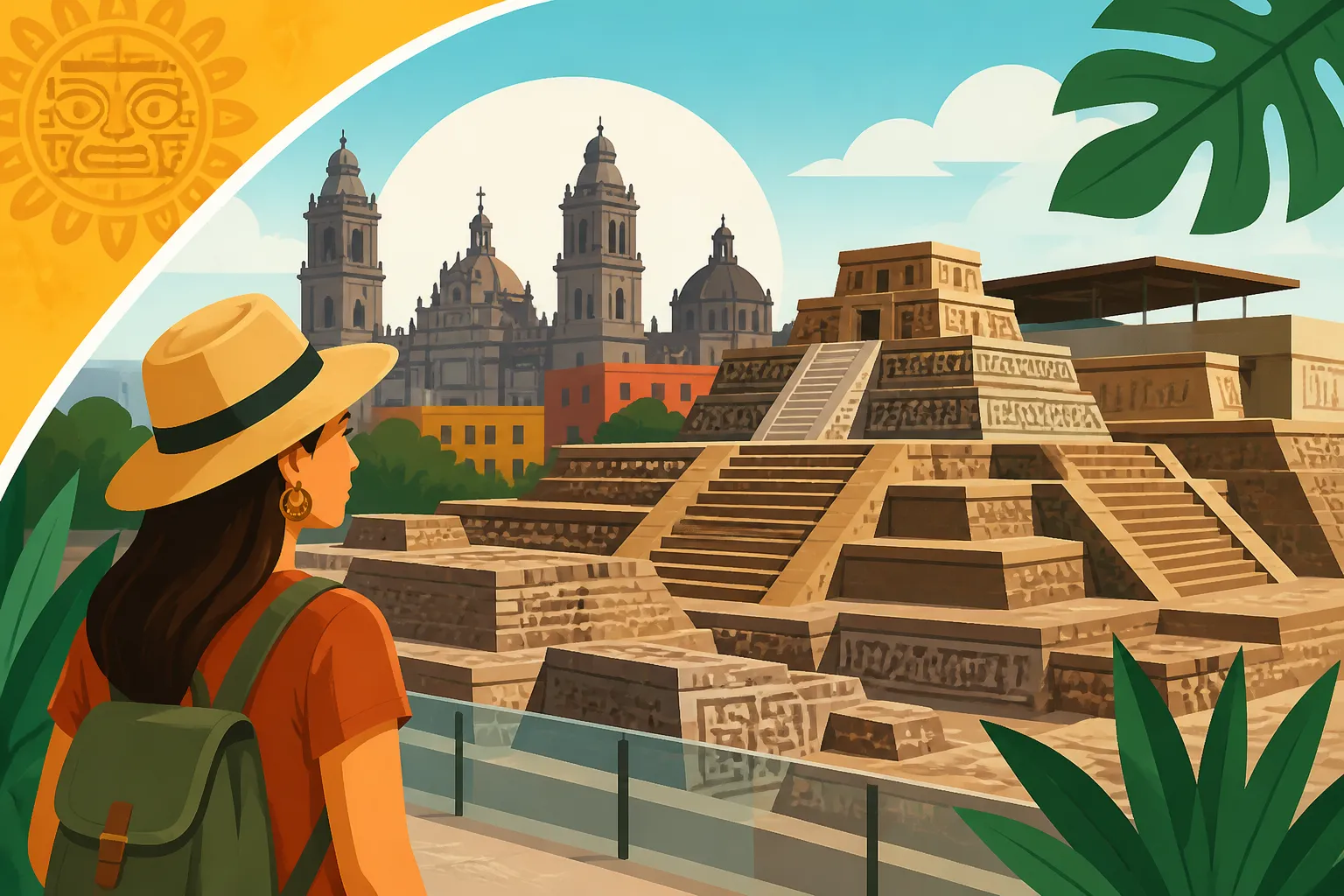
So before the logistics, it helps to understand what’s there. This is the ceremonial heart of Tenochtitlan, the Mexica capital that once filled what is now downtown Mexico City. Every major ritual, coronation and offering in the Aztec world revolved around this structure. When you stand on the walkways, you are standing where the empire believed the center of the universe sat.
The Twin Temple and Its Two Gods
The Templo Mayor was a pyramid topped by two shrines side by side. The southern shrine honored Huitzilopochtli, the god of war and the sun and the patron of the Mexica. The northern shrine honored Tláloc, the god of rain and agricultural fertility. War and water were the two forces that kept the empire alive: conquest brought tribute, and rain brought maize.
When you visit, try to keep that north-south split in your head. On the Tláloc side you can still see traces of blue paint and the famous reclining Chac Mool figure. The Huitzilopochtli side is tied to the myth of his birth on Coatepec, the Serpent Mountain, where he defeated his sister Coyolxauhqui. The temple itself was a stone version of that mountain.
That myth explains why the Coyolxauhqui stone matters so much. This huge carved disc shows the dismembered goddess, thrown down from the mountain by her brother. It was placed at the foot of the Huitzilopochtli stairs. Electricity workers digging in the street struck it by accident, and that discovery kicked off the large-scale excavation you walk through today. Before then, the temple was buried under colonial buildings and generally known only from chronicles.
Why It Looks Like a Pile of Walls: The Construction Layers
Here’s the part that confuses almost every first-time visitor, and it confused me badly. You won’t see a tall, intact pyramid like the ones at Teotihuacán. The Mexica didn’t tear down their temple when they renovated it. They built a new, larger temple right over the old one, encasing it like the layers of an onion. Archaeologists have identified seven main construction phases.
When the Spanish conquerors leveled the top layers and reused the stone, the oldest inner layers survived beneath the rubble. What you see today is a cutaway of those nested temples. One wall belongs to an early phase. The staircase just behind it belongs to a later one. A platform a few meters away belongs to another phase again. Once you understand this, the “jumble” turns into a timeline you can walk through.
Signs along the route mark the phases with Roman numerals. My strong tip is to stop at the first big explanatory panel near the start and study the diagram of the nested layers for a couple of minutes. It takes the confusion out of everything that follows. Many visitors skip it because they’re eager to get to the stones. Those are usually the people you hear muttering “I don’t get it” ten minutes later.
The Museum Is Half the Experience
Your entry ticket covers both the open-air archaeological zone and the Museo del Templo Mayor, which sits at the end of the outdoor route. The museum holds the objects that came out of the ground: offerings, sculptures, ceramics, jewelry, ritual knives, animal remains and more. Its halls are arranged roughly to mirror the temple itself, with one wing for the world of war and sacrifice and another for water, agriculture and daily life.
The undisputed star is the Tlaltecuhtli monolith. This enormous carved slab depicts the earth deity and is among the largest Mexica sculptures ever found. You see it from a balcony above, and the scale catches people off guard. I’ve watched whole school groups go silent in front of it.
Also look for the life-size clay eagle warrior figures from the House of the Eagles, the model of the ceremonial precinct, and the cases of offerings found buried inside the temple layers. The offerings include shells, coral and sea creatures carried from both coasts, a powerful reminder of how far the empire’s reach extended. If you plan to see more of Mexico’s ancient past, Aztec and Central Mexican Sites: Teotihuacán and Templo Mayor explains how this site fits alongside the bigger pyramids outside the city.
Planning Your Visit: Timing, Getting There and Entry Rules
The logistics of Templo Mayor are not complicated, but small details can sour your day. These include which day the site closes, where the real entrance is, what you can bring inside, and how hot the open walkways get at midday. I’ve had friends arrive on a closed day, get turned away for carrying a big backpack, and bake on the metal walkways at two in the afternoon. All of it is avoidable.
Choosing the Best Day and Time
Like most museums run by INAH, the national institute that manages Mexico’s archaeological heritage, Templo Mayor has traditionally been closed on Mondays. Please confirm the current hours on INAH’s official page before you go. Schedules can change for holidays, maintenance or events in the Zócalo. Arriving on a Monday and discovering locked gates is one of the most common disappointments I hear about from visitors.
Sundays are a special case. Mexican nationals and legal foreign residents with valid ID generally get free entry to INAH sites on Sundays. That makes Sundays lively, full of families and noticeably more crowded. If you’re a resident with your card, Sunday is a lovely, very local experience. If you’re a tourist paying regular admission, a weekday morning is calmer. For a wider look at which museums open their doors for free and when, see How to Find Free Museum Days in Mexico City.
Time of day matters more than people expect. The outdoor walkways have very little shade. In the dry season, the late-morning sun bouncing off stone and metal is intense, even though Mexico City is high and often cool in the shade. In the rainy season, roughly the summer months, afternoon storms often roll in quickly. Doing the outdoor section first thing in the morning and finishing in the covered museum works well in every season.
Getting to the Entrance
Templo Mayor sits at the northeast corner of the Zócalo, just east of the Metropolitan Cathedral. The ticket entrance is on Calle Seminario, the pedestrian street that runs alongside the ruins. If you’re facing the cathedral from the main square, walk to its right-hand side and look for the plaza with the large model of Tenochtitlan. The entrance is right there.
| Way to Arrive | Where You End Up | Best For | Things to Watch |
|---|---|---|---|
| Metro Line 2 to Zócalo/Tenochtitlan | Directly on the main square, a short walk away | Budget travelers, anyone staying along Line 2 | Rush hour crowds; keep bags in front |
| Metro Allende station | A few blocks west, through pedestrian streets | Combining with a walk down Madero or Tacuba | Slightly longer walk through busy streets |
| Metrobús to República de Argentina area | Northeast edge of the Centro | Visitors coming from the airport side | Routes change during street closures |
| Uber, DiDi or other ride-hailing app | Drop-off on a nearby street | Families, travelers with limited mobility | Traffic and closures around the Zócalo |
| On foot from a Centro hotel | Front door in minutes | Anyone staying in the historic center | Uneven sidewalks and street vendors |
The metro is honestly the easiest choice, and the station right on the square makes it almost foolproof. If you’ve never used the system, How to Use the Mexico City Metro as a First-Time Visitor walks you through buying a card, reading line colors and staying comfortable in crowded cars. For the bigger transport picture, including Metrobús and ride-hailing, see Getting Around Mexico City: Metro, Metrobús, and Apps.
One local quirk: the Zócalo often hosts concerts, protests, book fairs, festivals or official ceremonies. Sometimes the square is fenced off or full of stages and tents. When that happens, car access around the area gets chaotic, and walking from a nearby metro station is usually faster than any car. Don’t panic if the square looks blocked. Templo Mayor usually stays reachable on foot along Seminario.
If you’re arriving in Mexico City by long-distance bus from Puebla, Oaxaca or elsewhere, you’ll land at one of the big terminals, such as TAPO in the east or Terminal Norte. Booking that intercity leg through an aggregator like Busbud lets you compare departure times across companies. From TAPO, the metro gets you to the Centro without much trouble.
Tickets, Bags and Rules Inside
Tickets are sold at the entrance on Seminario. Bring some cash in pesos as a backup, because card terminals at public institutions can be temperamental. Keep your ticket handy, since staff may check it again where the outdoor route meets the museum. Residents should carry their physical residency card if they’re hoping for resident benefits. A photo on your phone is often not accepted.
There’s usually a guardarropa, a free bag check, for large backpacks and bulky items. Large bags are typically not allowed through the route, so travel light or be ready to check your bag. Food and drinks are generally not permitted inside the zone or the museum. Water bottles are a gray area that depends on the day and the guard, so drink before you go in and keep a bottle in your checked bag for after.
Photography for personal use is normally fine. Flash inside the museum and tripods or professional equipment usually require special permission. Drones are a hard no anywhere in the historic center. I once watched a guard very politely, but very firmly, shut down a visitor who’d set up an elaborate video rig in front of the Tlaltecuhtli. Keep it simple with your phone, and you won’t have any trouble.
A Step-by-Step Walkthrough of Your Visit
The route is one-way and fairly intuitive, but knowing the sequence helps you pace yourself. You won’t burn out on the first wall or rush past the best pieces. Here is how a typical visit unfolds, along with what I tell friends to slow down for.
Walking the Outdoor Archaeological Zone
- Enter on Calle Seminario, buy your ticket, and check any large bag at the guardarropa.
- Stop at the first explanatory panels and study the diagram of the seven construction phases before moving on.
- Follow the raised metal walkways that wind above and between the ruins, keeping to the marked one-way direction.
- Look for the serpent heads at the base of the platforms, some of which keep traces of their original color.
- Find the Tláloc shrine area and the Chac Mool figure, with its painted details on the northern side.
- Pause at the spot near the Huitzilopochtli stairs where the Coyolxauhqui stone was found. A replica marks the original location.
- Continue to the House of the Eagles, with its benches carved with processions of warriors and its sense of enclosed, sacred space.
- Take a moment at the edge of the site to look back at the cathedral rising behind the ruins. The two eras sit almost on top of each other.
- Follow the signs into the Museo del Templo Mayor to continue indoors.
Signage is mainly in Spanish, with English on many key panels, though not always on every detail. If your Spanish is shaky, a few basics go a long way when you’re asking guards for directions or the bag check. Survival Spanish for Travelers in Mexico: Key Phrases has a good starter set. A translation app with camera mode is also great for the longer Spanish-only text in the museum.
Accessibility in the outdoor section is uneven. The walkways are mostly flat, but there are steps in places, and the surfaces can be slippery after rain. If you or someone in your group has limited mobility, ask staff at the entrance about the most accessible path. The museum building itself is easier to get around.
Exploring the Museum Halls
The museum is spread over several floors, with halls arranged around a central open space. You’ll see the Tlaltecuhtli monolith early, from a viewing balcony, and I strongly recommend lingering there. Look closely at the carved details: the claws, the skulls, the patterns of the deity’s garments. Then come back to the balcony at the end of your visit. You’ll notice things you missed the first time, once the rest of the collection has given you context.
The original Coyolxauhqui stone is on display inside, raised so you can study it from above, roughly the way it would have been seen from the temple stairs. The eagle warrior figures are another highlight, as are the masks, the ritual knives with inlaid faces, and the offerings full of marine life, jaguar remains and carefully arranged objects. The offerings are where the Mexica’s view of the world really comes through. Everything was placed with meaning, in order, in a specific direction.
The upper halls cover daily life, agriculture, trade and the fall of Tenochtitlan. They sometimes get rushed because visitors are tired by then. Plan a short break on one of the benches before you head up. If you’re traveling with kids, the model of the ceremonial precinct is a great place to pause and point out where you just walked, which turns the visit into a small treasure hunt.
How Long to Allow and How to Pace Yourself
For most visitors, two to three hours covers both the ruins and the museum comfortably. History lovers can easily spend half a day. If you’re short on time, here is how I’d budget it.
| Visitor Type | Outdoor Ruins | Museum | Total Realistic Time |
|---|---|---|---|
| Quick overview, tight schedule | 30 to 40 minutes | 45 minutes, highlights only | About 1.5 hours |
| Typical curious traveler | 45 to 60 minutes | 1 to 1.5 hours | 2 to 2.5 hours |
| History enthusiast | 1 hour or more | 2 hours or more | 3 to 4 hours |
| Family with young children | 30 minutes | 45 minutes with breaks | About 1.5 hours |
Pacing really matters at altitude, especially in your first day or two in the city. Walking slowly, sitting down in the museum and drinking water before and after the visit all help a lot. Don’t try to stack Templo Mayor, the Palacio Nacional, the cathedral and a museum marathon into one morning on your first day. You’ll enjoy all of them more with some breathing room.
Making Templo Mayor Part of a Full Day in the Centro Histórico
Templo Mayor sits in the densest cluster of history in the city. Within a few blocks you’ll find colonial churches, government palaces, murals and even more ruins hidden in surprising places. With a bit of planning, it becomes the anchor of one of the best days you’ll have in Mexico City.
Where to Stay for an Easy Visit
Staying in or near the Centro Histórico means you can walk to Templo Mayor first thing in the morning, before the sun and the crowds arrive. The Centro has everything from historic hotels with rooftop views over the Zócalo to simple, budget-friendly guesthouses on side streets. On Booking.com, I filter for properties within a short walk of the Zócalo. Then I check recent reviews for comments about street noise, since some streets get loud with music and vendors well into the evening.
Many travelers prefer to stay in Roma or Condesa for the cafés and leafy streets, then head to the Centro by metro or ride-hailing app. That works perfectly well. It just means a later start. If you’re still choosing a base, What’s the Best Neighborhood to Stay in Mexico City? compares the main areas honestly, including how each works for sightseeing in the historic center. If you’re flying in and heading straight downtown, How to Get From Mexico City Airport to the Center covers the authorized taxi, the metro and the Metrobús options.
Wherever you stay, use some ordinary big-city caution in the crowded streets around the Zócalo, especially near metro entrances and in packed market areas. Keep your phone in a front pocket and your bag zipped. Street Safety: Tips for Avoiding Pickpockets and Scams in Mexico has practical habits that make crowded areas feel much less stressful.
What to Pair With Templo Mayor Nearby
The Metropolitan Cathedral is right next door, and visiting it straight after the ruins is revealing. Part of the cathedral was built with stone taken from the Mexica precinct, so you’re seeing the conquest written in architecture. Look at the way the cathedral floor dips and tilts. The whole area sits on old lakebed, and the heavy colonial buildings have been sinking unevenly for centuries.
The Palacio Nacional, on the east side of the Zócalo, holds Diego Rivera’s mural cycle on the history of Mexico. It includes a vivid depiction of the great market of Tlatelolco and life in Tenochtitlan. After Templo Mayor, those murals feel like the imagined, painted version of the world whose stones you just walked over. Access to the palace can be restricted by official events and ID checks, so confirm it’s open on your day and bring your passport.
For more hidden archaeology, the Centro Cultural de España, just behind the cathedral, has remains of a Mexica school in its basement, and it’s often free to visit. The Antiguo Colegio de San Ildefonso and the Secretaría de Educación Pública building, both a short walk north, hold major murals by Orozco, Rivera and others. For a well-organized multi-day plan that includes the Centro, see How to See Mexico City’s Main Sights in Three Days.
If Templo Mayor leaves you hungry for more Mexica history, the natural next step is the National Museum of Anthropology in Chapultepec, home to the Sun Stone and an enormous collection from across ancient Mexico. How to Visit the National Museum of Anthropology in Mexico City explains how to plan that visit. I recommend seeing Templo Mayor first, because standing on the actual temple site makes the Anthropology Museum’s Mexica hall far more meaningful.
Going Independently or With a Guide
Templo Mayor is very doable on your own. But this is one place where a good guide can transform the experience, because so much of what you’re seeing depends on context. A guide can point out where the Coyolxauhqui stone sat, which wall belongs to which phase, and how the precinct connected to the streets around you.
| Approach | How It Works | Pros | Cons |
|---|---|---|---|
| Fully independent | Buy your ticket at the gate, use the panels and a translation app | Total flexibility, lowest cost, go at your own pace | Easy to miss context; some signs are Spanish-only |
| Pre-booked guided tour online | Reserve a walking tour that includes Templo Mayor through a platform such as Viator | Confirmed English-speaking guide, clear meeting point, reviews to check | Fixed schedule; group pace may feel rushed or slow |
| Local guide booked through your hotel | Ask reception to arrange a licensed guide | Personal recommendations, sometimes flexible timing | Quality varies; confirm language and credentials |
| Combined Centro walking tour | Tour covering the Zócalo, cathedral, Templo Mayor and nearby murals | Efficient way to see several sights with one story tying them together | Less time inside the museum itself |
If you go the pre-booked route, read recent reviews carefully. Check whether admission is included or paid separately, and confirm how much time is actually spent inside the museum rather than just outside the fence. On Viator, the better Centro tours list the guide’s language, the group size and the exact meeting spot. That saves a lot of confusion when the Zócalo is crowded. Ask your guide whether they’re licensed to work at federal archaeological sites, and don’t feel shy about asking questions. Good guides love curious visitors.
For travelers on a tight budget, my favorite compromise is to go independently but prepare beforehand. Read a little about the twin shrines and the construction phases, study the layer diagram at the entrance, and give yourself enough time in the museum. With that groundwork, the site explains itself remarkably well. Templo Mayor has a way of rewarding attention. The more you slow down, the more the stones start to tell you what happened there.
Disclaimer
This article is for general informational purposes only and does not constitute professional advice. Laws, prices and regulations vary by location and change over time. Consult a qualified professional for guidance on your specific situation.