How to Order Food in Spanish in Mexico Without Stress
Stepping into a Mexican restaurant or a bustling fonda for the first time can feel like walking onto a stage where everyone else knows their lines, and you're just trying to find your seat. The vibrant atmosphere, the tantalizing smells, and then… the menu. It's all in Spanish, and suddenly that delicious taco al pastor feels miles away, lost in translation. But trust me, as an expat who's been there, done that, and eaten way too many tortas by accident (they’re delicious, but not what I ordered!), mastering a few simple phrases will transform your dining experience from stressful to truly savory. This guide will walk you through everything you need to confidently order food in Spanish, making your culinary adventures in Mexico utterly stress-free and deliciously rewarding.
Disclosure: This post may contain affiliate links. We may earn a commission at no extra cost to you if you make a purchase through these links. Read full disclosure.
Navigating the Menu Like a Pro: Understanding Mexican Food Terms
One of the biggest hurdles isn't just speaking Spanish, but understanding the food-specific Spanish that graces every menu across Mexico. It's a whole new vocabulary! Don't let those long, unfamiliar names intimidate you. With a bit of insight into common categories and dish components, you'll be deciphering menus like a seasoned local in no time.
Basic Menu Categories and Their Meanings
Mexican menus, whether at a high-end restaurant or a simple street stall, usually follow a logical flow. Knowing these basic categories can help you orient yourself immediately, even before you start looking at individual dishes.
- Entradas / Botanas: These are your appetizers or snacks. Think guacamole, queso fundido (melted cheese), or sopa de tortilla (tortilla soup). They're perfect for sharing and easing into your meal. If you're wondering what to try first, checking out these sections is always a good bet, especially if you're exploring the broader Mexican Food Culture: Eating and Drinking as a Visitor.
- Platos Fuertes / Platos Principales: Main courses. This is where you'll find the heartier dishes, from grilled meats to elaborate moles. This section is usually where you'll make your main decision, so take your time and don't be afraid to ask for clarification if something sounds intriguing but unclear.
- Acompañamientos / Guarniciones: Side dishes. These often include rice (arroz), refried beans (frijoles refritos), or various types of vegetables. Sometimes, a main dish will come with sides included, but other times you might want to order something extra.
- Postres: Desserts. From flan to churros, this section is for satisfying your sweet tooth after a delicious meal.
- Bebidas: Drinks. This could range from aguas frescas (fresh fruit waters) to sodas, beers (cervezas), and even harder liquors like tequila or mezcal. Don't forget to check out the non-alcoholic options, especially the refreshing aguas frescas.
Decoding Common Dish Names and Ingredients
Many Mexican dish names are descriptive, telling you a lot about what's inside if you know a few key words. For example, anything ending in -ado or starting with a la often indicates a style of cooking or a main ingredient.
Let's break down some common terms you'll see:
- Taco / Quesadilla / Tostada / Enchilada / Huarache / Sopes: These are all corn (or sometimes flour) tortilla-based dishes, but their preparation differs. A taco is typically a folded tortilla with filling. A quesadilla has cheese, usually melted, sometimes with other fillings. A tostada is a crispy, flat tortilla with toppings. Enchiladas are rolled tortillas covered in sauce. Huaraches and sopes are thicker, often oblong or round masa bases with toppings. Understanding these basic forms will help you visualize what's coming to your table. If you're looking for an in-depth dive, checking out How to Eat Tacos Like a Local in Mexico can be incredibly helpful.
- Carnes: Meats. Res (beef), Cerdo (pork), Pollo (chicken), Pescado (fish), Camarón (shrimp). These are fundamental. If you see "Arrachera," that's flank steak. "Pastor" typically refers to marinated pork, often cooked on a vertical spit.
- Verduras / Vegetales: Vegetables. Cebolla (onion), Tomate (tomato), Chile (chili pepper – a very broad category!), Aguacate (avocado), Champiñones (mushrooms), Elote (corn).
- Salsas: Oh, the glorious sauces! Almost every dish comes with, or can be enhanced by, a salsa. Common types include salsa verde (green, often tomatillo-based), salsa roja (red, chili-based), pico de gallo (fresh chopped tomato, onion, cilantro, chili), and mole (a complex sauce with many ingredients, often chocolate). Don't be afraid to ask for salsa picante (spicy sauce) or salsa no picante (non-spicy sauce) if it's not immediately obvious.
- Frijoles: Beans. Typically frijoles refritos (refried beans) or frijoles de la olla (pot beans). A staple with almost every meal.
- Arroz: Rice. Often served Mexican-style, which means it’s usually reddish from tomatoes and spices.
When in doubt, a quick search on your phone or simply pointing and asking "Este, ¿qué es?" (This, what is it?) can go a long way. Many places, especially in tourist areas, will have staff who speak some English, or at least understand enough to help you out. And remember, sometimes the best discoveries come from taking a chance on a name that sounds interesting!
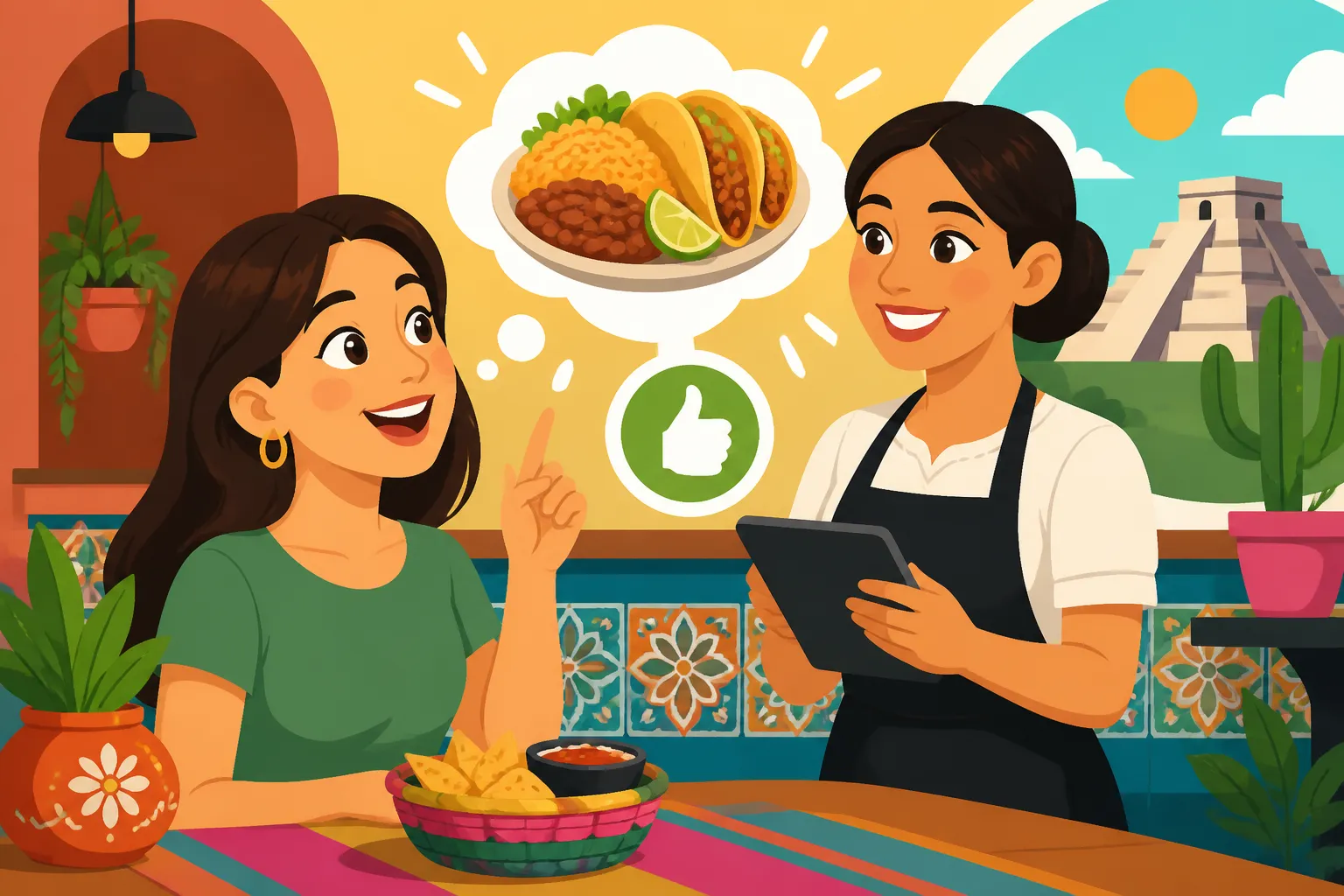
Asking for Recommendations: ¿Qué me recomienda?
Don't be shy! Mexicans are generally warm and hospitable, and they love to share their food culture. Asking for a recommendation is not only polite but can lead you to some truly authentic and delicious dishes you might not have picked otherwise.
Scenario: You've looked at the menu, and everything looks amazing (or confusing).
What to say:
- "Hola, ¿qué tal? ¿Qué me recomienda hoy?" (Hello, how are you? What do you recommend today?)
- "¿Cuál es el plato más popular?" (Which is the most popular dish?)
- "¿Qué es la especialidad de la casa?" (What is the house specialty?)
- If you have a preference: "Me gusta el pollo. ¿Qué plato de pollo me recomienda?" (I like chicken. What chicken dish do you recommend?)
They might describe something to you in Spanish. If you still don't understand, you can politely say, "Disculpe, ¿puede explicármelo un poco más lento, por favor?" (Excuse me, can you explain it a bit slower, please?) or "Lo siento, no entiendo. ¿Hay alguna foto?" (Sorry, I don't understand. Is there a photo?) Many modern restaurants even have QR code menus with pictures, which can be a lifesaver.
Your Essential Phrasebook for a Smooth Dining Experience
Now that you're a menu-decoding wizard, let's get down to the actual act of ordering. This is where those key phrases come in. You don't need to be fluent; you just need to know how to get your point across clearly and politely.
Getting Seated and Greeting Your Server
First impressions matter, even in a restaurant. A friendly greeting goes a long way.
-
Entering:
- "Hola, buenas tardes/noches." (Hello, good afternoon/evening.)
- "Una mesa para dos, por favor." (A table for two, please.)
- "¿Tienen una mesa libre?" (Do you have a free table?)
- If you have a reservation: "Tengo una reservación a nombre de [Your Name]." (I have a reservation under the name of [Your Name].)
-
When the server approaches:
- "Hola, ¿cómo está?" (Hello, how are you?)
- "Gracias." (Thank you.) – A simple one, but vital!
Placing Your Order with Confidence
This is the main event! The key is to be clear and use polite phrasing.
-
To start, you might be asked: "¿Qué van a tomar?" (What are you going to drink?) or "¿Están listos para ordenar?" (Are you ready to order?)
-
Your reply:
- "Sí, por favor." (Yes, please.)
- "Todavía no, un momento por favor." (Not yet, one moment please.)
- "Para mí, [dish name], por favor." (For me, [dish name], please.)
- "Quisiera [dish name], por favor." (I would like [dish name], please.) – This is a very polite way to say "I would like."
- "Me gustaría [dish name], por favor." (I would like [dish name], please.) – Another excellent polite option.
- "Voy a pedir [dish name], por favor." (I'm going to order [dish name], please.)
- When ordering for multiple people: "Para ella/él, [dish name]." (For her/him, [dish name].)
-
Ordering drinks:
- "Un agua mineral, por favor." (A sparkling water, please.)
- "Una Coca-Cola, por favor." (A Coca-Cola, please.)
- "Una cerveza [brand name], por favor." (A [brand name] beer, please.) – If you're exploring Tequila, Mezcal, and Mexican Drinking Culture, you might even try "Un mezcal/tequila, por favor."
-
If you need more time:
- "¿Me puede dar unos minutos más, por favor?" (Can you give me a few more minutes, please?)
Making Specific Requests
Sometimes you need an extra napkin, or your water is empty. Don't hesitate to ask!
- "Disculpe…" (Excuse me…) – Always start with this to get attention.
- "¿Me puede traer más agua, por favor?" (Can you bring me more water, please?)
- "¿Otra servilleta, por favor?" (Another napkin, please?)
- "¿Puedo tener un tenedor/cuchillo/cuchara?" (Can I have a fork/knife/spoon?)
- "Está delicioso, gracias." (It's delicious, thank you.) – Always a good phrase to throw in!
Asking About Ingredients and Allergies
This is crucial, especially if you have dietary restrictions or allergies. Don't assume anything.
- "¿Qué ingredientes lleva esto?" (What ingredients does this have?)
- "Soy alérgico/a a [ingredient]." (I am allergic to [ingredient].) – Important: "Soy alérgica" if you are female, "Soy alérgico" if male.
- "¿Contiene [ingredient]?" (Does it contain [ingredient]?)
- "¿Es picante?" (Is it spicy?)
- "Sin [ingredient], por favor." (Without [ingredient], please.) – E.g., "Sin cebolla, por favor" (Without onion, please).
Here’s a handy table of essential phrases to get you started:
| English Phrase | Spanish Phrase |
|---|---|
| Hello, good day/afternoon/evening. | Hola, buenos días/tardes/noches. |
| A table for two, please. | Una mesa para dos, por favor. |
| I would like dish, please. | Me gustaría dish, por favor. |
| For me, dish, please. | Para mí, dish, por favor. |
| What do you recommend? | ¿Qué me recomienda? |
| Is it spicy? | ¿Es picante? |
| Without [ingredient], please. | Sin [ingredient], por favor. |
| I am allergic to [ingredient]. | Soy alérgico/a a [ingredient]. |
| The bill, please. | La cuenta, por favor. |
| Thank you. | Gracias. |
| Please. | Por favor. |
| Excuse me. | Disculpe. |
Remember, even if your pronunciation isn't perfect, making the effort shows respect and will almost always be met with patience and helpfulness. The key is to speak slowly and clearly.
The Art of Special Requests: Dietary Needs and Customizing Your Meal
Living as an expat in Mexico, you quickly learn that while Mexican cuisine is incredibly diverse and delicious, it's not always easy to navigate with specific dietary needs. But don't despair! With the right phrases and a little patience, you can absolutely enjoy fantastic meals tailored to your preferences. This is especially true if you are mindful of your choices, as elaborated in Staying Healthy in Mexico: Essential Tips for Food, Water, and Preventive Care.
Vegetarian, Vegan, and Gluten-Free Options
The good news is that Mexican food, at its core, relies heavily on corn, beans, and vegetables, making it quite adaptable. However, you'll need to be explicit.
-
Vegetarian:
- "Soy vegetariano/a." (I am vegetarian – masculine/feminine.)
- "¿Tienen opciones vegetarianas?" (Do you have vegetarian options?)
- "¿Este plato lleva carne/pollo/pescado?" (Does this dish have meat/chicken/fish?) – Often, caldo de pollo (chicken broth) is used as a base, so you might need to confirm.
- Many traditional dishes like chiles rellenos (stuffed poblano peppers), sopa de tortilla (ask about broth), and enchiladas suizas can be made vegetarian. Don't be afraid to ask, "Se puede hacer vegetariano?" (Can it be made vegetarian?). You'll find more insights on this in Vegetarian and Vegan Food in Mexico.
-
Vegan: This requires a bit more specificity, as even seemingly vegetarian dishes might contain cheese (queso), sour cream (crema), or lard (manteca).
- "Soy vegano/a." (I am vegan – masculine/feminine.)
- "No como carne, pollo, pescado, lácteos ni huevos." (I don't eat meat, chicken, fish, dairy, or eggs.)
- "¿Tienen opciones veganas?" (Do you have vegan options?)
- Specify ingredients to avoid: "Sin queso, sin crema, sin manteca, por favor." (Without cheese, without cream, without lard, please.)
-
Gluten-Free: Many traditional Mexican dishes are naturally gluten-free because they use corn tortillas instead of flour.
- "Soy celíaco/a." (I am celiac – masculine/feminine.)
- "No puedo comer gluten." (I cannot eat gluten.)
- "¿Este plato lleva trigo o harina?" (Does this dish contain wheat or flour?)
- Ask if corn tortillas are available: "¿Tienen tortillas de maíz?" (Do you have corn tortillas?) – Nearly all places do! Be cautious of cross-contamination in kitchens, especially with fried items.
Modifying Your Dish: No Picante, Por Favor!
This is probably one of the most common requests. Mexicans generally love their food with a kick, and what's "mild" to them might still be fiery for you!
-
Less/No Spice:
- "No picante, por favor." (Not spicy, please.) – Essential!
- "Poco picante, por favor." (A little spicy, please.)
- "Sin chile, por favor." (Without chili, please.)
- If a dish comes with a side of chili, you can ask for it "aparte" (on the side): "El chile aparte, por favor."
-
Other modifications:
- "Sin cebolla, por favor." (Without onion, please.)
- "Sin cilantro, por favor." (Without cilantro, please.) – Yes, some of us exist!
- "Extra [ingredient], por favor." (Extra [ingredient], please.) – E.g., "Extra aguacate, por favor!"
Remember, while restaurants are generally accommodating, small street food stalls might have less flexibility, as dishes are often pre-prepared. When exploring local Street Food in Mexico: Tacos, Tamales, and More, it's good to be aware of this.
Dealing with Food Allergies
For serious allergies, always be extra cautious. While Mexicans are generally understanding, the concept of severe allergies requiring complete separation of ingredients might not be as universally understood as in some other countries.
- Be explicit and repeat if necessary.
- Write it down: Carry a small card with your allergy clearly stated in Spanish: "Soy alérgico/a a los [allergen]. Es muy peligroso para mí. ¿Este plato contiene [allergen]?" (I am allergic to [allergen]. It is very dangerous for me. Does this dish contain [allergen]?).
- Common allergens:
- Nueces (nuts)
- Cacahuetes (peanuts)
- Mariscos (seafood)
- Gluten (gluten)
- Lácteos (dairy)
- Huevo (egg)
Consider using a translation app for complex explanations, though remember to preface it with "Disculpe, uso un traductor porque mi español no es muy bueno" (Excuse me, I'm using a translator because my Spanish isn't very good). Sometimes, taking a food tour with a company like Viator can also give you the confidence to articulate your needs, as guides are often well-versed in local culinary practices and language nuances.
Wrapping Up Your Meal: La Cuenta, Payment, and Propina
You've successfully navigated the menu, placed your order, and enjoyed a fantastic meal. Now comes the grand finale: getting the bill, paying, and handling the propina (tip). This can be a point of cultural difference for many foreigners, but with a few simple phrases, it's nothing to stress over.
Requesting the Bill
Unlike in some other countries where the bill might automatically appear, in Mexico, it's generally considered rude for the server to bring the bill without you asking for it. Take your time, enjoy your post-meal conversation, and then make your request.
-
How to ask for the bill:
- "La cuenta, por favor." (The bill, please.) – This is the most common and polite way.
- "¿Me trae la cuenta, por favor?" (Can you bring me the bill, please?)
- You can also make a writing gesture in the air or a simple hand signal towards them if they are busy, but speaking the phrase is always best.
-
After receiving the bill:
- Take a moment to review it. Double-check that everything you ordered is listed correctly.
- If anything looks amiss, politely point it out: "Disculpe, creo que hay un error aquí." (Excuse me, I think there's a mistake here.)
- "No pedimos esto." (We didn't order this.)
Payment Methods and What to Expect
Mexico is a mix of cash and card, and it can vary wildly depending on the establishment.
-
Cash is King (Often!): Many smaller establishments, particularly street food vendors, fondas, and markets (like those you'd explore after reading Mexican Markets and Food Halls for Visitors), will be cash-only. Always carry smaller denominations of pesos. Don't expect them to have change for a 500-peso note if your meal is 80 pesos.
-
Credit/Debit Cards: Larger restaurants, cafes, and supermarkets will almost certainly accept cards.
- When you ask for the bill, the server might ask: "¿Efectivo o tarjeta?" (Cash or card?).
- If they don't ask, you can state your preference: "Con tarjeta, por favor." (With card, please.) or "En efectivo, por favor." (In cash, please.)
- Sometimes, they will bring a portable terminal to your table. Other times, you might need to go to a counter to pay.
- It's a good habit to keep some cash for smaller purchases, as discussed in Cash vs Card in Mexico: What Visitors Should Know.
-
Splitting the Bill: If you're dining with friends, splitting the bill can be tricky, as not all places have systems for it.
- "¿Podemos pagar por separado?" (Can we pay separately?)
- "¿Podemos pagar la mitad cada uno?" (Can we pay half each?)
- Often, the easiest way to split is for one person to pay the whole bill and then others pay them back in cash.
Navigating Tipping Culture (Propina)
Tipping culture in Mexico is similar to that in the US or Canada, but there are nuances.
-
Restaurants: A standard tip in sit-down restaurants is 10-15%. For exceptional service, 20% is appreciated but not necessarily expected.
- The tip (propina) is almost never included in the bill. If it is, it will be clearly stated as "servicio incluido" (service included), which is rare. Always assume it's not included unless explicitly stated.
- It's best to leave the tip in cash, even if you paid the main bill with a card. This ensures the tip goes directly to your server. You can say: "Aquí está para la propina." (Here is for the tip.)
- For a deeper understanding of this custom, refer to Tipping in Mexico (Propina): When and How Much.
-
Cafes/Bars: For just drinks or a quick coffee, 10% or rounding up is usually fine. There might be a tip jar on the counter.
-
Street Food Stalls: Tipping is generally not expected at simple street food stalls. However, if someone goes above and beyond, or if you're feeling generous, a few extra pesos (5-10 MXN) is a very kind gesture.
-
Leaving: Once you've paid and tipped, a simple "Gracias, adiós" (Thank you, goodbye) as you leave is polite.
Don't let the language barrier steal the joy from your Mexican culinary adventure. With these phrases and tips, you'll be ordering like a seasoned local, savoring every bite, and truly experiencing the warmth and flavor of Mexico. Enjoy your meals, ¡Buen provecho!
Disclaimer
The information provided in this guide is for general informational purposes only and does not constitute legal, financial, or immigration advice. While we strive to keep the information up-to-date and correct, rules, regulations, and economic conditions in Mexico can change rapidly. Always consult with qualified local professionals for advice tailored to your specific situation. We are not responsible for any actions taken based on the information in this article.