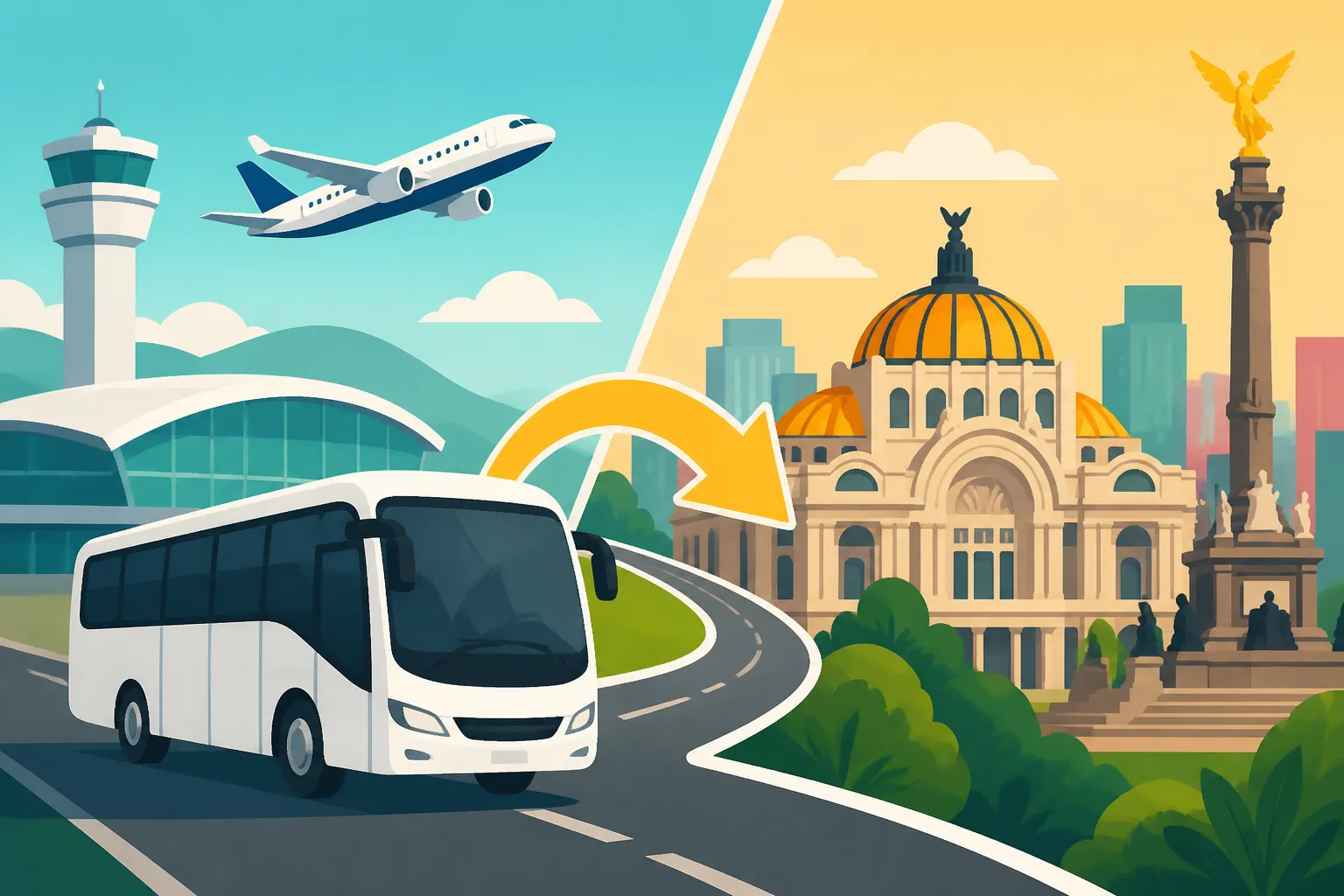
How to Get From Mexico City Airport to the Center
Arriving at Benito Juárez International Airport (MEX), commonly known as AICM, for the first time is a sensory overload of shouting taxi touts, confusing signage, and two sprawling terminals. It is incredibly easy to get overwhelmed, lose your bearings, and end up overcharged or lost within minutes of landing. This guide provides a detailed, veteran expat’s perspective on the safest, most efficient, and budget-friendly ways to reach Mexico City’s center, ensuring you start your trip on the right foot.
Disclosure: This post may contain affiliate links. We may earn a commission at no extra cost to you if you make a purchase through these links. Read full disclosure.
Understanding Mexico City International Airport AICM
The first thing you need to realize is that Mexico City’s airport is essentially two separate airports connected by a monorail. Where you land depends entirely on your airline. Terminal 1 is the older, massive complex that handles many international carriers and budget domestic airlines. Terminal 2 is newer, sleeker, and serves as the primary hub for Aeroméxico and its partners. Navigating between them can take 15 to 20 minutes, so knowing your terminal is the first step in planning your exit.
Terminal 1 vs Terminal 2
If you land at Terminal 1, you are closer to the city’s Metro system, but the terminal itself is a labyrinth. You will find most of the international car rental agencies and currency exchange booths here. Terminal 2 is more compact but often feels more crowded because of the high volume of Aeroméxico flights. If you accidentally end up in the wrong terminal or have a connecting flight, you can use the Aerotrén (monorail), provided you have a boarding pass. Otherwise, you will have to take a specialized bus that runs between the two for a small fee.
When you exit the secure customs area, you will be greeted by a wall of people. Many will be holding signs, but many more will be "independent" taxi drivers trying to grab your luggage. As a veteran who has navigated this dozens of times, my best advice is to keep walking. Do not engage with anyone who approaches you inside the terminal offering a ride. Only authorized transportation is safe and regulated here.
Layout and Navigation for First Timers
Signs in AICM are generally bilingual, but the sheer volume of shops, restaurants, and people can make them hard to spot. Follow the icons for "Transporte Terrestre" (Ground Transportation). If you are looking for the center of the city—usually meaning the Zócalo, Reforma, Roma, or Condesa—you have several tiers of options ranging from the dirt-cheap Metro to luxury private transfers.
Before you even step outside, you might want to look into your accommodation. If you haven’t booked yet, checking Booking.com for a hotel in the Centro Histórico or near the Paseo de la Reforma is a smart move, as these areas are the most accessible from the airport via public transit and authorized taxis.
The Safest Bet Authorized Airport Taxis
For most newcomers, the authorized airport taxi system is the gold standard. It is safe, regulated, and operates on a fixed-price system based on zones. You don't have to worry about a meter running up while you are stuck in the infamous Mexico City traffic, and you don't have to negotiate with the driver.
How the Authorized Taxi System Works
You will see several booths labeled "Taxi Autorizado" near the exit gates of both terminals. Common companies include Sitio 300, Nueva Imagen, and Porto Taxi. You walk up to the booth, tell the attendant your destination or the neighborhood (Colonia), and pay right there. They accept cash (pesos) and most major credit cards.
The attendant will give you a paper ticket. You then walk to the designated taxi line outside, where a coordinator will take your ticket and point you to a specific car. You do not pay the driver anything for the fare itself, though a small tip for handling bags is customary. This system is designed to prevent the "long-hauling" or price gouging that often plagues tourists. For those worried about safety, these companies are vetted, and you can find more tips on this in our guide on Safety in Mexico: What Expats Need to Know About Staying Safe.
Comparing the Different Taxi Booths
In reality, there isn't a massive difference in price between the major companies like Nueva Imagen or Sitio 300. However, some offer different vehicle sizes. If you are traveling with a large family or excessive luggage, ask for an "Ejecutivo" or a van (Camioneta). The price will be higher than a sedan, but you won't be trying to cram four suitcases into a tiny trunk.
| Transport Option | Est. Cost (MXN) | Travel Time | Convenience Level |
|---|---|---|---|
| Metrobus (Line 4) | $30 | 45-60 mins | High (Budget) |
| Authorized Taxi | $250 – $450 | 30-50 mins | Very High |
| Uber / Didi | $150 – $300 | 30-50 mins | Moderate (Pickup Hurdles) |
| Private Transfer | $600+ | 30-40 mins | Premium |
| Metro (Subway) | $5 | 50-70 mins | Low (No large luggage at peak hours) |
Ridesharing Apps Uber and Didi at the Airport
If you are used to using apps like Uber or Didi, you can use them at AICM, but there is a major catch. There has been an ongoing legal battle between the "taxi union" and rideshare apps. Technically, federal zones (like airports) sometimes restrict non-authorized cars from picking up passengers.
The Legal Gray Area and Pickup Logistics
In practice, Ubers still pick up passengers every day, but the pickup points are often not directly at the terminal curb. You might have to walk to a specific gate or even slightly away from the terminal to meet your driver. Drivers will often message you to confirm you are at a specific "Punto de Encuentro." Be prepared to move quickly, as they cannot linger at the curb without risking a fine from the airport police.
Using an app is usually cheaper than an authorized taxi, but when you factor in the stress of finding your driver in the chaotic pickup lanes, it might not be worth the $100 MXN savings. If you do choose this route, make sure you have a working data plan. You can read our advice on How to Get a SIM Card in Mexico as a Foreigner to ensure you are connected the moment you land.
Pros and Cons of Using Apps vs Taxis
The pro is obviously the price and the familiar interface. The con is the potential for a "phantom" cancellation or the driver asking you to sit in the front seat to look like a friend rather than a commercial passenger. If you are arriving late at night or during a rainstorm, the wait times for an Uber can skyrocket, making the authorized taxi line much more appealing. For more on how these services compare across the country, see our detailed breakdown on Taxis, Uber, and Ride-Hailing in Mexico.
Public Transport The Metrobus and Metro
For the budget-conscious traveler or the adventurous expat, Mexico City’s public transport is world-class, provided you know the rules. The airport is surprisingly well-connected, but it isn't always luggage-friendly.
Line 4 Metrobus The Direct Link to the Center
Line 4 of the Metrobus is specifically designed to serve the airport. It has dedicated space for luggage and picks up passengers at both Terminal 1 and Terminal 2. This line goes directly to the Centro Histórico, making stops at the Buenavista train station and near the Zócalo. It costs 30 pesos (about $1.50 USD), which is a steal compared to a taxi.
To use the Metrobus, you must have a "Tarjeta de Movilidad Integrada" (Integrated Mobility Card). You can buy these at vending machines near the Metrobus boarding areas. You can't pay the driver in cash. This is a great way to see the city as you arrive, but keep in mind that at peak hours (8:00 AM to 10:00 AM and 6:00 PM to 8:00 PM), even the airport buses can get very crowded.
Navigating the Metro with Luggage Warning
The Mexico City Metro (the subway) has a station called "Terminal Aérea" on Line 5, right outside Terminal 1. It is the cheapest way to get to the center (5 pesos), but I rarely recommend it for new arrivals. Why? Because the Metro officially prohibits "large or bulky luggage" during peak hours, and honestly, navigating the stairs and transfers with a 50lb suitcase is a nightmare.
If you are a backpacker with a single carry-on, go for it. But if you have a checked bag, the Metrobus is a much better choice. For a complete map of the system, check out Getting Around Mexico City: Metro, Metrobús, and Apps.
Private Transfers and Specialized Services
If you want the "VIP" experience—someone waiting for you with a sign, helping with your bags, and whisking you away in a late-model suburban—private transfers are the way to go. This is particularly popular for business travelers or those arriving with young children.
Booking Private Drivers and Group Shuttles
You can book these services in advance through platforms like Viator. This eliminates all the guesswork. You pay ahead of time, and the driver tracks your flight. If your flight is delayed (a common occurrence at MEX), they will still be there. For those traveling further afield, such as to Puebla or Querétaro directly from the airport, you might check Busbud for luxury coach schedules that depart right from the airport terminals.
When to Book in Advance
If you are arriving during a major holiday like Day of the Dead or Christmas, the airport can become an absolute madhouse. In these cases, having a pre-arranged transfer can save you an hour of waiting in taxi lines. It’s also a good idea if you are heading to a specialized location, like a hospital for a medical appointment. If that's the case, you might want to look into Healthcare in Mexico City: Top Hospitals and Clinics for Expats to find the best facilities near your destination.
Practical Tips for a Smooth Arrival
Before you step into any vehicle, there are a few "boots-on-the-ground" details that will make your life much easier. Mexico City is a high-altitude, fast-paced megalopolis, and being prepared pays off.
Currency Exchange and SIM Cards
While you can pay for taxis with a card, having some cash is essential for tips or a quick snack. The exchange rates at the airport are actually surprisingly competitive compared to hotels, though usually not as good as a local ATM. Look for the "Best Rates" booths located in the halls between the gates and the exit. For more on managing your money, visit our guide on Best Banks in Mexico for Expats: Comparing Fees and Services.
Safety and Scams to Avoid
The most common "scam" is simply the unofficial taxi driver who tells you the Metro is closed or that the authorized taxi line is "two hours long" when it isn't. They will lead you to a private car and then charge you triple the official rate at the end of the trip. Always stick to the official booths.
Additionally, keep your phone and wallet secure in the crowded terminal areas. While the airport is generally safe, pickpockets thrive in the "bottleneck" areas near the customs exits. Once you are in your authorized taxi, you can relax and enjoy the view of the city as you head toward your stay.
Disclaimer
The information provided in this guide is based on current regulations and personal experience as of early 2026. Transport prices, airport policies, and rideshare legality in Mexico are subject to frequent change without prior notice. Always verify current rates at official airport booths and consult with your local embassy or airline for the most up-to-date travel requirements.