San Miguel de Allende for Visitors
You booked San Miguel de Allende after seeing photos of that pink Gothic church glowing at sunset. Then the questions arrive. Which airport do you use, since the town has none? Where should you stay to avoid steep hills and church bells at dawn? Is a week too long? This guide covers transport, neighborhoods, sights, day trips and the practical details first-timers usually learn too late.
Disclosure: This post may contain affiliate links. We may earn a commission at no extra cost to you if you make a purchase through these links. Read full disclosure.
Getting to San Miguel de Allende Without the Headaches
The first surprise for most visitors is that San Miguel de Allende has no commercial airport. Every route here ends with a stretch of road. That can feel annoying when you are planning from abroad, but it is one reason the town has kept its unhurried, walkable character. I have arrived every possible way, including one regrettable overnight bus with a broken air conditioner. The trick is choosing the route that suits your budget, your luggage and how tired you will be when you land.
Flying In via Querétaro or León
Most international visitors fly into one of two airports. Querétaro Intercontinental Airport is usually the closer option by road. Del Bajío International Airport near León is a bit farther, but it often has a wider choice of flights from US hubs. Both airports are small and easy to manage compared with Mexico City’s main airport. That matters a lot after a long travel day.
From either airport you have three realistic choices. You can pre-book a shared shuttle, hire a private driver, or rent a car. Shared shuttles are the budget-friendly middle ground. You share the van with other travelers and are dropped near your hotel, though you may wait for other passengers or make a few stops in town. Private drivers cost more, but they meet you at arrivals and take you straight to your door. If you land late at night, that is worth paying for. Many hotels and guesthouses in San Miguel will arrange a driver if you ask, and I would trust your host’s recommendation over an unknown name from a forum.
Here is the scenario I see repeatedly. A couple lands in León at dusk and decides to “figure out transport at the airport.” They end up waiting while tired and paying more than they would have if they had booked ahead. Arrange your transfer before you fly. It costs nothing to reserve with most operators, and it saves you from negotiating in Spanish while half asleep.
Taking the Bus from Mexico City
If you are combining San Miguel with Mexico City, the long-distance bus is excellent. First-class lines such as Primera Plus and ETN run from Terminal Central del Norte in the north of the capital. The seats recline, the buses have bathrooms, and some even have individual screens. Mexican first-class buses are a different experience from what many North Americans picture when they hear “bus.” For a full rundown on lines and comfort tiers, see Long-Distance Buses in Mexico: ADO and Premium Lines.
Schedules change, and premium departures can sell out on Friday afternoons and holiday weekends, when residents of the capital head to the Bajío. A booking platform like Busbud is useful here. You can compare departure times and operators side by side before you commit, which beats juggling several Spanish-language bus company websites. Always check the arrival terminal on your ticket. San Miguel’s bus station sits on the edge of town, so you will need a short taxi ride to reach the center, especially with luggage on cobblestones.
My practical advice is to bring a light layer even in warm months. Mexican buses keep the air conditioning very cold, and passengers in shorts end up shivering for hours. If you are new to intercity travel here, How to Travel Between Cities in Mexico by Bus walks through ticket purchase and terminal etiquette step by step.
Driving Yourself
Renting a car gives you freedom for day trips to vineyards, hot springs and nearby towns. In San Miguel itself, though, a car becomes a burden. The historic center has narrow one-way streets, steep slopes, and very little parking. If you rent, choose accommodation with secure parking and expect to leave the car there most of the day. You will explore the center on foot anyway.
The toll highways connecting Querétaro, Celaya and San Miguel are generally in good condition. As anywhere in Mexico, the usual advice applies: drive in daylight, use the toll roads where possible, and watch for topes, the speed bumps that appear with little warning at the entrance to every village.
| Route | Best For | Main Advantage | Main Drawback |
|---|---|---|---|
| Fly to Querétaro plus transfer | Short trips, most travelers | Usually the shortest road leg | Fewer international routes |
| Fly to León plus transfer | Travelers wanting more flight options | Wider choice of US connections | Longer drive to town |
| First-class bus from Mexico City | Combining San Miguel with the capital | Comfortable and easy to book | Peak weekends sell out |
| Rental car | Day trips and rural exploring | Total flexibility | Parking in Centro is very difficult |
Where to Stay in San Miguel de Allende
Where you sleep shapes your whole visit here more than in most Mexican destinations. The town is built on a hillside, so a hotel described as “a ten-minute walk from the Jardín” can mean a pleasant stroll down or a lung-burning climb back up. Think about your fitness and your tolerance for noise before you fall for a rooftop photo.
Centro and the Jardín
Staying in Centro puts you within walking distance of nearly everything: the Parroquia, the main restaurants, galleries, the artisan market and the evening atmosphere around the Jardín Principal. For a first visit, especially a short one, this is where I send almost everyone. You step out the door and you are in the postcard.
The trade-off is sound. Church bells ring early and often. Mariachis play in the square until late, wedding processions with brass bands and giant papier-mâché figures pass through on weekends, and fireworks go off at hours that will astonish you. If you sleep lightly, ask for a room facing an interior courtyard rather than the street, and pack earplugs. Locals barely notice the noise. Visitors spend the first night wondering whether something is wrong.
Guadiana, San Antonio, and Atascadero
If you prefer a quieter base, a few nearby neighborhoods work well. Guadiana sits just south of Centro, close to Parque Juárez. It is leafy and residential, and still an easy walk from the action. San Antonio, a little farther southwest, feels more local and has small cafés and taquerías where you will hear more Spanish than English. Both are relatively flat compared with the hills on the eastern side of town.
Atascadero and the hillside areas above Centro offer the famous views. You can see the whole town spread below you with the Parroquia’s spires at its heart. They are beautiful, but the walk back up is serious at this altitude. I have watched fit visitors stop halfway, red-faced and laughing at themselves. If you stay up there, plan on taxis for the return trip and treat the downhill walk as a scenic bonus.
Hotels, Boutique Inns, and Rentals
San Miguel has a strong boutique hotel scene: converted colonial mansions with courtyards, fountains and rooftop terraces. There are also simple family-run guesthouses and a large supply of vacation rentals. Booking.com is handy for comparing all three in one place. Filter for features that matter in this specific town, such as secure parking if you are driving, and heating, because highland nights get surprisingly cold in winter and many older buildings have none. Read recent reviews for mentions of noise and stairs. Many historic properties have no elevator.
For a broader look at lodging types across the country, Accommodation in Mexico: Hotels, Hostels, and Rentals explains the differences. If you are thinking of using San Miguel as a base and branching out, Where to Stay in Queretaro and Guanajuato: Colonial City Bases covers the neighboring cities. Book early for any major festival or holiday period. Rooms fill quickly, and last-minute rates climb sharply.
The Best Things to Do in San Miguel de Allende
San Miguel rewards slow travel. The town’s appeal is less about ticking off sights and more about the rhythm of long breakfasts, gallery browsing, sunset drinks on a rooftop, and wandering callejones lined with bougainvillea. That said, there are places you should not miss.
The Parroquia and the Historic Core
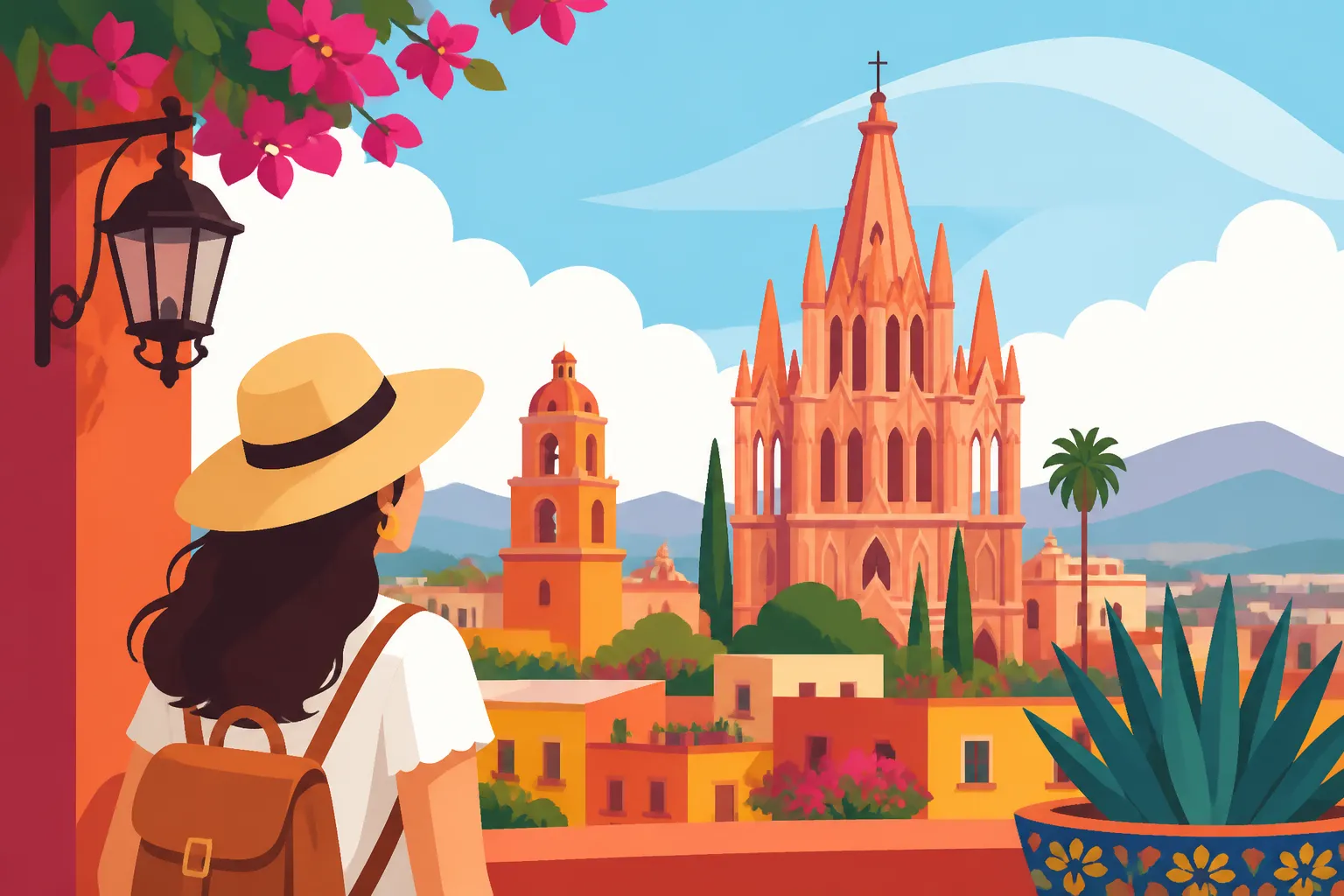
The Parroquia de San Miguel Arcángel is the image everyone knows. Its pink sandstone neo-Gothic facade was added to an older church by a local builder who, according to the story residents love to tell, worked from postcards of European cathedrals. Visit at different times of day. In the morning light it looks pale and delicate. At sunset it turns rose-gold, and at night it glows under floodlights. Step inside quietly, as it is an active parish.
Directly in front sits the Jardín Principal, the town’s living room. Sit on a wrought-iron bench, buy a corn cup from a street vendor, and watch the town go by: families, dancing couples, kids chasing pigeons, and mariachis hoping you will request a song. Just off the square, the Museo Histórico Casa de Allende occupies the birthplace of Ignacio Allende. He was one of the leaders of Mexico’s independence movement, and the town later took his name. The museum gives useful context on why this quiet colonial town holds such a central place in national history, and it is a good stop before you visit Dolores Hidalgo.
Several other churches deserve a few minutes each: the Templo de San Francisco with its ornate churrigueresque facade, and the Oratorio de San Felipe Neri. San Miguel and the nearby Sanctuary of Atotonilco are jointly recognized as a UNESCO World Heritage Site. Mexico’s UNESCO World Heritage Sites: A Visitor’s Guide explains how they fit into the country’s wider list.
Art, Galleries, and Fábrica La Aurora
San Miguel has drawn artists for generations, and it shows. The Centro Cultural Ignacio Ramírez, known locally as Bellas Artes, is housed in a former convent. It holds an unfinished mural by David Alfaro Siqueiros, and its courtyard is a peaceful place to rest your legs. Classes and exhibitions run throughout the year, and the noticeboards are a good way to find out what is on.
Fábrica La Aurora, a former textile factory on the northern edge of Centro, now houses studios, galleries, design shops and cafés. Plan an unhurried morning there. Some artists work in open studios and are happy to chat. Prices range from affordable prints to serious collector pieces, so browse without pressure.
For handicrafts, the Mercado de Artesanías winds down a long alley near the Mercado Ignacio Ramírez. You will find tin work, papel picado, glassware, textiles and pottery. Some of it is made locally and some comes from other states. Polite bargaining is acceptable at stalls, though not in galleries. Mexican Crafts (Artesanías): What to Buy and Where can help you tell regional pieces apart and avoid paying artisan prices for mass-produced items.
Gardens, Viewpoints, and Walks
El Charco del Ingenio is a botanical garden and nature reserve on the hill above town. It is known for its cactus and succulent collection and its walking trails along a canyon. It is a lovely morning outing, especially after rain when the landscape turns green. Bring water and a hat, because the sun is strong at this elevation.
The Mirador, the lookout on the road above Centro, offers the classic panorama of the town at sunset. Many visitors walk up. Others take a taxi up and stroll back down through the old streets as the lights come on. Down in Guadiana, Parque Juárez is shady and calm, and nearby are the old public washing basins at El Chorro, where tradition says the town’s original spring was found.
My favorite activity is the simplest one: walking with no plan. Pick a direction, follow the colorful doors and climbing vines, and peer through open zaguanes into hidden courtyards. Just wear proper shoes. The cobblestones are uneven and polished smooth in places, and stylish sandals are the cause of more twisted ankles here than anything else.
Day Trips and Side Adventures
Once you have absorbed the town itself, the surrounding Bajío region opens up. It offers colonial cities, sacred sites, hot springs and a growing wine scene, most of them reachable within a morning’s drive.
Atotonilco and Dolores Hidalgo
The Sanctuary of Jesús Nazareno de Atotonilco lies a short drive outside town. It is often called the “Sistine Chapel of Mexico” because its interior is covered in vivid folk-baroque murals. Visitors often find it unexpectedly moving. It is still an important pilgrimage site, so dress modestly and keep your voice down. Combine it with a soak at one of the hot springs on the same road.
Farther along, Dolores Hidalgo is where the call to independence rang out from the parish church, an event commemorated nationwide every September. The town is also famous for its colorful Talavera-style ceramics and for ice cream stands selling startling flavors, from avocado to shrimp. Dolores Hidalgo is one of the region’s designated Magic Towns. Colonial Towns and Pueblos Mágicos puts it in context with other small historic towns worth a detour.
Guanajuato City
Guanajuato is a completely different experience, and many visitors love it even more than San Miguel. It is a former silver-mining city packed into a ravine, with houses painted in every color climbing the hillsides, roads that run through underground tunnels, and a lively student population. Highlights include the Teatro Juárez, the Callejón del Beso, and the funicular up to the Pípila monument for the view.
You can do it as a long day trip, but it deserves at least one night if you can manage it. Guanajuato has a strong nightlife centered on its university, and the callejoneadas, roving musical walks led by costumed minstrels, happen in the evening. See Guanajuato: Colorful Streets and History for the background and How to Visit Guanajuato as a Tourist for logistics.
If you do not want to drive, guided day tours to Guanajuato, Atotonilco and Dolores Hidalgo are widely available. Viator lists a range of these, from small-group outings to private drivers. That is useful for checking itineraries, inclusions and recent reviews before you go. Local agencies around the Jardín sell similar trips. Compare both, since sometimes booking on the ground is cheaper and sometimes the platform’s cancellation terms win. Booking Tours in Mexico Online: Platform Prices vs Booking on the Ground goes deeper into that trade-off.
Hot Springs, Vineyards, and Balloons
The hot springs near San Miguel are a highlight, especially on cool mornings. La Gruta is the best known: you wade through a tunnel into a warm, steamy cave pool. Escondido Place is a quieter, garden-style alternative. Go early on weekdays to avoid crowds. Weekends fill up with day-trippers from Mexico City.
The Guanajuato wine route has grown quickly, with vineyards around San Miguel and Dolores Hidalgo offering tastings, lunches and tours. Dos Búhos, close to town, and Cuna de Tierra, near Dolores Hidalgo, are two names visitors often mention. Arrange a driver rather than combining tastings with a rental car.
Hot air balloon flights at sunrise are another popular splurge, floating over the town and the surrounding countryside as the light comes up. Flights depend entirely on weather, and early-morning pickups are standard. Hot Air Balloon Rides in Mexico: Teotihuacan and Beyond explains what to check before booking any operator, from safety records to what happens if your flight is cancelled.
When to Visit and How to Handle the Practical Stuff
Choosing your dates and preparing for a few local realities will make the difference between a lovely trip and a frustrating one.
Seasons, Festivals, and Crowds
San Miguel has a mild highland climate, but it changes noticeably through the year. Winter days are sunny and pleasant, while nights can be properly cold. Spring is the warmest and driest stretch, with jacarandas blooming in purple across town. The rainy season, roughly the summer months, usually brings afternoon storms rather than all-day rain, and the hills turn green. Autumn is clear and comfortable.
Festivals are part of the town’s identity. The Alborada, honoring the archangel Michael, the town’s patron saint, takes place in late September with fireworks before dawn and processions through the streets. Semana Santa brings solemn processions and carpets of flowers. Día de Muertos fills the town with altars, marigolds and catrina face paint. For general guidance on these events, see Local Fiestas and Patron Saint Festivals in Mexico and Día de Muertos in Mexico: A Visitor’s Guide.
| Season | Weather Pattern | What to Expect | Pack |
|---|---|---|---|
| Winter | Sunny days, cold nights | Busy with snowbirds and holiday visitors | Warm jacket, layers |
| Spring | Warmest and driest | Jacarandas, Semana Santa crowds | Sun hat, sunscreen |
| Summer | Afternoon storms | Greener, fewer visitors on weekdays | Light rain jacket, umbrella |
| Autumn | Clear and comfortable | Alborada and Día de Muertos events | Layers, earplugs for fireworks |
Weekends are busy all year because of visitors from Mexico City, Querétaro and Guadalajara. If your dates are flexible, a Monday-to-Thursday stay means quieter streets, easier restaurant reservations and often better room rates. For a compact itinerary, How to Spend a Weekend in San Miguel de Allende lays out how to use limited time well.
Altitude, Cobblestones, and Weather
San Miguel sits high in the central highlands, close to two kilometers above sea level. You may notice it in your first day or two: shortness of breath on hills, mild headaches, and feeling tipsy faster than usual. Drink plenty of water, go easy on alcohol the first evening, and save the hilltop walks for day two. Living at High Altitude: Tips for Expats in Mexico City and Highland Areas offers more on adjusting comfortably.
The cobblestones deserve repeating. Bring supportive shoes with good grip, especially after rain, when the stones turn slippery. Wheelchair users and travelers with limited mobility will find parts of Centro challenging. Sidewalks are narrow and steps appear without warning, so choose ground-floor rooms and flatter neighborhoods.
The sun is intense at this elevation even when the air feels cool, so wear sunscreen and a hat. Mornings and evenings can be chilly outside summer, which surprises visitors who packed only for “Mexico.” San Miguel’s style also tends to be smart-casual. Locals dress up a bit for dinner. Dress Code in Mexico: What to Wear for Different Occasions will help you pack without overthinking.
Money, Tipping, and Getting Around Town
San Miguel is one of the more expensive destinations in central Mexico, particularly for dining and boutique lodging. Many restaurants and hotels accept cards. Market stalls, street food, small taquerías and taxis usually expect cash, so keep pesos on hand in smaller denominations. Use ATMs inside banks or shopping areas during daytime. When a card machine or ATM offers to charge you in your home currency, choose pesos.
Tipping follows national norms. Restaurant staff expect a tip, and musicians who play at your table expect something too. Grocery baggers, hotel housekeeping and guides also appreciate a gesture. Check whether a service charge has already been added to your bill, which happens more in tourist-heavy places.
For getting around, your feet are the main transport in Centro. Taxis are plentiful, and drivers generally know every hotel. Confirm the fare before you get in, as most local taxis do not use meters. Ride-hailing availability has varied over time here, so do not count on it. Keep a taxi number from your hotel saved on your phone. San Miguel is widely regarded as one of the calmer destinations in the country. Normal precautions still apply: watch your phone in crowds during festivals, take a taxi late at night when you are far from Centro, and keep valuables out of sight.
Give yourself at least three full days. That leaves time for the town itself, one day trip, and the long, lazy afternoons that make San Miguel addictive. Many visitors who planned a short stop end up extending, and some come back to live. If you leave already scrolling rental listings, that happens to plenty of people.
Disclaimer
This article is for general informational purposes only and does not constitute professional advice. Laws, prices and regulations vary by location and change over time. Consult a qualified professional for guidance on your specific situation.