Beach Town vs Mountain City: Choosing the Right Environment in Mexico
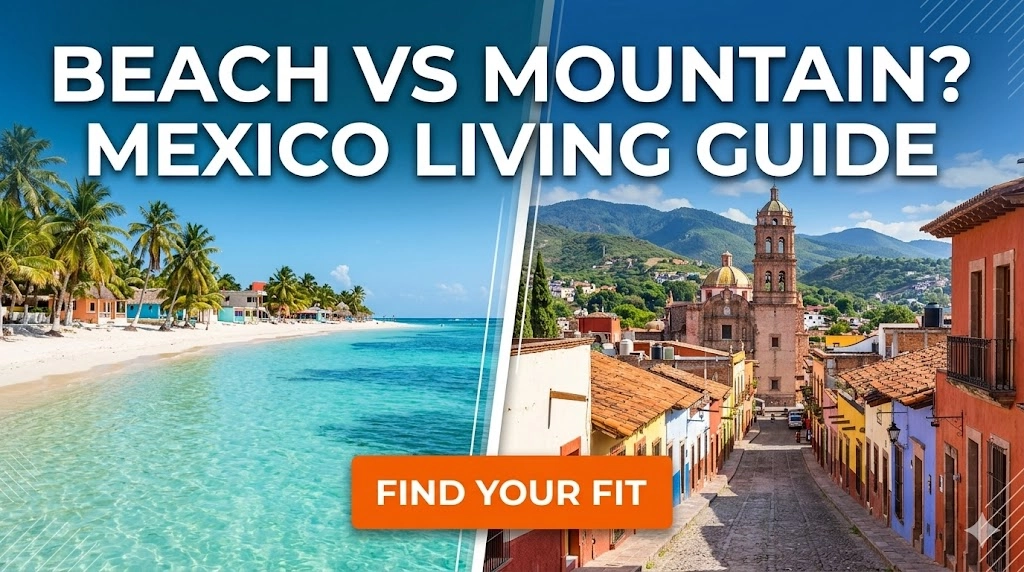
Sweating through my shirt while battling black mold on my favorite leather shoes in Playa del Carmen made me question my entire relocation. I once thought living in a Mexican beach town was the ultimate dream, until the brutal humidity forced me to reconsider the colonial highlands. This guide breaks down the physical, logistical, and financial realities of coastal versus mountain living so you can choose the exact environment where you will thrive.
Disclosure: This post may contain affiliate links. We may earn a commission at no extra cost to you if you make a purchase through these links. Read full disclosure.
The Climate Shock and Physical Toll
The Searing Reality of Coastal Humidity
Many expats envision sitting on a sun-drenched patio in Tulum or Puerto Vallarta, sipping a margarita while a gentle ocean breeze keeps them perfectly cool. The reality of coastal Mexico, particularly from May through October, is a relentless, suffocating humidity that fundamentally alters how you live. The heat index can easily push past 100°F (38°C), and the air is so thick with moisture that stepping outside feels like walking into a wet towel. You will sweat through your clothes within ten minutes of leaving your air-conditioned bedroom.
During the summer rainy season, this extreme humidity breeds absolute chaos in your daily life. Black mold becomes your sworn enemy, attacking leather bags, belts, and the backs of wooden cabinets within days if left unchecked. You cannot simply open a window to air out the house; doing so only invites more moisture and mosquitoes inside. The intense coastal climate forces you to live in a sealed, climate-controlled bubble for half the year, which dramatically spikes your monthly utility bills.
Furthermore, coastal living means accepting the reality of hurricane season. From the Riviera Maya to the Baja Peninsula, tropical storms can cause massive flooding, multi-day power outages, and severe infrastructural damage. You must have an evacuation plan and emergency supplies ready at a moment’s notice. If you are not prepared to manage the physical exhaustion of perpetual summer heat and the anxiety of severe weather alerts, the romanticized beach town lifestyle will quickly lose its appeal.
The Hidden Chill of High Altitude Mountains
Expats who flee the coastal heat often head straight for the colonial highlands—cities like San Miguel de Allende, Oaxaca, or the sprawling metropolis of Mexico City. These mountain cities are frequently marketed as having an “eternal spring” climate. While the days are often spectacularly sunny and comfortably warm, new arrivals are almost always blindsided by the bitter, inescapable chill of the mountain nights.
Because traditional Mexican architecture is specifically designed to stay cool in the summer, houses in the highlands completely lack central heating and proper insulation. They are built with thick concrete, stone, or brick walls that absorb the night’s cold and trap it inside. During the winter months (December through February), the temperature inside your living room can easily drop into the low 40s°F (5°C). I remember wearing a winter coat, a beanie, and heavy wool socks just to comfortably eat breakfast in my unheated kitchen in Guanajuato.
Additionally, the altitude itself is a massive physical hurdle. Mexico City sits at roughly 7,300 feet, while San Miguel de Allende is over 6,000 feet above sea level. When you first arrive, your body will violently rebel. You will likely experience mild altitude sickness, characterized by shortness of breath from simply walking up a flight of stairs, sudden fatigue, persistent dull headaches, and severe dehydration. It takes several weeks for your cardiovascular system to acclimate to the thinner air, meaning your initial exploration of the city will be physically exhausting.
Managing Your Health and Environment
The specific climate you choose directly impacts your physical well-being. On the coast, the constant heat and humidity can lead to severe lethargy, chronic dehydration, and dangerous fungal skin infections if you are not meticulously dry. However, for older expats suffering from severe arthritis or joint pain, the warm, heavy, pressurized coastal air often provides profound, life-changing relief compared to cold, damp climates up north.
In the mountains, the dry, thin air presents the exact opposite set of challenges. Expats with asthma, COPD, or other respiratory issues often struggle immensely in the highlands, especially during the spring agricultural burning season when the valleys fill with smoke. You will find yourself constantly applying heavy moisturizers and lip balm, and you must aggressively increase your water intake to combat the invisible, rapid moisture loss at high altitudes.
Regardless of which environment you choose, you must actively engineer your indoor climate to protect your health. For coastal residents, this means investing heavily in commercial-grade dehumidifiers to fight mold. For mountain residents, it means buying reliable, safe space heaters and heavy winter duvets. Because finding high-quality, specialized climate-control appliances in local Mexican hardware stores is often an exercise in pure frustration, veteran expats bypass the local supply chain and order directly through Amazon Mexico. Utilizing the localized Amazon Mexico platform ensures you can quickly secure the exact HEPA air purifiers, heavy-duty dehumidifiers, or ceramic space heaters you need to survive the extreme seasonal shifts without battling international customs delays.
Housing Realities and Infrastructure
Battling the Elements in Beach Homes
Living directly on the coast means waging a perpetual, expensive war against salt air and corrosion. The romantic idea of opening your balcony doors to let the sea breeze in quickly dies when you realize that same breeze is carrying microscopic salt particles that will relentlessly destroy your electronics, your appliances, and your vehicle.
If you rent or buy a home within a few miles of the ocean in places like Playa del Carmen or Mazatlán, you will notice that anything made of cheap metal rusts within months. Screws in your laptop, the hinges on your front door, and the exposed coils on your refrigerator are all highly vulnerable. You must constantly wipe down surfaces and accept that appliances in beach towns have a significantly shorter lifespan than they do inland.
Furthermore, coastal infrastructure is often battered by the elements. The intense tropical sun bleaches exterior paint rapidly, and the torrential summer rains expose every single hidden leak in a flat concrete roof. You must become incredibly proactive about waterproofing (impermeabilización) your roof every two to three years. If you are navigating the complex responsibilities of structural maintenance in a rental agreement versus a purchased home, you must thoroughly read Real Estate in Mexico: Renting vs Buying for Expats.
Colonial Charm and Structural Quirks
Mountain cities offer stunning, deeply historic architecture. Living in a 200-year-old colonial home with soaring vaulted ceilings, interior courtyards, and beautiful Talavera tilework is a dream for many expats. However, that historic charm comes with profound structural quirks that can test your patience daily.
The plumbing in colonial mountain towns is often ancient and highly fragile. In many historic homes, you cannot flush toilet paper; it must be thrown in a designated bin to avoid catastrophic clogs. Water pressure is frequently reliant entirely on gravity from a rooftop tank (tinaco), meaning your morning shower might be a disappointing trickle unless you install a pressurized pump. Additionally, older homes have remarkably few electrical outlets, and the wiring is rarely grounded, which poses a severe risk to your expensive laptops and televisions during a power surge.
The charming cobblestone streets (adoquines) that make mountain towns so photogenic are also brutal on your physical body and your vehicles. Walking on uneven cobblestones requires sturdy footwear and intense vigilance to avoid twisting an ankle. If you have any mobility issues, navigating the steep, narrow, historic streets of a city like Guanajuato or Taxco can quickly lead to intense isolation.
Outfitting Your Unfurnished Mexican Home
Whether you choose a beachfront condo or a mountain casita, you must prepare for the brutal reality of the Mexican rental market: “unfurnished” (sin amueblar) means completely, echoing empty. In Mexico, an unfurnished home rarely includes a refrigerator, a stove, or even built-in closets. You are essentially renting a concrete shell and are entirely responsible for outfitting the functional interior.
This requires a massive upfront cash investment during your first week in the country. You must navigate chaotic local big-box stores to buy heavy appliances, arrange complex deliveries in Spanish, and hope the items fit through your narrow colonial doorways. To understand the exact administrative hurdles of getting the lights and water turned on in these empty units, you must carefully study Setting Up Utilities in Mexico: Electricity, Water, and Internet.
To minimize this massive logistical headache, expats heavily rely on localized e-commerce. Instead of fighting traffic and language barriers to find a specific mattress, ergonomic desk chairs, or high-quality kitchenware, you can order them directly through Amazon Mexico. The convenience of having heavy, specialized household items delivered reliably to your new, empty apartment allows you to focus your energy on unpacking and exploring your new neighborhood rather than fighting the local retail supply chain.
Connectivity and Remote Work Logistics
Wi Fi Struggles on the Coast
For digital nomads and remote professionals, the beach town aesthetic often violently clashes with the harsh reality of telecommunications infrastructure. Highly sought-after coastal hubs like Tulum, Sayulita, and Puerto Escondido suffer from explosive, unregulated tourist growth that has completely outpaced their local electrical grids and internet bandwidth.
In these towns, experiencing blazing-fast 100 Mbps fiber-optic internet one minute and a complete, hours-long blackout the next is entirely common. The coastal infrastructure is notoriously fragile; a minor tropical storm or even a brief period of high wind can knock out the power for an entire neighborhood. If you are a remote worker whose career depends on constant, high-definition Zoom calls, trying to maintain a professional appearance while sweating in a dark, disconnected beachfront Airbnb is a living nightmare.
The Digital Advantage of Mountain Hubs
Conversely, major mountain cities and inland hubs generally offer a much more robust, highly reliable digital infrastructure. Cities like Guadalajara (often called the Silicon Valley of Mexico), Mexico City, and Queretaro are heavily wired with modern fiber-optic networks. In these areas, residential internet speeds of 200 to 500 Mbps are the absolute standard, making heavy data transfers and uninterrupted remote work completely effortless.
While the power grid in the mountains is still subject to the national supplier (CFE) and occasional micro-outages during the rainy season, the overall stability is vastly superior to the coast. You are significantly less likely to lose a massive client contract due to an unpredictable blackout in the highlands than you are in a developing surf town. For a deep dive into mastering this specific professional lifestyle, read our Digital Nomads in Mexico: Remote Work Guide.
Building a Fail Proof Tech Setup
Regardless of whether you choose the beach or the mountains, you cannot rely on a single point of failure if you are working remotely in Mexico. You must actively build a redundant tech stack the absolute moment you arrive.
First, if you are attempting to work from a fragile coastal town, you need a hyper-reliable basecamp. Booking a co-living suite or a dedicated desk at a Selina location is a brilliant strategic maneuver. Selina properties in places like Cancun, Puerto Escondido, or Oaxaca City provide commercial-grade, redundant internet and backup generators. When the neighborhood power grid collapses, the Selina co-working space stays illuminated and connected, instantly surrounding you with other remote professionals rather than leaving you isolated and panicked in the dark.
Second, you must localize your cellular data the absolute second your plane lands. Relying on your home country’s “free roaming” plan is a highly dangerous gamble, as major carriers frequently throttle speeds after prolonged foreign usage. By downloading an eSIM profile through Airalo, you instantly connect to Mexico’s premier cellular networks. Having a dedicated Airalo data package means that if your residential Wi-Fi drops mid-presentation, you can instantly tether your laptop to your phone and save your workday without missing a beat. It is the ultimate digital safety blanket for expats.
Cost of Living and Lifestyle Inflation
The Gringo Tax in Beach Towns
The economic reality of living in a Mexican beach town is heavily dictated by global tourism. Coastal hubs like Los Cabos, Playa del Carmen, and Puerto Vallarta are priced specifically for short-term vacationers carrying US Dollars or Canadian Dollars. As a full-time resident, you are constantly fighting the “Gringo Tax”—the inflated pricing applied to everything from real estate to a simple lunch at a beachfront restaurant.
Furthermore, coastal rental markets are intensely seasonal. If you try to sign a lease between November and April (the high season for “snowbirds” fleeing the Northern winters), landlords will demand astronomical monthly rates. A modest two-bedroom condo near the beach that costs $800 USD in September might jump to $2,500 USD in January. Finding long-term, stable affordability on the coast requires living significantly further inland, far away from the ocean views that likely drew you there in the first place. To legally manage the income you are spending and understand your financial compliance, read Taxes in Mexico for Expats: A Complete Guide to Income Tax and More.
The Economic Stability of Mountain Cities
Mountain cities, particularly those that are not massive international tourist traps, offer a much more stable and realistic cost of living. In places like Guanajuato, Puebla, or the outskirts of Guadalajara, the local economy is driven by Mexican professionals, universities, and domestic industry, rather than transient foreign tourism.
Consequently, the rental prices do not fluctuate wildly based on the season. You can easily secure a beautiful, spacious home for a fraction of what you would pay on the coast. Groceries at the local mercados (open-air markets) are astonishingly cheap, and you can enjoy incredible, multi-course meals at traditional restaurants without feeling financially exploited. While highly gentrified expat bubbles like Roma Norte in Mexico City or the center of San Miguel de Allende are undeniably expensive, the broader mountain regions offer a vastly superior return on your financial investment. To understand the exact financial metrics required to even legally reside in these areas, review Mexico Immigration Fees and Costs: Budgeting for Your Residency.
Navigating Expat Bubbles and Integration
Your chosen environment heavily dictates how deeply you will integrate into the local culture. Beach towns often foster highly transient, superficial expat communities. Because so many people are there for a six-month escape, the community lacks deep roots. You can easily spend your entire life in Puerto Vallarta speaking only English and eating at Americanized sports bars, completely isolated from authentic Mexican culture.
In mountain cities, while large expat communities exist (like Lake Chapala), the daily rhythm forces you to engage more deeply. You must learn functional Spanish to negotiate with the plumber, chat with the butcher, and navigate the local transit system. This forced integration is terrifying at first, but it ultimately leads to a much richer, more authentic, and deeply fulfilling life abroad.
| Lifestyle Metric | Coastal Beach Towns | Inland Mountain Cities |
| Climate | Intense heat, high humidity, hurricane risk. | Temperate days, cold nights, high altitude. |
| Cost of Living | High (Driven by seasonal tourism and snowbirds). | Moderate to Low (More stable, localized economy). |
| Infrastructure | Fragile power grids, salt corrosion, spotty Wi-Fi. | Older plumbing, robust internet, cobblestone streets. |
| Expat Vibe | Transient, vacation-focused, English-heavy. | Integrated, historically focused, requires more Spanish. |
Health, Wellness, and Medical Access
Medical Tourism Hubs vs Rural Clinics
Your proximity to world-class healthcare is a massive factor, especially for retirees. Mexico boasts an incredible private healthcare system, but its distribution is not equal. Major coastal hubs like Cancun, Tijuana, and Puerto Vallarta are actually massive medical tourism destinations. They feature pristine, JCI-accredited hospitals staffed by bilingual doctors who cater specifically to Americans flying down for cheaper surgeries. If you live in these specific resort towns, your access to elite care is immediate.
However, if you move to a sleepy, undiscovered beach town like Mahahual or a remote surf village in Nayarit, you are hours away from a Level 3 trauma center. In an emergency, the local rural clinic can only offer basic stabilization before putting you in an ambulance for a grueling, high-speed drive to a major city. To understand how these emergency dispatches actually operate and what numbers to call, you must read Calling an Ambulance in Mexico: How Emergency Services Operate.
Securing Your Medical Safety Net
Regardless of whether you choose the beach or the mountains, you cannot rely on the Mexican public healthcare system (IMSS) for complex, catastrophic care. The public system is chronically underfunded, heavily backlogged, and operates exclusively in Spanish. Attempting to navigate a major medical crisis in a crowded public hospital is terrifying for a foreigner.
You must secure access to the elite private sector. However, private Mexican hospitals will mercilessly demand massive upfront credit card deposits—often between $3,000 and $5,000 USD—before they will admit you to the emergency room. Attempting to self-insure this risk is financial suicide. You must secure robust international health coverage to guarantee VIP access to the best hospitals without draining your life savings. To compare how these policies operate and why local domestic plans often fall short, consult Choosing Private Health Insurance: Local Mexican Plans vs International Coverage.
Furthermore, you must establish a baseline relationship with local specialists. To learn how to locate vetted, bilingual professionals before an emergency strikes, utilize the strategies detailed in Finding English-Speaking Doctors and Specialists in Mexico. If you need ongoing maintenance medications for a chronic condition, understanding the local pharmacy laws is vital; read Pharmacies in Mexico: How to Get Medications (OTC vs Prescription).
Making the Final Transition
The Try Before You Buy Strategy
The most dangerous mistake you can make is selling your home, packing all your belongings, and signing a blind 12-month lease in a Mexican city you have only ever visited on a one-week vacation. You must employ a “try-before-you-buy” strategy to protect your sanity and your savings.
Before you commit your capital, rent a short-term apartment or stay at a highly connected co-living space like Selina for at least a month in both a beach town and a mountain city during their worst respective seasons. Go to Playa del Carmen in August to see if you can physically survive the blistering humidity and sargassum seaweed. Go to San Miguel de Allende in January to see if you can handle the freezing, uninsulated nights. Only by experiencing the environmental extremes can you make an educated, permanent decision.
Securing Your Legal Residency
While you are exploring these regions, you must ensure your administrative standing is flawless. You cannot legally live in Mexico long-term on a tourist visa anymore. The government has cracked down aggressively on border runs, and immigration agents frequently hand out restricted 15-day or 30-day tourist stamps rather than the standard 180 days.
To legally rent a home, buy a car, and open a bank account in your chosen city, you must secure a Temporary or Permanent Resident Visa based on economic solvency. This requires proving specific income or savings thresholds at a Mexican consulate in your home country before you move. To ensure your paperwork is flawless and you survive the bureaucratic gauntlet, strictly follow the steps outlined in How to Apply for Temporary Residency in Mexico: Step-by-Step.
Embracing the Chaos and Thriving
Ultimately, no city in Mexico is perfect. The beach towns will test your patience with fragile power grids, aggressive tourist pricing, and relentless humidity. The mountain cities will challenge your physical stamina with high altitudes, complex historic plumbing, and freezing winter mornings.
Thriving in Mexico requires surrendering your rigid home-country expectations and embracing the vibrant, unpredictable chaos of the culture. Whether you choose the rhythmic crashing of the Pacific waves or the quiet, cobblestone elegance of the colonial highlands, preparation is your greatest asset. Secure your digital connectivity with Airalo, manage your visa paperwork, build your medical safety net, and allow Mexico to offer you the most extraordinary chapter of your life.
References
Primary sources (official)
- Secretaría de Turismo (SECTUR): The official federal tourism portal providing data on coastal and inland destinations, infrastructure developments, and regional safety guidelines for expats and visitors. https://www.gob.mx/sectur
Other helpful sources
- International Living: A massive, highly trusted resource offering firsthand accounts of the cost of living, healthcare quality, and lifestyle differences between Mexican beach towns and mountain retreats. https://internationalliving.com/countries/mexico/
- Mexperience: A comprehensive expat portal detailing the cultural nuances, climate challenges, and logistical realities of relocating to various topographies across Mexico. https://www.mexperience.com/lifestyle/living-in-mexico/
Disclaimer
The information provided in this guide is for educational, logistical, and informational purposes only and does not constitute formal immigration, legal, real estate, or medical advice. The cost of living, internet infrastructure, and rental market prices in Mexican coastal and mountain cities are highly volatile and subject to rapid economic shifts. Always consult with a certified bilingual Mexican attorney or a registered immigration facilitator before signing long-term leases, and thoroughly verify your international health insurance coverage networks before relocating abroad.